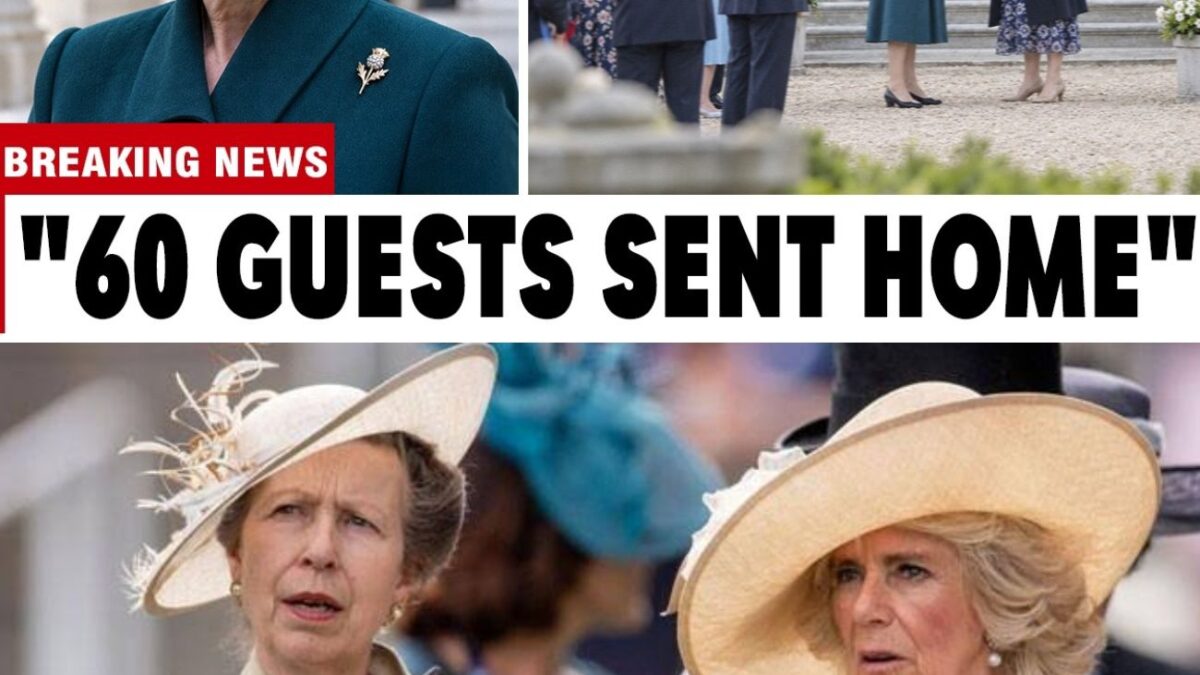
“60 GUESTS SENT HOME!” Princess Anne’s Explosive Frogmore Move Leaves Camilla’s Daughter Facing a Royal Setback
“60 GUESTS SENT HOME!” Princess Anne’s Explosive Frogmore Move Leaves Camilla’s Daughter Facing a Royal Setback
The evening was supposedly meant to be a quiet tribute to Queen Elizabeth II. Sixty guests had reportedly been invited to gather for dinner, share memories, and honor the late monarch’s legacy. The tables were prepared, the seating plan had been checked, and staff were ready to welcome the guests. Then, according to the dramatic account, Princess Anne made an unexpected decision: the dinner was canceled, and everyone was told not to come.
The story claims that the cancellation was not simply a reaction to an uncomfortable moment at the dinner table. It allegedly marked the beginning of a wider dispute involving Frogmore House, Queen Camilla’s daughter Laura Lopes, and the rules governing access to royal venues. At the center of the narrative was Anne’s determination to protect what she believed were the principles of fairness and responsibility associated with her late mother.
Yet one important distinction must be made from the outset: there is no reliable public evidence confirming that this dinner was canceled, that the alleged booking documents exist, or that King Charles signed the orders described in the account. The following article recounts the supplied narrative as an unverified royal-drama story, not established news.
The chair that allegedly changed everything
According to the story, the trouble began when Camilla entered the dining room before the scheduled dinner. A chair had reportedly been left apart from the other places at the table. It was described as the seat Queen Elizabeth had traditionally used during similar family gatherings.
Camilla allegedly asked why the chair was empty and then requested that her own place card be moved there. The account portrays this moment as the spark that finally pushed Anne to act.
For Anne, the chair supposedly represented something larger than seating arrangements. It symbolized respect for the late Queen and the traditions that had shaped the family for decades. The narrative suggests that Anne believed royal privileges should not automatically extend to relatives who did not undertake official royal duties.
Rather than confront Camilla publicly, Anne allegedly asked staff to cancel the dinner. The calls went out to all sixty guests, each receiving the same message: the event would not take place, and no replacement date was being offered.
The account describes a quiet operation rather than a public confrontation. There was supposedly no announcement, no dramatic speech, and no immediate explanation. Instead, the story claims, Anne turned her attention to a document that would take the dispute in a different direction.
Why Frogmore House became the focus
Frogmore House occupies a distinctive place in British royal history. According to the Royal Collection Trust, Queen Charlotte acquired the property in 1792, and it later became closely associated with Queen Victoria and her family. The house is no longer occupied by the Royal Family, although it is used for entertaining and special events. These historical details are documented by the Royal Collection Trust.
In the supplied account, however, Frogmore House becomes the setting for an alleged dispute over who could reserve the venue and under what conditions.
Anne supposedly requested the house’s booking ledger, a record that the story claims listed dates allocated to various events. One name allegedly appeared repeatedly: Laura Lopes, Camilla’s daughter and an art curator who generally maintains a relatively private public profile.
The narrative describes several events over approximately three years, including an art charity lunch, a drinks reception, a private dinner, and a spring gathering. It claims these bookings raised questions because other members of the extended Royal Family, including Zara Tindall, Princess Beatrice, and Princess Eugenie, supposedly had not received comparable access.
The comparison is central to the story’s argument. Anne is portrayed as believing that family connections should not replace transparent procedures. If one relative required a formal sponsor to book a royal venue, the same standard should apply to everyone.
However, no verified booking ledger has been presented to substantiate the alleged pattern. Nor is there reliable evidence that Laura Lopes received repeated preferential access to Frogmore House.
The mysterious note in the booking file
The story becomes more dramatic when Anne allegedly discovers a standing note in the booking paperwork.
According to the narrative, the note was written after the coronation in 2023 and instructed staff to treat requests from the Queen’s family as effectively preapproved. That single line supposedly allowed subsequent bookings to proceed without the usual individual approval.
The account emphasizes that neither Camilla nor Laura was necessarily responsible for creating the arrangement. Instead, it suggests that a junior household official may have written the note while attempting to accommodate the new Queen’s relatives.
This detail changes the nature of the accusation. Rather than depicting Camilla as personally orchestrating a campaign to secure royal privileges for her children, the narrative presents a bureaucratic failure: an informal decision allegedly became routine because nobody challenged it.
Anne supposedly asked the venue’s events manager to retrieve the original booking file. The manager, described as experienced and independent of the family dispute, allegedly confirmed that staff had followed the note without knowing who had authorized it.
A dated document bearing an official’s initials would have been important evidence if such a document existed. But the alleged note has not been independently verified, and the account provides no authenticated copy or corroborating public record.
The guest list that allegedly raised more questions
The next stage introduces a second set of records. According to the story, Anne requested security logs for events listed in the booking ledger.
The alleged figures did not match. One event supposedly described as a modest lunch for forty people was said to have generated more than seventy vehicle entries. Another gathering allegedly involved caterers, floral deliveries, photographers, and other arrangements suggesting a larger reception.
The story does not establish that any of these details occurred. Even if a vehicle count differed from an event estimate, that alone would not prove misconduct. Staff, suppliers, guests, and drivers could all contribute to the total. Nevertheless, within the narrative, the records are presented as the evidence Anne needed to challenge the standing note.
Rather than accusing Laura or Camilla of wrongdoing, Anne allegedly focused on the process. If bookings had been approved without proper authorization, the remedy would be to suspend them and introduce clear rules for the future.
That distinction is important. The narrative itself does not establish that Laura broke a rule, that money was misused, or that anyone acted illegally. Its central allegation concerns an approval process that supposedly lacked sufficient oversight.
King Charles is drawn into the dispute
The most consequential moment in the account comes when Anne allegedly writes a cancellation order. The document reportedly suspends bookings made under the standing note until each has been reviewed and properly approved.
A spring reception for approximately 120 guests is identified as the first event affected. The story says that a caterer had already been booked and a deposit paid, making the cancellation particularly disruptive.
Anne supposedly sent the document to King Charles, whose signature would transform her request into a decision backed by the monarch. According to the narrative, Charles read the paperwork the following morning and signed it without a public confrontation or an elaborate family discussion.
This alleged decision is presented as the turning point. The booking note was withdrawn, the spring reception was canceled, and Camilla’s daughter was told that future requests would have to follow the normal process.
There is no reliable public confirmation that Charles signed such a document or that the reception described in the story was ever scheduled. The alleged private conversation between Charles and Camilla is likewise unverified.
A new rule—and an uncomfortable question
The narrative does not end with the cancellation. It claims Anne drafted a second document setting out three simple requirements: bookings at Frogmore House must have an appropriate working royal sponsor, the sponsor must personally initial the request, and standing approvals are not permitted.
The account says Charles signed this document as well. It portrays the new rule as deliberately neutral because it names neither Camilla nor Laura. In theory, the same procedure would apply to every relative seeking access to the venue.
The story then describes a Sunday service at the Royal Chapel of All Saints in Windsor Great Park. Anne allegedly hands her daughter, Zara Tindall, a booking slip bearing the required sponsorship initials. Camilla supposedly notices the exchange and realizes that a decision has been made without her involvement.
Later, Laura is said to have been informed that her planned spring reception would not proceed. The narrative claims she accepted the decision and moved a future charity lunch to a gallery in London.
These scenes provide the story with a symbolic conclusion: the rules supposedly apply equally, and family relationships no longer guarantee access. But they remain unverified scenes from the supplied account, not confirmed events.
What the story really asks
The emotional appeal of this narrative lies in a familiar question: should personal connections open doors that remain closed to others? Supporters of Anne’s supposed decision might see it as a defense of consistency, accountability, and respect for Queen Elizabeth’s legacy. Critics might argue that canceling an event at short notice would be unnecessarily harsh if the booking had been made in good faith.
The story also risks turning ordinary family relationships into evidence of wrongdoing without proof. Laura Lopes’s work in the arts and her relationship with Camilla do not, by themselves, establish that she received improper privileges. Likewise, Frogmore House’s history and royal associations do not prove that the alleged booking dispute occurred.
The strongest conclusion is therefore not that Anne definitively defeated Camilla’s family, but that the narrative uses a canceled dinner and a disputed ledger to explore royal privilege, institutional rules, and accountability.
For now, the headline “60 Guests Sent Home” should be understood as a dramatic claim, not a verified report. The alleged cancellation, the standing note, the security records, and Charles’s signatures have not been independently substantiated. Until credible evidence emerges, the story remains an unconfirmed royal drama rather than a documented palace scandal.








