A 20-year-old homeless man returned his wallet to a Hells Angels member – 350 bikers changed his life.
A 20-year-old homeless man returned his wallet to a Hells Angels member – 350 bikers changed his life.
On a cold night in Oakland, Toby Mitchell found something that would change his life. The twenty-year-old had hardly any money, no fixed address, and had barely eaten anything for two days. For eight months, he had been sleeping under a bridge near Interstate 880. Not because he was an addict or had run away from his parents, but because after his time in the foster care system, he had ended up on the streets without any support.
Shortly after 2:00 a.m., Toby was searching behind the industrial buildings on San Leandro Street for cardboard boxes and wood to make his sleeping place a little warmer. His boot bumped against a heavy object. A large leather wallet lay in a dirty puddle. A thick steel chain was attached to it, but it was broken.
Toby picked up the wallet and opened it under a dim streetlamp. His heart began to race. It was filled with bundles of hundred-dollar bills. He later counted exactly $3,200. For him, that was a fortune: a motel room, hot meals, and maybe even a new beginning.
Then he saw the driver’s license.
Kenneth J. Carter.
Toby knew the name. In East Oakland, almost everyone knew who Kenneth “Iron Rick” Carter was: the president of the local Hell’s Angels chapter. In the wallet, Toby also found club cards and a photo of a little blonde girl sitting on a Harley-Davidson motorcycle.
He could have taken the money. No one would have missed him on the street. But the photo reminded him of his own childhood in the nursing home. He thought of the adults who had made promises and then forgotten him.
Toby closed the wallet.
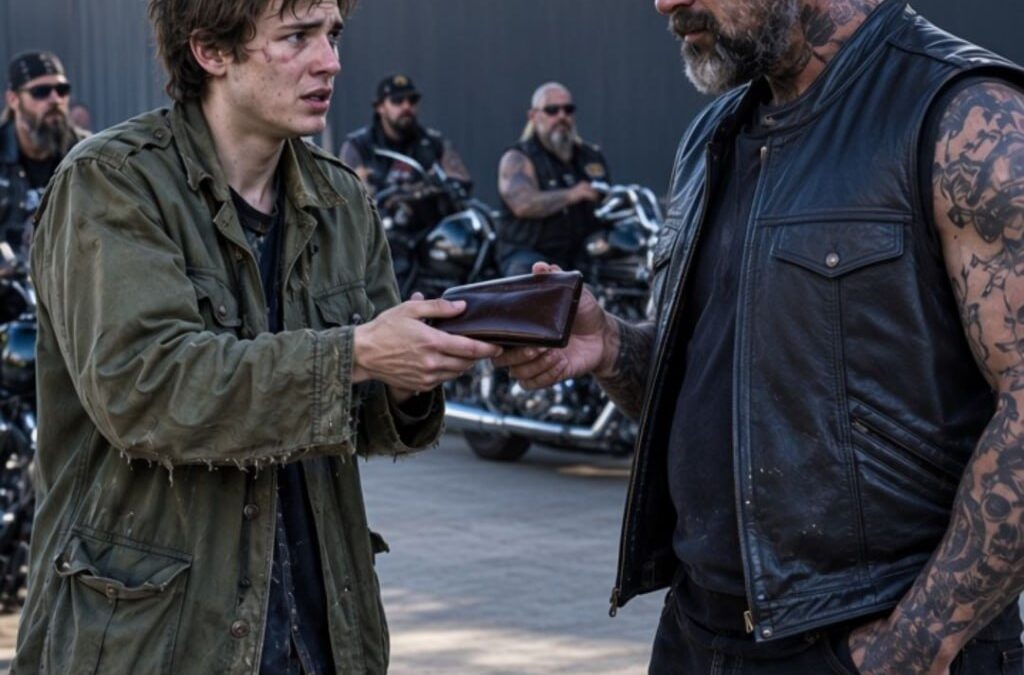
The next morning, he stood in front of the clubhouse on Foothill Boulevard at nine o’clock. The building looked like a fortress: high walls, a black gate, and cameras at every corner. Toby wore an old military jacket and boots with worn soles. Nevertheless, he knocked.
After a brief check, he was led into the courtyard. Several men in leather vests were waiting there. One was named Bobby. Shortly afterward, Kenneth “Iron Rick” Carter appeared.
Rick took the wallet and counted the money. Not a single bill was missing.
“$3,200,” he said calmly.
Then he looked more closely at Toby. “You’re homeless.”
Toby nodded.
“Why didn’t you keep it?”
Toby looked at the concrete floor. “Because of the photo. And because I knew whose wallet it was.”
For a moment, nobody said anything. Then Rick laughed surprisingly loudly. He pulled $500 out of his pocket and pressed it into Toby’s hand.
“For your honesty. Now go.”
Toby thought that was the end of it. Three days later, however, he was sitting in a small diner on San Pablo Avenue when two men entered. The taller one introduced himself as Detective Ray Harris. He was friendly, but his tone remained harsh.
Harris knew a surprising amount about Toby. He showed him a surveillance photo that showed him in front of the clubhouse.
“I want you to work for me there,” the detective said. “You don’t need any special access. Ask for a job, listen, and tell me what you find out.”
Toby refused. He knew he would be risking his life.
Harris smiled coldly. “If you don’t cooperate, the Vipers will soon know you’re working with Iron Rick.”
That same evening, Toby walked for hours in the rain. He couldn’t escape or go to the police. Finally, he decided on another option: he would tell Rick the truth.
The next morning he was back in front of the clubhouse. Bobby let him in. Several men were working on motorcycles in the yard. When Rick appeared, Toby told him everything. He even showed him the number on Harris’s badge and the license plate number of his car.
Rick had him searched. Toby was not carrying a recording device or a weapon.
Then Rick said, “You brought my things back. After that, you came back and told me the truth. That’s what counts.”
He offered Toby a place to sleep in the back office and work in the workshop.
The following weeks were tough. Toby got up early, cleaned the yard, scrubbed engines, and polished chrome. He slept on an old leather sofa. Nobody treated him particularly gently. Nevertheless, for the first time in years, he wasn’t invisible.
When food was ordered, Toby got a portion too. When the heating broke down in the workshop, Bobby wordlessly tossed him a warm jacket. It wasn’t a cuddly family, but it was a community that had its own rules.
Toby learned from a mechanic named Dog that Rick’s own son had died of an overdose five years earlier. The boy had also been twenty. Toby asked no questions. Some wounds deserved respect, not curiosity.
Meanwhile, Harris was putting increasing pressure on the club’s men. There were traffic stops, searches, and sudden raids on Rick’s motorcycle workshop. Toby sensed that Harris had never forgotten him.
One rainy afternoon, Rick sent Toby alone to a warehouse on San Leandro Boulevard to pick up motor oil and spare parts. No sooner had he loaded the boxes into an old Chevrolet pickup truck than two black cars blocked the entrance.
Four men got out of the car. They belonged to the Vipers, the rivals of the Hell’s Angels. Their leader was Tommy “Two-Tone” Miller.
Tommy was holding the same photo that Harris had shown Toby in the diner. Harris had given it to the Vipers, claiming Toby was working as an informant.
Toby tried to convince the men that he wouldn’t betray anyone. But Tommy hit him with a tool and had his men hold him down.
At that moment, Bobby and Dog appeared on motorcycles. They had been following Toby because Rick wanted to make sure the young man wasn’t left alone. The Vipers retreated.
Back at the clubhouse, Dog examined Toby’s injured ribs. Rick was angry, but his anger wasn’t directed at Toby.
Shortly afterward, Sullivan, who handled the club’s finances and information, arrived. He had investigated Harris. The documents showed that the detective had significant gambling debts and had apparently embezzled money from illegal seizures. There was also evidence of connections to the Vipers.
Rick realized that Harris had used Toby to instigate a conflict between two groups.
“We’re not going to kill him,” Rick said. “We’re going to make sure the evidence brings him down.”
Together they devised a risky plan. Toby was to call Harris and claim he had stolen an internal business ledger from Rick. They chose an abandoned dockyard in West Oakland as their meeting place.
Harris appeared shortly before midnight. Fog hung over the old warehouses. Toby held a blank book in his hand and waited.
“Give me the book,” Harris shouted.
“Money first,” Toby replied.
Harris didn’t pull out any banknotes, however. Instead, he pointed a gun at Toby.
“You really think you can negotiate with me?”
Toby was scared, but he stopped. “You made a mistake, Detective.”
Suddenly the floodlights came on. Several motorcycles emerged from the fog. At the same time, black vehicles with flashing blue lights arrived on the compound. Federal officers got out and ordered Harris to drop his weapon.
Harris obeyed. Moments later, he was lying handcuffed on the hood of his own car.
Sullivan had previously passed the collected information on to the relevant federal authorities. This included financial records, messages, and data about Harris’s contacts. Toby hadn’t been fighting the detective alone; he had helped bring the truth to light.
A few weeks later, Toby’s life had changed drastically. Harris was indicted, and the pressure on the clubhouse eased. The Vipers withdrew.
Toby was now living in a small apartment above Rick’s motorcycle repair shop. He was officially an apprentice, learning from Dog and Bobby how to repair engines. Rick didn’t want Toby getting involved in the most dangerous aspects of club life.
One evening, Toby stood in front of the workshop and looked down at the street. He still could hardly believe how it had all started: with an old wallet in a dirty puddle.
He had found $3,200 back then and chosen honesty, even though he himself owned almost nothing. The money could have made his life easier in the short term. But his decision had given him something he could never buy: a place where someone would check on him when he wasn’t there.
Rick stepped next to him and handed him a coffee.
“Tomorrow at seven,” he said. “The old Harley engine is waiting for you.”
Toby smiled. “Am I here?”
Rick nodded and went back into the workshop.
Toby stood there for another moment. For the first time in his life, he didn’t feel like he was just tolerated anywhere. He had a job, a home, and people who trusted him.
Not because he was strong. Not because he had money.
But because he made the right decision on a night when no one would have been looking.
For Toby, this was the most important lesson: family didn’t have to start where you were born. Sometimes it started where people decided to take responsibility for each other. He knew his past wouldn’t disappear. But it no longer had to define who he was allowed to be. When he closed the workshop door behind him, for the first time the evening didn’t feel like the end of a day, but like the beginning of a life of his own.








