“ANNE WAS RIGHT!” The Alleged Sandringham Warning That Could Explain Prince William’s Rift With Harry
Anne Was Right? The Sandringham Warning at the Heart of the William–Harry Rift
For years, the strained relationship between Prince William and Prince Harry has been one of the most closely watched stories surrounding the British royal family. Yet a dramatic new narrative places Princess Anne at the center of a supposed turning point: a private conversation at Sandringham that allegedly persuaded William to take a harder line toward his younger brother.
The account describes a family dispute that supposedly grew into a question of institutional responsibility, public trust, and the future of the monarchy. It also makes extraordinary claims about secret legal documents, royal titles, and Harry and Meghan Markle’s controversial visit to Nottingham. However, these details have not been independently established, and the story should be treated as an unverified account rather than a confirmed palace revelation.
The Nottingham visit that allegedly changed the atmosphere
According to the narrative, the Sussexes’ Nottingham appearance became a flashpoint because of questions surrounding security, publicity, and the way their visit was presented to the public.
The script alleges that a detailed itinerary appeared on the regional website Nottingham Live before the couple arrived. It argues that publishing specific locations and arrival times could have encouraged spectators to gather, creating a security challenge that might later be cited in arguments about protection during Harry’s visits to Britain.
The account further claims that aerial footage showed a much smaller crowd than some enthusiastic media descriptions suggested. It portrays the event as an unsuccessful attempt to recreate the excitement associated with earlier royal walkabouts.
But a published itinerary, crowd size, and the intentions behind a public appearance are separate questions. Even if an itinerary was publicly available, that alone would not establish that Harry and Meghan deliberately engineered a security incident. The script’s suggestion that the visit was designed to influence legal proceedings remains an allegation, not a demonstrated fact.
Nevertheless, within the story’s dramatic interpretation, Nottingham becomes the moment when William supposedly began to see the conflict differently. What had appeared to be another disagreement between brothers was recast as a challenge involving the royal institution itself.
The MasterClass footage and questions about public image
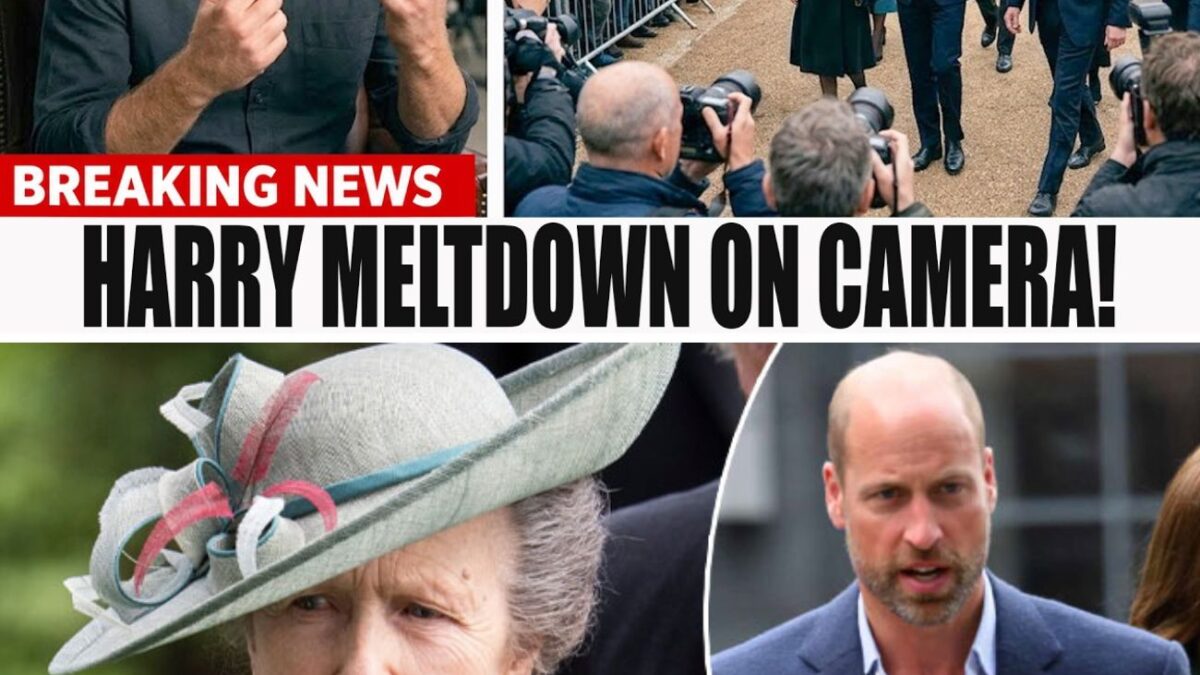
Another central element concerns an alleged recording of Harry during a commercial production connected with MasterClass. The script describes him shifting restlessly in a chair, making unusual facial expressions, swearing, and shouting phrases about fighting and rising up before attempting to explain his behavior.
The narration uses these alleged moments to question the contrast between Harry’s public advocacy for emotional resilience and the image presented in the supposed outtakes.
Yet an edited or disputed recording cannot establish a person’s mental health, intentions, or overall character. Without reliable context and authenticated footage, the claims should not be treated as proof that Harry was unstable or incapable of carrying out responsibilities. The story’s interpretation of his behavior is commentary, not a clinical assessment.
The account then makes a much more consequential allegation: that people connected to the Sussex camp were preparing to use claims about Harry’s emotional trauma to influence King Charles over security and financial support. It describes a supposed confidential dossier containing clinical material and portrays it as a strategy to appeal to the King’s guilt as a father.
No independently verified evidence is presented in the script to establish that such a dossier existed or that anyone planned to use private medical information as leverage. These are serious allegations involving personal health and private conduct, and they should not be repeated as established facts.
Within the narrative, however, this alleged development is the moment when William supposedly recognizes a danger that cannot be resolved through another private family conversation.
Why Princess Anne matters in the story
Princess Anne is presented as the decisive voice because of her reputation for directness, discipline, and devotion to royal duty. Unlike relatives who might be portrayed as emotionally torn between competing loyalties, Anne is cast as someone prepared to distinguish personal affection from institutional responsibility.
The story returns to the Sandringham summit of January 2020, when Queen Elizabeth II addressed Harry and Meghan’s decision to step back from their roles as senior working royals. The Queen’s position was widely summarized as meaning that the couple could not combine royal duties with the independent life they wanted on their own terms.
In the script’s version of events, Anne later tells William that the Queen’s decision to allow a transition period reflected her generation’s preference for patience and reconciliation. The Queen was an elderly grandmother who loved Harry, the account suggests, and she hoped time might eventually repair the family relationship.
Anne allegedly argues that the opportunity for reconciliation was instead used to establish an independent media and commercial identity. She supposedly warns William that continued hesitation could leave the monarchy vulnerable to further conflict.
The alleged conversation is the emotional center of the story. It offers an explanation for why William, rather than Charles, would supposedly take the most uncompromising position. But no verified record of this private exchange is supplied, so the dialogue and its claimed consequences remain speculative.
The dramatic claim about titles and constitutional power
The script escalates the story by alleging that William secretly delivered a dossier to government officials and helped initiate a process to remove Harry and Meghan’s royal titles, revoke their styles, and exclude Harry from official constitutional responsibilities.
It invokes the Titles Deprivation Act 1917, legislation enacted during the First World War that provided for the deprivation of certain titles held by people who had supported Britain’s enemies. The script presents a modern revival of that law, together with new royal instruments, as the mechanism behind William’s supposed move.
However, the narrative does not provide verifiable evidence of such a legal process being initiated or completed. Nor should it be assumed that William, as heir to the throne, can unilaterally strip titles or exercise the sovereign’s constitutional powers. Any genuine change of this magnitude would require a clear legal basis and reliable public documentation.
The story also claims that Harry’s position as a counsellor of state created an urgent constitutional concern. Counsellors of state are designated under legislation to perform certain official functions when the monarch is unavailable. The exact eligibility rules and practical arrangements are matters of law, not simply a question of whether a royal is popular or involved in a family dispute.
The script’s sweeping assertion that William had already finalized an irreversible legal order should therefore not be accepted without confirmation from authoritative sources.
Commercial value and the Sussex identity
The narrative argues that royal titles have commercial significance beyond ceremony. It points to the Sussexes’ media projects and business ventures, suggesting that their association with the monarchy has helped make them attractive to entertainment companies and audiences.
That argument raises a legitimate broader question: how does a royal connection affect the commercial value of a public figure who no longer performs official royal duties? The answer, however, cannot be reduced to the claim that removing a title would automatically destroy a person’s business prospects. Commercial contracts, audience interest, reputation, and individual projects all operate differently.
The script goes further, predicting that entertainment companies and public-relations partners would distance themselves from Harry and Meghan if William were to sever their remaining institutional connections. Those predictions are not proof of an actual commercial collapse, and claims about private arguments or financial vulnerability require reliable sourcing.
Catherine, family loyalty, and the next generation
The account also places Catherine, Princess of Wales, and the couple’s children at the heart of William’s supposed motivation. It portrays him as determined to protect his wife and children from the ongoing strain of public attacks and family controversy.
It contrasts that approach with the narrative’s depiction of Harry, whose public discussion of Princess Diana and his experiences within the royal family is described as a betrayal of family privacy. These are interpretations of deeply personal matters, and the script presents them in highly partisan terms.
Both brothers experienced the loss of their mother in childhood. The story uses that shared tragedy to draw a sharp distinction between their supposed responses to grief: William is portrayed as choosing restraint and family protection, while Harry is accused of turning personal pain into a public narrative. That contrast is emotionally powerful, but it simplifies complex lives and motives that outsiders cannot fully know.
What the Sandringham warning really represents
In the final passages, the story imagines a monarchy moving toward a firmer, less sentimental future under William. It describes an institution determined to separate public duty from private commercial activity and to prevent family disagreements from becoming permanent constitutional distractions.
Princess Anne’s alleged warning serves as the key to that imagined transformation. She is portrayed as the person who tells William that compassion cannot mean endless hesitation and that protecting the institution may require painful decisions.
Yet the most dramatic claims in the account—including secret legal papers, the removal of royal titles, an alleged plan to manipulate security proceedings, and Anne’s private intervention—remain unverified. The narrative does not establish that the legal actions it describes actually occurred.
The real question is therefore not whether a secret constitutional purge has already happened, but why the story of a private Sandringham warning feels so compelling to royal watchers. It brings together familiar tensions: two brothers divided, a father caught between love and duty, a sister known for blunt advice, and a monarchy constantly balancing tradition with modern public scrutiny.
Whether or not the alleged conversation took place, the underlying issue remains significant. Can a family preserve personal relationships while protecting the boundaries of a public institution? And when reconciliation repeatedly fails, who decides that enough is enough? In this dramatic account, Princess Anne supplies the warning and William becomes the figure expected to act. The verified facts, however, must be kept separate from the speculation that has made the story so explosive.








