CAMILLA’S ROYAL POWER PLAY BACKFIRES? Catherine’s Dazzling Golden Gown and Princess Anne’s Bold Move Spark a Windsor Showdown
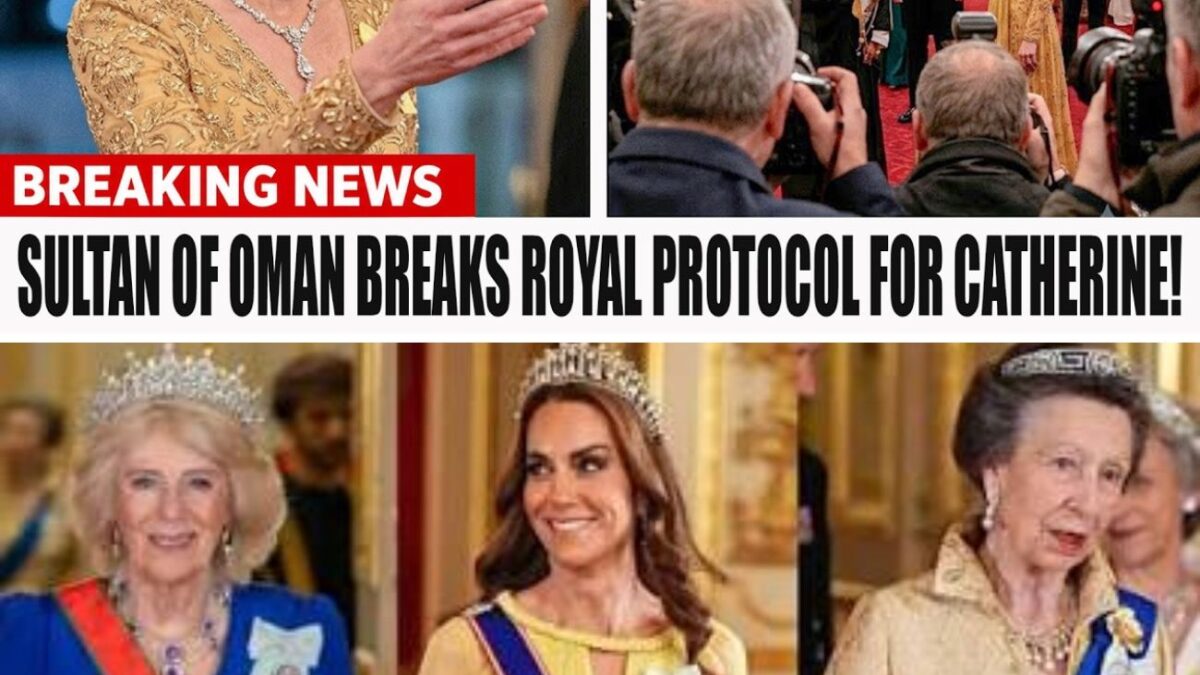
The Golden Gown That Changed the Room: Catherine, Camilla, and an Alleged Battle for Royal Influence
A Golden Entrance at Windsor Castle
The final echoes of a ceremonial gun salute had barely faded over Windsor Castle when the evening’s most striking image began to take shape. In the story presented by the script, a state visit by Oman’s Sultan Haitham bin Tariq becomes the setting for a confrontation that has little to do with jewels or fabric—and everything to do with status, influence, and the future of the British monarchy.
Catherine, Princess of Wales, arrives at the state banquet wearing a flowing desert-gold gown. Its embroidery reportedly combines white jasmine, Oman’s national flower, with the English rose. The symbolism is deliberate: a visual tribute to the visiting country and a gesture intended to communicate respect beyond the formalities of diplomatic protocol.
Queen Camilla, meanwhile, is described as wearing a restrained midnight-blue gown. According to the script, her private office had spent weeks encouraging the royal women to avoid conspicuous colours and elaborate styling.
The contrast is immediate. Catherine’s dress catches the candlelight, while Princess Anne’s complementary gold ensemble creates the impression of an unexpected alliance. The script portrays the room’s attention shifting toward the Princess of Wales, leaving Camilla facing an uncomfortable question: who controls the monarchy’s public image when tradition, personal ambition, and the demands of modern diplomacy collide?
The tension supposedly deepens when Camilla confronts Anne over the wardrobe guidance. Anne’s alleged response is pointed: if the intention was to make everyone disappear into the background, perhaps the royal family should not have been invited.
It is a memorable line in the narrative, but its significance lies in the principle it represents. A royal household cannot project unity if its members appear to be competing for permission to be seen.
Why the Visit Matters
The story argues that the banquet was far more consequential than an ordinary ceremonial dinner. Britain and Oman have longstanding diplomatic, commercial, and security ties, and a state visit provides an opportunity to strengthen them.
The script describes an unusually compressed planning period, with security arrangements, formal speeches, hospitality, and diplomatic schedules supposedly coordinated in just three weeks. It also portrays King Charles as managing medical treatment while continuing his public responsibilities, placing additional pressure on those organising the occasion.
Within this context, Camilla’s alleged preference for subdued clothing is presented as an attempt to prevent distractions and protect the dignity of the event. That interpretation deserves consideration. A state banquet is not a fashion competition, and a host has legitimate reasons to coordinate ceremonial arrangements.
Yet the script suggests that Catherine approached the challenge differently. Rather than treating cultural sensitivity as a reason to become visually inconspicuous, she supposedly saw it as an opportunity to demonstrate genuine knowledge of the guest’s heritage.
The distinction is important. Diplomatic respect is not necessarily achieved by removing every striking element from a room. It can also come from understanding the history, symbols, and traditions that matter to the people being welcomed.
The Alleged Memorandum
The central revelation in the script arrives through a purported confidential memorandum prepared at Clarence House.
According to the narrative, Camilla asks a trusted aide, identified as Lady Eleanor Witcom, to develop wardrobe guidance for the visiting Omani delegation’s banquet. The document reportedly recommends restrained colours, limited metallic embellishment, and less dramatic headpieces, presenting these restrictions as expressions of cultural sensitivity and ceremonial discipline.
The script then supplies a more controversial explanation: internal media analysis allegedly showed that Catherine attracted disproportionate attention during previous state visits. Camilla, it claims, feared that the Princess of Wales would once again dominate international photographs and headlines.
These allegations have not been independently substantiated. Nevertheless, within the story, the alleged memorandum becomes the turning point because it transforms an apparently practical decision into a question of motive.
Catherine’s private secretary, Rebecca Hartley, supposedly notices that the document lacks the normal ceremonial routing marks. Meanwhile, Anne examines an appendix that allegedly contains media-risk assessments focused on Catherine’s popularity.
The narrative claims that Anne then consults contacts familiar with Omani protocol and discovers that the delegation never requested the muted dress code described in the memorandum. Instead, the visitors supposedly welcomed the full splendour of British state pageantry.
If that account were accurate, it would raise serious questions about the use of diplomatic protocol to justify an internal preference. But without documentary evidence or confirmation from the relevant households, the alleged correspondence remains part of the script’s unverified account.
Anne’s role is particularly important. Rather than treating the matter as a personal disagreement between two women, she supposedly recognises the institutional implications. If one member of the family can use administrative guidance to diminish another’s visibility, the same mechanism could be used again.
Catherine and Anne Make Their Move
Catherine’s response, as the script tells it, is calculated rather than confrontational.
She allegedly commissions a gown inspired by the golden sands of Oman’s Wahiba region, incorporating white jasmine and the English rose into its embroidery. The result is designed to honour the visiting nation while remaining unmistakably regal.
It is a clever narrative reversal. A dress code supposedly intended to limit Catherine’s visibility becomes the inspiration for a garment that expresses cultural understanding more powerfully than a conventional formal outfit might.
Anne then joins the strategy. Her own gold ensemble makes it harder to portray Catherine’s clothing as an isolated act of defiance. The two women, both appearing in shades of gold, become a visual statement of solidarity.
The script also describes Anne privately briefing Charles about the potential diplomatic consequences of placing Catherine away from the principal photography positions. The king supposedly approves the final seating arrangements, positioning Catherine prominently beside members of the visiting delegation.
By the time the banquet begins, the alleged plan has been reversed. Catherine will be visible, Anne will stand beside her in spirit and appearance, and the king’s approval will settle the matter of seating.
The supposed victory does not come through a public argument. It comes through a series of decisions that leave little room for a dramatic confrontation.
The Toast That Steals the Evening
As the guests gather beneath the chandeliers of St George’s Hall, Catherine’s golden gown becomes the defining image of the script’s imagined evening.
She is said to greet Sultan Haitham in Arabic and refer to Omani heritage, including the country’s architectural and cultural traditions. The Sultan, according to the narrative, responds warmly, placing his hand over his heart.
The most dramatic moment arrives during his speech. Rather than restricting his remarks to familiar expressions of friendship and cooperation, he supposedly acknowledges Catherine’s cultural knowledge and the symbolism woven into her gown.
He raises his glass in her direction, and the room erupts in applause.
In the story, Charles responds with visible pride while Camilla sits rigidly, watching an evening she had allegedly hoped to control unfold differently.
The toast functions as more than a compliment. It becomes a symbol of a broader argument: genuine diplomatic influence depends on preparation, sensitivity, and the ability to make another country feel understood.
Still, the script’s specific speech and reactions should not be mistaken for a verified historical record. Their dramatic significance comes from what they represent within the narrative.
A Private Reckoning
The story moves behind closed doors after the guests depart. Camilla allegedly discovers that international coverage has focused on Catherine’s gown and her interaction with the Sultan. Her team supposedly considers alternative press arrangements, only to find that changing the official imagery could attract even more attention to the alleged dispute.
Camilla then confronts Charles, demanding to know why he approved seating arrangements that undermined her plans.
His supposed response cuts to the heart of the conflict: was she asking Catherine to dress appropriately, or asking her to appear less impressive?
The script presents Charles as insisting that royal authority cannot be used to make another family member diminish herself. Yet the more meaningful question is not whether one woman won a fashion contest. It is whether the monarchy can maintain institutional confidence without turning ceremonial precedence into a competition for affection.
The following morning, Anne allegedly arrives with a letter from Queen Elizabeth II’s private papers. The message expresses the principle that an older generation should not require the younger generation to become smaller simply to preserve its own place at the centre of public life.
The letter provides the story with its moral conclusion. Tradition matters, but it must leave room for renewal.
The script then describes Charles establishing clearer rules for ceremonial decisions, with formal guidance routed through the appropriate household offices rather than private memoranda. These purported measures, like the earlier conversations, remain unverified.
The Lesson Behind the Golden Gown
The final scenes offer a quieter ending. Camilla supposedly invites Catherine for tea and admits that years of comparison have left her feeling insecure. Catherine listens without surrendering the boundaries of her own role.
Her message is simple: one woman’s future does not have to erase another woman’s present.
In the script’s conclusion, Camilla later declines to impose another set of restrictive dress guidelines, while Anne sends Catherine a photograph of them together in their gold ensembles. The handwritten message celebrates their ability to stand firm.
Whether or not the described confrontation happened as presented, the underlying theme reaches beyond Windsor Castle. Public institutions often struggle when established authority encounters a new generation whose influence grows naturally through public service and personal connection.
A title can confer precedence, but it cannot guarantee admiration. A protocol can organise a ceremony, but it cannot manufacture warmth. And a carefully managed image may prove less powerful than a sincere effort to understand another culture.
The golden gown, in this dramatic retelling, becomes a symbol of confidence rather than rebellion. Catherine does not need to defeat Camilla for her own role to flourish. The monarchy’s future depends on whether its members can recognise that distinction.
The strongest ending is therefore not the image of one royal woman eclipsing another. It is the possibility that neither needs to disappear for the institution to move forward.








