Catherine Defies Camilla at Sandringham! One Royal Card Sparks a Stunning Showdown Before Church
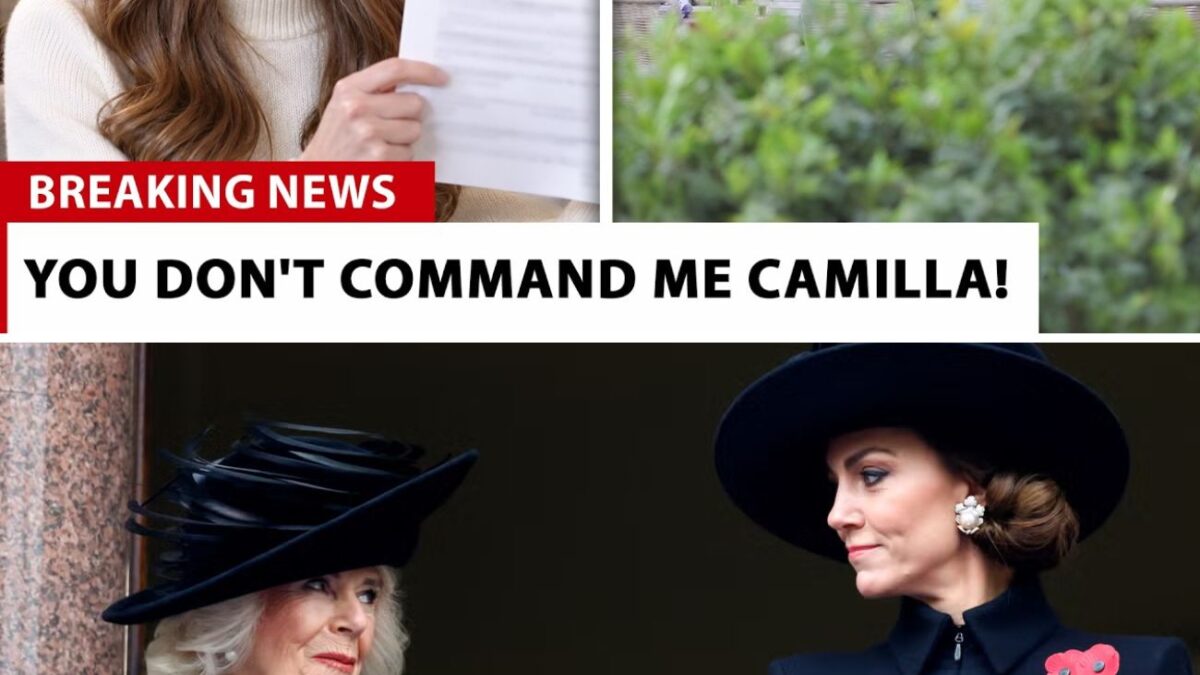
Catherine Defies Camilla at Sandringham! One Royal Card Sparks a Stunning Showdown Before Church
At Sandringham, where royal routines are usually polished down to the smallest detail, one quiet movement reportedly changed the mood of an entire luncheon.
Princess Catherine sat at the table before the family’s church appearance when she picked up a cream-colored card, read one particular line, and calmly turned the card face down.
There was no raised voice. No dramatic gesture.
Yet everyone understood that something was wrong.
The disputed line concerned the following morning’s harvest festival service at St. Mary Magdalene. According to the story, the revised order of proceedings instructed only King Charles and Queen Camilla to greet the public at the churchyard gate. William, Catherine, and the children were expected to walk directly inside, while flowers and gifts offered by well-wishers would be collected by staff.
Catherine’s reaction was immediate.
“Who decided this?”
The question was simple. The atmosphere around the table was not.
The story says Catherine had already learned about the change hours earlier at Anmer Hall. Her private secretary had received the revised instructions from the Queen’s office through the King’s private secretary. The covering note reportedly made clear that the decision was considered settled.
But Catherine noticed something else.
The justification referred to a crowd-management plan that she had not been shown.
She wanted to see it.
Her secretary could not provide it. The document remained with the estate.
That apparently made Catherine more curious rather than less.
The issue, according to the account, was never simply about where Catherine herself would stand. She knew the people who gathered outside the church each year. Some arrived before dawn. Others came by bus from Kings Lynn carrying thermoses, folding stools, homemade cards, flowers, and small gifts prepared at their kitchen tables.
One elderly woman particularly stayed in Catherine’s mind.
Every year, the retired woman brought a small posy from her garden, tied together with red wool. The arrangement was modest, filled with Michaelmas daisies and rose hips.
Under the new instruction, that gift would not reach Catherine directly.
A staff member would take it.
To Catherine, that apparently changed the meaning of the entire encounter.
William reportedly found her examining the instructions and asked whether she intended to challenge the decision. Catherine said she first wanted to understand who had written the plan.
Later that morning, she went to St. Mary Magdalene herself.
Estate workers were already preparing the area. Barriers were being positioned, leaves swept away, and harvest displays arranged with wheat and apples. Catherine walked the route with the estate steward and asked him to explain where crowds traditionally gathered.
Eventually they reached the churchyard gate.
The steward reportedly identified it as the main “pinch point.”
Everyone wanted to stand there because that was where the royal family traditionally arrived.
Catherine then asked for the complete crowd-management plan.
The steward explained that the document had gone through the proper household channels.
Catherine’s response was reportedly brief.
“Then please consider yourself asked.”
The request traveled quickly through the estate.
By lunchtime, the matter had reached the Queen’s office.
Camilla did not ignore it.
Instead, the story says she arranged for the disputed cards to be placed at the table so the disagreement could be discussed openly, with King Charles present.
At 1:34 p.m., Catherine turned the card over again.
Camilla spoke first.
She said she had requested the change.
Her reasoning was straightforward. The annual church walk had become increasingly crowded. Too many stops could delay the service, create pressure around the gate, and turn what was supposed to be a quiet Sunday service into something resembling a public event.
King Charles reportedly agreed that the change had been presented to him as a safety matter.
Catherine listened.
Then she placed both hands on the table.
“I understand why you’ve done it,” she said, according to the story. “But I’m not going to walk past them.”
Camilla reportedly raised her eyebrows.
“It’s one morning, Catherine.”
Catherine answered:
“It’s their one morning.”
That sentence became the emotional center of the confrontation.
Catherine argued that the people behind the barriers might have waited for hours simply to offer something they had made themselves. If staff automatically collected those gifts at the gate, the crowd would be concentrated in precisely the place the safety plan was supposed to keep clear.
Princess Anne then entered the discussion.
According to the account, she supported Catherine’s question.
“Line four does,” Anne reportedly said when Camilla insisted nobody was treating the public as a problem.
William also spoke.
He did not make a dramatic speech. He simply said Catherine had asked a fair question.
King Charles then requested evidence.
After lunch, a private secretary arrived with a thin blue folder.
But there was a problem.
The folder did not contain the full crowd-management plan. It contained only a short summary.
One sentence recommended reducing pressure at the churchyard gate.
Catherine read it twice.
Then she noticed the contradiction.
If flowers could only be handed over at the gate, she argued, people carrying flowers would naturally move toward the gate.
The measure could actually concentrate the crowd rather than disperse it.
The discussion became more complicated when Camilla returned with a plain white envelope.
Inside was a single photograph from the previous year.
It showed King Charles standing alone at the churchyard gate, apparently preparing to greet the crowd.
But almost every phone in the crowd was pointed elsewhere.
Toward Catherine.
Camilla explained that Charles had stood there for nearly a minute without anyone noticing.
Suddenly, the disagreement looked different.
Camilla had not simply wanted to control Catherine’s movements. She had been trying to ensure that her husband received the attention and space she believed he had been denied.
Catherine reportedly studied the photograph carefully.
“I’m sorry,” she said. “I didn’t see it.”
But she still disagreed with the proposed solution.
Her answer was unexpected.
She suggested keeping the walk exactly as the estate plan recommended: Charles and Camilla would go first, while the rest of the family would spread along the path.
And if someone gave Catherine a gift intended for Charles, she would personally carry it to him.
Camilla reportedly considered the proposal.
King Charles looked at the photograph.
Then came his decision.
“Reprint it.”
The disputed line was removed.
The following morning, the new card carried a different instruction: members of the royal family would greet well-wishers along the path.
At 9:15 p.m. the previous evening, the revised card had been approved.
When the family appeared at St. Mary Magdalene, the crowd was as large as ever.
People had arrived early with tea, stools, homemade cards, flowers, and protective plastic sleeves.
This time, the King and Queen went first.
The other members of the family spread along the path.
And then Catherine found the retired woman.
She was holding two small posies tied with red wool.
“One is for you,” the woman reportedly said, “and one is for His Majesty.”
Catherine accepted both.
She carried the second arrangement herself to Charles at the churchyard gate.
As she handed it to him, the King looked back toward the woman who had made it.
He raised his hand.
This time, people were watching.
Camilla saw it too.
After the service, there was no staff basket waiting at the gate.
Later, according to the story, Camilla placed the original card—the one containing the disputed line—inside the same white envelope as the photograph.
The gesture left one question hanging over Sandringham.
Why did Camilla keep the evidence?
Perhaps because the photograph preserved something important about the disagreement: neither woman had been entirely wrong.
Camilla had seen a husband standing unnoticed.
Catherine had seen people waiting behind barriers with gifts made by hand.
The final change was only one line on one card.
But sometimes, within the walls of a royal household, one line can reveal an argument far larger than the paper itself.








