“Dad, may you eat with us?” asked the boy – then the millionaire stood up and did the unexpected.
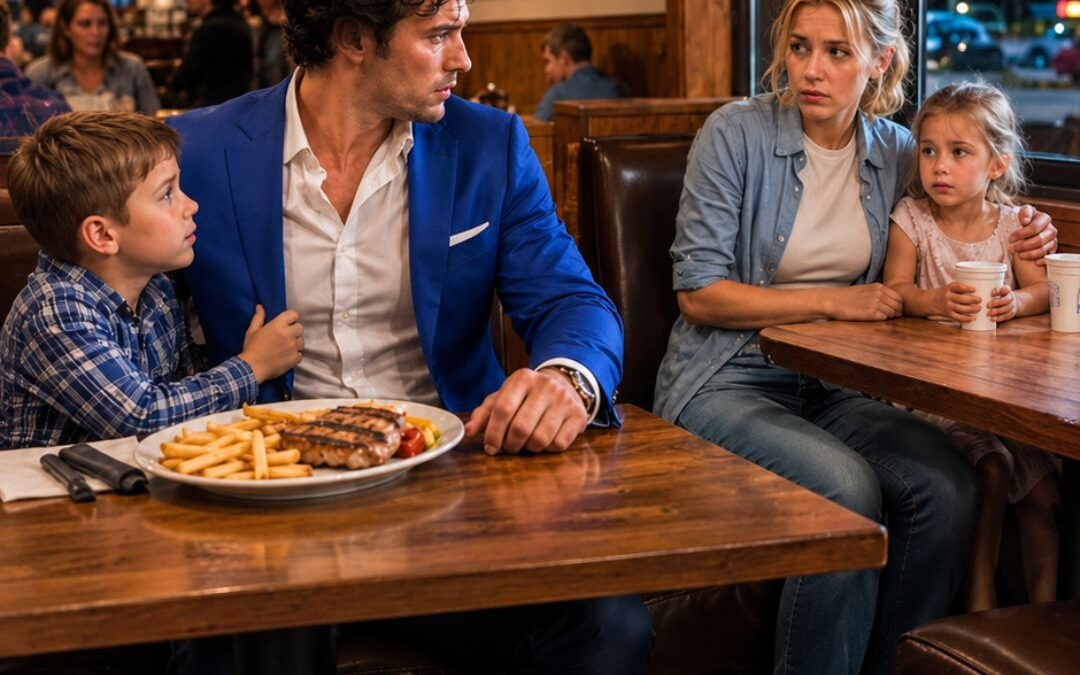
“Dad, may you eat with us?” asked the boy – then the millionaire stood up and did the unexpected.

When Noah asked his father that evening if two strangers could eat with them, Daniel Hayes had no idea that this simple sentence would change his life.
The restaurant was busy. Warm light fell on white tablecloths, glasses sparkled, and the kitchen smelled of fresh bread and roast meat. Daniel sat across from his nine-year-old son, trying to forget about business for the evening.
At thirty-eight, Daniel had achieved almost everything money could buy. He owned a successful technology company, lived in a large house overlooking the city, and traveled frequently for business. But since his wife’s death three years ago, he knew that wealth didn’t mean having enough time for another person.
Noah was his only son. Daniel loved him, but he also knew how often his cell phone had come between them. That’s why he had promised this evening: no calls, no appointments, no emails. Just father and son.
Noah had been talking happily at first. Then he suddenly fell silent.
A young woman and a girl of about seven sat by the window. They each had only a glass of water in front of them. The mother wore clean but clearly worn clothes. She repeatedly glanced at the menu and then at her daughter. The girl watched every plate that was carried past their table.
Noah stared for a long time. Then he bent over the table.
“Dad, can the two of them eat with us?”
Daniel followed his gaze. The woman noticed she was being watched and immediately lowered her head. There was no anger in her face, but shame.
Daniel knew that feeling.
Suddenly, he remembered his own childhood. He had been eight when his father left the family. His mother had often claimed she wasn’t hungry so he could have the last piece of bread. Daniel had buried those memories under work, money, and success years later.
Suddenly, the memory was back in front of him.
He stood up and went to the woman.
“If you wish, we would be delighted if you would join us for dinner.”
The woman looked at him as if she hadn’t understood the words. Then she looked at her daughter.
“My name is Emily,” she finally said. “And this is Lily.”
Emily hesitantly explained that she had lost her job at a small cleaning company a few weeks earlier. Since then, every purchase had become a bill she couldn’t pay. That evening, she had promised Lily they would go out for dinner because, after a particularly difficult week, the child desperately needed a little something to cheer her up.
In fact, Emily only had enough money left for one drink. She wanted to let Lily drink it and then pretend she wasn’t hungry.
Daniel sat down again.
Noah immediately moved aside and showed Lily the menu. He explained which fries he liked best and which dessert he absolutely wanted to try. After just a few minutes, Lily was laughing.
When the food arrived, Daniel noticed that Emily hardly touched anything. Instead, she kept pushing the best pieces onto Lily’s plate.
Daniel ordered a second meal for her.
Emily wanted to protest, but Daniel shook his head.
“Today you don’t have to worry about tomorrow.”
The atmosphere at the table grew increasingly cheerful as they ate. Daniel watched Noah and Lily and realized how little children need to understand each other. No money, no shared home, not even the same history. A smile was enough.
Then Noah reached into his trouser pocket.
He took out a small toy car and placed it in front of Lily.
Daniel recognized it immediately. It was his son’s favorite toy, a gift from his late mother. Noah had kept it for years.
“You can have it,” he said.
Lily carefully took the car in her hand.
“Really?”
Noah nodded.
Daniel said nothing. He only felt his throat tighten. His son had just given away something that was valuable to him personally. Not out of a sense of duty, but because he had seen that someone else could use it.
On the way home, Daniel remained unusually quiet.
Finally, Noah asked, “Dad, why are you so thoughtful?”
Daniel looked at him.
“Because you taught me something today.”
The next morning, Daniel wasn’t just thinking about Emily. He wondered why a woman with work experience and a strong sense of responsibility could lose all security so quickly. He asked his assistant to contact Emily, and didn’t simply offer her money. He wanted to know what she was capable of.
Emily had organized offices, created work schedules, looked after clients, and supported elderly people. Daniel realized she didn’t need charity. She needed a way to become independent again.
His company had just prepared a social program to support families in difficult life situations. However, they lacked people who truly understood the daily lives of such families.
Daniel offered Emily a position in this program.
She was speechless at first.
“I’m not giving you charity,” Daniel said. “You’re getting a job you’ll be paid for. And a chance to rebuild your security.”
Emily accepted the position.
In the following months, she worked to support families with temporary housing, childcare, food, and career guidance. She knew from her own experience how quickly a stable life could be thrown off balance.
Things changed for Daniel as well.
He started ending appointments earlier. He picked Noah up from school more often. They cooked together, went for walks, and sometimes just sat at the kitchen table in the evenings without a screen between them.
One evening, Noah asked his father, “Dad, are you rich now?”
Daniel had to laugh.
“Why are you asking that?”
Noah shrugged.
“Because you said money can buy many things.”
Daniel thought for a moment.
“Yes. But it can’t buy the feeling that someone no longer feels alone.”
Noah smiled.
“Then we are quite rich today.”
Daniel looked at his son and felt tears in his eyes.
Years later, Noah barely remembered the restaurant, the expensive meals, or the large house of his childhood. But he remembered Emily and Lily vividly. Above all, he remembered the little toy car.
Emily and Lily remained a part of her life. Emily helped develop the social program and eventually helped many families who were at a point where they didn’t know what to do next.
Daniel changed his perspective on his own success. He understood that a company shouldn’t be measured solely by numbers. He began to provide greater support to employees who suddenly found themselves in difficult life situations, creating opportunities for flexible working hours and financial assistance during these times.
But the most important change happened at home.
For years, Daniel had believed he had to buy Noah a secure future. Now he understood that a child primarily needs memories: shared meals, conversations, reliability, and a father who is truly present.
Sometimes Noah would later ask what had changed his father so much that evening at the restaurant.
Daniel always gave the same answer.
“You asked me if two strangers could eat with us.”
“And that was all?”
Daniel smiled.
“No. You showed me that a place at the table can be worth more than anything money can buy.”
Only many years later did Daniel understand the full significance of that evening. He had wanted to help Emily because he had seen her hunger. But in truth, he too needed something: a reminder of who he had been before money and responsibility had dominated his life.
Lily received only one meal back then. Emily got a career opportunity. Noah received a lesson in compassion.
And Daniel received something he could not have bought with any fortune: time, closeness, and the certainty that his son did not have to learn to be rich in order to lead a good life.
From that evening on, Daniel always kept his phone in his pocket during meals. Noah noticed the change first. His father listened again, asked about his friends, and knew what was on his mind. For Noah, it wasn’t anything spectacular. It was simply what a father should do.
Emily, in turn, often remembered that first evening. She later said that the crucial thing wasn’t that a wealthy man had paid the bill. What was crucial was that Daniel hadn’t treated her like a needy person. He had looked at her, respected her dignity, and then given her a real opportunity.
Lily also kept the little car. As she grew older, she put it in a box with her most cherished mementos. For her, it was a reminder that strangers can sometimes be kind without expecting anything in return.
Daniel now knew that Noah’s question hadn’t been an extraordinary moment. It had simply been honest. And perhaps therein lay its power: a child hadn’t asked about income, origin, or social standing. He had only seen that two people were hungry.
Since that night, Daniel has tried not to forget that simplicity. Humanity sometimes begins where no one expects anything from us.








