EVICTED? The Billionaire Estate Story That Could Deepen the Rift Between Prince Harry and Prince William
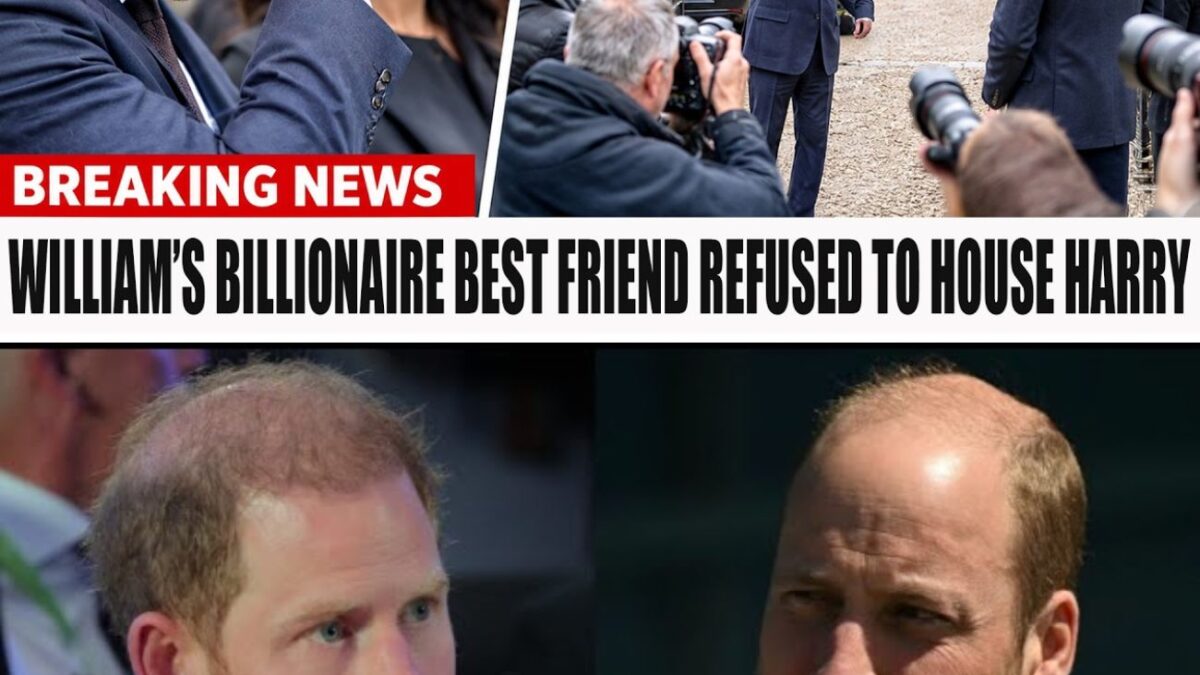
Inside the Alleged Billionaire Estate Dispute Involving Harry and Meghan

A dramatic story circulating in royal commentary has placed Prince Harry and Meghan Markle at the center of an alleged dispute involving a wealthy British financier, a secluded country estate, and the increasingly strained relationship between Harry and Prince William. At the heart of the narrative is Ian Wace, the co-founder of hedge fund firm Marshall Wace, whose reported friendship with William is portrayed as the reason the Sussexes were offered temporary hospitality in the English countryside.
The claims are striking, but they require an important qualification: the account presented in the circulating script has not been independently established in its entirety. Assertions about an eviction, private conversations, personal motives, and a definitive declaration by William should therefore be treated as allegations rather than confirmed events.
A Private Retreat With Royal Connections
The story describes a wealthy financier who values privacy above public attention. Ian Wace is presented as a man whose professional success gave him access to expansive country properties, private travel, and influential social circles. According to the narrative, his relationship with Prince William was central to the decision to offer Harry and Meghan a secluded place to stay.
The alleged arrangement was not portrayed as a close personal friendship between Wace and the Sussexes. Instead, the story suggests that Harry appealed to the billionaire through his connection with William, hoping that an act of generosity might also preserve a channel for reconciliation between the royal brothers.
That interpretation forms the foundation of the entire controversy. If hospitality was extended primarily out of loyalty to William, any perceived breach of privacy could have carried consequences beyond an ordinary disagreement between a host and his guests.
Yet the script does not provide independently verified documentation establishing the terms of such an arrangement or proving that Harry deliberately used his brother’s friendship to secure accommodation. Those distinctions matter, particularly when claims involve living public figures.
The Warning Attributed to a Former Wife
Another central character in the account is Saffron Aldridge, described in the script as Wace’s former wife and a former supermodel. The narrative attributes to her a warning that hosting Meghan could prove difficult, drawing on an alleged earlier experience of having the couple as guests.
According to the story, Aldridge supposedly believed that household staff could be placed under unreasonable pressure and that boundaries might not be respected. The script then presents Wace as someone who allegedly ignored that warning because he wanted to honor his relationship with William.
These are serious personal allegations, and the supplied account does not establish them through independently verified statements or documentary evidence. They should not be treated as proven descriptions of Meghan’s conduct or of Aldridge’s views.
Nevertheless, the warning plays an important role in the story’s dramatic structure. It introduces the possibility that the supposed conflict was not a sudden misunderstanding but a foreseeable clash between a host who prized discretion and guests whose public lives were shaped by constant media attention.
The Alleged Guests and the Question of Boundaries
The script next portrays the estate as becoming busier than its owner expected. It alleges that Meghan’s friends, including people identified as Kelly and Marcus Anderson, joined her during the stay, turning a private retreat into a gathering place for a wider circle.
The account suggests that the host expected a quiet environment and strict control over who entered the property. The alleged arrival of additional guests is presented as a source of tension, particularly because the estate was described as a sanctuary rather than a venue for social entertaining.
However, the story does not supply independently verified records confirming who stayed at the property, what permissions were granted, or whether the owner objected at the time. Without that evidence, claims of unauthorized access or mistreatment of staff remain allegations.
The larger question raised by the narrative is familiar: when a public figure accepts private hospitality, where should the boundaries lie between personal freedom and a host’s expectations? For a household accustomed to intense scrutiny, even a small disagreement about guests or access could become a major controversy if private details reached the public.
The 34-Second Video That Allegedly Changed Everything
The most vivid moment in the script concerns a short social-media video. It claims that Meghan posted footage of a morning walk, showing children, landscaped grounds, a lake, tree-lined paths, and features that online viewers allegedly connected to the private estate.
According to the narrative, internet users examined the scenery and identified the location. The script argues that this exposure undermined the host’s desire for privacy and potentially created security concerns.
It also alleges that another video showed the estate’s kitchen, including an expensive cooker, in connection with Meghan’s lifestyle interests. The story presents this as a particularly damaging breach because it supposedly transformed a private residence into a backdrop for public-facing content.
But the script does not provide independently authenticated posts, a verified timeline, or evidence demonstrating that the property was identified as a result of the alleged footage. Nor does it establish that the owner had prohibited filming or that any commercial arrangement existed. The claims should not be confused with a verified finding of misconduct.
The episode nevertheless highlights a genuine tension surrounding the lives of modern public figures. Social media can turn ordinary personal moments into widely shared material, while even seemingly harmless images may reveal more about a private location than intended. Whether that happened in this particular case requires evidence beyond the narrative itself.
Prince William and the Royal Rift
The story’s turning point is attributed to Prince William. It claims that a newspaper report, supposedly based on sources close to the Prince of Wales, conveyed that he had no intention of reconciling with Harry.
The script depicts this reported position as the moment Wace supposedly reconsidered his hospitality. If the financier had been motivated by the hope of helping the brothers rebuild their relationship, a belief that reconciliation was no longer possible would have changed the rationale for the arrangement.
The account then describes a message being delivered through intermediaries, allegedly asking the Sussexes to leave the cottage by the end of the month. It also attributes a pointed remark about filming the kitchen to the host.
No independently verified eviction notice or authenticated account of such a private exchange is supplied in the script. Similarly, the suggestion that William issued a definitive personal declaration should not be presented as a confirmed quotation or formal announcement without reliable sourcing.
Still, the alleged sequence offers the story its most dramatic premise: that a family rift may have influenced a separate relationship between the Sussexes and a wealthy potential host. It is a compelling narrative, but its central causal link remains unverified.
Searching for a New Home
The script claims that, after the supposed eviction, Harry and Meghan’s circle briefed sympathetic media outlets about looking for a substantial property in England, reportedly valued at around £10 million and featuring nine bedrooms.
The narrative interprets such a search as an attempt to preserve appearances after being asked to leave. But even if a property search took place, that alone would not prove that the couple had been evicted. People can explore housing options for many reasons, and a report about a possible purchase does not establish the circumstances behind it.
The account also links the alleged episode to wider questions about the Sussexes’ commercial future, public image, and relationships with wealthy supporters. It portrays the supposed loss of a country retreat as a symbolic setback, suggesting that proximity to influential benefactors cannot substitute for durable personal trust.
That conclusion is commentary rather than demonstrated fact. Claims that other supporters have withdrawn their friendship, that business arrangements have collapsed, or that the couple has been broadly excluded from elite circles would each require separate evidence.
What the Story Ultimately Raises
Beyond the dramatic language of expulsion and betrayal, the narrative raises a broader question about privacy, generosity, and public life. A private residence is not simply a luxurious backdrop; it is also a place where owners may expect discretion. Guests, meanwhile, may have their own understanding of what is acceptable to share, especially when social media forms part of their public presence.
The difficulty is establishing what actually happened. The script combines claims about private conversations, alleged warnings, social-media footage, royal relationships, and a supposed eviction into one sweeping account. Without independent corroboration, those elements cannot responsibly be treated as a single proven chain of events.
The reported estrangement between Harry and William is also distinct from the separate question of whether a billionaire offered the Sussexes accommodation or later asked them to leave. One does not establish the other.
For now, the alleged episode remains a provocative royal narrative rather than a fully verified account. Its central themes—family division, the risks of public exposure, and the fragile nature of private hospitality—are undeniably compelling. But the most sensational claims deserve scrutiny, not automatic acceptance.
If reliable records or on-the-record statements eventually clarify the story, they may reveal whether a private disagreement truly unfolded behind the gates of an English estate. Until then, the difference between allegation and established fact remains essential. In a royal story where reputation is at stake, that distinction may matter more than the headline itself.








