He let a homeless mother into his bakery – unaware that her son was his grandson.
He let a homeless mother into his bakery – unaware that her son was his grandson.
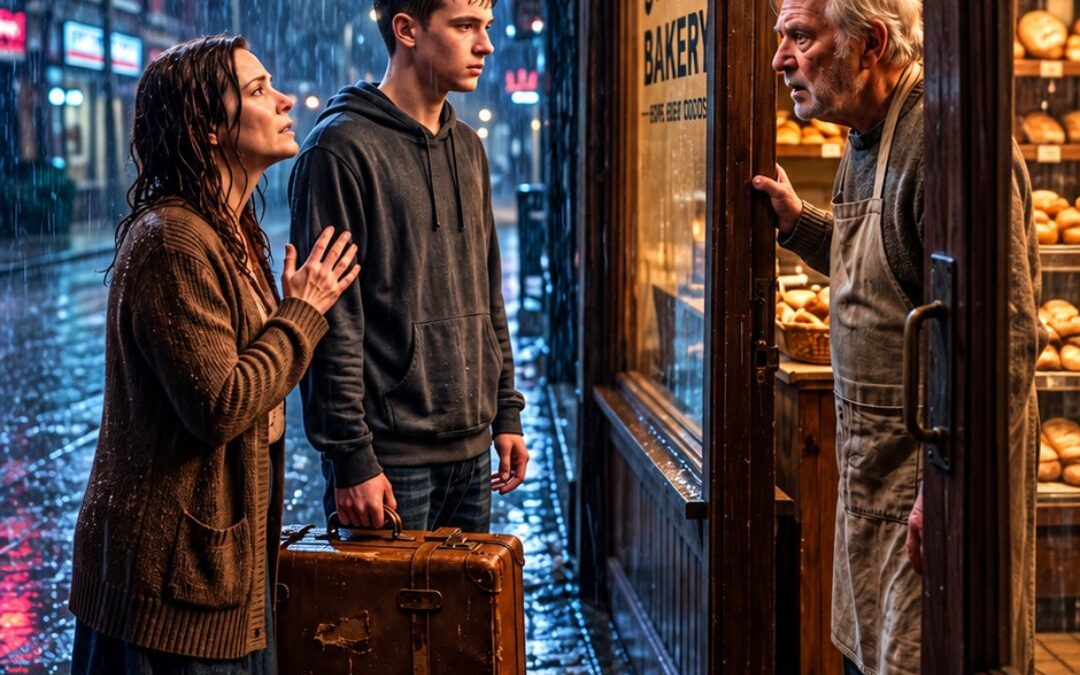
When Lucy Cole stood on the street in Milbrook, Ohio, that rainy evening with her nineteen-year-old son Matthew, she had lost more than just her apartment. With her last suitcase, she had also lost the feeling of belonging anywhere. Eight months earlier, her husband Andrew had died of a heart attack. Since then, Lucy had worked, done the math, and tried to stay strong for Matthew. Now, a new job was starting on Monday, but there were only five days until her first paycheck.
The landlord, Mr. Puit, was unsympathetic. He had placed the suitcases outside the door and declared the deadline over. Lucy asked for five more days. In vain. Matthew silently took the luggage. In one bag lay his father’s old silver wristwatch, its hands frozen for years.
The rain intensified. Several houses turned them away. Finally, mother and son found shelter under the rusty awning of an old bakery. Above the door, the faded gold letters were still visible: The Golden Wheat Bakery. Light shone through an upstairs window.
Lucy knocked. After a while, an older man opened the door. He introduced himself as Ernest Hail. He didn’t want to take in strangers. But when Matthew coughed from the cold and Lucy cast aside her dignity, Ernest let them in for the night. They were to stay until morning and not touch anything.
The bakery seemed like a place forgotten by time. Tables stood under white cloths, old molds hung on the walls, and next to the large oven was a locked cupboard. Matthew also discovered a photograph: Ernest as a young man, with a woman and a man of about twenty-two beside him. The young man wore a baker’s apron and smiled crookedly.
“Is this your son?” Matthew asked.
Ernest hastily took the picture. “Go to sleep.”
Matthew couldn’t sleep that night. After 2 a.m., he heard a metallic noise. A floor tile next to the oven was loose. Underneath, he found an old notebook wrapped in a cloth. On the first page, in neat woman’s handwriting, it read: “For Andrew, if he decides to come back.”
Matthew froze. Andrew was his father’s name.
Ernest appeared carrying an old lantern. When Matthew asked who Andrew was, the old man turned pale. Finally, he said Andrew had been his son and had been dead for twenty-two years. But Ernest had no answer to Matthew’s question as to why the book spoke of his return.
The next morning, Lucy stayed even though she was allowed to leave. She had promised Ernest she would clean the bakery. For hours she scrubbed windows, work surfaces, and old baking trays. When Ernest came downstairs, he noticed that the room was bright again for the first time in years.
Little by little, he told Andrew’s story. His son had wanted to take over the bakery, but at the same time, he was exploring new avenues: different recipes, deliveries, and business dealings with restaurants in Columbus. Ernest hadn’t seen this as love, but rather as criticism of his life’s work. After a heated argument, he had told Andrew not to come back until he had learned to show respect.
Andrew was twenty-four at the time. He took a bus to Pittsburgh. On a dark night, the bus veered off the road and caught fire. Andrew’s bag, wallet, and driver’s license were found. His family believed he was among the dead.
Ernest also spoke of his wife, Margaret. She had never believed Andrew was truly dead. For fourteen years, she kept the bakery open, writing recipes in the notebook so that her son would find something to eat if he returned. Eight years before that rainy evening, Margaret died. Her last words to Ernest were: Don’t lock the door in case Andrew came back one day.
But Ernest had closed the door.
Matthew heard the story and whispered that his own father had died eight months earlier. A quiet understanding arose between the old man and the young widower’s son.
When the rain returned, Lucy and Matthew decided to stay a while longer. Lucy wanted to bake bread. Matthew checked the old oven. The pipes were dry, and the flame lit itself. Then Matthew shaped a loaf using a simple technique his father had taught him as a child: a special twist at the end of the dough.
Ernest dropped his cup.
He explained that his grandfather had developed this folding technique. Ernest had only taught it to Andrew. Hardly anyone in all of Ohio knew it. Matthew had learned it from his father without knowing its origin.
The first loaf of bread attracted neighbors. Rose, an older regular customer, recognized the aroma immediately. Soon, people were standing at the open door. After years, Ernest tied on his old apron again. Together they baked a second batch. For the first time in a long time, Ernest smiled.
But on the third morning, Beatrice Hail, Ernest’s daughter, arrived from Columbus. She was convinced her father had been taken advantage of. She had already found a buyer for the building and accepted a down payment. For Beatrice, the bakery was no longer a family legacy, but a burden that had held her father captive for years.
The situation escalated when Matthew showed his father his watch. Engraved on the back were the words: “Keep the fire going, Dad.” Ernest recognized them immediately. He had commissioned the watch from Kesler’s Jewelers for Andrew’s twenty-first birthday.
Then Matthew said his father’s full name: Andrew Cole.
Cole was Margaret’s maiden name.
Lucy was stunned. Andrew had always told her his parents were dead. Ernest, on the other hand, suddenly realized that the boy in front of him could be his grandson. Beatrice demanded a DNA test and sent Lucy and Matthew away for the time being.
At the bus station, Lucy opened a box containing Andrew’s papers. Inside, she found an unopened letter addressed to Ernest and Margaret Hail, The Golden Wheat Bakery, 14 Maple Street, Milbrook, Ohio.
Andrew had started the letter again and again over the years. In it, he explained the truth: He hadn’t even been on the bus that day. He had gotten off in Wheeling and called his father. He wanted to come home. Ernest, still seething with anger, had said on the phone, “I no longer have a son.” Shortly afterward, Andrew saw his own name listed among the dead in a newspaper. He decided not to bother the family anymore.
Years later, he returned to Maple Street. He saw the closed bakery and left. In his letter, he wrote that he had since married Lucy and had a son named Matthew. Every Sunday, Matthew baked his grandfather’s bread with the special twist. Andrew still wore the old watch. In the end, he didn’t ask for forgiveness. He simply asked if he could come home one day.
Matthew read the letter and realized that his father hadn’t simply disappeared. He had been looking for a door that hadn’t opened.
At that moment, Ernest and Beatrice arrived at the train station. Ernest had realized he couldn’t afford to lose his son a second time. He read Andrew’s letter, wept, and told Matthew he had made a mistake he would regret for the rest of his life. Then he said the words Andrew would never hear again:
“You are my grandson. If you would like, come home with me.”
Matthew hugged him.
Beatrice stood beside him. The sentence from Andrew’s letter, in which he apologized to his sister for leaving her to cope with everything alone, finally softened her last vestiges of hardness. She wasn’t suddenly free of pain, but she was ready to no longer direct it against her father.
The next morning, the buyer from Lambert Development appeared. Ernest didn’t sign. Beatrice explained that she would handle the deposit and the penalty clause. Before the lawyer could leave, neighbors arrived. Rose brought 123 orders for the weekend. A merchant delivered flour on credit. A retired handyman brought lumber for the shelves.
The bakery was once again part of the street.
In the following weeks, everyone pitched in. Ernest taught Lucy his old recipes, Lucy contributed her own experience, and Matthew put Andrew’s plans into action. He set up a small delivery service to restaurants in Columbus. Beatrice began taking care of the books. Every Sunday she drove to Milbrook, and this time the door was open before she even got out of the car.
Six months later, Kesler’s Jewelers repaired Matthews’ watch. The hands were working again. The engraving on the back was still legible: “Keep the fire going.”
A new sign now hung above the door: “The Golden Wheat Bakery – Hail and Family.”
Lucy and Matthew had since found their own apartment. Nevertheless, Ernest no longer referred to the room above the bakery as a guest room. “It’s your home if you want it to be,” he said.
And the old door of The Golden Wheat Bakery remained open to anyone who knocked.
Because sometimes a person believes they are only looking for a dry place to stay for one night. Only later do they understand that behind the door, someone might have been waiting who had long forgotten what hope feels like. That was the most important lesson Ernest and his family took away from all those lost years: A locked door doesn’t always protect against pain. Sometimes it only prevents love from returning in time.








