“HIS KEY. HIS HOUSE!” King Charles Allegedly Gives Sandringham Home to Michael Middleton After Camilla’s Children Were Turned Down — Did the Queen Freeze?
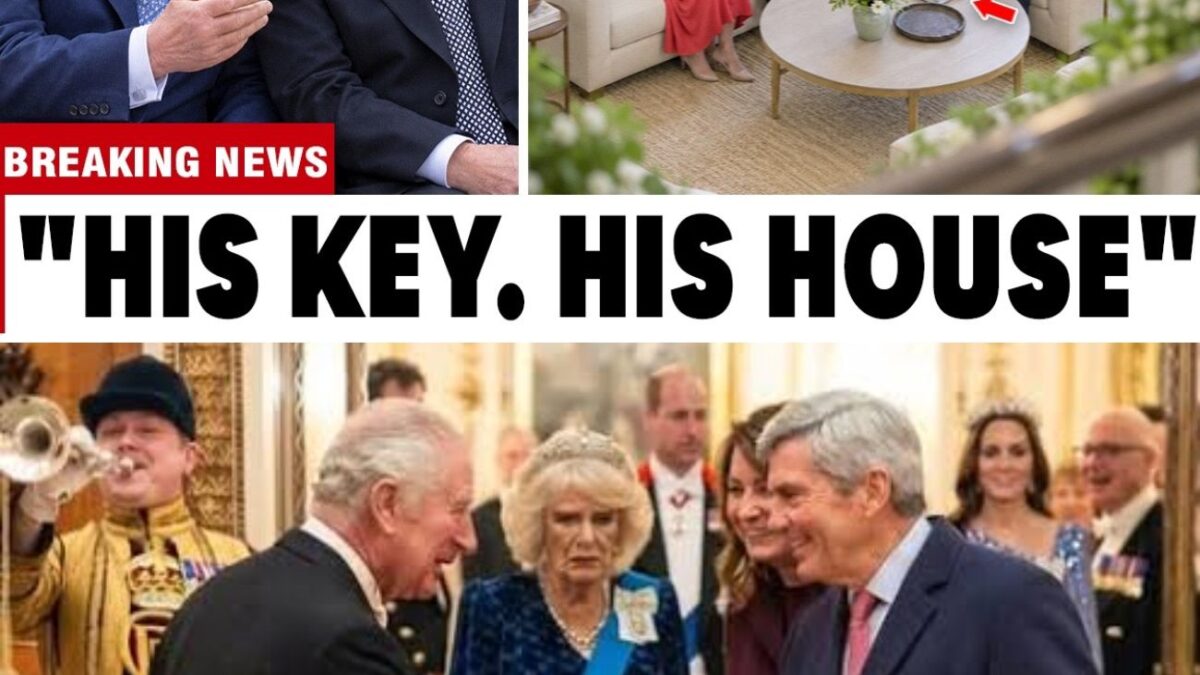
“His Key. His House.” The Alleged Sandringham Decision That Could Have Left Camilla Speechless
A House, a Key, and a Surprising Decision
A modest house on the Sandringham estate has become the center of a story about gratitude, family loyalty, and the complicated boundaries of royal privilege. According to the supplied account, King Charles chose Michael and Carole Middleton, the parents of Catherine, Princess of Wales, to receive lifetime use of a property that had allegedly been requested three times for Queen Camilla’s children, Tom Parker Bowles and Laura Lopes.
The story describes the property as a former keeper’s house in Wolverton, Norfolk. Built more than a century ago, the four-bedroom home is said to stand among quiet country lanes, with a walled garden and views across the surrounding fields. It had reportedly remained empty while the estate considered its future.
At the center of the narrative is an alleged letter dated October 14, printed on Sandringham estate stationery and bearing Charles’s signature. The document supposedly granted Michael and Carole the right to live there for the rest of their lives, without rent, provided they did not rent it out or use it for business.
If authentic, such an arrangement would be a significant gesture. Yet the story becomes more controversial with the claim that three earlier requests for the same property had been declined.
Three Requests, Three Refusals
According to the script, the earlier letters came from Camilla’s office at Clarence House. The first allegedly asked whether the house might be available for family visits to Norfolk. A later request reportedly named Tom and Laura, while a third proposed a longer-term arrangement.
Each request, the account claims, received a refusal.
The explanations supposedly changed over time. Initially, the estate had not decided what to do with the vacant property. Later, it was allegedly being kept available for possible household use. The final refusal reportedly stated that the king did not intend to grant a long-term arrangement to members of Camilla’s family.
This is the point at which the narrative invites readers to consider competing interpretations. Was Charles simply protecting the future use of an estate property before deciding that the Middletons had a stronger claim? Or would the decision, if the reported sequence were accurate, inevitably feel hurtful to a family whose requests had repeatedly been rejected?
The script presents the refusals as evidence of a deliberate distinction. However, without the original correspondence and independent confirmation, neither the documents nor the motives attributed to the king can be established as fact.
Why Michael Middleton, According to the Story?
The alleged explanation is strikingly personal.
Michael Middleton built his career outside royal life. He worked as a flight dispatcher for British Airways before he and Carole developed a family business selling party supplies. He has never held a royal title, and the script portrays him as someone who has avoided publicity despite his daughter’s position.
According to the account, the Middletons offered William and Catherine a private place to retreat from the pressures of royal duties. Their home in Berkshire supposedly provided the couple with ordinary family moments away from official residences and public attention.
The story claims that Charles valued this quiet support. Rather than viewing the property as a privilege to be distributed among relatives, he allegedly regarded it as a gesture of gratitude toward someone who had helped his son and daughter-in-law without publicly demanding recognition.
The script attributes a handwritten note to the king: “In 20 years, Michael has never asked this family for a single thing. He has given a great deal. This is his to keep.”
Those words form the emotional center of the narrative. If genuine, they would suggest that Charles wanted the decision understood not as a rejection of Camilla’s children, but as recognition of a relationship he considered especially valuable.
Camilla’s Alleged Reaction
The account places the revelation at a private lunch at Sandringham in October.
A retired local farmer supposedly mentioned that the empty keeper’s house would soon have occupants, adding that Catherine’s parents were expected to move in. Camilla, who allegedly had not been told about the decision, was said to have gone completely still.
Rather than confronting anyone publicly, she reportedly asked the estate manager whether the news was true. He supposedly confirmed that Charles had granted the property to the Middletons.
The script describes a restrained reaction: Camilla finished her coffee, remained courteous, and left without making a scene. The drama, in this telling, came from the silence rather than an argument.
Later, Camilla allegedly asked her husband why her children had been turned down repeatedly before the same house was offered to someone else. Charles is said to have answered that the decision was about Michael, not Tom or Laura.
The alleged exchange raises an important distinction between a personal gift and a family entitlement. Even if the reported conversation cannot be verified, the question at its heart is familiar: should family connections carry weight when a valuable property is being allocated, or should individual circumstances determine the decision?
Was the Decision Fair?
The story acknowledges that Camilla’s children could reasonably have felt disappointed. Tom and Laura are described as having been part of the wider royal family for years, attending important family occasions and supporting their mother through periods of intense public scrutiny.
The script also raises comparisons with other royal relatives, including Princesses Beatrice and Eugenie and Zara Tindall, who are not portrayed as having received a similar offer of this particular property.
But the narrative argues that the Middletons’ alleged advantage was not their connection by marriage. It was the support they supposedly provided to William and Catherine over two decades.
That argument will not convince everyone. A lifetime arrangement involving a house on a royal estate is a substantial benefit, even when no ownership is transferred. Questions about fairness, transparency, and how private estate properties are allocated would be legitimate if such an arrangement existed.
At the same time, the account says Tom and Laura did not personally submit the requests and were reportedly more uncomfortable with the resulting appearance of entitlement than angry about losing the house. Their supposed response adds nuance to a story that might otherwise portray the family as divided into winners and losers.
The Middletons’ Alleged Dilemma
Perhaps the most unexpected turn comes when Michael and Carole are said to have considered refusing the offer.
According to the script, Michael worried that accepting a house from the king could create unwanted headlines and make it appear that he had supported the royal family in expectation of a reward. He and Carole already had a home, the story says, and did not want Catherine to face further scrutiny because of her parents.
Michael allegedly drafted a refusal before speaking to his daughter. Catherine supposedly encouraged him to reconsider, explaining that Charles viewed the offer as a personal expression of gratitude rather than payment for services.
After reflecting on the decision, Michael is said to have accepted, promising to care for the house responsibly.
The account then describes village gossip bringing the news to Laura and Tom. They allegedly felt hurt by the way they discovered the decision, although Laura reportedly acknowledged that Michael was a good man and that the king had a reason to thank him.
The story claims that Camilla subsequently instructed her office not to make further requests for royal estate accommodation on behalf of her children. That alleged decision would mark a shift away from seeking arrangements through family connections, although the claimed instruction has not been independently established.
The Key Handover and the Fine Print
In the script’s most cinematic scene, Charles visits the property with the estate manager and a protection officer. Michael and Carole are waiting at the gate.
The king supposedly walks with them through the garden, points out the vegetable patch, and views the surrounding fields before entering the freshly prepared house. He then takes an old iron key from his pocket and hands it directly to Michael.
There is no public announcement or formal photo opportunity in the account. Instead, the moment is presented as a private exchange between two men: one offering a gesture of thanks, the other promising to look after the house.
The story says Charles hoped the couple would be happy there. Michael allegedly joked that the king should visit for tea, drawing a laugh and a promise to come.
A subsequent occupancy agreement is described as confirming that the house could not be rented, transferred, or passed to another member of the Middleton family. Major repairs would remain the estate’s responsibility, while Michael and Carole would handle everyday upkeep.
These details reinforce the narrative’s central theme: the property was allegedly intended for the couple alone, not as a transferable family asset.
A Decision That Raises Bigger Questions
The final twist concerns the estate’s alleged property register. According to the script, the entry for the keeper’s house was changed so that the next occupant would be chosen personally by the sovereign, rather than through the usual estate management process.
A space for the future occupant’s name supposedly remains blank. The account speculates that William might eventually make that decision if he becomes king before the property returns to the estate.
It is a dramatic ending, but it also leaves the reader with a more enduring question. If a royal property is offered as a private gesture of gratitude, how can the decision be made transparent enough to avoid the appearance of favoritism?
The phrase at the heart of the story—“His key. His house.”—captures the argument that a gift should belong to the person for whom it was intended. Yet the alleged refusals, Camilla’s reported surprise, and the questions surrounding the property’s future make the tale more complicated than a simple act of generosity.
Until the claimed documents and conversations can be verified, the story remains an unconfirmed account rather than a proven royal dispute. But its central dilemma is easy to understand: when family, privilege, and gratitude intersect, even a quiet country house can become the subject of a very public argument.








