“I’m sorry… this is the only dress I have,” she whispered – what the CEO did next made the room completely silent.
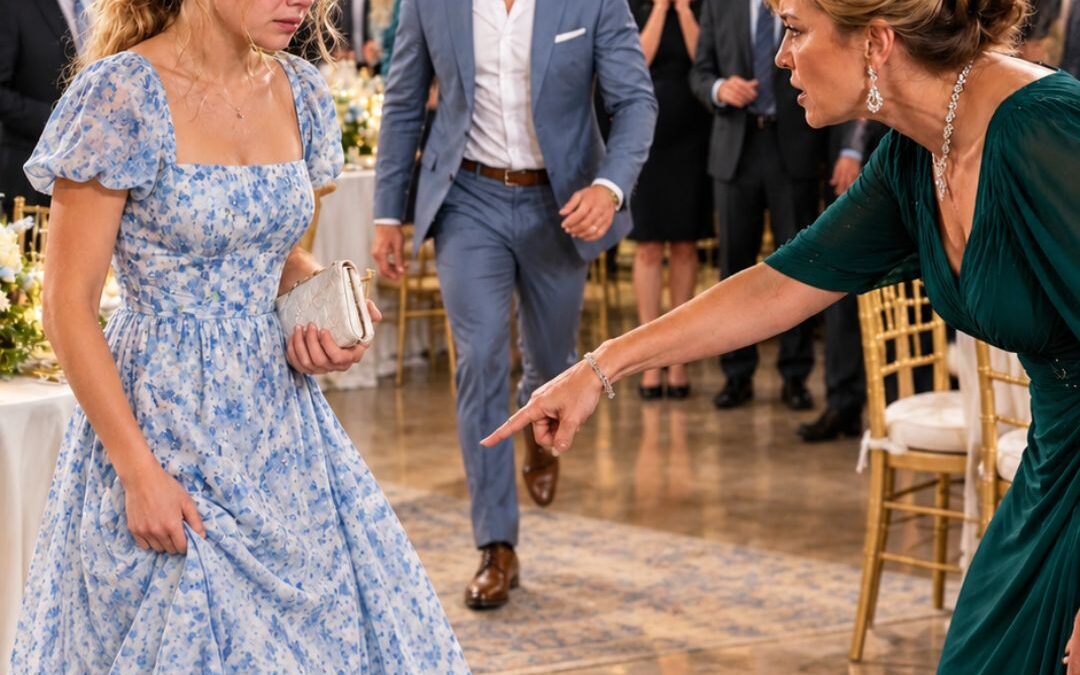
“I’m sorry… this is the only dress I have,” she whispered – what the CEO did next made the room completely silent.

On the evening of the benefit gala in downtown Boston, a sudden hush fell over the room. Emma stood beneath the warm lights of the festively decorated hall, clutching her small handbag so tightly her fingers ached. She wore a simple blue floral dress. It was clean and tidy, though the fabric was slightly faded at the waist, and Emma had repaired a small tear at the hem herself.
She knew perfectly well that she would attract attention. Nevertheless, she had hoped that no one would look too closely.
Emma was twenty-four and worked as a waitress in a small café on the other side of town. Since her mother had died two years earlier, she and her younger brother Noah had been running the household. The money was enough for the rent of their small apartment, groceries, and Noah’s school supplies. There was nothing left over for a new dress.
For three days, Emma had debated whether she should even go to the gala. The café had donated the catering for the event, so the employees were allowed to attend. Emma would have preferred to put her invitation away. She only knew this world from afar: elegant coats, expensive watches, and cars that pulled up in front of the café while she worked behind the glass.
Noah had finally convinced her.
“You deserve a nice evening,” he had said.
So Emma borrowed a pair of simple pumps from a colleague, washed and ironed her best dress, and set off with a nervous smile.
No sooner had she arrived in the hall than she noticed the stares. Some guests looked at her shoes, others at her dress, and then at her companions. Emma tried not to let on and stood at the edge of the room.
Victoria approached them there. She was one of the foundation’s most important donors and wore a black evening gown whose subtle sheen was noticeable even from a distance.
“Are you part of the service staff?” Victoria asked.
Emma swallowed.
“No. I’m invited as a guest.”
Victoria looked her up and down. Then she smiled politely, but without warmth.
“Are you sure? There’s a certain dress code for tonight.”
Emma felt her face get hot. Suddenly, all she could see were the faded patches on her waist and the small, repaired tear.
“I’m sorry,” she whispered. “This is the only dress I have.”
Several people heard the words. Nobody said anything.
This silence was worse than any laughter.
Emma lowered her head. She wanted to leave, but her legs felt heavy. Tears welled up in her eyes. She thought of Noah and how carefully she had prepared. She hadn’t asked to come here, and yet she felt as if she had to apologize for her poverty.
At the other end of the room, Daniel Carter had observed the scene. As the managing director and host of the gala, he was used to people turning around to look at him. But at that moment, he wasn’t thinking about the event. He only saw Emma.
Daniel knew what shame could feel like.
When he was twelve years old, his father’s company had collapsed. The family had lost their home and lived for several months in a small apartment above a grocery store. Daniel still remembered a winter evening when his mother had cried because she couldn’t afford a warm coat for him.
At the time, an older stranger had paid for her groceries at the checkout and left before she could thank him.
Daniel had never forgotten that gesture.
He then walked across the hall towards Emma.
When he stopped beside her, she looked up. For a moment, she thought another unpleasant remark was about to follow.
Instead, Daniel took off his dark jacket and carefully placed it over her shoulders.
A soft murmur went through the room.
Daniel addressed the guests.
“We are here today to support people, not to judge their clothing.”
His voice remained calm.
“A dress code should never determine how much a person is worth. Emma has nothing to apologize for.”
Victoria said nothing.
Daniel continued speaking. He told the guests that the foundation would be launching a new program: the Second Chance Fund. It would support people who were making a fresh start after difficult periods in their lives, with financial assistance, further education, and career opportunities.
But then his voice became more personal.
The café owner had told him that Emma often worked double shifts to help her brother. She had also completed online courses in business management alongside her job. Her dream had been to own a small bakery.
Daniel therefore offered her a paid position as manager of a new community café, which was to be financed by his foundation.
“Not out of pity,” he said. “But because someone who possesses so much perseverance deserves a fair opportunity.”
Emma couldn’t say anything at first.
For years she had believed that simply making ends meet each month was already a success. For the first time, someone wasn’t talking about what she lacked, but about what she was capable of.
Tears streamed down her cheeks.
The applause began hesitantly and then grew louder and louder. Emma knew that some guests were embarrassed. But what mattered most to her was that Daniel hadn’t belittled her. He hadn’t offered her salvation, but had opened a door.
The next morning, Emma told Noah about the offer. He listened silently and finally grinned.
“I told you you deserved a nice evening.”
Months later, the new community café opened in a renovated building on a busy street. Emma stood behind the counter, wearing a simple blue apron, greeting families, the elderly, students, and working people. They served good coffee, fresh pastries, and affordable meals.
Noah often came by after school and helped with tidying up. When someone asked who ran the café, he answered with obvious pride: “My sister.”
A framed photograph of that gala hung above the entrance.
Emma wore the same blue floral dress on it.
She had kept it.
Not because she wanted to cling to the humiliation. She wanted to remember something else: the moment when she had stopped despite her shame. Her courage. And a person who had defended her dignity without making her a victim.
Daniel sometimes visited the café unannounced. He never treated Emma like a charity recipient. They discussed new ideas, worked out projects together, and occasionally even argued about trivial matters. Over time, his offer had developed into a genuine professional partnership.
Emma had come to understand that a new beginning rarely looked like what one imagines as a young person. It didn’t always come with a big win, a perfect dress, or a carefree life. Sometimes it began with a humiliating moment, an open door, and the courage to walk through it.
Noah changed too. He no longer had to witness his sister coming home exhausted from work every evening, yet still managing everything. He began to talk about his own future. Emma listened and realized that her responsibility for him didn’t mean she had to determine his future.
One quiet afternoon, shortly before Christmas, Emma stopped in front of the framed photograph. The blue dress looked almost as simple in it as it had back then.
She smiled.
She used to believe her clothes told people everything about her. Now she knew better. A dress could be old. A bank account could be empty. A life could be full of worries. None of that said anything about a person’s worth.
Victoria had judged Emma that evening solely based on what was visible. Daniel had looked more closely.
Perhaps that was the true meaning of generosity: not to make someone feel they need to be rescued, but to show them that they can build something themselves.
Emma often thought back to the moment when Daniel’s jacket had covered her shoulders. Not because he had protected her from the gaze of others, but because in that moment he had given her back something she had almost lost: her dignity.
The blue dress remained in the café, neatly folded in a small box behind her office. It wasn’t a precious keepsake. Nevertheless, for Emma it was one of the most important things she owned.
For she had learned that evening that poverty is not a stigma, shame is not truth, and a difficult beginning is not a final fate.
Sometimes a person doesn’t need much.
Just someone who looks.
Someone who doesn’t ask what’s missing, but recognizes what’s already there.
And sometimes a new life begins right there.
Since then, Emma has tried to pass on this attitude. If a new employee arrived uncertain on her first day, she took the time to be with her. If a customer had little money, she treated them with the same kindness as everyone else. She now knew how much it could mean not to be judged by appearances. The café became more than just a workplace. It became a place where people could breathe freely. And when Emma turned off the lights in the evening, she reflected on how a small gesture had been enough to change their outlook on the future.








