“IT’S OVER!” King Charles’ Alleged Betrayal Bombshell Rocks Camilla’s World — Is Prince William Preparing to Take Control?
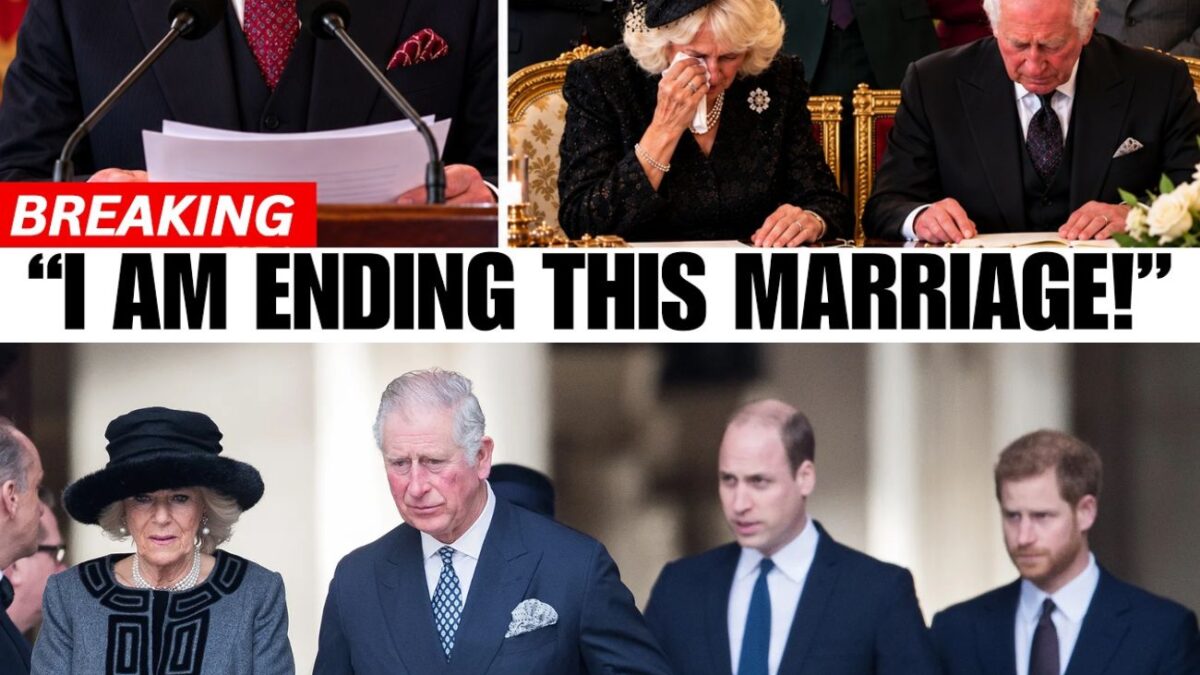
“It’s Over!” The Explosive Royal Divorce Story That Could Change the Future of the Crown
The royal family has survived public scandals, painful departures, and decades of relentless scrutiny. But in this fictional royal drama, nothing prepares the household for the moment King Charles III allegedly decides that his marriage to Queen Camilla can no longer continue.
The scene unfolds at Clarence House on a cold, rain-soaked morning in London. Behind closed doors, Charles reportedly gathers a small circle of trusted advisers and places an unmarked folder on a polished mahogany table. His expression is exhausted, his voice controlled, and his decision, according to the story, already made.
“I intend to end this marriage,” he declares.
No argument follows immediately. The advisers understand that this is not an ordinary domestic disagreement. The consequences could reach far beyond the couple themselves, affecting the monarchy’s public image and the family expected to carry it into the future.
Yet the most explosive question is not whether the marriage can survive. It is what Charles believes has happened behind his back.
The Dossier That Allegedly Changed Everything
In the days leading up to the supposed announcement, palace staff are said to have noticed a troubling pattern. Private details about royal life were appearing in media inquiries and tabloid reports with a precision that raised suspicions about an internal source.
A confidential investigation allegedly followed.
At the center of the fictional account is a thick black dossier compiled by a palace security team. Its contents supposedly include communication records, correspondence, and details concerning a proposed royal biography. Investigators are portrayed as believing that the project was intended not simply to tell a story about Camilla’s life, but to reshape her legacy at the expense of other members of the royal family.
The alleged manuscript contains harsh portrayals of the late Princess Diana, questioning her motives and character. It also reportedly criticizes Prince William, presenting him as ill-prepared for the responsibilities of the Crown, while casting doubt on Princess Catherine’s suitability for her future role.
The accusations create a devastating picture: a royal household divided not merely by personal disagreements, but by competing visions of who deserves to shape its future.
For Charles, the most painful possibility is that his wife may have been seeking to protect her own position while undermining the people he hopes will preserve the monarchy.
But the dossier allegedly contains another section, one that takes the story into even more serious territory.
The Meetings That Raise Difficult Questions
According to the fictional narrative, investigators uncover records suggesting that Camilla held three private meetings with a powerful international media executive over several weeks. The meetings are portrayed as having taken place away from ordinary royal scheduling and public scrutiny.
The supposed purpose, the story alleges, was to discuss legacy management, personal finances, and the development of an independent media strategy.
If true, such claims would raise serious questions. Yet the script offers no independently verifiable evidence establishing that the meetings occurred or proving the alleged intentions behind them. Within the drama, however, Charles interprets the information as evidence that the trust between himself and Camilla has broken down beyond repair.
His reaction is shaped by the history of their relationship.
He endured years of public criticism and controversy before marrying Camilla. Their relationship became one of the most discussed chapters of modern royal life, and their eventual marriage followed a long, complicated personal journey.
In this imagined scenario, Charles feels that the loyalty he believes he gave his wife has been repaid with a betrayal involving the very institution they were meant to serve together.
The possibility that his children could have been drawn into the dispute makes the alleged revelations even more painful.
The Confrontation at St. James’s Palace
Charles reportedly summons Camilla to a private drawing room at St. James’s Palace. The atmosphere is tense, and the king lays the dossier between them, expecting an explanation.
Instead, the fictional account portrays Camilla as dismissing the investigation as exaggerated and unreliable. She argues that authors have the freedom to interpret history and that she cannot be held responsible for every draft or discussion connected to a proposed biography.
Charles listens in silence.
For years, he has defended their relationship against criticism. Now, he believes he is being asked to accept an explanation that does not address his deepest concern: whether he can still trust the person beside him.
The confrontation ends without reconciliation. Camilla leaves the room, while Charles remains behind, overwhelmed by what he believes the evidence means.
In the days that follow, the story depicts the king withdrawing from several engagements and spending long periods walking alone in the grounds of Windsor Castle. Advisers worry about the combined weight of personal distress and the responsibilities of the Crown.
His grief gradually hardens into resolve.
Camilla’s Alleged Exile and Anne’s Intervention
The next stage of the story is even more dramatic. Camilla’s office is supposedly disconnected from internal communications systems, members of her staff lose access to shared records, and her engraved nameplate is removed from her private office.
She is then portrayed as leaving central London for Raymill House in Wiltshire.
The fictional narrative presents the move as an institutional separation intended to prevent further conflict. Attempts to contact Charles allegedly go unanswered, leaving Camilla isolated from the household she once shared with him.
Princess Anne now enters the story as a forceful defender of royal duty.
After reviewing the supposed dossier, Anne travels to London and confronts her brother. Her message is uncompromising: he must decide whether his personal relationship can continue without placing the monarchy’s stability at risk.
Anne is portrayed as believing that the institution cannot survive if its senior members appear to place private loyalties above public responsibility.
Her intervention strengthens Charles’s determination. Meanwhile, William becomes increasingly involved in discussions about the monarchy’s future direction.
The story even imagines legal advisers preparing restrictions on Camilla’s access to certain resources and her ability to profit from her royal position. These extraordinary claims remain part of the fictional scenario, not established events.
William and Catherine Face a Defining Moment
As the crisis deepens, William is depicted as moving beyond the traditional role of a waiting heir. He begins taking a more active part in long-term planning, while Catherine supports efforts to project stability and reassurance.
For William, the alleged crisis reinforces a principle he believes must guide the monarchy: public trust cannot be demanded simply because someone possesses a title.
The fictional account portrays him as insisting on personal accountability, regardless of rank or family connection. Catherine, meanwhile, represents a calmer public presence as the household attempts to navigate the turmoil.
The story also introduces a symbolic change inside Buckingham Palace. Camilla’s portrait is supposedly removed from a prominent gallery and replaced by an image of Diana alongside William, Catherine, and their children.
The gesture is presented as a powerful statement about memory and the future. But it also raises an uncomfortable question: would revisiting the past truly heal old wounds, or simply create new ones?
Could Charles Step Aside?
The final and most consequential possibility concerns the Crown itself.
The fictional narrative suggests that Charles, worn down by personal heartbreak and the pressures of his role, may eventually consider abdication. William could then assume the throne earlier than expected, with Catherine beside him.
Such a transition would be historic, but the story provides no verified evidence that Charles is preparing to step down. Nor does it establish the alleged marital breakdown or accusations against Camilla as fact.
Nevertheless, the imagined scenario leaves readers with a compelling dilemma. If the monarchy’s survival depends on public confidence, how far should a king go to protect that confidence when personal relationships and institutional responsibilities collide?
As night falls over Windsor, Charles is pictured walking alone beneath the autumn sky, carrying the burden of a decision that could reshape his family’s future.
The Crown has endured wars, political upheaval, and generations of change. Its greatest challenge, however, may not always come from outside its walls. Sometimes, the deepest crisis begins with a loss of trust between the people expected to stand together.
Would ending a marriage protect the monarchy—or create a wound that no royal declaration could ever repair?
That is the question at the heart of this dramatic fictional story. And it leaves one final thought hanging over the royal household: when duty and love demand different things, which one should a monarch choose?








