“IT’S OVER!” King Charles’ Alleged Decision on Camilla Sparks Royal Firestorm — Is William Preparing to Take the Crown?
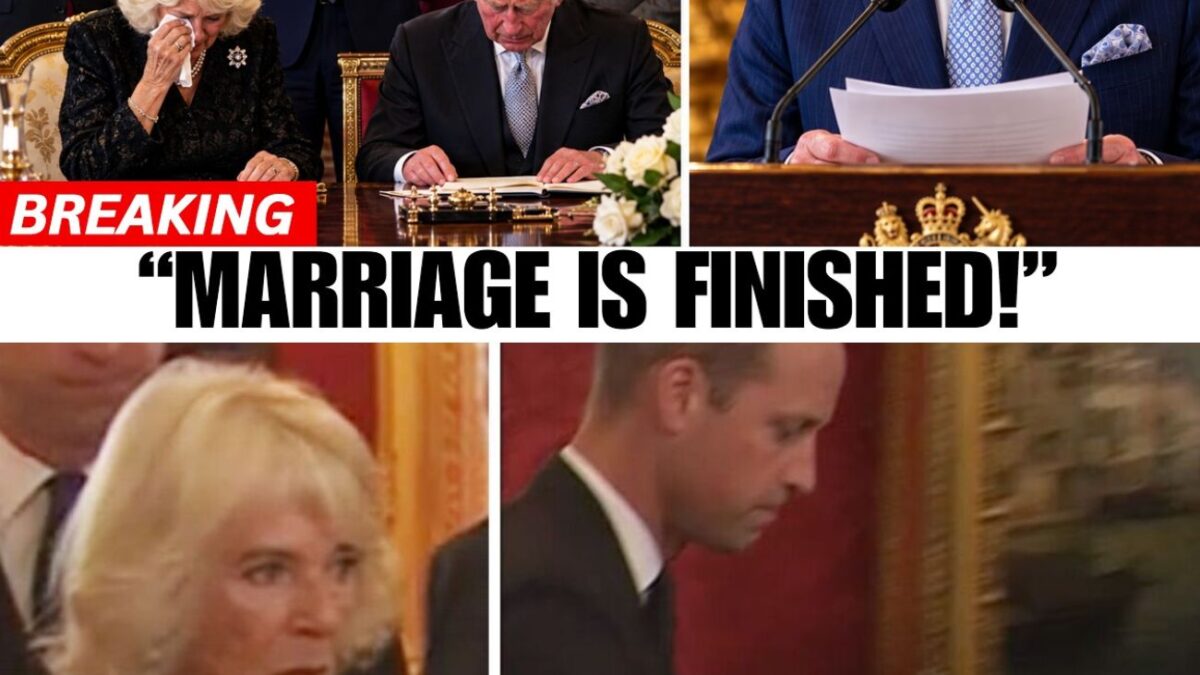
“IT’S OVER!” The Explosive Royal Divorce Rumor That Could Change Everything
Imagine a rainy morning in London. Behind the imposing walls of Clarence House, a small group of senior advisers gathers around a long mahogany table. The atmosphere is tense, the doors are closed, and King Charles III is preparing to make a decision that could transform his personal life and send shock waves through the British monarchy.
In this dramatic, unverified scenario, Charles announces that his marriage to Queen Camilla has reached a breaking point. There is no public argument, no emotional outburst, and no lengthy discussion. Instead, a confidential folder is placed on the table, and the king allegedly tells those present that the trust between him and his wife has been irreparably damaged.
The imagined announcement is extraordinary. Charles and Camilla have spent decades navigating public criticism, personal sacrifice, and the complicated expectations attached to royal life. A separation would therefore represent more than a private marital crisis. In the story, it becomes a test of the monarchy’s ability to protect its reputation while confronting painful questions about loyalty, family, and power.
Yet the central claims remain unverified. No reliable evidence has established that Charles has announced a divorce or that such a confidential meeting took place.
The Mysterious Dossier
The story begins eight days before the supposed announcement, when a thick black dossier allegedly reaches the king’s private desk.
According to the narrative, palace staff had noticed a pattern of unusually detailed stories appearing in the British tabloids. The reports seemed to contain information that could only have come from people close to the royal household. What initially appeared to be a communications problem supposedly developed into a secret investigation involving digital records, private correspondence, and security specialists.
The dossier’s most explosive alleged claim concerns a royal biography. Rather than presenting a flattering account of the monarchy, the manuscript is portrayed as an attempt to reshape Camilla’s public image at the expense of other members of the family.
In the imagined drafts, the late Princess Diana is described in deeply unflattering terms, while Prince William is portrayed as emotionally fragile and poorly prepared for his future responsibilities. Princess Catherine is also allegedly subjected to harsh judgments about her health, stamina, and suitability for her eventual role.
The manuscript’s supposed message is unmistakable: the younger generation is incapable of leading, while Camilla alone understands how to preserve the institution.
For Charles, the suggestion that his wife might be involved in a campaign undermining his children would be devastating. The scenario presents him as a husband forced to confront the possibility that personal loyalty and royal duty have become impossible to reconcile.
However, there is no substantiated evidence that such a manuscript or investigation exists.
Alleged Secret Meetings Raise the Stakes
The dossier’s second section supposedly contains material that changes the king’s perspective entirely.
The narrative alleges that investigators discovered records of three private meetings between Camilla and a powerful international media executive. The meetings are said to have taken place at a secured residence in London’s exclusive Mayfair district over a period of six weeks.
Their alleged purpose, according to the story, was to discuss Camilla’s future influence, financial independence, and public reputation.
The imagined investigation suggests that she was preparing for a future in which her position would no longer depend on Charles. Through media connections, she supposedly hoped to preserve her personal standing regardless of what happened to the monarchy.
The most serious accusation is that these efforts might have threatened William’s eventual reign. Within the story, the possibility that Camilla could be building an independent power network becomes the final blow to Charles’s confidence.
For a monarch whose public image has been shaped by decades of controversy, the idea of another private crisis would carry enormous emotional weight. But the allegations about secret meetings and deliberate sabotage remain unsupported and must not be confused with established facts.
A Confrontation at St. James’s Palace
The next scene takes place inside a dimly lit drawing room at St. James’s Palace.
Charles allegedly summons Camilla and lays the dossier between them, expecting an explanation. Instead, the story portrays her as calm and dismissive. She reportedly questions the credibility of the investigation, suggesting that authors are free to interpret history as they choose and that she cannot be held responsible for every draft that crosses her desk.
Her reaction, as imagined by the narrative, leaves Charles more troubled than an emotional argument might have done.
After years of defending their relationship against public criticism, he supposedly realizes that he can no longer distinguish between the woman he loves and the institution he is sworn to protect.
The story then describes a period of withdrawal. Charles allegedly cancels private engagements, postpones meetings, and spends long hours walking alone through the gardens of Windsor Castle. Palace staff are depicted as deeply concerned by his emotional state.
These scenes heighten the drama by connecting a personal heartbreak to the immense pressure of kingship. Nevertheless, the claimed cancellations and private conversations have not been verified as consequences of any marital dispute.
The Palace Closes Ranks
The alleged response is swift. In the scenario, Charles’s private secretary orders a digital shutdown of Camilla’s office network. Her staff lose access to internal systems, and several senior aides supposedly resign amid confusion and ethical concerns.
The story then describes Camilla being moved from central London to Raymill House, her country residence in Wiltshire. Her communications with the king are allegedly restricted, and attempts to reach him are unsuccessful.
What had once been presented as a shared royal household becomes, in this imagined account, a divided institution.
Princess Anne now enters the center of the crisis. Known for her disciplined public service, she is portrayed as a determined defender of the monarchy’s continuity. After supposedly reading the dossier, Anne travels to London and confronts her brother.
Her message is blunt: Charles must choose between preserving his marriage and protecting the crown.
In the story, Anne’s intervention provides the emotional turning point. She is not depicted as seeking personal power, but as insisting that the king confront the consequences of a decision he has allegedly delayed.
Again, there is no verified evidence that Anne issued such an ultimatum or that Camilla was subjected to the measures described.
William’s Moment of Authority
As the alleged crisis deepens, Prince William is portrayed as stepping into a more commanding role. The narrative suggests that advisers begin preparing legal arrangements that would limit Camilla’s institutional influence and prevent her from commercially exploiting her royal position.
One particularly dramatic claim involves a proposed restriction on future memoirs, interviews, or productions using her royal experiences. The story presents this as an attempt to prevent the family’s internal disputes from becoming public entertainment.
Meanwhile, Buckingham Palace supposedly undergoes a symbolic transformation. Camilla’s portrait is removed from a prominent gallery, while a portrait of Diana is placed beside images of William, Catherine, and their children.
The scene is designed to suggest a deliberate restoration of Diana’s place in the monarchy’s public memory.
William, in this imagined future, is no longer simply waiting to inherit the throne. He becomes the figure directing the family’s response, with Catherine portrayed as a trusted partner in a strategy focused on accountability and institutional reform.
But the narrative’s claims about portrait changes, legal restrictions, and a transfer of operational authority have not been substantiated.
Could a New Royal Era Begin?
The final chapter introduces an even more dramatic possibility: that Charles might abdicate before the end of 2026, allowing William to become King William V and Catherine to become queen.
Such a transition would represent an extraordinary moment in British royal history. Yet the story provides no verifiable evidence that an abdication announcement is being prepared, and the supposed public polling and private parliamentary discussions it describes should not be treated as confirmed developments.
The emotional heart of the scenario lies in the contrast between Charles’s personal suffering and the monarchy’s relentless demand for stability. The king is imagined walking alone through Windsor Castle, contemplating the cost of a lifetime spent balancing love with duty.
Beyond the palace gates, the questions are larger than one marriage. How should a royal family respond when private relationships appear to threaten public confidence? Should tradition protect individual members, or should the institution place accountability above personal loyalty? And how much of Diana’s legacy continues to shape the way the monarchy is judged today?
These questions help explain why dramatic royal stories attract such intense attention. But compelling storytelling is not proof. Until reliable evidence emerges, the alleged divorce, secret dossier, and succession plans remain unverified elements of a sensational narrative—not established events.
For now, the most important distinction is between speculation and fact. The British monarchy’s future is a legitimate subject of public interest, but claims about private betrayal and major constitutional change deserve careful scrutiny before they are accepted as truth.








