KING CHARLES’ FINAL DECISION: The $16.7 Million Montecito Mansion That Allegedly Exposed Harry and Meghan’s Financial Collapse
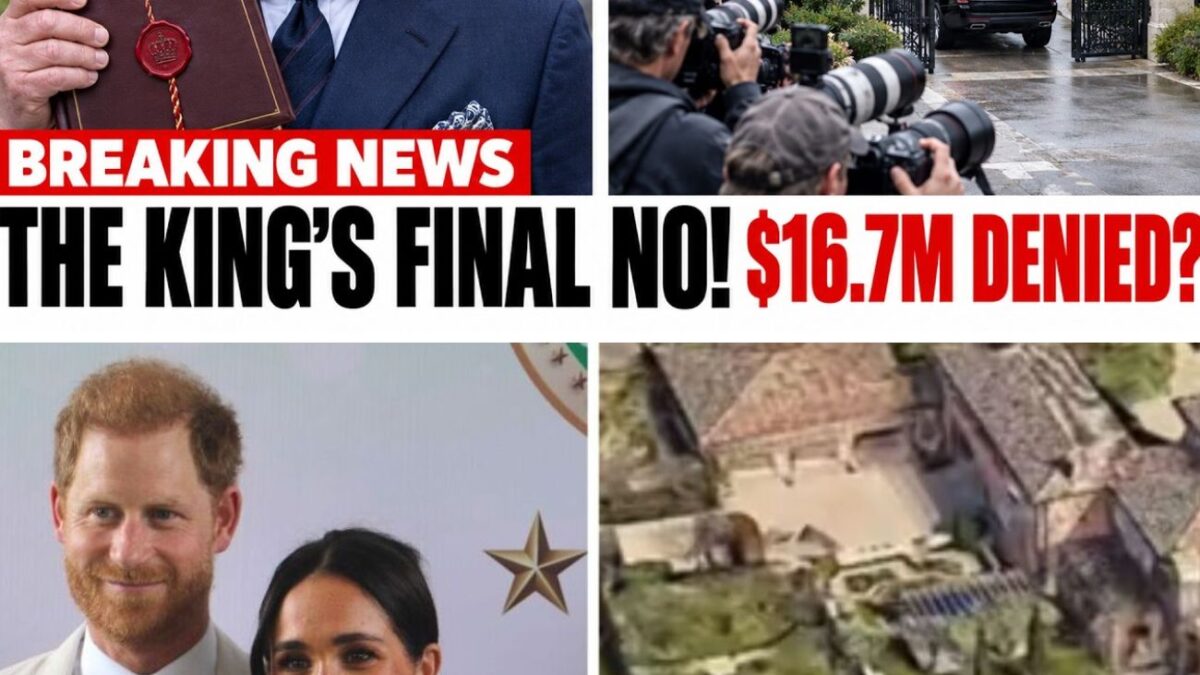
KING CHARLES’ FINAL DECISION: The $16.7 Million Montecito Mansion That Allegedly Exposed Harry and Meghan’s Financial Collapse
The story surrounding Prince Harry and Meghan Markle has taken a dramatic fictional turn in this account, beginning with an alleged attempt to rebuild their British presence and ending with a financial reckoning in California. According to the supplied script, the Sussexes planned a return to the English countryside while hoping King Charles would soften his position. Instead, the plan allegedly collided with a formal royal directive, resistance in Oxfordshire, and the withdrawal of Tyler Perry’s financial support.
At the center of the story is the $16.7 million Montecito mansion. The script claims that Tyler Perry, rather than Prince Harry and Meghan, remained the decisive financial figure behind the property. For years, the couple supposedly enjoyed the appearance of ownership while Perry carried major financial responsibilities. That arrangement, the narrative argues, became impossible to sustain once the Sussexes’ commercial income weakened and their hopes of renewed royal assistance disappeared.
The pressure allegedly intensified during late summer and early September 2026. Harry and Meghan were said to have developed an ambitious plan to establish themselves again in Britain. They reportedly pursued a long-term lease on a rural Oxfordshire property in the Cotswolds and considered enrolling Archie and Lilibet at a prestigious local preparatory school.
Behind that public image, however, the script describes a very different calculation. Returning to Britain with the children could create pressure around security. Harry had spent years challenging the government over his security arrangements, and the strategy supposedly depended on the idea that authorities would face enormous public criticism if anything happened to Diana’s grandchildren on British soil. In that telling, physical presence became leverage.
The plan allegedly reached King Charles through emotional appeals rather than direct financial demands. Harry supposedly spoke about family unity, his children, Princess Diana’s memory, and the possibility of a powerful reconciliation photograph. The script portrays this as an attempt to persuade the king to provide temporary accommodation and financial assistance without forcing either side into a public confrontation.
Then came the decisive twist.
According to the script, what Harry expected to be a personal letter from his father was instead an administrative directive. It allegedly moved through the Lord Chamberlain’s office and was circulated to government departments and security authorities. The document, as described in the supplied material, contained three major provisions.
First, Harry and Meghan were allegedly reaffirmed as non-working members of the royal family, with their HRH styles remaining in abeyance. Second, the directive supposedly blocked taxpayer funding and royal-estate subsidies for the Sussex household. Third, it allegedly made clear that Harry had no automatic entitlement to state-funded armed protection and would have to meet the same legal requirements as any private individual seeking security.
The decision was allegedly the product of pressure from Prince William and Princess Anne. Anne is depicted as the uncompromising defender of royal duty, arguing that those who did not perform official work should not expect access to public funds. William, meanwhile, is portrayed as determined to prevent another ambiguous compromise from becoming a future financial or institutional problem.
The alleged consequences became visible in the Cotswolds. Meghan reportedly appeared at the Three Horseshoes pub with Ellen DeGeneres and Porsche Dasi, surrounded by a substantial security presence. Four armored vehicles allegedly blocked the narrow village road, creating frustration among local residents and traffic. Inside the pub, the story says, staff treated the group as ordinary private customers.
That moment became symbolic in the script. The planned British return was supposed to demonstrate confidence, family connection, and a graceful new chapter. Instead, the cold reception allegedly exposed how different life could look without the practical authority associated with working royal status. Reports that Archie and Lilibet’s proposed school arrangement had collapsed added another blow to the plan.
Thousands of miles away, Tyler Perry was supposedly watching the situation closely. Once it became clear the British monarchy would not provide financial rescue, Perry allegedly decided that the California property could no longer remain an open-ended obligation. Harry allegedly called him after the Oxfordshire plan failed, asking for more time and describing the dangers of losing the home.
Perry’s reported response was blunt but quiet. The mansion, according to the story, had originally represented a generous sanctuary during a crisis, not a permanent credit facility. Carrying costs, security expenses, mortgages, and other obligations had accumulated. Perry therefore allegedly instructed his lawyers to begin a private liquidation of the $16.7 million Montecito property, with proceeds directed toward outstanding financial obligations rather than the Sussexes’ next venture.
For Harry and Meghan, the story ends with a striking reversal. The independence they had publicly associated with California is portrayed as increasingly dependent on private benefactors, commercial contracts, and the expectation that some form of royal connection might remain available. Once those supports disappeared, the carefully constructed image of complete financial independence allegedly began to unravel.
The final institutional blow allegedly came from Prince William. The script says he authorized the permanent reallocation of Frogmore Cottage, removing it as a future residential option for Harry. Remaining charitable and military connections were also supposedly redistributed among working royals, including Princess Anne and Sophie, Duchess of Edinburgh.
That is what gives the story its dramatic edge. Every earlier promise, every private favor, and every expectation of reconciliation appears to converge at the same point: a household now confronting bills that can no longer be postponed, and an institution finally determined to make its boundaries unmistakably clear.
The supplied script ultimately presents the episode not as a simple family argument but as a clash between personal emotion and institutional discipline. King Charles is portrayed as a father caught between affection and duty, while William and Anne represent a harder line focused on protecting the monarchy. Tyler Perry represents another boundary: friendship and generosity can provide refuge during a crisis, but they cannot necessarily become permanent financial obligations.
Whether viewed as royal drama, political storytelling, or a fictionalized scenario, the account builds toward one unmistakable conclusion: the mansion is more than a piece of California real estate. In the script, it becomes the final symbol of a larger illusion collapsing under financial pressure. The royal door closes, the benefactor steps away, and the house that once represented independence becomes evidence of how fragile that independence may have been.








