King Charles Rushed to Hospital? Prince William and Queen Camilla Caught in an Explosive Alleged Palace Power Struggle

Prince William’s Dramatic Rise: King Charles’ Medical Scare and Queen Camilla’s Alleged Secret Power Play
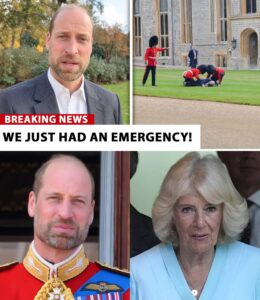
What would happen if King Charles suddenly became too ill to carry out his royal duties? For the British monarchy, such a possibility would involve far more than a family emergency. It would raise difficult questions about constitutional authority, succession, and the people entrusted with protecting the institution. An explosive online narrative imagines precisely that scenario, claiming that Charles was rushed to hospital, Prince William moved to take charge, and Queen Camilla became embroiled in a dramatic confrontation over power. The allegations remain unverified, but the imagined crisis reveals why questions about the monarchy’s future can ignite such intense public debate.
The Night Everything Allegedly Changed
In the story, the crisis begins shortly before midnight inside Buckingham Palace. King Charles is supposedly working alone in his private study, surrounded by official documents and the familiar red dispatch boxes used for government papers.
Then, without warning, the atmosphere changes. Charles reportedly experiences sudden chest discomfort, struggles to breathe, and collapses beside his desk. A protection officer outside the room hears the sound of breaking glass and rushes inside, discovering the king unconscious.
Within moments, the narrative describes an extraordinary security response. Palace communications are allegedly restricted, staff members are instructed to remain silent, and arrangements are made to transport Charles to a private medical facility without attracting public attention.
There is no independently verified evidence that this specific emergency or communications blackout occurred. Nevertheless, the scene establishes the story’s central tension: what happens when the monarch is suddenly unable to perform his responsibilities?
For a royal family whose public image depends heavily on stability and continuity, even uncertainty surrounding the sovereign’s health can generate enormous speculation. Behind the ceremonial appearances and carefully managed announcements lies a constitutional institution that must be prepared for unexpected circumstances.
In this imagined account, the silence surrounding Charles becomes the spark that sets an extraordinary chain of events in motion.
Prince William Receives the Call
At Adelaide Cottage, Prince William is supposedly awakened by an urgent secure telephone call from a senior royal official. The message is short, alarming, and impossible to ignore: his father has collapsed, remains unconscious, and doctors are uncertain about his condition.
The story portrays William as remarkably composed. Rather than allowing panic to overwhelm him, he immediately asks questions about the king’s medical situation, the palace’s communications arrangements, and the constitutional procedures that might become necessary.
Catherine, Princess of Wales, is depicted as standing firmly beside her husband. In this version of events, she encourages him to remain decisive and warns him against allowing competing interests to influence his response.
William then leaves for London, accompanied by his security team. His journey becomes a symbolic turning point, representing the moment the heir apparent must confront the possibility that his family’s future could change overnight.
Yet an important legal distinction matters here. The British heir does not automatically become king or acquire unlimited executive authority simply because the reigning monarch becomes incapacitated. A regency involves established statutory procedures and safeguards. The scenario’s portrayal of William immediately becoming the country’s absolute ruler is therefore not an accurate description of constitutional law.
Even so, the prospect of William assuming greater responsibilities offers the narrative its most powerful question: would he prioritize family unity, or insist that the institution’s rules come first?
The Alleged Document That Threatens Camilla
The story’s most explosive allegation concerns Queen Camilla and a supposed confidential document titled the “Joint Consort and Air Regency Protocol.”
According to the narrative, Camilla’s legal advisers prepared the document months earlier, allegedly presenting it as a safeguard for the royal family during a possible medical emergency involving Charles.
Its purported provisions, however, would give Camilla a mechanism to influence or obstruct decisions made during a regency. The account suggests that Charles had signed the document without fully appreciating its potential consequences and that Camilla’s office attempted to submit it while he was unconscious.
These claims have not been substantiated, and the alleged protocol should not be treated as an authentic royal or government document.
Within the story, however, the document represents something more troubling than a legal disagreement. It symbolizes the fear that a personal interest could interfere with the orderly transfer of responsibility during a national crisis.
The narrative suggests that a member of the palace security team discovers the attempted transmission and alerts William before it can proceed. William, already travelling toward the hospital, allegedly orders the document blocked and Camilla’s staff access to palace systems restricted.
The scene transforms an imagined medical emergency into a battle over loyalty, authority, and the limits of influence within the royal household.
A Confrontation in the Hospital Corridor
When Camilla arrives at the hospital, the story claims she expects immediate access to her husband. Instead, she encounters William standing in the corridor with security officers nearby.
The confrontation is portrayed as tense from the beginning. Camilla allegedly insists that she has the right to see Charles, while William demands an explanation for the document his team has supposedly intercepted.
He then presents the papers and accuses her of attempting to interfere with the constitutional arrangements at the very moment the king is most vulnerable.
The account attributes a devastating exchange to the two royals, with William questioning Camilla’s motives and refusing to allow her alleged plan to proceed. It describes her attempting to defend herself by arguing that the document was intended to protect the family rather than undermine the heir.
William, unconvinced, supposedly tears up the document in front of her.
The dramatic narrative does not stop there. Camilla’s private secretary is allegedly dismissed, his security access revoked, and other members of her inner circle removed from sensitive positions. Camilla herself is portrayed as being prevented from controlling information about Charles or issuing statements on behalf of the palace.
These details remain unverified allegations, not established events. Still, the confrontation illustrates the central conflict of the story: whether authority should be guided by personal relationships or by clearly defined institutional responsibilities.
William Faces His Father’s Uncertain Future
After the confrontation, the narrative shifts from anger to a quieter and more emotional scene.
William finally enters Charles’ hospital room. The king lies unconscious, surrounded by medical equipment and doctors monitoring his condition. For the first time that night, William is no longer confronting advisers, documents, or competing claims to authority. He is simply a son facing the possibility of losing his father.
He takes Charles’ hand and stands beside the bed in silence.
Catherine later joins him, offering support as the family confronts an uncertain future. In this imagined moment, the grandeur associated with the monarchy disappears. There are no ceremonies, cheering crowds, or ceremonial uniforms. There is only a family waiting for news.
That emotional contrast gives the story its strongest human dimension. Whatever their public responsibilities, members of the royal family must still confront the same fear and uncertainty that accompany a loved one’s serious illness.
The Monarchy’s Future Hangs Over the Story
The final chapter imagines William beginning a sweeping review of palace security and administration, determined to prevent any individual from exploiting a future emergency. Camilla is portrayed as isolated from her former circle of advisers, while questions emerge about who knew of the alleged document and why it was supposedly prepared.
The narrative also speculates about whether Charles would recover sufficiently to resume his duties. That uncertainty becomes a metaphor for the monarchy itself: an institution balancing tradition, personal relationships, and the demands of a changing public.
But the distinction between dramatic storytelling and verified reporting remains essential. There is no substantiated basis here for claiming that Camilla attempted a coup, that William seized the throne, or that Charles was secretly rushed to hospital in the circumstances described.
The constitutional questions, however, are worth understanding. A monarch’s incapacity would trigger established procedures, not an unrestricted transfer of power to whichever family member acted fastest. Likewise, allegations of misconduct by senior royals require credible evidence rather than anonymous claims alone.
Ultimately, this imagined royal showdown asks a question that will continue to fascinate observers: when personal loyalties collide with institutional duty, which should prevail?
For Prince William, King Charles, and Queen Camilla, the real answer cannot be found in an unverified palace thriller. It lies in the constitutional rules, documented decisions, and actual events that shape the British monarchy’s future.








