KING CHARLES’ SHOCK ROYAL DECISION? Prince Harry’s Frogmore Hopes COLLAPSE as William Takes Center Stage
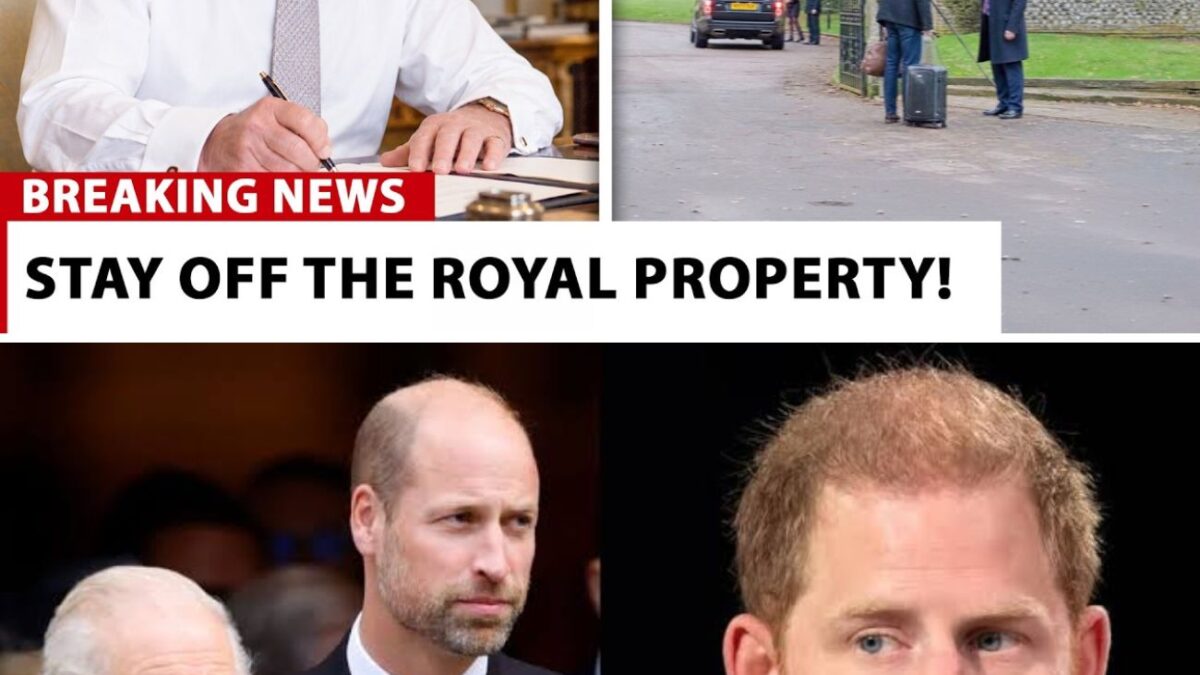
King Charles, Prince Harry and the Royal Lockout: Has Prince William Drawn the Final Line?
The British royal family has weathered scandals, bitter disagreements and years of public speculation, but the latest dramatic narrative surrounding King Charles, Prince Harry, Prince William and Meghan Markle presents a particularly explosive scenario. At its center is Frogmore Cottage, the Windsor residence once associated with the Duke and Duchess of Sussex, and an alleged breakdown in reconciliation efforts that could leave Harry more isolated than ever.
According to the storyline, Harry arrives in London hoping to reopen a channel of communication with his family. Instead, he encounters a wall of institutional silence, while William allegedly moves behind the scenes to ensure that royal residences and private communication channels remain firmly out of reach. Yet the most controversial element is not the reported housing dispute itself. It is the suggestion that a proposed apology became entangled in a wider public relations battle.
A Reconciliation That Never Materialized
The drama begins with reports that Harry and Meghan might finally be prepared to make peace with William and Catherine. The proposed reconciliation is linked to the couple’s explosive 2021 interview with Oprah Winfrey, during which allegations about a senior royal’s comments concerning their son’s skin tone became a major source of controversy.
In the scenario described by the script, a newspaper headline suggests that the Sussexes recognize the damage caused by the interview and are considering a private apology. For observers hoping to see the brothers rebuild their relationship, the possibility offers a glimmer of hope.
That hope disappears when a reported response attributed to the Sussex camp rejects the suggestion that Harry and Meghan intend to apologize to William and Catherine.
The conflicting messages raise an obvious question: was a genuine attempt at reconciliation misunderstood, or was the prospect of an apology never as straightforward as the headlines suggested?
The script advances a much more suspicious interpretation, portraying the competing accounts as part of a calculated communications strategy. However, the alleged coordination and motives remain unverified. Without independently authenticated correspondence or reliable corroboration, the supposed sequence cannot establish that anyone deliberately engineered a deception.
Nevertheless, within the dramatic narrative, the conflicting statements become the turning point. Harry is portrayed as pursuing private discussions in London while public messaging threatens to undermine his efforts before they have a chance to succeed.
Why Frogmore Cottage Matters
Frogmore Cottage represents much more than a picturesque residence in the storyline. It symbolizes Harry’s remaining connection to the institution into which he was born.
The property became closely associated with Harry and Meghan after their marriage, but their departure from royal duties fundamentally changed their relationship with the Royal Family. Their housing arrangements subsequently became a visible reminder that personal history does not necessarily guarantee continuing institutional privileges.
The script portrays Harry as hoping to regain access to Frogmore Cottage or secure another royal residence. It also suggests that such an arrangement could improve his position in the ongoing debate over security during visits to Britain.
These issues must be distinguished from established fact. Access to royal property does not automatically confer working-royal status or guarantee publicly funded police protection. Harry’s security arrangements have been the subject of separate legal proceedings, and residency, royal status and eligibility for protection are not interchangeable matters.
Even so, the narrative uses Frogmore as a powerful symbol. Without a royal residence, Harry is depicted as a visitor negotiating accommodation, protection and access on terms different from those enjoyed during his earlier life.
For a prince whose identity has always been inseparable from the monarchy, that change carries emotional as well as practical significance.
A Family Crisis Deepens the Tension
The most disturbing section of the script introduces an alleged tragedy involving Dr. Hannah Terry, a physician described as having connections to medical care around Sandringham. The narrative claims that she was found dead at her home in Norfolk and that her husband, Mark Kaine, was subsequently charged with murder.
These are serious allegations involving identifiable individuals, and the script does not provide independently verifiable documentation establishing the account. They should not be treated as confirmed reporting.
Within the story, however, the tragedy becomes central to the explanation for Charles’s supposed silence. The king is portrayed as emotionally shaken by the death of someone trusted by the royal household while also dealing with his own health concerns.
The contrast is deliberately stark: Harry is allegedly seeking renewed access to his family at a moment when his father is facing an intensely personal crisis.
This juxtaposition supplies the narrative with its emotional force. Rather than depicting the dispute as a simple disagreement over a house, it frames the conflict as a question of timing, empathy and competing priorities.
But there is an important distinction between dramatic interpretation and evidence. Without reliable confirmation of the alleged incident and its claimed connection to the king, no conclusion can responsibly be drawn about Charles’s private feelings or the reasons for any decision concerning Harry.
Meghan’s Business Troubles and the Apology Controversy
The script then shifts its attention to Meghan’s commercial activities, alleging that a luxury chocolate Advent calendar priced at approximately $148 attracted criticism during a period when many households were struggling with living costs.
It further describes a dispute involving Anglican clergy who reportedly promoted a cheaper alternative associated with charitable giving. According to the storyline, online supporters of the Sussexes responded aggressively, and Meghan subsequently praised her supporters publicly.
The account presents these events as a reputational crisis that allegedly created pressure for a dramatic change in the news cycle. It suggests that reports of a possible royal apology could have redirected attention from the commercial controversy.
Yet the proposed explanation depends on assumptions about motive. A controversial product launch, criticism on social media and subsequent coverage do not, by themselves, demonstrate that a reconciliation story was deliberately manufactured to distract the public.
The script nevertheless builds its central theory around that possibility, portraying the reported denial as evidence of a prearranged strategy. It claims that communications connected to the denial were prepared before the original newspaper story appeared.
Such a conclusion would require authenticated timestamps, original correspondence and independent verification. Without those materials, the allegation remains speculation rather than a demonstrated finding.
William’s Alleged Intervention
As the story progresses, Prince William emerges as the figure supposedly determined to prevent further instability. The script claims that he reviewed the alleged communications trail and concluded that informal negotiations with Harry were no longer advisable.
It then describes an administrative response that would prevent Harry from using royal residences, require formal written communication through official channels and restrict informal approaches through relatives.
The alleged order is presented as an institutional boundary rather than a public confrontation. In this version of events, William understands that responding emotionally to every headline would only prolong the dispute.
Catherine’s well-being is also portrayed as a major consideration. The narrative depicts William as determined to protect his wife from being drawn into another exhausting public controversy.
The distinction between an imagined or alleged directive and an established royal decision is crucial. The script supplies no authenticated order demonstrating that Charles signed an emergency ban covering royal properties, nor does it establish that William personally imposed the described restrictions.
Still, the scenario captures a genuine question at the heart of the wider public debate: how should a family balance reconciliation with privacy, institutional responsibilities and the consequences of deeply public disagreements?
A Public Display of Duty
The storyline contrasts Harry’s alleged isolation in London with William’s public engagements, including a ceremony honoring rugby figure Sir Kevin Sinfield for his charitable efforts connected to motor neurone disease research.
Rather than directly attacking his brother, William is portrayed as concentrating on public service. The narrative also describes a subsequent visit to Somerset, where he supposedly receives a warm public welcome.
These scenes function as a symbolic contrast. One prince is depicted as struggling to recover access to his former world, while the other continues with the visible responsibilities associated with his position.
The contrast is powerful precisely because it avoids a direct confrontation. In the story, William’s public appearances become a statement of continuity, suggesting that the monarchy can continue its work without resolving every private disagreement.
The Final Message
The closing chapters return to Harry’s alleged attempt to secure a brief meeting with his father before leaving Britain. The script describes a formal response stating that Charles’s schedule and medical recovery prevent an audience from taking place.
Harry is then portrayed leaving London without a reconciliation, a restored residence or a breakthrough on security. The journey back to California becomes the narrative’s image of separation: a prince returning across the Atlantic without the family connection he hoped to repair.
But the deeper question remains unresolved. Is reconciliation still possible when trust has been damaged, public narratives compete with private intentions, and every apparent gesture risks becoming another headline?
The story offers a bleak interpretation, presenting William as the defender of institutional boundaries and Harry as a man increasingly distant from the royal life he once knew. Yet the strongest conclusion is not that a permanent royal ban has been proven. It is that the relationship between family loyalty and public duty remains an extraordinarily difficult balance.
Until the alleged orders, communications and private decisions are independently verified, claims of an emergency royal lockout must be treated with caution.
For now, Frogmore Cottage remains the central symbol of this dramatic account: not simply a house, but a reminder that returning to a place is never the same as restoring the trust that once made it home.








