MEGHAN FURIOUS? Catherine and Charlotte’s Alleged Secret Tube Ride Sparks a Royal PR Showdown
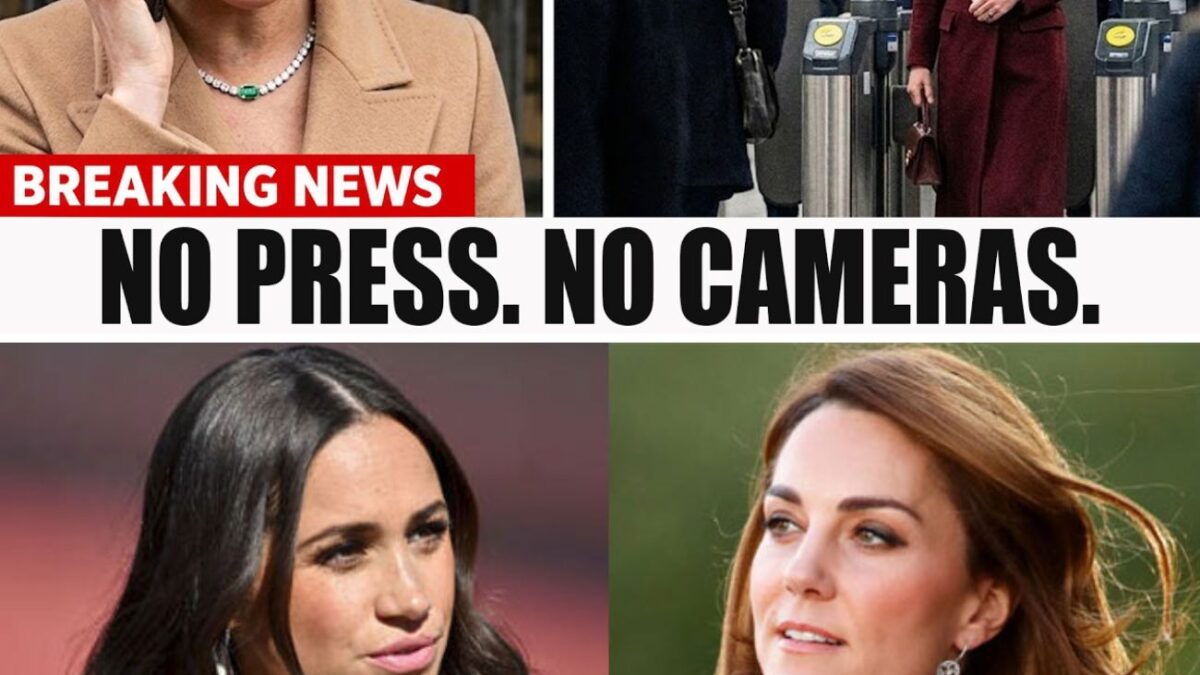
Meghan Markle Under Fire? Catherine and Charlotte’s Alleged Tube Ride Sparks a Royal PR Showdown
Sometimes, the smallest moments create the biggest headlines. In this royal story, it is not a grand balcony appearance, a glittering state banquet, or a carefully choreographed walkabout that captures the imagination. It is a mother and her young daughter, sitting among ordinary passengers on a London train.
According to the supplied account, Catherine, Princess of Wales, took Princess Charlotte on the Elizabeth line without arranging an official photo opportunity. The alleged journey soon became the centerpiece of a much larger debate about royal life, public image, and the increasingly complicated relationship between service and celebrity.
Meghan Markle was drawn into the controversy because of a contrasting set of claims involving a luxury hotel appearance and a lifestyle-brand promotion. The result, as the narrative presents it, was a sharp comparison between two very different approaches to public life.
But was the contrast deliberate, or did commentators turn two separate stories into a royal rivalry?
A quiet journey through London
The story begins on Saturday, October 10, when Catherine and Charlotte allegedly boarded the Elizabeth line and travelled through central London. Instead of being surrounded by photographers, they reportedly sat among everyday commuters, chatted quietly, and made their way towards Tottenham Court Road.
A passenger was said to have recognized them. There was no official announcement, no palace photograph, and no carefully written caption explaining the significance of the outing.
That absence of publicity became part of the story itself.
In the supplied narrative, Catherine’s purpose was simple: to give Charlotte an experience outside the protected routines of royal childhood. For a young girl whose public life is necessarily shaped by security arrangements and family responsibilities, travelling on a busy train would offer something different—a glimpse of the city as millions of people experience it every day.
The account describes Charlotte looking around the carriage with curiosity while Catherine checked her phone and held her daughter’s hand as they left the train. Their security officers were allegedly present but discreet.
The appeal of the scene is easy to understand. There is something deeply relatable about a parent wanting a child to experience an ordinary adventure, away from ceremony and expectations.
Yet the story goes further, suggesting that the journey carried a message about what the monarchy should represent. That interpretation is compelling, but it remains an interpretation rather than proof of Catherine’s private intentions.
The comparison with Meghan Markle
The narrative then shifts to Mayfair, where Meghan Markle was allegedly photographed outside Claridge’s after meeting Nobel Peace Prize laureate Malala Yousafzai.
The script describes Meghan wearing designer clothing and an emerald-and-diamond necklace reportedly valued at more than $21,000. It also alleges that professionally produced photographs appeared days later as part of a lifestyle-brand promotion involving tea, fruit spreads, and clothing.
The contrast is designed to provoke a reaction. On one side is Catherine, supposedly travelling without an official camera crew. On the other is Meghan, whose public image is presented as closely connected to fashion, carefully prepared photographs, and commercial projects.
For critics, such a comparison raises questions about how public figures use their visibility. When charitable causes, personal appearances, and commercial partnerships overlap, audiences may reasonably ask where public service ends and promotion begins.
But the distinction should not be oversimplified. Wearing expensive clothing does not, by itself, prove insincerity, and promoting a commercial product does not automatically invalidate charitable work. The script’s allegations about Meghan’s motives and the timing of the photographs are not independently established facts.
Nor is there verified evidence here that Meghan was furious about Catherine’s alleged journey. The headline’s suggestion of personal anger is a dramatic hook, not a confirmed account of Meghan’s reaction.
A lesson Catherine learned long before becoming a princess
One of the story’s strongest themes is the influence of Catherine’s life before she married Prince William.
The supplied narrative recalls her years living in London, when she reportedly used public transport and worked in the fashion industry before becoming a member of the royal family. Those experiences are presented as a foundation for her approach to motherhood.
The story also invokes Princess Diana, who was known for taking William and Harry beyond the tightly controlled royal environment. Her public outings helped expose her sons to experiences shared by children outside the palace.
The point is not that royal children should be denied security or protection. Rather, it is that protection and ordinary experience do not necessarily have to be opposites.
In the narrative, Catherine carries that philosophy forward by allowing Charlotte to discover the practical details of everyday travel. The train journey becomes a symbol of connection with the people the monarchy represents.
Queen Elizabeth II also features in this theme. The Elizabeth line bears her name, and the late monarch attended its official opening at Paddington in May 2022. The railway therefore offers a fitting backdrop for a story about tradition meeting modern life.
Still, the idea that Catherine deliberately planned the journey as a message to Meghan or to commercial celebrity culture is not substantiated by the material provided.
The ticket that became a symbol
The most sentimental moment in the script involves Charlotte purchasing a ticket herself.
According to the account, Catherine encourages her daughter to handle the transaction rather than completing it for her. Charlotte uses coins, studies the ticket machine, and retrieves the printed ticket after making the payment.
The small achievement becomes a lesson in independence: understanding how a journey works, taking responsibility for a simple task, and experiencing the satisfaction of doing something without assistance.
The script gives the ticket an even more personal role. After leaving the train, Catherine allegedly writes seven words on its reverse: “Your first ticket same as everyone else’s.”
The ticket is said to be kept in a drawer at Adelaide Cottage, preserving a memory that might otherwise have disappeared among the family’s many formal engagements.
There is no independently verified evidence presented here that the ticket or handwritten message exists. Nevertheless, the imagined scene captures the emotional center of the story: the idea that a childhood memory can be more valuable than a carefully produced public image.
For Charlotte, such an experience would not need to become a statement about another member of the family. Its value could lie entirely in the memory itself.
The alleged palace pressure
The supplied script also describes an alleged request from the Sussex camp for Buckingham Palace to promote Harry and Meghan’s planned charitable engagements. It portrays the request as an attempt to secure institutional support and claims that Princess Anne’s office declined a proposed joint appearance because her schedule was full.
These are serious claims about private communications, but the script provides no independently verifiable documentation establishing that the exchanges occurred as described. They should therefore be treated as allegations within the narrative, not confirmed palace events.
The wider question is nevertheless familiar: how should the royal family respond when relatives who no longer undertake official royal duties pursue independent public and commercial projects?
The answer involves boundaries, expectations, and the distinction between private enterprise and institutional endorsement. Official royal channels carry a particular meaning, and any decision to promote an outside project could be interpreted as an endorsement. That does not, however, establish that a specific request was made or rejected in this instance.
What the controversy really reveals
Ultimately, the story works because it turns an ordinary train journey into a debate about competing ideas of public life.
Catherine and Charlotte’s alleged outing represents simplicity, privacy, and the possibility of allowing a royal child to experience the world without turning every moment into a public event. Meghan’s alleged promotional appearance represents a different model, in which fashion, personal branding, and charitable partnerships may intersect.
But the sharpest comparisons can also conceal important differences. Catherine’s role as a working royal is not identical to Meghan’s position outside the institution. Their public obligations, commercial opportunities, and relationships with the monarchy are not interchangeable.
It is therefore premature to treat the alleged journey as a deliberate attack or to conclude that it provoked anger in California.
The enduring message is less explosive but perhaps more meaningful: the smallest experiences can shape a child’s understanding of the world. A train ticket, a crowded platform, and a few minutes spent watching other passengers may teach lessons that no palace ceremony can easily reproduce.
Whether the reported journey happened exactly as described remains unverified. The supposed private messages, ticket inscription, and Meghan’s alleged reaction also lack independent confirmation. What remains is a dramatic royal narrative that invites readers to consider a genuine question: should public life be measured by the image a person presents, or by the values that person demonstrates when nobody is watching?








