MEGHAN MARKLE UNDER FIRE: Did Claridge’s Security Footage Reveal a Secret Paparazzi Setup That MALALA YOUSAFZAI Never Agreed To?
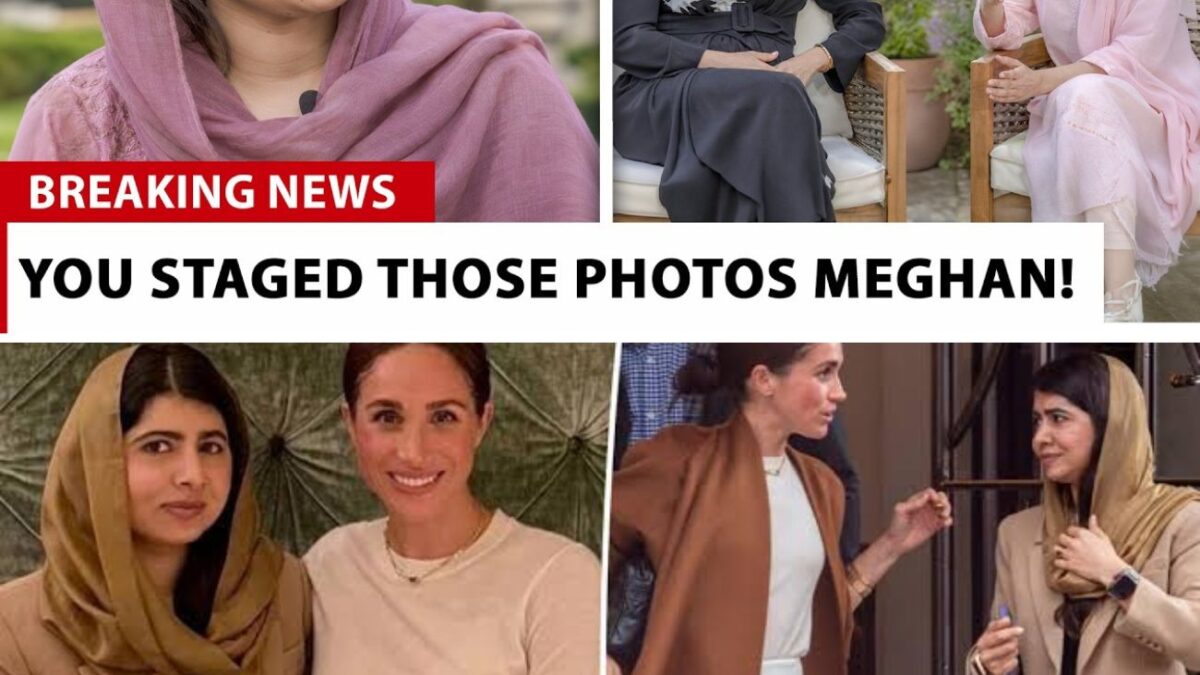
The Claridge’s Controversy: The Question Meghan Markle Couldn’t Easily Answer
A private meeting at one of London’s most prestigious hotels was supposed to be an opportunity for two influential women to connect over issues that mattered to them. Instead, the encounter became the center of a dramatic controversy involving an alleged photographic arrangement, disputed security records, and one question that cut through every explanation.
At the heart of the story were Meghan Markle, the Duchess of Sussex, and Malala Yousafzai, the Nobel Peace Prize laureate whose advocacy for girls’ education has made her an internationally recognized figure.
According to the account circulating about the alleged incident, Malala’s visit to Claridge’s was intended to remain private. Yet the circumstances surrounding the pair’s departure reportedly raised questions about whether the meeting had been turned into a carefully coordinated public-relations opportunity without Malala’s informed agreement.
The most striking moment came when Malala allegedly challenged Meghan directly: if Meghan had not been informed about the photographers, how had she known precisely which exit they were supposed to use?
It was a question that, according to the account, became difficult to separate from the timeline and documentation subsequently examined by the hotel.
A Private Tea Takes an Unexpected Turn
Malala had reportedly traveled from Birmingham for a private tea at Claridge’s. Her team had requested that the hotel arrange a discreet departure through the Davies Street exit shortly after five o’clock.
The request was straightforward. Claridge’s, known for accommodating high-profile guests, had a side entrance designed to help visitors avoid unnecessary attention. According to the account, hotel staff agreed to the arrangement.
However, Meghan allegedly expressed a preference for the main entrance on Brook Street. She reportedly suggested that leaving through the side door might create the impression that the women were trying to escape public attention. She also claimed that the front entrance was clear and that security could manage the departure.
Malala’s aide reiterated the request for Davies Street, pointing out that the hotel had already agreed to hold the exit. Nevertheless, Meghan allegedly repeated her preference for the main entrance.
When Malala herself hesitated and asked whether the cars could be brought around, Meghan reportedly insisted once again that the front would be fine.
A disagreement over a hotel entrance might ordinarily seem insignificant. But the allegation that photographers were already positioned along the proposed route transformed the question into something considerably more serious.
According to the narrative, Malala eventually agreed to leave through the main entrance rather than prolong the disagreement. The pair proceeded through the reading room and toward the Brook Street foyer, with Meghan apparently setting the pace.
A man carrying a compact camera was reportedly waiting in the corridor. Meghan allegedly dismissed the situation as unimportant and encouraged Malala to keep moving.
Outside, several photographers were said to be waiting with long lenses.
When the doors opened, they began taking pictures. The resulting images reportedly included a photograph of the women embracing on the hotel steps.
The images appeared polished rather than accidental, according to the account. For Malala, the concern was not simply that photographs existed. It was whether the circumstances of their creation matched what she had agreed to when accepting the invitation.
A Formal Complaint Changes Everything
Rather than confront the hotel publicly, Malala reportedly chose a more formal approach.
Before midnight, her representative submitted a written complaint to Claridge’s general manager, copying the head of security and the hotel’s legal department.
The complaint allegedly identified the booking, the time of the meeting, the original request for the Davies Street exit, and the presence of a photographer inside the building. It also questioned the coordinated appearance of photographers outside.
Most importantly, the representative requested that relevant surveillance footage, door-access records, and visitor logs be preserved before routine deletion could erase them.
That request reportedly prompted a detailed internal review.
According to the account, the hotel isolated relevant camera recordings and access records, copied the material to a secured drive, and suspended the normal deletion process for the evidence connected with the complaint. Other guests’ privacy was reportedly protected by restricting access to relevant footage and masking unrelated faces.
The hotel also retained an independent solicitor to examine the preserved material under a limited, confidential arrangement.
This distinction mattered. Rather than relying solely on competing recollections, the review reportedly compared the available footage with access records and visitor documentation.
The account claims that a visitor slip recorded a person connected to the photographer, while access logs showed that individuals had entered through a goods passage under visitor authorization associated with Meghan’s London contact.
A vehicle bay on Brook Street had also allegedly been reserved in advance.
According to the narrative, these arrangements had not been requested by Malala’s team, which had asked for the alternative exit.
The reported findings raised a central question: who had organized the arrangements, and who knew about them?
The Alleged Document That Raised More Questions
When Malala reportedly returned to Claridge’s the following morning, the hotel offered her a restricted viewing of relevant footage.
The arrangement was designed to protect the privacy of unrelated guests. The meeting reportedly included the duty manager, the head of security, the retained solicitor, Malala, and her aide. Mobile phones were not permitted on the table.
The footage allegedly showed a photographer arriving before the meeting concluded and testing an angle near the corridor arch. Other recordings reportedly showed a group of photographers arriving outside and taking positions near the entrance.
The account describes a sequence in which the women left the reading room, proceeded toward the main entrance, and emerged onto the pavement, where the photographers began shooting.
It also alleges that the hotel discovered a document left near equipment used by the photographer. The sheet reportedly listed a location, a time window, positions inside and outside the building, and instructions involving an embrace before the cars departed.
Two names or roles were allegedly identified as the principal and the guest, although the account does not establish independently that Meghan personally prepared or approved the document.
A contact number was reportedly traced to a London office associated with Meghan’s photographic arrangements. When the hotel contacted that office, the person answering allegedly did not deny the document’s existence but requested its return.
The manager reportedly refused, treating it as material relevant to the formal complaint.
These details, if accurately represented, would be significant. However, the full document and the underlying security records have not been independently established here, and the allegations should not be mistaken for verified findings of personal wrongdoing.
The Confrontation in the Corridor
The most dramatic exchange allegedly occurred after Malala completed the restricted viewing.
Meghan was reportedly nearby, discussing the incident with hotel staff and suggesting that the situation had been misunderstood.
According to the account, Meghan denied hiring the photographer or knowing about a coordinated schedule. She characterized the photographer as a freelancer who might have acted independently. She also maintained that using the main entrance had been an ordinary decision and that the embrace reflected genuine affection.
Malala, however, reportedly challenged the explanation.
She pointed out that a freelancer could not explain why Meghan had repeatedly discouraged the use of the side exit. The photographer’s presence alone was one issue; the insistence on a particular route was another.
Then came the question that became the defining moment of the alleged confrontation.
“If nobody told you about the cameras, how did you know exactly which door we had to use?”
According to the narrative, Meghan responded by reiterating that the main entrance was the simplest option and that security arrangements had influenced the decision.
Malala allegedly countered that her own team had already arranged the Davies Street exit and that the hotel had agreed to accommodate the request.
The account portrays the exchange as controlled but tense. Malala did not need to raise her voice to make the point: the discrepancy between the requested route and the route ultimately taken required an explanation.
She reportedly rejected the suggestion that friendship alone could resolve the matter, arguing that a private conversation about girls’ education did not require a carefully timed photographic departure.
A Wider Security Concern
The controversy allegedly expanded when the hotel reviewed the unauthorized access connected with the photographer.
According to the account, security personnel discovered that two additional camera operators had entered a private sitting room on an upper floor while Malala was still meeting Meghan.
Neither operator had reportedly received permission to film inside the hotel. Their access was allegedly connected to the same visitor authorization used by the photographer in the corridor.
The manager reportedly ordered filming to stop, revoked the relevant visitor authorization, and had the crew escorted from the restricted area.
The hotel did not confiscate their cameras or memory cards. Instead, the manager allegedly directed any preservation requests through the respective legal departments.
Malala reportedly made her position clear: her image was not automatically available for promotional material simply because she had attended a private meeting.
She intended to add that objection to her written complaint.
She then reportedly left through the Davies Street exit originally requested by her team.
Why the Allegations Matter
The controversy inevitably invites comparisons with earlier public debates involving Meghan and Prince Harry over privacy, photography, and the treatment of public figures.
Their widely publicized New York encounter with photographers in May 2023 generated competing accounts and renewed arguments about celebrity security. However, that controversy does not establish that any alleged photographic arrangement at Claridge’s occurred.
The underlying issue is broader than celebrity gossip. A photograph can suggest friendship, cooperation, or endorsement even when the people pictured have not agreed to participate in a promotional campaign.
For someone such as Malala, whose public work centers on education and the rights of girls, the distinction between choosing to appear publicly and being placed into a potentially misleading image would be particularly important.
If the reported events occurred as described, the concern would not simply be that photographers captured an embrace. It would be whether a guest’s explicitly stated preference had been overridden and whether her presence had been used to create an impression she had not authorized.
At the same time, allegations about a document, visitor records, and an alleged photographic plan require careful verification before responsibility can fairly be assigned to any individual.
The Question That Remained
In the days following the alleged incident, the hotel reportedly retained its records, maintained the revoked visitor authorization, and kept the solicitor’s review confidential. Malala’s representative allegedly reiterated that her image should not be licensed for material associated with the disputed filming.
The photographs themselves could not simply be recalled from every phone or publication. But the question of whether Malala had knowingly agreed to the circumstances behind them remained separate from the images already taken.
According to the account, Meghan’s position continued to be that the meeting was genuine, the departure was ordinary, and any unauthorized activity could be attributed to a freelancer.
Malala’s alleged challenge cut through those competing explanations by returning to one concrete detail: the exit.
If the side door had been arranged, why had the main entrance been insisted upon? If the photographers had been unexpected, why did the route appear to correspond with their reported positions? And if the entire encounter had been spontaneous, what explained the alleged schedule?
Those questions are central to the story, but they are not proof that Meghan personally orchestrated a paparazzi operation. Establishing that would require independently authenticated records and reliable confirmation of the people responsible.
Nevertheless, the alleged confrontation offers a powerful illustration of how quickly a private meeting can become a public controversy when questions of consent, publicity, and trust collide.
The most memorable moment was not necessarily the embrace on the steps or the cameras outside Claridge’s. It was the question reportedly asked afterward, when explanations were no longer enough.
For Malala, the issue was whether a meeting intended to be private had been turned into something else without her agreement.
And that is why the alleged question about the door continues to define the controversy: because sometimes the smallest detail in a carefully arranged public appearance becomes the biggest question of all.








