Meghan Markle’s AGE BOMBSHELL? Alleged Birth Record Sparks Explosive Questions About the Year She Was Born
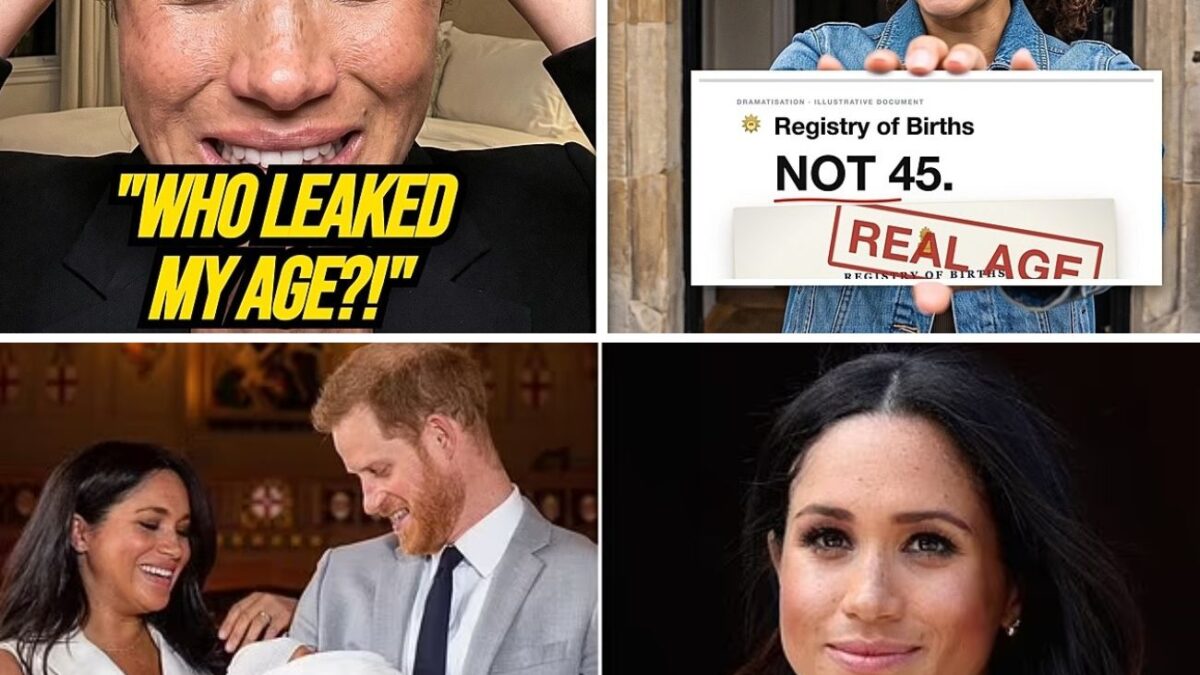
Meghan Markle’s AGE BOMBSHELL? Alleged Birth Record Sparks Explosive Questions About the Year She Was Born
For years, Meghan Markle’s date of birth has appeared to be one of the simplest facts surrounding her public biography. August 4, 1981 has been repeatedly associated with her name, her public profile and major moments in her life.
But a circulating story has now attempted to reopen that question through an alleged family document connected to Lucia Giuliano.
The claim is extraordinary.
According to the narrative, Lucia reportedly shared what she described as a copy of an old birth record kept by her father. The document allegedly contained a date that appeared to conflict with the year generally associated with Meghan Markle.
The reaction was immediate.
The controversy did not begin with a palace announcement or an official investigation. Instead, it reportedly began with a photograph posted online and a series of questions about what the document actually represented.
Lucia allegedly said she was not asking for money, publicity or a commercial opportunity. She wanted one thing: the date.
That simple statement became the center of the controversy.
According to the circulating story, the document was described as a longer-form record containing information that did not appear on another version of a birth certificate. One particular field allegedly listed the mother’s date of birth as August 4, 1974.
That is where the story takes its dramatic turn.
August 4 is also the date publicly associated with Meghan Markle.
The year, however, is different.
The narrative claims that the alleged record showed 1974 while Meghan’s widely reported birth year is 1981.
Supporters of the claim argue that the seven-year difference cannot simply be dismissed because the day and month allegedly remain identical.
Critics, meanwhile, have questioned the authenticity and interpretation of the document, warning that an image circulating online does not by itself establish the truth of what it appears to show.
That distinction is crucial.
Yet the story continued to gather momentum because it attempted to connect the alleged document with other statements and records.
One of the most frequently repeated points in the narrative involves Samantha Markle, Meghan’s older half-sister.
The circulating account revisits an earlier statement attributed to Meghan in which she allegedly described herself as thirteen years younger than Samantha. Commentators then attempted to compare that statement with Samantha’s age and Meghan’s publicly known birth year.
The arithmetic became part of the controversy.
What had previously been treated by some commentators as a possible mistake or inconsistency was suddenly presented as something much more significant.
The story then brought Thomas Markle into the discussion.
As Meghan’s father, Thomas was portrayed in the narrative as someone who would naturally know the circumstances surrounding his daughter’s birth. Yet the script claims that when asked about the disputed year, he did not provide a direct answer.
Instead, the story says he referred the question elsewhere.
That silence was interpreted by commentators as suspicious.
But silence, of course, does not establish proof.
The controversy became even more complicated when the story turned toward Meghan’s children.
The narrative compares the alleged Illinois document with information reportedly associated with California birth records involving Lilibet.
Commentators claimed that certain California records contain maternal information and attempted to compare those details with the alleged older document.
Again, the story presents the contrast as potentially significant.
But different jurisdictions use different forms, fields and procedures, and a comparison between documents does not automatically prove that one record is fraudulent or that a person has misrepresented their identity.
Still, the allegation was powerful enough to create a new wave of speculation.
Then came the detail that reportedly pushed the controversy into another direction.
According to the circulating narrative, the alleged document carried a form designation associated with an older Illinois vital-record format. Supporters of the document argued that the format looked sufficiently specific to suggest that it originated from an actual administrative system rather than being casually created online.
Skeptics responded with an equally important question:
Even if a file number or record format exists, does that prove that every piece of information visible in a photograph is genuine?
That remains unanswered within the story.
The alleged record reportedly disappeared from social media after a privacy complaint, which only intensified speculation.
The removal was interpreted by some commentators as evidence that someone wanted the image gone.
Others saw it simply as a normal privacy-related action involving sensitive personal information.
The difference between those interpretations is enormous.
Yet the drama did not stop there.
The story claims that Meghan’s representatives responded by pointing toward documents that identify her birth date as August 4, 1981. That response was presented by supporters of Meghan as a straightforward reaffirmation of the established record.
Critics, however, argued that it did not directly address the alleged 1974 document.
And that left the central question hanging.
Which document should be believed?
The narrative then turned toward Prince Harry.
According to the script, Harry was allegedly concerned enough by the controversy to seek additional documentation himself.
That detail adds another layer of drama because it transforms the story from an online argument into an alleged family question.
If Harry genuinely wanted clarification, what would the official paperwork reveal?
Would it confirm the publicly accepted year?
Would it expose an administrative error?
Or would the entire controversy collapse once the original records were examined?
Those questions remain the heart of the story.
There is also a deeply personal dimension.
Meghan has spent years building a public identity around her family history, childhood, education and journey into the British royal family. A dispute over something as fundamental as a birth year therefore carries emotional significance far beyond a simple number.
The circulating narrative attempts to suggest that the alleged document could force a complete reconsideration of that history.
But an allegation is not evidence, and a photograph of a document is not necessarily the same thing as an authenticated original.
That distinction matters particularly when the claims involve private birth records and identifiable family members.
For now, the story leaves readers with two competing versions.
On one side is the established public biography identifying Meghan Markle as born on August 4, 1981.
On the other is the alleged document described in the circulating narrative, which supposedly contains August 4, 1974.
Seven years.
One date.
Two radically different stories.
And that is precisely why the controversy has generated so much attention.
The most important question may ultimately be much simpler than the dramatic claims surrounding it.
What does the original official record actually say?
Until an authenticated record from the relevant authority is independently examined and verified, the competing claims remain just that—competing claims.
Yet the mystery has already created another chapter in the long-running fascination surrounding Meghan Markle, her family and the documents behind her public story.
And if the original records are ever conclusively examined, the answer may finally settle a question that has suddenly become far larger than a birthday.
For now, however, the alleged birth record remains at the center of an explosive online controversy—one that has drawn Meghan Markle, Lucia Giuliano, Thomas Markle, Samantha Markle and Prince Harry into a mystery where a single number has become the biggest question of all.








