No Prenup, No Royal Shield: Harry Faces a Brutal 50/50 Battle as Charles Draws the Line
No Prenup, No Royal Shield: Harry Faces a Brutal 50/50 Battle as Charles Draws the Line

The scenario presented in the video begins with an unusually cold image: King Charles attempting to reach out to an old friend, the polar explorer Sir Ranulph Fiennes, only for the call to reportedly go unanswered. On its own, the moment would mean very little. But within this dramatic narrative, it becomes symbolic of a much larger question: if Charles can no longer count on even personal connections, how much emotional energy does he have left for Prince Harry’s increasingly complicated life in America?
The story then turns sharply toward Harry and Meghan Markle, portraying the King as having finally closed the royal purse and treated the Sussexes as private citizens. That premise is especially striking because Harry’s real security dispute with the British government has already been fought in court. In 2025, the Court of Appeal rejected Harry’s challenge concerning his UK security arrangements, while the court emphasized that his concerns did not establish a legal entitlement to the protection he sought.
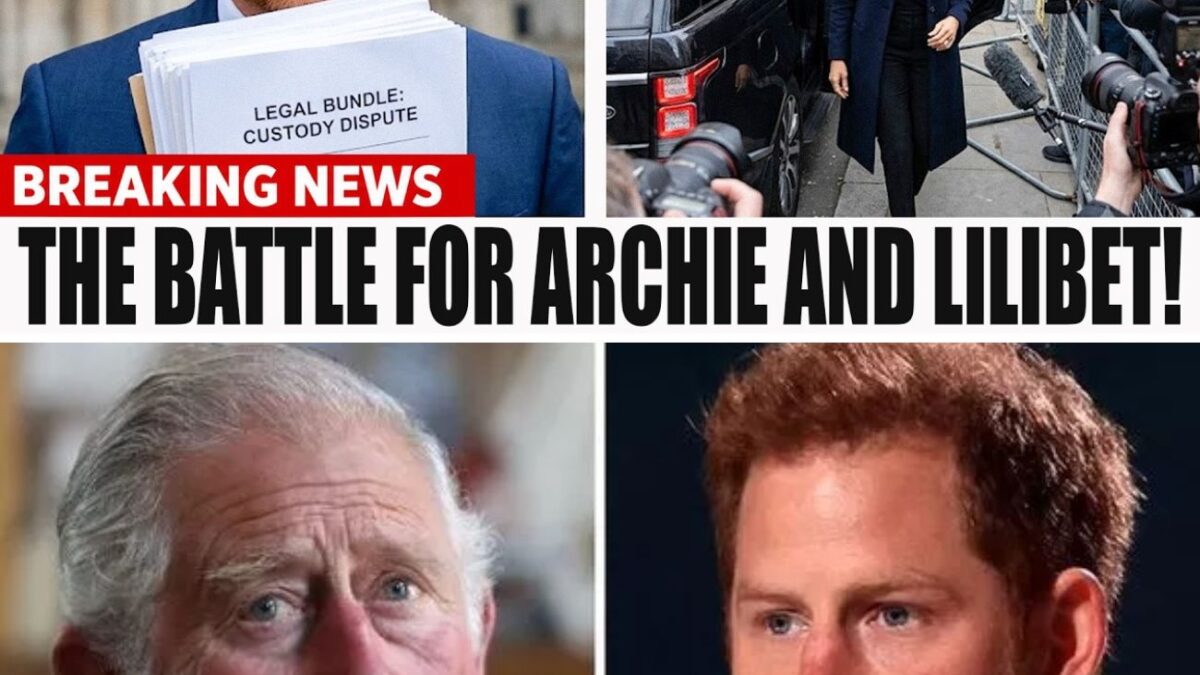
Against that real legal backdrop, the video constructs a far more explosive scenario: Harry and Meghan’s marriage is allegedly approaching a breaking point, while their children, Archie and Lilibet, become central to a looming jurisdictional battle.
The narrative places the children in Britain after the Sussex family returned from California. That element has a real-world basis: Harry and Meghan moved back to Britain in 2026, and their children began attending school there. Their first school was changed after only two days because the family’s security team raised concerns about the practicalities of the journey.
But the video takes that development much further.
According to its storyline, the children’s presence in England is not simply a family decision or educational choice. It is presented as the beginning of a legal clock that could fundamentally alter where a future custody dispute would be heard. The script repeatedly emphasizes the idea that jurisdiction follows the children and suggests that several months of residence in Britain could shift the legal center of gravity toward England.
That is where the story becomes particularly dramatic. Harry is portrayed as quietly establishing a permanent base in Britain while Meghan allegedly remains focused on California and her commercial ambitions. The video depicts the couple as no longer moving together as a single unit, but instead heading toward two separate futures on opposite sides of the Atlantic.
The narrative then reaches back into Harry’s relationship with his late mother, Princess Diana. It presents Diana’s memory as one of the defining forces behind Harry’s decisions, while making the controversial claim that her image has also been repeatedly used within the Sussex commercial story. The script points to Diana-inspired fashion, jewelry and public references before making a much harsher interpretation of their purpose.
Those claims are presented as part of the video’s argument, not as established fact. The central theme is that Harry spent years believing he was escaping the circumstances that surrounded Diana, only to find himself facing another highly public family crisis.
The financial question arrives next, and it provides the title’s most explosive premise: the alleged absence of a prenuptial agreement.
The script claims that Harry and Meghan entered their 2018 marriage without a prenup and then accumulated enormous commercial interests during their years together. It points to Harry’s memoir, production agreements, speaking engagements, podcasts and other ventures, while portraying Meghan’s businesses and commercial projects as equally important pieces of the financial puzzle.
There is one important legal distinction here. California generally treats community property acquired during marriage as jointly owned and, in divorce, community property is generally divided equally, while separate property is treated differently. That does not mean every asset or every dollar associated with either spouse automatically becomes a 50/50 split. The actual classification can depend on when and how property, income and debts were acquired, as well as agreements between spouses.
Yet the video deliberately simplifies that complicated legal landscape into a brutal headline: fifty-fifty.
From there, the story claims that Meghan’s legal advisers were preparing for a powerful financial position when an unexpected development allegedly emerged from Britain. The scenario portrays Harry as having made a pre-emptive move by bringing the children into England and enrolling them in British schools before any formal divorce proceedings.
The video describes this as a calculated legal maneuver, suggesting that Harry was attempting to establish a British jurisdiction before Meghan could control the proceedings from California. It even portrays the move as a carefully prepared strategy involving British legal advisers and constitutional considerations.
That claim should be treated as part of the dramatized storyline. There is no reliable public evidence establishing that Harry secretly engineered such a custody strategy with the specific purpose described in the script.
Then comes the moment the video presents as the decisive royal intervention.
King Charles allegedly signs a letter formally emphasizing that Harry and Meghan are private citizens. In the story, those two words become devastating. Harry is portrayed as discovering that returning to Britain does not automatically mean returning to royal protection, royal financial support or institutional intervention.
The narrative then piles on three consequences: reduced financial secrecy, the cost of private security and the disappearance of royal leverage in a divorce dispute.
The security portion has a real-world foundation. Harry has fought a lengthy legal battle over his UK protection arrangements and lost his Court of Appeal challenge in 2025. But the video transforms that documented legal dispute into a much broader story about Harry being completely isolated from the institution.
The next sequence is visual rather than legal. Harry appears alone at a charity event in Britain, while Meghan is portrayed attending a glamorous Los Angeles gathering without him. The script highlights the absence of Harry’s engagement ring on Meghan’s hand and emphasizes Diana’s Cartier watch, using the details as supposed clues to a fractured marriage.
Again, those interpretations belong to the video’s narrative rather than established evidence.
The story then contrasts the Sussexes with Prince William and Catherine, portraying the future King and Queen as representing stability and continuity. William is depicted as determined to protect the succession and ensure that George’s future remains institutionally secure.
The narrative becomes even darker when it describes the Sussex commercial operation as an “alternative royal court” in California, arguing that its commercial appeal depended heavily on proximity to the monarchy. It claims that without Harry physically beside Meghan and without the children in California, the commercial foundation of that model would weaken dramatically.
Finally, the story reaches the Royal Courts of Justice.
The video imagines an evidentiary bundle containing school records, financial documents, birth registrations and other material that could be examined in a future custody proceeding. Its message is blunt: public relations cannot control a courtroom in the same way they can control a television interview or magazine profile.
That becomes the central metaphor of the entire story. The Sussexes may control their public narrative, the video argues, but they cannot control documentary evidence once a legal dispute reaches court.
The final image is therefore not a screaming confrontation or a dramatic palace announcement. It is paperwork.
Harry, according to the scenario, began by trying to escape the constraints of the monarchy and protect his family on his own terms. Instead, he allegedly finds himself confronting California property law, British jurisdiction, private security costs and the possibility of a future custody battle.
Meghan, meanwhile, is portrayed as facing the financial consequences of a marriage allegedly entered without a prenup and a commercial empire whose value has long been connected to the couple’s royal identity.
The real-world situation remains more complicated than the video’s dramatic conclusion suggests. Harry and Meghan remain publicly together, and recent reporting has focused on their children’s return to British schools and continuing security concerns rather than a confirmed divorce.
But as a piece of royal drama, the scenario leaves readers with one deliberately provocative question: if the Sussex marriage ever did enter a formal legal battle, would the greatest conflict be over money, the children, or the royal identity that neither Harry nor Meghan has ever completely escaped?








