Prince Edward’s HEARTBREAKING Windsor Decision Leaves William Begging Him to Stop — Then He Opens His Father’s Old Leather Case
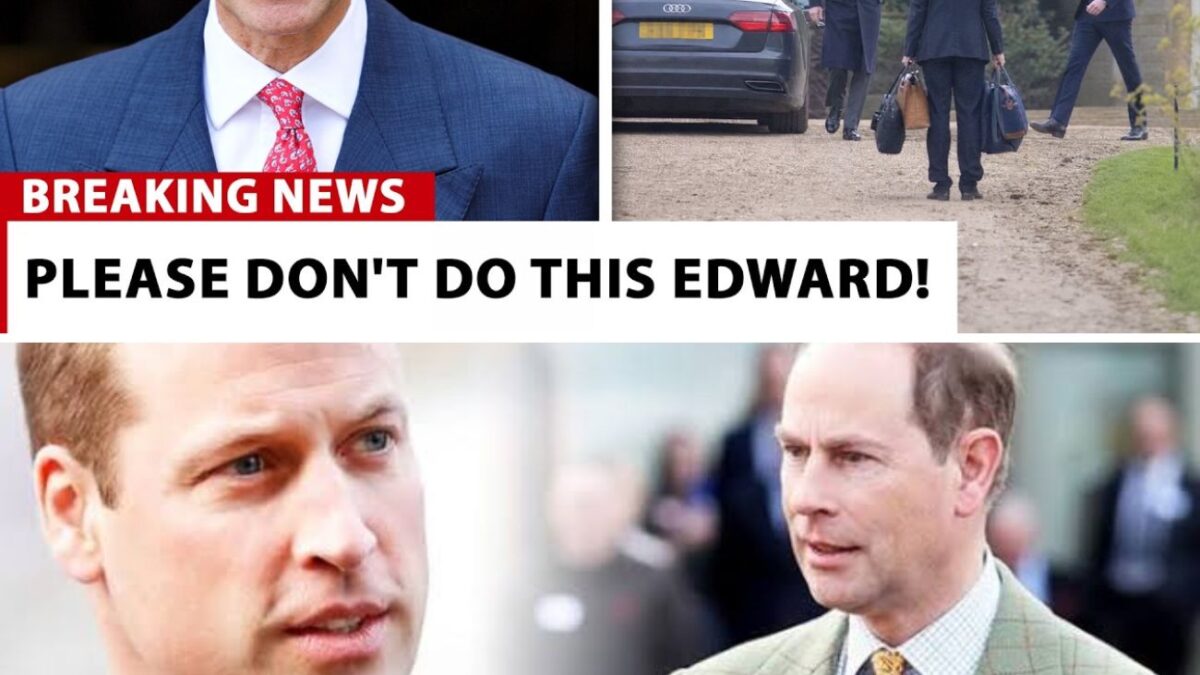
Prince Edward’s HEARTBREAKING Windsor Decision Leaves William Begging Him to Stop — Then He Opens His Father’s Old Leather Case
There are moments in royal life when a decision is announced with ceremony, cameras and carefully prepared statements. And then there are moments when a single sentence leaves an entire room unable to speak.
According to the scenario described in the original script, Prince Edward faced one of those moments at Windsor Castle.
The issue appeared straightforward at first. Prince William’s team was developing a new structure around youth, public service and early childhood development. But there was an awkward problem sitting directly in the middle of that plan: the Duke of Edinburgh’s Award.
For decades, Edward had been closely associated with the organization founded by his father, Prince Philip. He had presented its gold awards, attended ceremonies and carried the same distinctive leather case his father once carried.
Then William’s advisers began considering how the program might fit into a broader youth initiative.
The obvious solution seemed to be moving the royal leadership role toward William.
But William reportedly refused.
He insisted that the award belonged to Edward and that his uncle should keep it.
As far as William was concerned, the matter was settled.
Edward, however, apparently saw the situation differently.
At an award presentation later that summer, a longtime trustee quietly explained the problem to him. William’s new team was building a carefully organized youth strategy, but Edward’s continued role created an awkward overlap.
The trustee did not accuse Edward of blocking William. Quite the opposite.
He reportedly suggested that William would never ask Edward to move aside because William respected him too much.
That was the sentence Edward could not forget.
For a man who had spent much of his royal life avoiding confrontation and never demanding more than his position required, the realization was painful.
He believed he had become an obstacle without anyone ever having the courage to tell him.
So Edward made a decision.
He would step aside.
But there was another person he had not properly consulted.
Sophie.
When Edward returned home to Bagshot Park, he placed Prince Philip’s old leather case on the hallway table.
Sophie immediately knew something was wrong.
The case had been part of their shared royal life for years. She had seen Edward carry it to countless presentations. She had stood beside him through decades of public appearances.
Now he told her he would no longer carry it.
Sophie did not explode.
She did not argue.
Instead, she became silent.
For six days, according to the story, she said almost nothing about the decision. She continued managing the household and behaving normally, but the silence between them became impossible to ignore.
Eventually, Edward found her near the garden gate.
She told him the problem was not the position itself.
It was that he had decided alone.
They had shared those ceremonies for more than twenty years. The award had become part of their life together.
Then Sophie delivered the sentence that reportedly struck Edward hardest:
“Your father gave you that.”
She walked away.
Edward now had another burden to carry.
Before he could announce his decision, he needed to speak with King Charles.
The meeting at Windsor was equally difficult.
Edward told his brother that he intended to surrender the lead royal role so William could build his new structure without having to work around him.
Charles strongly disagreed.
He reminded Edward that their father had given him the responsibility and that Edward had devoted decades to it.
From Charles’s perspective, stepping aside voluntarily looked dangerously close to allowing himself to be pushed out.
Edward disagreed.
He was not being removed, he insisted.
He was choosing to put something down.
Charles reportedly told him that, from the outside, the difference would be almost impossible to see.
Yet he ultimately allowed Edward to make his own decision.
Two days later, William learned about it indirectly.
The irony was painful.
Edward had discovered the pressure through someone else.
William now discovered Edward’s decision through someone else.
William immediately went to Bagshot Park.
When he confronted his uncle, Edward confirmed that he intended to announce the change publicly.
William reportedly pleaded with him not to do it.
He would rather have an incomplete structure for years than take something away from Edward.
But Edward had already decided.
He told William that he knew his nephew would never ask.
That was precisely why he had to do it himself.
Then William remembered something Catherine had told him: don’t ask what a change saves you. Ask what it costs the other person.
That question changed the conversation.
William finally understood that Edward was paying a price far greater than the loss of a title or position.
And still, Edward refused to change his mind.
On Tuesday, he arrived at Windsor carrying his father’s old leather case.
Sophie walked beside him.
Inside the meeting room, William, his advisers, trustees and senior officials were waiting.
Edward placed the case on the table.
Then he announced that he was stepping down from the lead royal role connected to the Duke of Edinburgh’s Award.
William immediately said no.
Edward answered that William was not taking anything from him.
He was giving it.
The emotional confrontation reached its peak when Edward admitted that he knew exactly what the decision had cost him.
Then he opened the case.
Inside was a row of gold award badges.
But underneath the lid was something nobody expected.
A single old badge.
It was Edward’s own gold badge from his younger years, presented personally by Prince Philip.
Edward explained that he had kept it inside the case for years.
His father had once given him a simple instruction: the position was never meant to become a trophy. Edward was only carrying it.
That realization had stayed with him.
If he refused to let go simply because the role mattered to him, then the role was beginning to carry him rather than the other way around.
William was visibly shaken.
But he refused to take the old badge.
Instead, he carefully removed it from the case and walked toward Edward.
He told his uncle that William could take responsibility for the award, but nobody was going to take Edward’s history away from him.
Then William pinned the old badge onto Edward’s lapel.
It was slightly crooked.
Edward stood motionless.
For a man who had spent weeks preparing himself to give something away, receiving something back was almost harder.
Catherine approached and placed a hand on William’s sleeve.
Then King Charles appeared at the doorway.
He had already told Edward that he believed the decision was a mistake.
But now he said nothing.
He simply watched.
Outside, the family walked into the Windsor quadrangle together.
Sophie followed Edward.
For several moments, nobody spoke.
Then she stepped toward her husband and gently straightened the badge on his lapel.
A small laugh escaped her through tears.
And finally she told him, “Now we can go home.”
The story leaves behind an uncomfortable contradiction.
Edward’s decision was selfless because he wanted William to succeed.
But it was also deeply personal, and he had made it without first consulting Sophie.
She was never angry simply because he gave up the position.
She was hurt because the decision belonged to their shared life, yet she had been informed afterward.
In the end, William did not simply inherit a responsibility.
He inherited the weight of what Edward had willingly surrendered.
And Edward did not simply lose a royal role.
He discovered that the legacy his father left him was never truly contained inside a title, a ceremony or a leather case.
It was carried by the people who stood beside him.
For Edward, William and Sophie, that may have been the most painful—and most meaningful—lesson of all.








