Prince William Takes Control as Charles Is Rushed to Hospital — Camilla Stunned by What Happens Before Dawn

Prince William Takes Control as Charles Is Rushed to Hospital — Camilla Stunned by What Happens Before Dawn
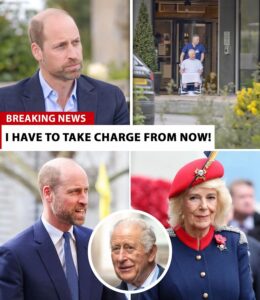
It was supposed to be an ordinary night at Clarence House.
Instead, in this dramatic royal scenario, one medical emergency sends the monarchy into a frantic struggle over information, authority and control.
King Charles had returned home after a long day of private engagements. It was close to 11:40 p.m. when the atmosphere suddenly changed.
According to the story, the King was sitting with two aides when he became pale and disoriented. He struggled to finish a sentence before one aide caught him as he began to collapse. An emergency call was made immediately.
Within minutes, a doctor arrived.
Soon afterwards, the decision was made to take Charles to hospital.
But while the King was being prepared for transport, another drama was unfolding behind the scenes.
The first notification did not go directly to Prince William.
Instead, according to the scenario, a senior figure connected to Camilla’s private office was contacted first.
That detail would later become the center of the entire confrontation.
William was asleep at Adelaide Cottage when his own protection officers noticed unusual activity on secure channels. They realized that something serious was happening before the palace formally informed him.
The future King was therefore learning that his father had been taken seriously ill from his security team.
Not from the palace.
Not from Camilla.
Not from the household.
William reportedly asked only one question.
“Who else knows?”
When he learned that Camilla’s office had already been involved for almost an hour, his reaction was described not as panic but as immediate calculation.
Within nine minutes, he was dressed and on his way to London.
Catherine remained behind with the children, but before William left, she reportedly gave him five words that stayed with him throughout the night:
“Do not let tonight be decided without you.”
At the hospital, Camilla was already waiting.
In the story, she had arrived composed and determined. She wanted the medical briefing coordinated through her office. She also wanted control over the family statement and sought to become the main point of contact for information concerning the King.
To Camilla, this was understandable. She was Charles’s wife and had remained beside him through years of personal difficulty.
But William saw the situation differently.
The moment he arrived shortly after 1 a.m., the atmosphere changed.
He entered through a secure route accompanied only by a small team. There was no large entourage and no media presence.
His first questions were direct.
Where was the King?
Who was with him?
And who had authorized the communications lockdown?
By then, William’s team had reconstructed the timeline.
Calls had gone to private lawyers. Medical information had been concentrated around Camilla’s office. The heir had not been informed through the normal channel.
Individually, each event might have had an innocent explanation.
Together, William regarded them as a serious institutional problem.
He asked Camilla for a private conversation.
The meeting lasted nearly forty minutes.
When the door eventually opened, the communications arrangements had changed.
In the fictional scenario, William ordered the information flow reorganized, with the King’s private secretary reporting directly to him for the immediate crisis response. Government officials received a consolidated briefing, and the Privy Council was placed on standby.
The entire atmosphere of the monarchy appeared to have shifted before sunrise.
Camilla was reportedly stunned.
At one point, she asked to be included in medical consultations.
The response was described as painfully formal.
The medical team, the King’s private secretary and the Prince of Wales would handle the consultations.
Camilla was not the central decision-maker.
That distinction matters constitutionally.
The Regency Act 1937 provides a formal mechanism for a Regency if the Sovereign is declared incapable under the conditions specified by the Act, while the same legislation provides for Counsellors of State in less severe circumstances involving illness or absence. A Regency is not triggered simply because the monarch has been taken to hospital.
That legal reality makes the scenario’s central conflict more complicated than the dramatic claim that William simply “took the throne.”
He did not become King.
He did not automatically become Regent.
But within the story, he became the person coordinating the immediate institutional response.
And that distinction became increasingly important.
The following hours were not filled with public arguments. They were filled with administrative changes.
Reporting lines were reviewed.
Briefings were redirected.
People who had previously worked closely with Camilla suddenly found themselves dealing with different offices.
The transformation was quiet.
No dramatic dismissal.
No public announcement.
Just paperwork.
Meanwhile, Prince Harry was reportedly not informed through the main palace chain either.
That detail added another layer to the family tension.
William’s priority, according to the narrative, was institutional stability rather than repairing old family wounds.
Then came the quietest moment of the night.
By early morning, Charles was conscious.
William entered the room alone.
There was no confrontation.
No shouting.
No accusation.
He simply told his father that the government had been informed, that the institution was secure and that arrangements were under control.
Charles listened.
Then he gave his son two words:
“Carry on.”
The phrase became the emotional center of the story.
It was not an abdication.
It was not a formal transfer of the Crown.
But within the narrative, it sounded like something else: trust.
While William handled the institutional response, Catherine was working on another front.
Communications.
She reportedly reviewed the eventual palace statement and favored saying as little as possible.
The final statement was deliberately brief.
Twenty-three words.
No detailed medical explanation.
No dramatic description of what had happened.
No invitation for speculation.
The silence itself became the message.
And for Camilla, the days that followed were uncomfortable.
Officially, her position had not changed.
She remained Queen Consort.
Yet the story portrayed her access and influence as gradually narrowing.
Meetings changed.
Schedules shifted.
Information increasingly passed through William’s office.
The transformation was subtle enough to avoid a public rupture but significant enough to be felt inside the palace.
Still, the most important question remained unanswered.
What would happen when Charles recovered?
Would the old arrangement return?
Or had the crisis exposed a new reality?
The fictional account suggests that William’s role continued expanding even after the immediate emergency had passed.
He received briefings.
He chaired meetings.
He became increasingly involved in matters previously handled directly by the sovereign.
But none of this should be confused with a formal change of monarchy.
The Crown had not officially passed.
Charles remained King.
The Regency had not automatically begun.
What had changed was the perception of who could step forward when the institution was suddenly forced into uncertainty.
That is what made the hospital night so dramatic.
It was not simply about Charles being taken away in an ambulance.
It was about what happened in the empty space left behind.
Camilla believed she could protect her husband and manage the situation.
William believed the heir had to be at the center of the response.
Catherine urged him not to allow decisions to be made without him.
And Charles, weakened but conscious, ultimately told his son to carry on.
By dawn, the monarchy in this fictional scenario looked different.
No coronation had taken place.
No throne had changed hands.
No formal announcement declared a new ruler.
Yet inside the palace, a new balance appeared to have emerged.
And that is why the most explosive part of the story was never the hospital itself.
It was the question of what happened after William walked through those doors.
Because once an heir discovers that he can take responsibility during a crisis, everyone around him begins to see him differently.
Including the King.
Including Camilla.
And perhaps most importantly, William himself.








