PRINCE WILLIAM’S BRUTAL ROYAL MOVE? Harry’s Explosive Interview Fuels Reconciliation Fears as a Family Rift Reaches Breaking Point
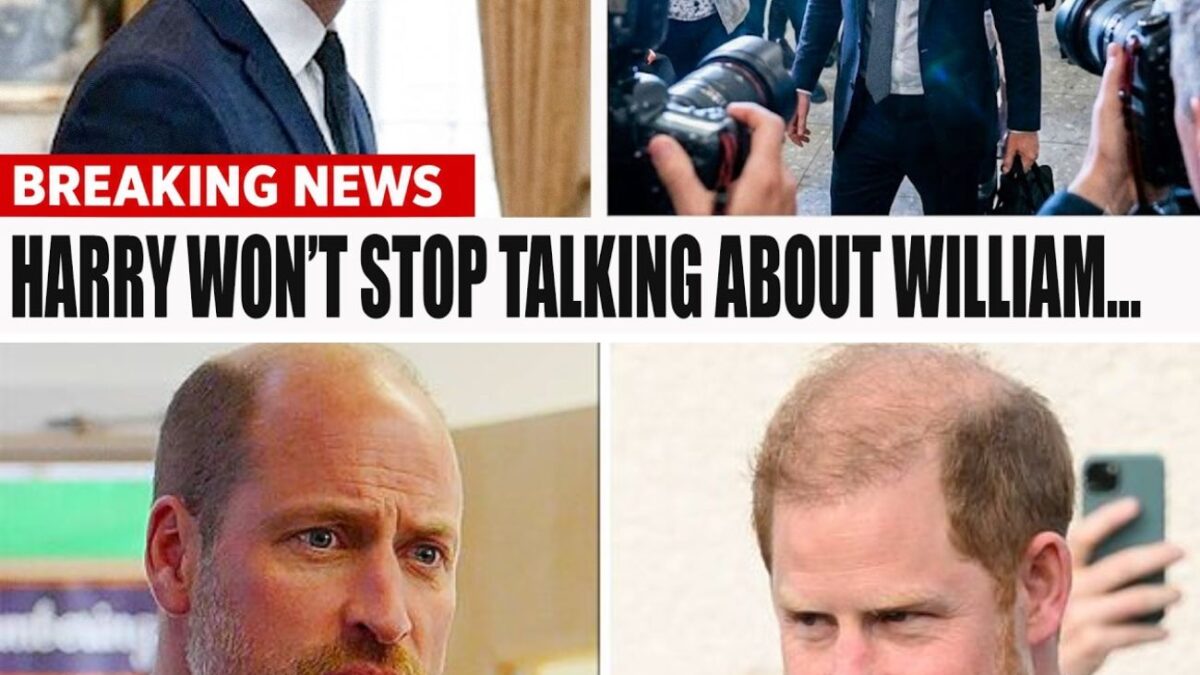
Prince William’s Alleged Hard-Line Response to Harry’s Explosive Interview: Is Royal Reconciliation Slipping Away?
An Interview That Reopens Old Wounds
The story begins with a question that has followed the British royal family for years: can Prince Harry and Prince William ever repair their fractured relationship?
In the supplied narrative, a lengthy interview with GQ becomes the latest flashpoint. Journalist Zack Baron is portrayed as asking Harry about the emotional impact of his mother Diana’s death and King Charles’s reported cancer diagnosis. The script describes Harry pausing before responding that his father is getting better.
That moment is presented as the turning point. Critics within the story interpret Harry’s response as emotionally distant, while the narrative contrasts his interview with the demanding public responsibilities facing Charles and William at Windsor Castle.
But a crucial distinction matters: an edited description of an interview cannot establish someone’s private emotions or intentions. Nor does a brief response, without its complete context, prove that a son lacks concern for an ill parent.
Nevertheless, the scenario builds its central conflict around the possibility that Harry’s attempt to explain himself publicly could have the opposite effect, making reconciliation appear even harder to achieve.
Family Grievances Meet Public Duty
The next section portrays Harry as increasingly confrontational when discussing his older brother. According to the script, he questions the expectations placed upon him and suggests that the public remembers an earlier version of him rather than accepting the person he has become.
The narrative interprets these remarks as resentment toward William’s position as heir to the throne. It also suggests that Harry’s references to his children’s upbringing could be understood as indirect criticism of William and Catherine’s approach to raising Prince George, Princess Charlotte, and Prince Louis.
Those interpretations are part of the script’s dramatic framing, not verified evidence of Harry’s motives.
The story then shifts from family relationships to national responsibility. Charles and William are depicted attending a diplomatic meeting with Oman’s Sultan Haitham bin Tariq, with the Strait of Hormuz and energy security presented as matters of major public concern.
The contrast is designed to intensify the controversy: one brother is shown participating in royal duties while the other discusses private grievances before an international audience.
Yet the timing and significance of the alleged events require independent confirmation. The video’s suggestion that Harry deliberately scheduled an interview to overshadow diplomacy should not be accepted as fact without reliable evidence.
Diana’s Legacy and Two Different Paths
The narrative reaches further back, to September 1997, when William and Harry walked behind their mother’s coffin during her funeral.
Both princes experienced a devastating loss, but the script imagines them drawing different lessons from it. William is portrayed as believing that personal suffering should remain separate from the institution he may one day lead. Harry, by contrast, is accused by the narrator of discussing family experiences publicly in ways that expose painful private history.
That is a powerful emotional contrast, but it is also a simplified one. Grief does not follow a single path, and speaking publicly about bereavement does not automatically mean someone is exploiting it.
The story also acknowledges Charles’s role in raising his sons after Diana’s death. It presents William as deeply conscious of his father’s efforts and suggests that this history would make any perceived disrespect toward Charles especially painful.
The underlying question is more complicated than the script’s accusations suggest: how can members of a famous family protect personal relationships when their experiences are also subjects of intense public attention?
For William and Harry, the challenge is not merely whether they agree about the past. It is whether they can find a way to communicate without turning every disagreement into another public confrontation.
The Alleged Strategy Behind the Interview
In the video’s next major turn, the interview is portrayed as part of a carefully coordinated effort to bring Harry back into the royal family’s orbit.
The script alleges that advisers hoped to present him as a peacemaker, using talk of family unity and his children’s potential connection to Britain to encourage Charles and William to meet with him.
It further claims that public appearances and media coverage could create pressure on the palace: a reunion might generate positive headlines, while a refusal could be interpreted by critics as a lack of compassion.
These are serious claims about the intentions of Harry and his advisers, but the supplied material does not provide independently verified documentation establishing such a plan.
The narrative then introduces an alleged financial and legal crisis, linking it to Harry’s litigation against Associated Newspapers, publisher of the Daily Mail. It presents a specific court ruling and a large interim legal payment as the hidden explanation for the interview.
Those details should not be repeated as confirmed findings without checking the relevant judgment and reliable reporting. The script’s figures and descriptions of the legal outcome require particular scrutiny.
Still, the dramatic theory is clear: the narrator suggests that Harry needed renewed royal association at a moment of commercial uncertainty. In this interpretation, reconciliation becomes not only an emotional question but also a matter of public reputation and financial pressure.
The difference between a plausible theory and a proven motive, however, is substantial. Financial difficulties, even if documented, would not by themselves establish that a family reunion was being pursued for commercial gain.
William’s Supposed Three-Part Response
The title’s promise of a “brutal move” comes into focus here. The video alleges that William responded not with a public argument but with quiet institutional measures.
First, the script claims that informal communication would be replaced by formal written channels. Second, it alleges that Harry and Meghan would be excluded from a family Christmas gathering and face stricter conditions for stays on royal property. Third, it suggests that advisers would prepare a legal framework concerning Harry’s dukedom.
The proposed measures are presented as a calculated effort to prevent private disagreements from becoming further public disputes.
But the distinction between a dramatic scenario and constitutional reality is essential. William is not the reigning monarch, and a future king cannot simply remove a peerage by personal decree. Formal changes to a dukedom would involve the relevant constitutional and legal processes, including Parliament where applicable.
The script’s suggestion that William had already implemented all three measures should therefore be treated as unverified. No reader should confuse the narrator’s imagined behind-the-scenes decisions with an official palace announcement.
Even so, the theme of the sequence is unmistakable: the story imagines William choosing boundaries and institutional procedure over emotional confrontation.
The Power of Silence
The video’s most cinematic moment comes during a supposed public appearance at Windsor Castle. Reporters are imagined asking William about his brother’s interview and whether reconciliation remains possible.
Rather than responding, William allegedly offers a shrug and continues walking.
The narrator interprets the gesture as indifference, arguing that refusing to engage can be more powerful than issuing a rebuttal. In the story, Harry expects a public reaction but receives silence instead.
That scene works as a symbol, whether or not the alleged exchange occurred. Public disputes often become harder to resolve when every remark invites a counterstatement and every silence is interpreted as evidence of hostility.
Yet a facial expression or brief gesture cannot reliably reveal what someone feels. Without authenticated footage and context, the alleged Windsor encounter should not be presented as a confirmed turning point.
Backlash, Titles, and an Imagined Final Break
The final sections describe a supposed public-relations crisis, with the Sussexes facing criticism and potential commercial consequences. The narrator claims that advisers attempted to defend Harry’s remarks, while professional relationships and business opportunities supposedly came under pressure.
The story then escalates to an alleged administrative removal of Harry’s remaining royal responsibilities and a formal communication arrangement involving lawyers. It ends with William, Catherine, and their children appearing together, a visual contrast intended to represent continuity and stability.
These claims about specific resignations, financial consequences, official records, and legal correspondence need independent evidence. The script does not establish that the sweeping institutional changes it describes actually took place.
Its final image is nevertheless clear: William represents the future of the monarchy, while Harry is portrayed as increasingly distant from the institution in which he grew up.
Is Reconciliation Still Possible?
The story closes by framing the brothers’ conflict as a struggle between public duty and personal grievance. William’s imagined response is discipline and silence; Harry’s is continued public explanation.
But real reconciliation rarely depends on one interview or one gesture. It requires trust, privacy, honest communication, and a willingness to acknowledge hurt without demanding that the other person surrender first.
The supplied script offers a dramatic vision of a royal door closing. It does not, on its own, prove that William has made an irreversible decision, that Harry’s titles are about to be removed, or that the brothers will never reconcile.
For now, the most important question is not whether a dramatic headline can declare the family feud over. It is whether the people involved can find a path forward beyond the public spectacle.
Until the central allegations are independently confirmed, the story is best understood as a dramatic account of royal tensions—not a verified report of a final royal severance.








