PRINCESS ANNE BREAKS DOWN IN TEARS: The Heartbreaking News About Catherine That Could Change the Royal Family Forever
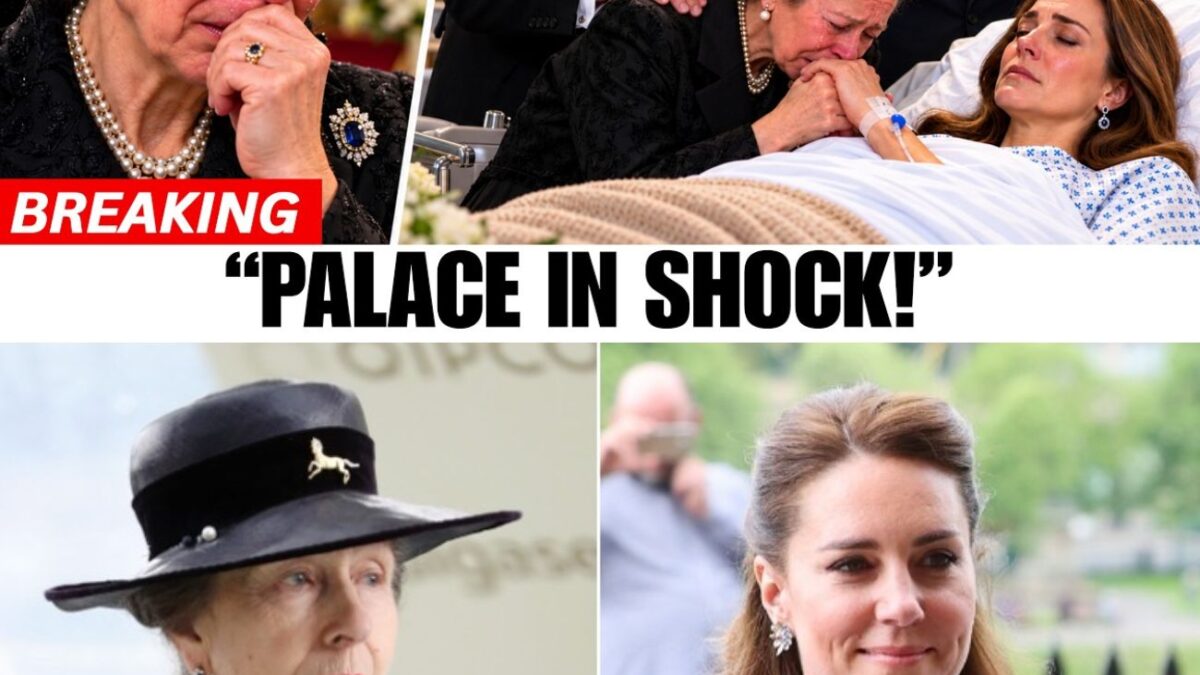
Princess Anne Breaks Down in Tears: The Heartbreaking News About Catherine That Could Change the Royal Family Forever

For decades, Princess Anne has represented discipline, resilience, and an almost extraordinary ability to keep her emotions private. Through family upheavals, public scandals, personal disappointments, and the relentless demands of royal life, she has cultivated a reputation as the woman who simply carries on. But in this imagined account, one sealed envelope brings her to a breaking point—and the person at the centre of her distress is Catherine, Princess of Wales.
The story begins in the quiet of Anne’s private sitting room. An envelope arrives, carrying information intended for a very small circle of trusted people. Anne studies the handwriting before opening it. At first, she reads the contents quickly, expecting an ordinary briefing. Then a particular passage makes her stop.
She returns to the beginning and reads every line again.
The letter describes a serious health crisis involving Catherine, suggesting that her recovery and future responsibilities may be more complicated than the family had hoped. The wording is clinical and direct, leaving little room for comforting assumptions. In this fictional scenario, Anne realises that the situation may require difficult decisions about treatment, public engagements, and the balance between royal duty and personal well-being.
For a woman accustomed to confronting problems without hesitation, the revelation is devastating.
Anne lowers herself into a chair beside the window. Her hands tremble as she presses the letter against her knees, and tears begin to fall. There are no cameras, no formal statement, and no audience expecting her to maintain a composed expression. For once, she allows herself to experience the fear she would ordinarily keep hidden.
What makes the moment so powerful is not simply the possibility of bad news. It is Anne’s realisation that someone she loves may be struggling beneath the weight of expectations that few people outside the palace could fully understand.
Yet she does not immediately summon her staff or arrange a public response. She sits quietly, gathers herself, folds the letter, and places it inside her jacket. Her instinct is still to act. But before she can do anything, she must understand what the news means—and who else knows about it.
A family united by duty
To understand Anne’s reaction, the imagined story looks back at the relationship she has developed with Catherine.
The two women occupy different positions within the royal hierarchy, but they share an understanding of responsibility. Both have had to navigate public expectations while protecting their private lives. Catherine entered the royal family under extraordinary scrutiny, with every appearance, expression, and decision examined by observers eager to interpret what they saw.
In this telling, Anne notices something beyond Catherine’s public smile. She sees a woman who learns the demands of the institution, fulfils her responsibilities, and raises three children while trying to maintain a sense of normality.
Their bond is not portrayed as dramatic or sentimental. Instead, it grows through quiet conversations, shared experiences, and a mutual respect for hard work. Catherine does not need to compete with Anne or imitate her. She earns her respect by taking her responsibilities seriously while remaining attentive to her family.
That connection makes the letter especially painful.
A second piece of information soon reaches Anne: knowledge of Catherine’s fictional medical situation has been restricted to a small circle. The intention, according to the story, is to protect the family from outside speculation. But Anne begins to question whether secrecy has created a different problem.
Prince William, she learns, has been carrying much of the emotional burden himself.
He is trying to support his wife, protect their children, manage royal commitments, and navigate the uncertainty surrounding Catherine’s future. In his determination to spare others unnecessary worry, he has become increasingly isolated.
Anne recognises a familiar pattern. Within a family trained to remain composed, silence can be mistaken for strength. People hide their fears because they believe doing so will protect the people they love. Eventually, however, that silence becomes another burden.
The conversation Catherine never expected
In the imagined account, Anne decides not to wait for a carefully arranged meeting. She goes to see Catherine privately, leaving formalities behind.
Catherine initially responds with the reassuring phrases she has learned to use whenever concern threatens to overwhelm a conversation. She explains that she is following medical advice, that a plan is in place, and that everyone should try not to worry.
Anne listens without interrupting. She notices the effort required to maintain that calm expression.
Then she reaches for Catherine’s hand.
“You do not have to be brave with me,” Anne tells her. “I am not the public. I am your family.”
The words change the atmosphere in the room. Catherine no longer needs to perform reassurance for someone who understands the demands of royal life. Her composure begins to fade, allowing the fear and exhaustion beneath it to emerge.
The scene is not about Anne finding a solution to a medical crisis. She cannot promise an outcome, and she cannot make uncertainty disappear. What she can offer is something more immediate: a place where Catherine does not have to pretend that everything is fine.
For Anne, that is the beginning of a different kind of responsibility—not managing appearances, but making sure the person at the centre of the crisis does not feel alone.
Anne confronts Prince William
Her next conversation is with William, and it is far less gentle.
Anne tells him that protecting his family does not mean keeping every difficult truth to himself. She understands why he wants to shield his wife and children from unnecessary distress, but she warns that refusing support can leave everyone struggling separately.
William explains that he wants to prevent further anxiety. He has been trying to hold the situation together, believing that if he manages enough details, he can spare his family some of the uncertainty.
Anne challenges that assumption.
Silence, she argues, does not remove pain. It merely leaves people to face it without the support they need. George, Charlotte, and Louis may be young, but the atmosphere around them matters. Their parents cannot eliminate every difficulty, yet they can show their children what it means for a family to face uncertainty together.
Then Anne asks William a question he has not expected.
“Who is carrying you?”
For a moment, he has no answer.
The question forces him to acknowledge that he, too, is frightened. His concern for Catherine has become so consuming that he has given little thought to his own emotional needs. Anne reminds him that he does not have to choose between being a devoted husband and accepting help from others.
Their conversation becomes a turning point. Instead of treating every decision as his personal responsibility, William begins to involve trusted family members and make space for honest discussions.
King Charles and the choice between duty and health
Anne also speaks privately with her brother, King Charles. In this fictional narrative, she urges him to place family unity ahead of appearances and give William the freedom to concentrate on his wife and children.
The monarchy has endured generations of upheaval, Anne reminds him. A revised schedule or postponed engagement is not a catastrophe. The family’s strength should not be measured by how convincingly it maintains a public routine during a difficult period.
Catherine, meanwhile, faces the emotional challenge of accepting that her responsibilities may need to change. She worries about speculation and the uncertainty that could follow a reduction in public engagements.
Anne’s response is direct: no royal appearance is more important than Catherine’s health. The institution can adjust its calendar. What matters most is that Catherine receives appropriate care and has the time and support she needs.
Gradually, the family begins to move away from secrecy and towards a clearer support system. The fictional medical update that follows offers cautious hope, not a miraculous resolution. Catherine’s recovery remains uncertain, but a plan is in place, trusted people understand what is needed, and decisions no longer depend on one person carrying everything alone.
The meaning behind Anne’s tears
In the weeks that follow, the imagined story describes late-night conversations between Anne and Catherine, more open discussions involving William, and a renewed determination within the family to support one another away from public scrutiny.
Anne’s tears become a symbol of something she has rarely allowed herself to demonstrate: vulnerability does not cancel out strength.
William learns that love cannot guarantee control over every outcome. Charles is reminded that stability means more than appearances. Catherine discovers that accepting support is not a failure of courage.
And Anne, the woman long associated with unwavering resolve, learns that even the strongest person in a family needs somewhere to set down the weight.
The story closes not with a dramatic announcement or a sudden cure, but with a quieter image: Catherine surrounded by people who care for her, while titles, schedules, and public expectations recede into the background.
The central message is simple. No family can promise that life will always unfold as planned. But honesty, compassion, and shared responsibility can make uncertainty less lonely.
In this imagined royal drama, the most important moment is not the letter itself. It is what Anne chooses to do after reading it: stop pretending that strength means standing alone, and remind the people she loves that they are allowed to lean on one another.








