Princess Anne BREAKS Her Silence on Diana’s Funeral Bombshell — Charles Spencer’s Memoir Sends the Palace Into Crisis
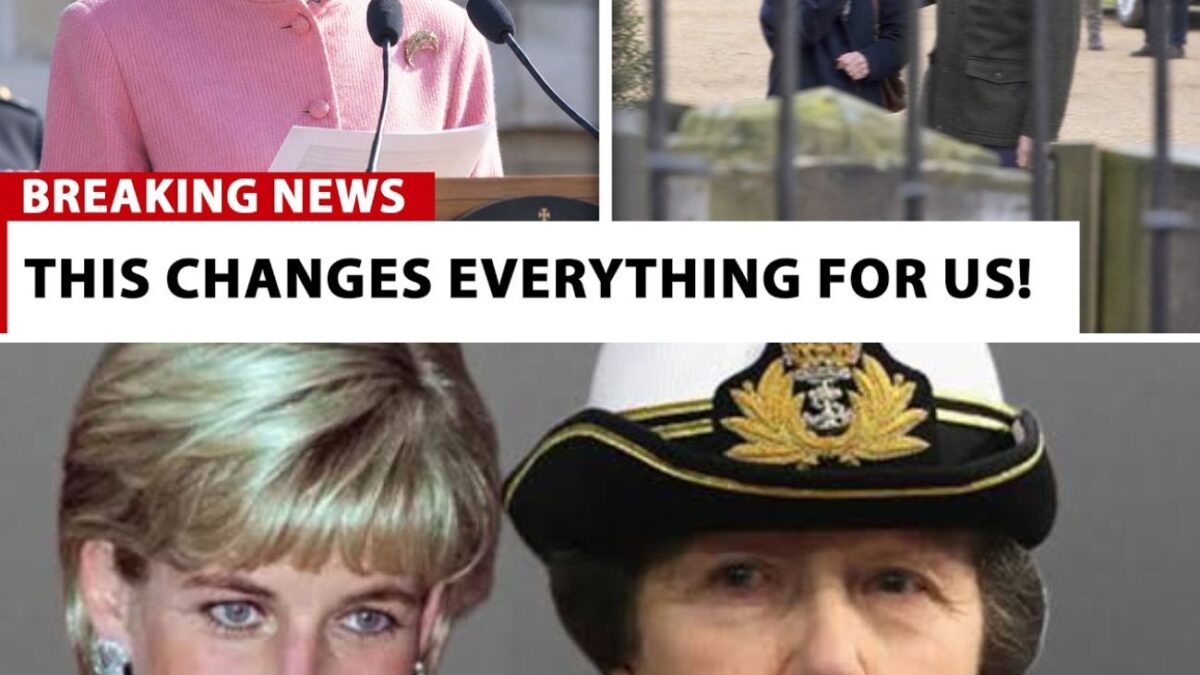
Princess Anne BREAKS Her Silence on Diana’s Funeral Bombshell — Charles Spencer’s Memoir Sends the Palace Into Crisis
The story surrounding Diana, Princess of Wales, has never truly disappeared. Nearly three decades after her death, memories of her marriage, her divorce, her funeral and the treatment of her sons remain some of the most sensitive subjects connected to the British royal family.
Now, according to the scenario described in the supplied script, Charles Spencer’s alleged memoir Swan Song: Diana, My Sister has reopened those wounds in a particularly explosive way. The controversy is not simply about what Spencer allegedly wrote about his sister. It is about how the Palace reportedly responded—and why Princess Anne has suddenly become central to the discussion.
According to the script, Spencer’s book contains deeply damaging allegations about the final years of Diana’s marriage and the events surrounding her funeral. One of the most controversial claims concerns a conversation between Prince Charles and Diana shortly before their 1981 wedding.
Spencer allegedly writes that Charles told Diana he was happy to marry her but was not in love with her. The timing makes the claim particularly painful: according to the account, it happened the night before Diana walked down the aisle at St. Paul’s Cathedral.
The memoir allegedly goes even further.
Spencer reportedly describes a telephone conversation following Diana’s death in Paris in which Charles sounded, in Spencer’s characterization, strangely exhilarated. He also revisits the devastating decision that placed 15-year-old William and 12-year-old Harry behind their mother’s coffin as it moved through London.
Spencer reportedly objected to the boys taking part in the procession, arguing that they were too young to carry such an enormous public burden. According to the account, Prince Philip intervened and helped make the procession possible.
But perhaps the most intriguing allegation concerns something far quieter: music.
The script claims that Diana had specifically requested Mozart’s Requiem for her funeral, but that the Palace ultimately replaced it with Verdi’s Requiem. The official order of service contained Verdi, Elton John’s Candle in the Wind and several hymns.
That missing piece of music has become symbolic in the story.
The question is no longer simply what music was played. It is whether Diana’s wishes were overridden because the funeral had become a carefully managed royal event rather than a private family farewell.
And this is where the Palace’s alleged response becomes controversial.
According to the supplied script, instead of directly disputing Spencer’s individual claims, the Palace responded with a statement suggesting that grief can affect judgment and memory, even many years after a traumatic loss.
Critics interpreted that as something more calculated than a straightforward denial.
They argued that the response did not say Spencer was lying. It did not provide transcripts contradicting him. It did not systematically challenge every allegation. Instead, it questioned the reliability of the person telling the story.
That distinction has become one of the most explosive elements of the controversy.
And standing quietly in the middle of it all is Princess Anne.
Anne occupies a unique position. She was an adult when Charles married Diana. She witnessed the breakdown of the marriage, the divorce and the aftermath of Diana’s death. She was also present during the extraordinary public mourning of 1997.
Yet she has rarely spoken extensively about Diana.
That silence is precisely why her alleged involvement in the Palace discussions has attracted so much attention.
According to the scenario in the script, three positions emerged as officials considered how to respond to Spencer’s memoir. One favored a detailed rebuttal. Another wanted complete silence, following the traditional royal philosophy of never complaining and never explaining. The third reportedly argued that some of the allegations might be true and that the appropriate response to painful truth was not necessarily another carefully constructed denial.
Anne was allegedly associated with that third position.
The script portrays her as someone who believes institutions eventually have to admit when they got something wrong.
That interpretation is reinforced by another episode referenced in the story: Anne’s comments about her father’s death and her mother’s experience of grief during the pandemic. She reportedly acknowledged that circumstances had prevented Queen Elizabeth II from mourning in the way she might have wanted.
That matters because it suggests Anne is capable of acknowledging institutional imperfections without turning the admission into a public rebellion.
Then comes the most painful issue: William and Harry.
They were children when they walked behind Diana’s coffin through London, surrounded by crowds and watched by millions. Harry later spoke publicly about how disturbing the experience had been, questioning whether any child should have been expected to endure such a spectacle.
William rarely discusses the experience directly, but his approach to protecting his own children has often been interpreted through the lens of what happened to him.
George, Charlotte and Louis have grown up under significantly greater boundaries around their privacy.
The script argues that William’s parenting choices are, in part, his answer to 1997.
He knows what it feels like to be a child grieving inside a global spotlight.
And that is why Spencer’s allegations resonate so strongly. Even if every detail of his account remains disputed, the underlying emotional question is difficult to escape: should two young boys really have been required to walk behind their mother’s coffin while the world watched?
The story then returns to Queen Elizabeth II.
According to Spencer’s account as presented in the script, after his famous eulogy for Diana at Westminster Abbey, the Queen privately told him, “It was his sister’s funeral.”
Those words carry extraordinary weight because they represented a recognition that, for one moment, grief had to come before institutional protocol.
The contrast with the Palace’s later language about memory is striking.
One response sounds personal and compassionate. The other sounds institutional and defensive.
That contrast has become the emotional heart of the controversy.
The supplied scenario claims Anne understood this difference and reportedly argued for an apology rather than another rebuttal. Not an apology for the entire history of Charles and Diana, but for specific decisions surrounding the funeral: asking two children to walk behind their mother’s coffin, allegedly overriding Diana’s wishes about music, and allowing silence to dominate the story for decades.
There is, however, an important distinction between those reported claims and established fact. The script itself acknowledges that the alleged conversations involving Anne are accounts rather than publicly released transcripts.
That makes the controversy even more intriguing.
If Anne truly argued for an apology, why was that position allegedly rejected?
The answer suggested by the story is institutional risk.
A Palace statement acknowledging that a decision made in 1997 was wrong would become part of the permanent historical record. It could attach responsibility to people who were involved and reopen questions about decisions surrounding Diana’s funeral.
A statement about memory, by comparison, creates no direct admission.
It is safer.
But safety is not necessarily the same thing as truth.
The monarchy is also operating with fewer senior working royals than it once had. Queen Elizabeth II and Prince Philip are gone. Prince Andrew no longer performs official duties. Harry and Meghan have stepped away from royal life. King Charles has faced serious health challenges, while William and Catherine have carried increasing responsibilities.
Against that backdrop, Anne’s importance becomes even more obvious.
She has spent decades quietly working for the institution, often without the drama or attention surrounding other members of the family.
The script points to her brief absence following her 2024 horse-riding accident as evidence of how quickly the royal schedule can become strained when one of its most dependable workers is forced to step back.
That is why her alleged position on Diana’s legacy matters.
She is not portrayed as an outsider attacking the monarchy.
She is portrayed as someone inside the institution asking whether the institution can finally tell the truth about one of its most painful chapters.
And perhaps that is why the controversy refuses to disappear.
The front pages eventually move on. Another royal story replaces the previous one. But the fundamental questions remain.
Was Diana’s funeral entirely what the Palace said it was?
Were her wishes fully respected?
Were William and Harry protected—or were they asked to perform a public role because the moment demanded it?
And after almost thirty years, does silence still protect the royal family, or does it simply allow someone else to define its history?
According to the scenario presented here, Princess Anne may be the person capable of confronting those questions without turning them into another royal war.
Her power would not come from a dramatic press conference or an angry statement.
It would come from something much simpler.
The willingness to say that an institution can get things wrong.
For a family whose history is so often preserved in official statements, carefully chosen photographs and carefully guarded archives, that could be more powerful than any explosive accusation.
The most haunting detail remains the missing name on the funeral music story—the alleged request that never appeared on the final program.
If that account were ever definitively confirmed, it would force another look at a funeral the world thought it already understood.
And if Princess Anne ever chose to speak openly about that week in 1997, every official sentence surrounding Diana’s death could suddenly be viewed through a different lens.
That is the real tension at the heart of this story.
Not whether the monarchy can survive another controversy.
It already has.
The question is whether, after twenty-nine years, it is finally willing to confront the parts of Diana’s story that cannot be managed by silence.
Because sometimes the most damaging thing an institution can do is not tell a lie.
It is leave a painful truth unanswered for so long that someone else eventually tells it for them.








