“Princess Charlotte STUNS Queen Camilla at Windsor — King Charles Watches in Shock as One Sentence Changes Everything”
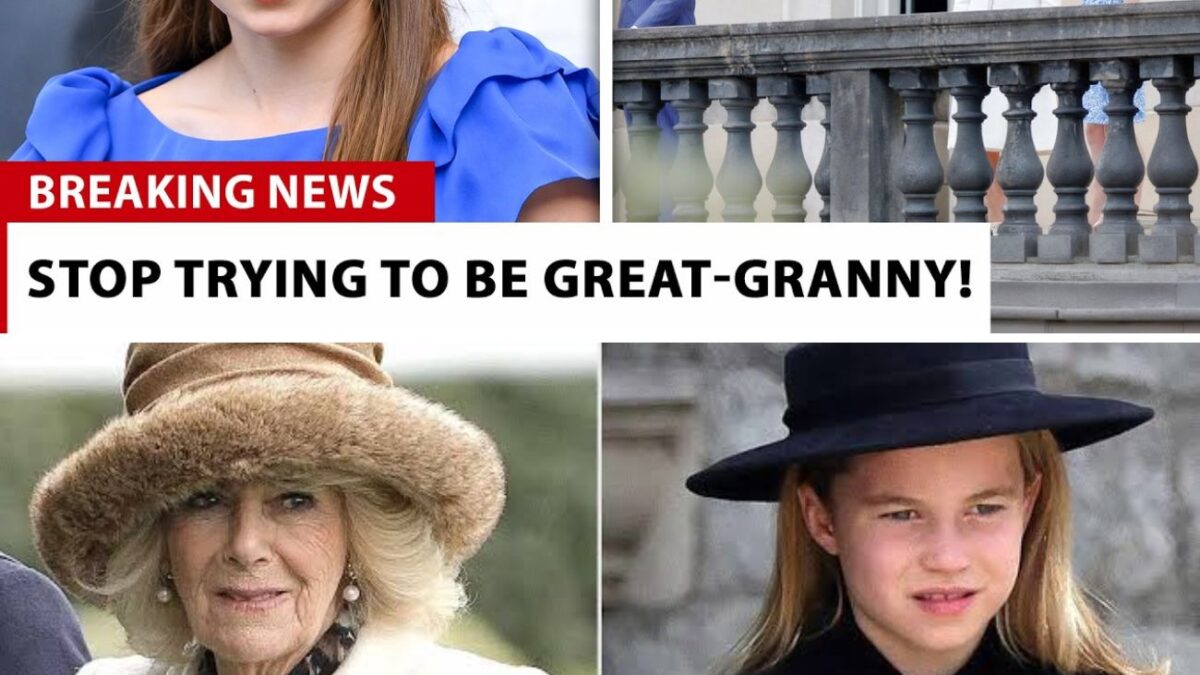
Princess Charlotte STUNS Queen Camilla at Windsor — King Charles Watches in Shock as One Sentence Changes Everything
Rain pressed against the tall windows of Windsor Castle as an extraordinary family scene unfolded inside the private library.
According to the scenario described in the circulating story, King Charles was resting in a velvet chair while Prince George and Prince Louis quietly occupied themselves nearby. Princess Charlotte was also in the room, creating an unusually informal family atmosphere far removed from the ceremony normally associated with royal life.
Then Queen Camilla entered.
What followed, according to the story, was not a routine family disagreement. It was presented as the moment when years of questions about tradition, authority and Queen Elizabeth’s legacy suddenly collided.
Camilla allegedly objected to Prince Louis handling an old botanical album associated with Queen Elizabeth. She reportedly ordered it removed and insisted that the children should follow stricter rules when she was present.
The atmosphere changed immediately.
Louis, still a young child, was described as shrinking back while George watched closely. Charlotte, however, supposedly remained silent for several moments.
Then she stood.
The story claims that the young princess walked across the room, faced Camilla and delivered five unforgettable words:
“You are not Queen Elizabeth.”
According to the narrative, the room fell completely silent.
King Charles allegedly watched the confrontation with tears in his eyes, while Camilla was left visibly shaken.
But the most dramatic part of the story was supposedly not the confrontation itself.
It was what had allegedly happened before it.
The document behind the argument
The scenario claims that several weeks earlier, palace officials had prepared documents concerning a proposed modernization of private royal residences.
The alleged proposals would have introduced stricter household etiquette for the Wales children, including formal gestures of deference inside certain private family spaces.
That detail transformed the supposed confrontation from a disagreement over a book into something much larger.
The story presents the proposed changes as an attempt to introduce formal court behavior into areas that had traditionally remained informal family spaces.
There is an important distinction here. The official Royal Family website confirms that Princess Charlotte is the second child of the Prince and Princess of Wales and currently stands third in the line of succession. Prince George is second, while Prince Louis is fourth.
However, there is no reliable public evidence confirming the alleged secret memorandum described in this story.
That distinction matters because the narrative has been presented online with the tone of an investigative royal exposé.
William enters the dispute
The story then turns to Prince William.
According to the supplied scenario, William allegedly received a copy of the disputed document and objected strongly to the idea of imposing ceremonial behavior upon his children inside their private family environment.
Rather than confronting Camilla publicly, he supposedly requested a private meeting with King Charles.
The imagined meeting takes place late at night, away from aides and cameras.
William allegedly places the document on his father’s desk and points toward the passages concerning his children.
His argument is simple: formal royal protocol belongs in formal settings. Childhood inside the family home should remain different.
The story portrays Charles as torn between two responsibilities.
On one side stood his wife and the pressure surrounding her position as Queen Consort. On the other stood his grandchildren and the traditions associated with his late mother, Queen Elizabeth II.
The Royal Family’s official website describes Queen Elizabeth’s strong family connections and notes that she had a particularly close relationship with her grandchildren and great-grandchildren.
That emotional history gives the fictional confrontation its dramatic weight.
The alleged “secret annex”
The most explosive element of the supplied script comes next.
It claims that the original proposal supposedly contained a hidden annex concerning the management of Queen Elizabeth’s personal possessions, correspondence and private collections.
The story alleges that the proposed arrangement would have placed greater administrative control over those materials in the hands of Camilla’s office.
Again, no reliable source located for this article confirms that such an annex exists.
Nevertheless, within the story, its discovery becomes the turning point.
Senior advisers are supposedly brought together to examine whether such arrangements could alter established royal practice. The documents are reviewed, debated and eventually rejected.
The story describes the decision as quiet rather than dramatic.
No press conference.
No public accusation.
No palace announcement.
Just a series of private decisions that allegedly restore the previous arrangements.
Charles faces Camilla
The final confrontation supposedly happens between Charles and Camilla.
By then, the palace dispute has become personal.
Camilla is portrayed as explaining how difficult it has been to live under constant comparison with Queen Elizabeth.
That part of the story echoes a very real public dynamic surrounding the modern monarchy: Camilla has spoken publicly about the pressure surrounding Charles’s cancer diagnosis and the difficulty of keeping his illness private before the announcement in 2024.
But the specific private conversation described in the scenario remains unverified.
In the story, Charles finally tells Camilla that a title can establish official position, but it cannot manufacture the affection and moral authority accumulated over decades.
He allegedly makes clear that his grandchildren must be protected from becoming symbols in an internal struggle over royal status.
Camilla says nothing.
The confrontation ends without shouting.
Her silence becomes the final dramatic moment.
Charlotte’s quiet message
The story eventually returns to Charlotte.
In the fictionalized account, the young princess becomes a symbol of continuity rather than rebellion.
She does not demand a crown.
She does not challenge the constitutional order.
Instead, her role is presented as something much simpler: defending the emotional traditions of her family.
The official succession list confirms her unusual constitutional position. She is third in line to the throne, immediately behind her father, the Prince of Wales, and her older brother, Prince George.
That makes every public appearance involving the Wales children naturally interesting to royal watchers.
The supplied story ends with an emotional image at a later ceremonial gathering.
Charles reportedly reaches for Charlotte’s hand.
She looks toward her grandfather and smiles.
Camilla stands nearby.
There is no argument this time.
No document.
No raised voice.
Only a brief gesture between a grandfather and his granddaughter.
And that is ultimately why this dramatic story has captured attention: not because the palace walls supposedly witnessed an explosive confrontation, but because it raises a question that has followed the British monarchy for generations.
What gives a royal genuine authority?
A title?
A crown?
A position?
Or the trust, affection and loyalty accumulated over a lifetime?
The story provides its own answer.
But whether the alleged confrontation ever happened is a separate question—one for which the available evidence does not currently provide confirmation.








