ROYAL COUTURE BOMBSHELL: Did Meghan Markle’s Alleged Gown Controversy Deepen the Rift With William and Catherine?
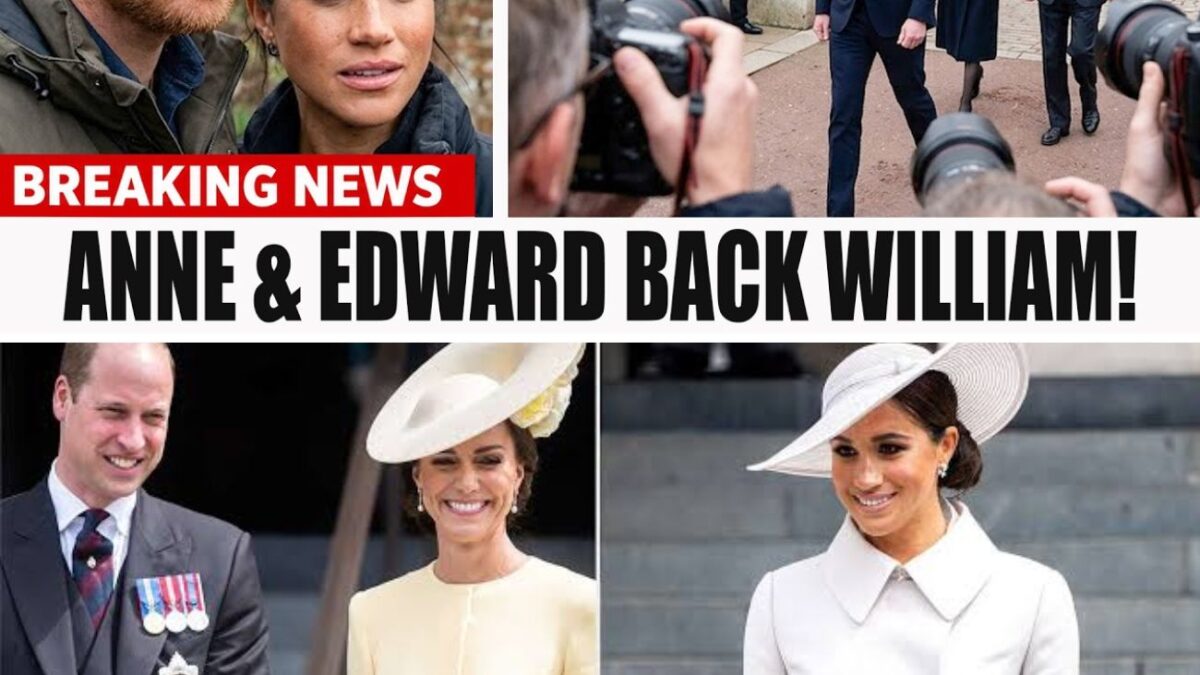
Royal Couture Bombshell: Did Meghan Markle’s Alleged Gown Controversy Deepen the Rift With William and Catherine?
Few things capture the public imagination quite like the British royal family: its ancient traditions, carefully managed appearances, and the private tensions that sometimes spill into public view. In this dramatic account, a disputed story about bespoke couture gowns becomes the opening chapter of a much larger narrative involving Meghan Markle, Prince Harry, Prince William, and Catherine, Princess of Wales.
The central allegation is striking. A celebrated French designer supposedly created exclusive garments intended as a private gift for Catherine, only for questions to arise over whether the delivery reached the right people. The script claims that an internal inquiry eventually uncovered a trail of confusion involving palace contacts and competing claims over the gowns. Yet no independently verified evidence has been presented here to establish that Meghan intercepted the clothing or that such an inquiry occurred.
Even with that important distinction, the story raises a question that has long fascinated royal watchers: what happens when personal relationships, fashion, status, and the institution of monarchy become entangled?
The alleged couture controversy
According to the supplied narrative, the designer’s team expected the bespoke gowns to be fitted by Catherine’s representatives. When questions allegedly arose about the missing garments, staff members supposedly contacted the Princess of Wales’s stylist to clarify the arrangements.
The script then takes a dramatic turn, suggesting that incorrect contact details and a disputed delivery chain led investigators toward Meghan’s circle. It portrays the episode as a serious breach of professional boundaries, claiming that the gowns were intended for Catherine rather than for another member of the royal household.
Those are serious allegations, and the script does not provide verifiable documentation sufficient to confirm them. There is no authenticated designer statement or established paper trail included in the material that proves deliberate interception. Nevertheless, within the story’s dramatic framework, the alleged mix-up becomes a symbol of something larger: the belief that access to the royal family can carry enormous social and commercial value.
Luxury fashion has always played a role in royal life. A carefully chosen coat, an internationally recognised designer, or a dress worn at a major public engagement can become a global talking point. But the difference between a private gift, a professional loan, and a commercial arrangement matters. Without reliable evidence, it would be unfair to conclude that any individual improperly claimed clothing intended for someone else.
William’s alleged breaking point
The narrative moves quickly from couture to the relationship between the two royal brothers. It portrays Prince William as increasingly determined to keep his private family life separate from the public controversies surrounding Prince Harry and Meghan.
One alleged confrontation is set in Norfolk, near the private world William shares with Catherine and their three children. According to the script, Harry’s team attempted to arrange an appearance connected to a military event, creating speculation that the brothers might meet. The story claims that Kensington Palace responded with silence rather than a reunion.
No independently verified evidence in the supplied material establishes that Harry attempted to force an encounter or that William personally ordered a permanent exclusion. Yet the episode serves a clear narrative purpose: it presents silence as a form of power.
In this telling, William has reached a point where another emotional exchange would accomplish little. Rather than argue publicly, he supposedly chooses distance, allowing formal schedules and institutional boundaries to communicate what words cannot.
The idea is compelling because family estrangement rarely announces itself with a single dramatic declaration. Sometimes it becomes visible through missed occasions, unanswered messages, and the gradual disappearance of shared routines. But the private motives attributed to the brothers remain speculation unless supported by credible reporting or direct confirmation.
A historical shadow: Edward VIII
To heighten the stakes, the script draws a parallel with the abdication crisis of 1936, when King Edward VIII gave up the throne to marry Wallis Simpson. The comparison suggests that the monarchy has previously responded to personal choices by redefining a royal figure’s relationship with the institution.
Edward’s departure reshaped the monarchy and led to a life largely spent outside Britain. The circumstances, however, were different from those surrounding Harry and Meghan. Edward abdicated the throne itself; Harry and Meghan stepped back from their roles as working royals while retaining their Duke and Duchess of Sussex titles.
The distinction is crucial. Historical precedent can help explain how the monarchy protects its public role, but it does not prove that William has activated a secret protocol to exile his brother permanently. The script’s language of constitutional traps and irreversible punishment should therefore be understood as dramatic interpretation, not confirmation of a newly enacted royal plan.
Still, the historical comparison highlights a genuine tension at the heart of monarchy: how can an institution steeped in tradition adapt to a modern world in which its members may tell their own stories, pursue commercial opportunities, and challenge established expectations?
Soho House and the question of connections
Another section of the narrative turns to Soho House, the private members’ club associated with celebrity and creative industries. It describes a network of social connections surrounding Meghan before her relationship with Harry became public.
The script focuses on Marcus Anderson, a hospitality figure associated with Soho House, and presents his connections as a bridge between Meghan and influential social circles. It also references other acquaintances and suggests that these relationships helped her move through elite environments.
The account goes further, questioning whether the couple’s first meeting was as spontaneous as the familiar romantic version suggests. But social photographs, mutual friends, and access to private clubs do not, on their own, demonstrate a calculated plan to enter the royal family. Nor does the existence of a well-connected social network establish deception.
The more responsible question is how modern celebrity relationships are shaped by overlapping professional and social worlds. Public figures often meet through introductions, events, and shared acquaintances. The presence of those connections may add context to a relationship without proving that the relationship was engineered.
Public duty versus private life
Throughout the story, Catherine is presented as a contrast to Meghan. The narrative emphasises Catherine’s public engagements and her role within the working monarchy, portraying her as a figure associated with continuity and institutional service.
Meghan, by contrast, is described through the language of celebrity, publicity, and commercial ambition. That contrast fuels the article’s dramatic structure, but it is also a highly selective framing. A public appearance cannot reveal everything about a person’s private intentions, just as commercial work does not automatically establish disloyalty.
The same caution applies to the script’s claims about staged photographs, media strategy, and the couple’s family life in California. The supplied material offers interpretations of their motives rather than independently verified evidence proving a coordinated attempt to manipulate public opinion.
The tension between privacy and publicity is nonetheless central to the Sussex story. Harry and Meghan have spoken publicly about their experiences, while also seeking greater control over aspects of their private lives. Critics may view that combination as contradictory; supporters may see it as an effort to establish boundaries on their own terms. Neither interpretation should be confused with proof of a hidden conspiracy.
What the royal rift really represents
The script concludes with an image of a monarchy determined to protect itself through discipline, institutional continuity, and carefully defined roles. It imagines William as a future king unwilling to let family sentiment override duty, while Harry and Meghan become symbols of the conflict between inherited status and modern celebrity.
The alleged couture-gown controversy functions as the story’s most vivid metaphor. A garment intended for one person becomes a symbol of access, entitlement, and trust. Yet without evidence confirming the alleged interception, it cannot responsibly be treated as the event that changed the royal family’s future.
What remains compelling is the broader question beneath the sensational claims: how much of a royal family’s private life can survive once every disagreement becomes public material?
For William and Harry, the answer may ultimately depend on choices that outsiders cannot fully observe. For the monarchy, the challenge is to preserve institutional credibility while confronting the realities of a media environment that rewards conflict and speculation.
And for readers, the distinction between an explosive allegation and a proven fact matters more than ever. The fashion story may be dramatic, but its significance depends on what can actually be established—not simply on how convincingly the narrative is told.








