“TAKE IT OFF RIGHT NOW!” — DID PRINCESS ANNE CONFRONT QUEEN CAMILLA OVER DIANA’S ICONIC TIARA?
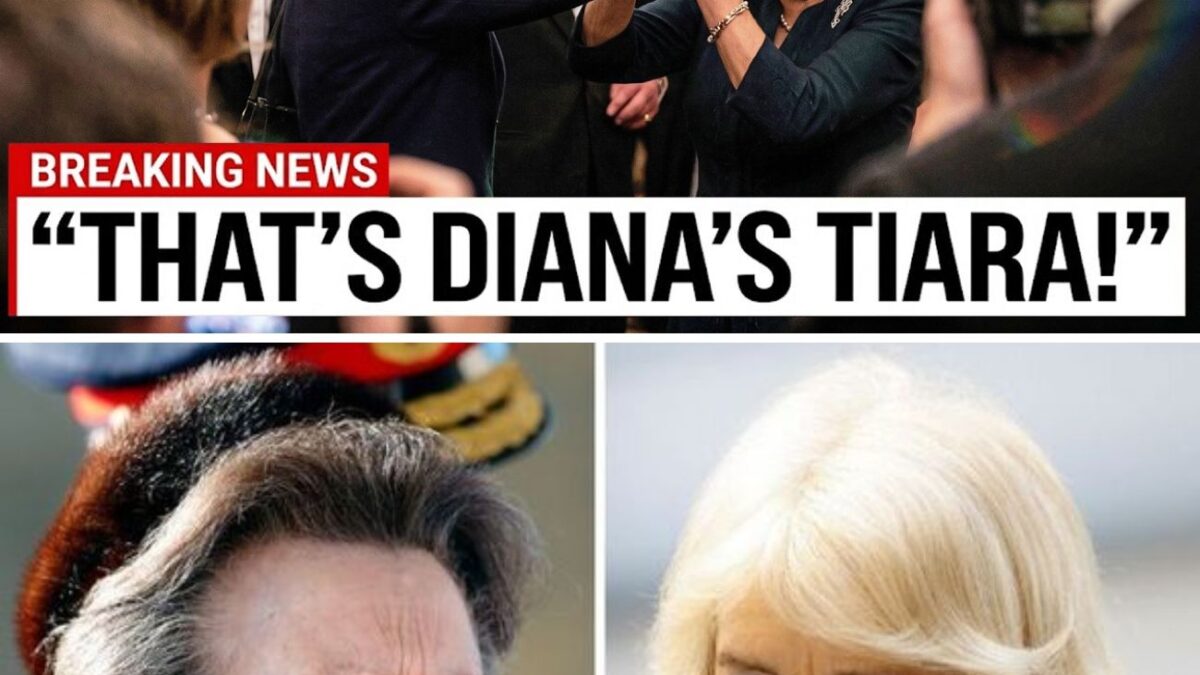
“TAKE IT OFF RIGHT NOW!” — The Explosive Royal Tiara Confrontation That Has Everyone Asking Questions
The image is almost cinematic: a private suite at Windsor Castle, a glittering diamond-and-pearl tiara, and Princess Anne standing in the doorway with a determination that leaves no room for argument. At the center of the imagined confrontation is Queen Camilla, preparing for a grand state banquet. The words attributed to Anne are short, sharp, and impossible to ignore: “Take it off right now!”
In this dramatic version of royal life, the tiara is more than an exquisite piece of jewelry. It becomes a symbol of family history, public loyalty, and the delicate balance between tradition and personal ambition. Catherine, Princess of Wales, is drawn into the story as the figure whose position and dignity allegedly lie at the heart of a growing dispute. Yet there is an important distinction between a compelling royal drama and a verified account: no reliable evidence has established that this confrontation occurred.
A Palace Filled With Unspoken Tension
The story opens behind the closed doors of Windsor Castle, where preparations for a major state banquet are supposedly underway. Staff hurry through historic corridors, checking arrangements and coordinating the arrival of distinguished guests. In the private rooms, however, the atmosphere is described as increasingly strained.
Queen Camilla stands before an ornate mirror while her attendants prepare her for the evening. According to the supplied narrative, she reaches for a diamond-and-pearl tiara associated with Princess Diana. The scene is presented as the culmination of a supposed struggle over royal jewelry and the symbolism attached to it.
The script portrays two competing centers of influence: Clarence House, associated with the King and Queen, and Kensington Palace, the home of the Prince and Princess of Wales. It suggests that the dispute concerns more than ceremonial arrangements. At stake, the story claims, is the public image of the monarchy and the way its future is represented.
Catherine occupies a particularly important place in this imagined conflict. Her public role, composed manner, and popularity are portrayed as sources of influence that cannot simply be assigned or withdrawn by administrative decisions. The script contrasts her restraint with Camilla’s alleged desire to command attention, creating a sharp division between duty and ambition.
That contrast drives the drama, although the claims of jealousy, deliberate exclusion, and covert maneuvering remain allegations within the narrative rather than established facts.
Why Princess Diana’s Tiara Carries Such Emotional Weight
Royal jewelry can communicate far more than wealth. Certain pieces are closely associated with particular occasions, historical figures, and the traditions of the monarchy. Their appearance at a state event may attract almost as much attention as the people wearing them.
Princess Diana’s connection to royal jewelry makes the subject especially evocative. Her personal history continues to attract worldwide interest, and any story linking her legacy to Catherine or Camilla can quickly become emotionally charged.
The supplied script builds its central conflict around a particular diamond-and-pearl tiara, describing it as an heirloom supposedly reserved for Catherine as the future queen consort. It further alleges that officials connected with Camilla sought to change the way the piece was classified and controlled.
Those assertions are crucial to the story, but they have not been substantiated. The narrative provides no authenticated estate document, verified correspondence, or official statement establishing that the tiara was reserved for Catherine or that an attempt was made to transfer its status.
The distinction matters. A jewel may carry enormous personal and historical significance without being legally designated for a particular future wearer. Its ownership, custody, and use depend on the actual arrangements governing the item—not simply on the symbolism that commentators or storytellers attach to it.
Nevertheless, within the dramatic account, the proposed use of Diana’s tiara becomes the moment when an underlying disagreement allegedly turns into open confrontation.
The Gallery Encounter That Changes Everything
Before the imagined clash in the private suite, the script places Catherine in a stone gallery at Windsor Castle. She is described as preparing for the banquet, accompanied by members of her team and surrounded by staff completing the evening’s arrangements.
Camilla then appears in the corridor. Instead of exchanging a customary greeting, the narrative claims that she deliberately blocks Catherine’s path and makes a dismissive remark about her ceremonial clothing and position.
The alleged insult is portrayed as an attempt to remind Catherine that the King and Queen occupy the highest positions in the current royal hierarchy. The assembled staff supposedly become uncomfortable, unsure whether they should intervene or pretend not to have witnessed the exchange.
Catherine, however, does not respond with anger. According to the script, she maintains her composure, acknowledges the encounter politely, and returns to her dressing room.
Her silence becomes an important part of the story. Rather than being presented as weakness, it is framed as discipline: the ability to refuse an argument even when provoked. The narrative suggests that Catherine understands the public consequences of a visible disagreement and chooses not to turn a private slight into a spectacle.
At the far end of the gallery, Princess Anne is supposedly watching.
In this telling, Anne does not need to raise her voice to establish her disapproval. Her reaction is conveyed through her rigid posture and controlled expression. She is portrayed as a defender of institutional responsibility, unwilling to tolerate what she perceives as an attack on the dignity of another member of the family.
It is a powerful dramatic turning point. But the reported gallery exchange, like the alleged insult itself, remains unverified.
The Moment at the Vanity
The story reaches its climax when Camilla allegedly enters the royal vault area and requests the tiara. She takes it to her private suite, where attendants help prepare her for the banquet.
As she sits before the Venetian mirror, the room is described as warm and brightly lit. The jewel catches the light while the Queen admires her reflection. For a moment, the narrative presents her as confident that the evening will unfold according to her wishes.
Then the doors open.
Princess Anne enters and orders the attendants to leave. Brushes, cosmetics, and other preparations are abandoned as the staff hurry into the corridor. The room becomes silent, leaving the two women facing one another.
Anne approaches the vanity and points toward the tiara.
“Take it off right now.”
The sentence, repeated with variations throughout the script, supplies the story with its defining moment. Camilla is portrayed as stunned by the directness of the demand. She supposedly invokes her position as Queen Consort, insisting that Anne respect the royal hierarchy.
But Anne refuses to retreat.
The speech attributed to her argues that a title alone cannot command affection or respect. Those qualities, she allegedly insists, are earned through service, restraint, and a willingness to place duty above personal display.
The narrative then gives Anne a particularly forceful declaration: “You will not wear her legacy.” The line transforms the tiara from a decorative object into a symbol of Diana’s memory and the family’s responsibility to preserve its history.
According to the script, Camilla eventually removes the jewel and places it on a velvet cushion. Anne closes the box, locks it, and takes possession of it before warning that any further attempts to undermine Catherine will have consequences.
The scene is written as a decisive defeat for Camilla and a triumph for Anne’s determination. Yet no verified account establishes that Anne issued this ultimatum, confiscated a jewelry box, or threatened to disclose private documents.
King Charles Arrives
The confrontation supposedly reaches the King when Charles enters the suite after staff alert him to the disturbance. The script describes him finding Camilla shaken and Anne holding the locked box.
Charles attempts to intervene, but Anne turns toward him with a message that challenges his authority within his own household. She is quoted as saying that if he cannot protect the future queen and maintain order, she will do so herself.
In the story, Anne then leaves with the tiara and proceeds to Catherine’s dressing room. There, she places the box on the table and offers a reassuring gesture of support.
The imagined ending contrasts the women’s appearances at the banquet. Camilla arrives wearing a simpler piece of jewelry, while Catherine enters with quiet confidence. The message is clear: the future of the monarchy depends not on the brilliance of a jewel but on the character of the people who represent it.
It is a satisfying conclusion for a dramatic narrative, but it should not be mistaken for a confirmed description of events.
The Real Question Behind the Royal Drama
Princess Anne has long been publicly associated with a strong sense of duty, while Catherine’s role as Princess of Wales places her at the center of the monarchy’s future. Camilla, meanwhile, occupies her own established position as Queen. These public roles are real; the alleged private battle described here has not been demonstrated.
That distinction does not make the story’s central theme uninteresting. Royal objects can become powerful symbols because they connect individual lives with an institution that depends heavily on continuity and public confidence. A tiara can evoke a previous generation, invite comparisons between royal women, and prompt questions about how history should be remembered.
But symbolism is not proof. Claims of secret orders, personal jealousy, stolen inheritance, or private threats require reliable evidence before they can be treated as facts.
The imagined command—“Take it off right now!”—is designed to capture attention because it reverses the expected balance of power. In the story, the sister of the King challenges the Queen in defense of Catherine and Diana’s memory. The dramatic force comes from the possibility of a private disagreement becoming a public crisis.
Whether readers view it as a tale of loyalty, a warning about palace politics, or simply a fictional royal showdown, the essential question remains: what matters more in a monarchy—the symbols it preserves or the conduct of the people who wear them?
For now, the alleged confrontation belongs to an unverified narrative, not established royal history. The real legacy of Princess Diana, and the responsibilities carried by the royal family today, deserve to be discussed with both curiosity and care.








