William Breaks Royal Silence for Catherine’s Parents — Then Charles’ 25-Second Silence Leaves Everyone Stunned
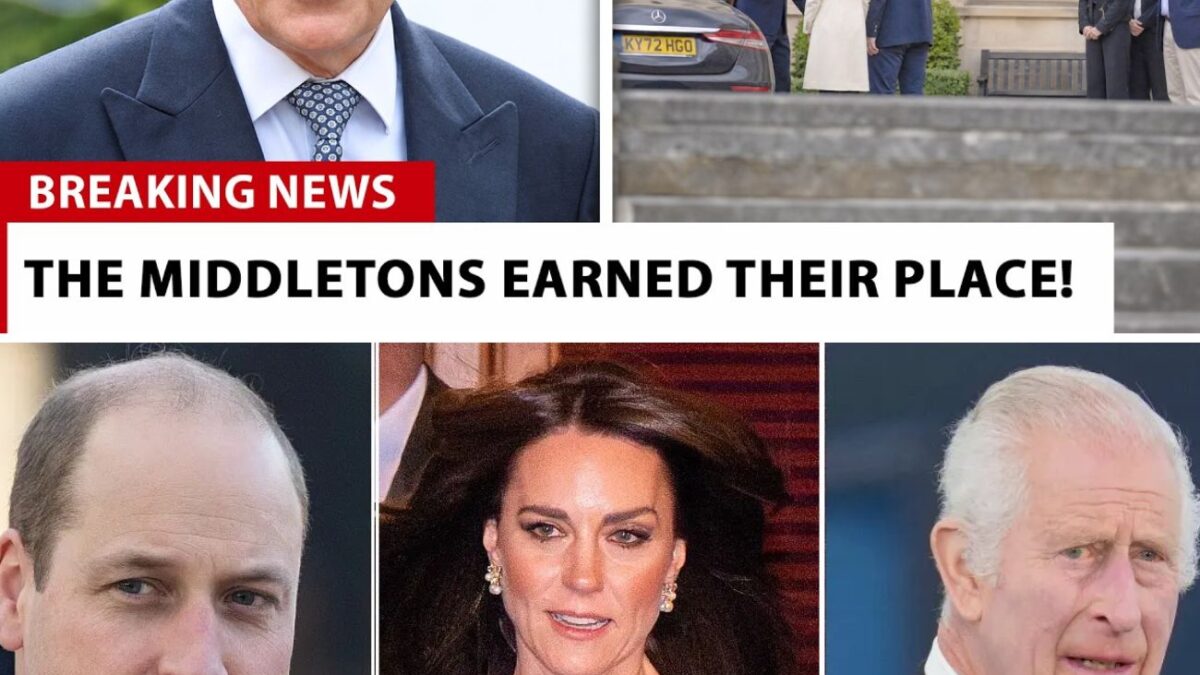
William Breaks Royal Silence for Catherine’s Parents — Then Charles’ 25-Second Silence Leaves Everyone Stunned
The rain had been falling steadily over Windsor when Prince William noticed the car waiting at the barrier near Forest Lodge.
It was not an unusual place to see a familiar vehicle. What caught his attention was the man standing outside it.
Michael Middleton was in the rain, wearing a waxed jacket with his hood pulled up. Inside the car sat Carole Middleton, holding a covered dish on her lap. They had already been waiting for twenty-six minutes.
The problem was simple. Their names were not on the evening visitor list.
The young officer at the gate was waiting for confirmation from the house. When William stopped and asked how long they had been there, Michael glanced at his watch.
“A little while, sir. It’s fine.”
The officer immediately apologized, explaining that the notification had arrived after four o’clock. Michael placed a hand on the young man’s shoulder.
“He’s doing his job properly,” he told William.
Then came the sentence that stayed with William.
“We’re used to being visitors.”
Michael said it without anger. There was no complaint, no demand and no suggestion that anyone owed him special treatment. It was simply a fact.
But William could not forget it.
The following day, he requested the gate records for Michael and Carole Middleton, covering their visits to Adelaide Cottage and Forest Lodge during the previous four years.
The result was startling within the story.
There were 412 entries.
Every single visit had been recorded under the same category: “visitor — purpose private.”
That meant the Middletons had passed through the gates roughly twice a week for four years, yet their status had never been changed.
William studied the records more closely. Catherine eventually saw the printout herself. She noticed the times first: early mornings, school days, winter journeys and repeated trips from Berkshire.
Then she found the notes.
Nine different officers had written essentially the same observation over four years: Mr. Middleton had offered to wait outside rather than cause trouble for the gate staff.
“He’s been doing that since Adelaide Cottage,” Catherine said quietly.
William made his decision.
Michael and Carole would be moved from the visitor list to the family list. They would receive a key to the private gate and a permanent vehicle permit.
The cost was almost laughably small.
One key. One permit.
But Catherine immediately asked the question William had overlooked.
“Have you asked them?”
When he admitted that he had not, she stopped him.
“Then don’t hand it to them as a present.”
She knew her father. Michael Middleton had spent years politely refusing things he believed he had not earned.
So William drove to Berkshire himself.
He placed a small envelope on the kitchen table. Inside were a brass key and a laminated permit.
Michael stared at them.
“What’s this for?”
William explained everything: the gate records, the 412 entries and the nine notes about waiting outside.
Michael immediately shook his head.
“We don’t need a key.”
William smiled.
“I know you don’t need it. That’s the point.”
He explained that Michael had never asked for anything, never complained and never attempted to use his relationship with the family for personal advantage.
“This isn’t a gift,” William told him. “It’s a correction. You were never visitors. The paperwork was wrong.”
Carole remained quiet, studying the key before finally placing the envelope in a drawer.
“Then we’ll be careful with it,” she said.
But one question remained.
“Does your father know?”
“He will on Friday.”
Carole paused.
“And Camilla? Her children have never had one, have they?”
The question changed everything.
Soon, a formal note from the Lord Chamberlain’s office arrived. It stated that no parent-in-law, stepchild or other relative by marriage of a member of the royal family currently held family standing on the Windsor lists.
Then came the line that caused the real tension.
Since Charles’s marriage to Camilla in 2005, her children had been entered as guests on every occasion.
Twenty-one years.
Every occasion.
When Charles received the weekly household note showing William’s amendment to the Forest Lodge family list, he marked every other item as usual.
Beside the Middleton entry, however, there was nothing.
No tick.
No question.
No initials.
Just a blank margin.
Then Camilla learned what had happened.
Her daughter Laura arrived at Clarence House that afternoon and, as usual, was checked against the visitor list. She entered wearing a paper visitor pass.
Camilla looked at the pass.
Then she looked at the official note.
The contrast was impossible to ignore.
For two decades, her children had been treated as guests.
The confrontation finally came during a family lunch at Windsor.
In the Oak Room, Camilla approached William calmly.
“I gather Michael and Carole have a key now.”
William did not avoid the question.
“They do.”
Camilla reminded him that her children had been guests on every occasion for twenty-one years.
“I’d simply like to know whether anyone ever thought they might be family.”
The room fell silent.
Catherine explained that her parents had never asked for the key. They had even tried to refuse it.
“Neither did mine,” Camilla replied. “Ask.”
Then she turned toward Charles.
“Did you know?”
Charles sat near the window, holding his cup and saucer.
He said nothing.
Twenty-five seconds passed.
Finally, he put down his cup and asked Anne whether the harvest at Gatcombe had begun.
That was all.
William had expected anger. He had expected a lecture about precedent.
He had not expected silence.
Later, Anne offered another interpretation.
“You think he disapproves,” she told William. “You’ve read it wrong. That wasn’t disapproval. I’ve seen that face before.”
She reminded him that Charles sometimes wore that expression when confronted with something he had once intended to do but never completed.
Catherine then went to Clarence House to speak privately with Camilla.
Camilla made one thing clear: she was not angry with the Middletons.
Her concern was her own children.
She explained that she had deliberately kept Laura and Tom away from royal complications because she believed she was protecting them.
But now she wanted to know who had decided they were visitors.
Was it a rule?
Was it a person?
Or had nobody simply remembered to change the arrangement?
That question led William back to the archives.
A faded blue folder was eventually found in the Lord Chamberlain’s files.
Inside was a draft from the weeks after Charles and Camilla married.
The proposal was remarkably familiar.
It suggested that Camilla’s children be given family standing, private keys and their own permits, without any public announcement.
William read it twice.
The proposal had come from his father’s office.
At the bottom was a handwritten instruction: hold, keep them out of this for now, revisit in a year.
It was dated May 12, 2005.
One year passed.
Then another.
Then twenty.
The temporary pause became permanent because nobody returned to the question.
Suddenly Charles’s silence in the Oak Room made sense.
He had once intended to do exactly what William had just done for the Middletons.
William took the folder to his father.
Charles recognized his own handwriting.
“I meant to,” he said quietly.
“I know,” William replied.
“Then finish it. Not for me. For her.”
Charles did not make a speech.
He picked up a pen.
The old proposal was sent to Camilla with one new line beneath it:
“Revisited September 2026. Yours to decide.”
Camilla read it alone.
Her answer was simple.
“No. They like their own lives, and so do I. But thank you for asking.”
This time, the choice belonged to her.
Her children remained guests because she had chosen that arrangement, not because an old instruction had quietly remained in place for twenty-one years.
The Middletons, meanwhile, remained on the family list.
A few days later, the weekly household papers returned with another handwritten note from Charles.
Beside the Middleton entry were three words:
“They earned it.”
And at 5:57 one autumn morning, Michael and Carole arrived at Forest Lodge.
The barrier lifted before their car stopped.
Michael raised his hand to the officer.
Carole sat beside him with another covered dish.
In the gate book, the entry was brief:
“Middleton M and C — family.”
For the first time, there was nothing in the notes column.
No explanation.
No apology.
No reminder that Michael had offered to wait outside.
Just an ordinary family entry.
And perhaps that was the real meaning of the entire episode: not the brass key, not the permit and not the confrontation.
It was the disappearance of the explanation.
After years of being asked to prove why they were there, the Middletons simply passed through the gate.
The book no longer needed to explain them.








