WILLIAM REFUSES PEACE TALKS! Harry’s Royal Future in Jeopardy as an Imagined Palace Showdown Reaches Breaking Point
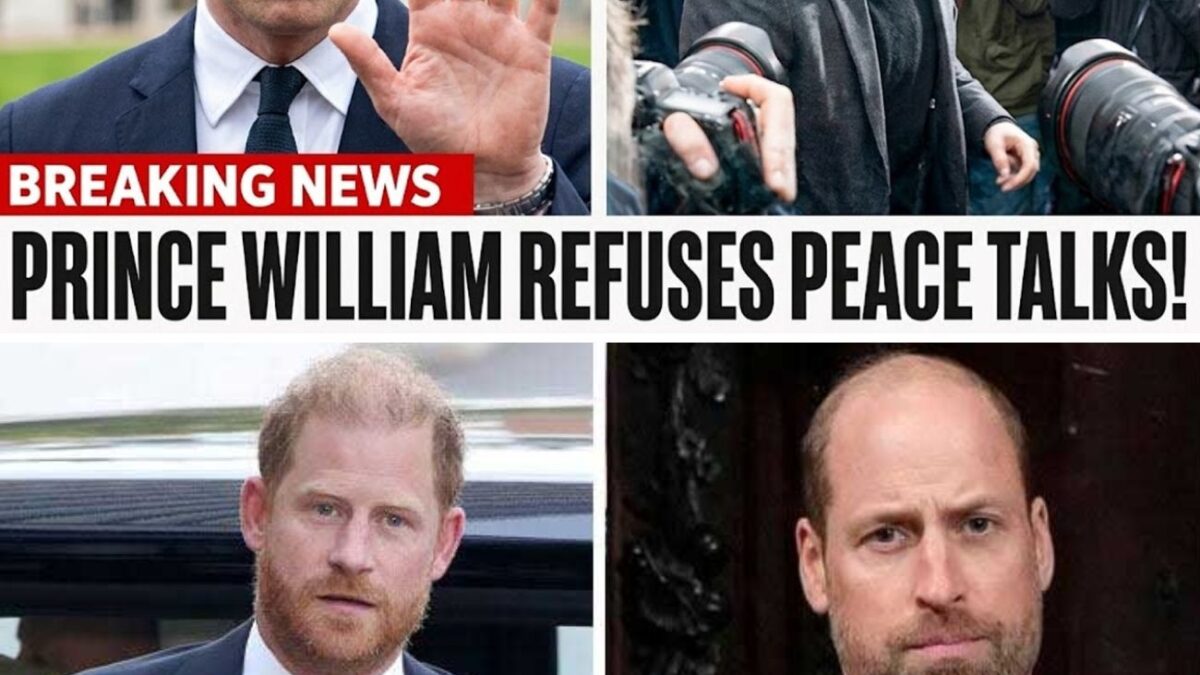
William Refuses Peace Talks! Harry’s Royal Future Hangs in the Balance as the Palace Draws a Line
The most painful family conflicts are not always the loudest. Sometimes, the moment everything changes is marked by a quiet decision, a closed door, and a message that never receives a reply.
In this imagined royal drama, Prince William reaches a breaking point with his younger brother, Prince Harry. What begins as another public dispute over reconciliation develops into a high-stakes confrontation involving royal identity, institutional responsibility, and the question of whether family ties can survive when trust has been repeatedly tested.
The fictional story opens on a tense morning at Windsor Castle. While preparations are underway for an important state visit, an urgent document arrives for William’s private secretary. Its contents, according to the scenario, concern demands from Harry’s representatives over a hypothetical parliamentary effort to reconsider his royal titles.
The timing could hardly be more dramatic.
Harry has recently appeared before international cameras, speaking about his desire for peace and suggesting that certain members of his family are unwilling to reconcile. To supporters, his words might sound like the plea of a younger brother who still hopes to repair a damaged relationship. To critics within the imagined narrative, however, the timing raises another question: is reconciliation still the central goal, or has the dispute become entangled with public pressure and royal status?
William refuses to respond publicly.
For years, the brothers’ relationship has been a subject of worldwide fascination. Their childhood, their shared grief following the death of Princess Diana, and their sharply different adult lives have all attracted intense scrutiny. But in this fictional account, William no longer believes that another public exchange will bring them closer.
Instead, he turns his attention to the document on his desk.
The ultimatum that changes everything
At 8:15 a.m., the fictional memorandum reaches Kensington Palace through an urgent legal channel. The document allegedly demands that senior members of the Royal Family intervene to halt a hypothetical parliamentary process concerning Harry’s titles.
It also contains a deadline.
According to the imagined scenario, Harry’s representatives warn that further private material could become public if the demand is ignored. The suggested disclosures concern sensitive royal discussions and confidential matters involving the family.
These are serious allegations within the story, not verified claims about Harry or his advisers.
For William, however, the contents of the document present an immediate dilemma. If he responds emotionally, the confrontation could become another public spectacle. If he attempts to negotiate under pressure, he risks allowing a family disagreement to interfere with decisions that belong to constitutional and parliamentary processes.
His private secretary waits for instructions.
William reads the document carefully, paying particular attention to the demands and the deadline. The room falls silent. He understands that a single angry response could generate another cycle of headlines, interviews, counterclaims, and increasingly personal accusations.
Then he makes his decision.
“Log the correspondence. Issue no reply. Do not allow this to interrupt the state visit.”
There is no dramatic outburst, no slammed door, and no hastily arranged press conference. William chooses administrative restraint over public confrontation.
Within the fictional narrative, the decision marks a turning point. Harry’s side expects an urgent response, perhaps even a private call from his older brother. Instead, the deadline approaches without an acknowledgement.
The silence becomes the most powerful message of the morning.
Two brothers shaped by the same tragedy
To understand the emotional weight of the standoff, the story returns to the loss that shaped both princes: the death of their mother, Diana.
The image of the two boys walking behind her coffin remains one of the defining moments of modern royal history. They experienced the same tragedy, yet no two people process grief in exactly the same way.
In this imagined account, William believes that some parts of family life must remain protected from commercial pressures and relentless public examination. He fears that private pain can become distorted when repeatedly presented through interviews, books, and entertainment projects.
Harry, by contrast, is portrayed as someone determined to speak openly about his experiences and explain his own version of events. His desire to be heard conflicts with William’s belief that certain boundaries are essential.
The fictional narrative does not resolve which brother understands their shared history better. Instead, it presents their disagreement as a collision between two deeply different approaches to privacy, accountability, and healing.
William remembers the vulnerability of a family living beneath the scrutiny of the press. He believes that once private conversations become public material, trust becomes increasingly difficult to rebuild.
Harry’s position, as depicted in the script, is that public discussion is necessary to explain his departure and challenge the version of events associated with the institution.
Between those positions lies a relationship that neither brother can repair alone.
Windsor Castle refuses to stop
As the morning advances, the royal household continues preparing for a major diplomatic engagement. Staff coordinate schedules, ceremonial arrangements, security measures, and the arrival of foreign dignitaries.
The contrast is striking within the story.
Thousands of miles away, Harry allegedly waits for a response that never arrives. At Windsor, William prepares to fulfil his public responsibilities. The imagined confrontation does not interrupt the official programme.
When the state procession begins, King Charles welcomes the visiting leader while William and Catherine stand alongside the senior royals. The ceremony proceeds with carefully coordinated precision.
Photographers capture the familiar image of continuity: the King, Queen Camilla, the Prince and Princess of Wales, and the formal splendour of a state occasion.
No public announcement addresses the alleged ultimatum. No visible confrontation takes place.
Yet the silence carries its own dramatic significance. William has decided that an emotionally charged family dispute will not dictate the day’s official business.
For the fictional Harry, the lack of response is deeply unsettling. He had expected that the possibility of fresh controversy might persuade the palace to open negotiations. Instead, he finds himself facing a boundary that cannot be overcome through another demand for immediate attention.
The deadline passes.
Harry faces the consequences of public conflict
Later, in a fictional television studio in New York, Harry struggles to keep the conversation focused. The interviewer asks about family reconciliation, his children, and his future plans, but the discussion repeatedly returns to the dispute.
The scenario depicts Harry as frustrated by the lack of communication from London. He believes his concerns have been ignored, while those around him worry that another emotional interview could deepen the divide.
The host attempts to steer the conversation towards more constructive subjects. Yet the unresolved conflict continues to dominate the atmosphere.
The imagined interview illustrates a difficult contradiction: a person may sincerely want reconciliation while also feeling compelled to defend himself publicly. But when every exchange becomes another public contest, the space for a private conversation can disappear.
William’s refusal to engage has its own cost. Silence may prevent an immediate escalation, but it does not settle old grievances or answer every question that remains between the brothers.
For Harry, the unanswered message becomes a symbol of exclusion. For William, it represents a refusal to allow pressure to determine his decisions.
Neither interpretation guarantees that peace will follow.
Princess Anne delivers a final warning
In the final act of the fictional drama, Princess Anne emerges as a firm voice for institutional responsibility. Rather than treating the confrontation as a simple dispute between siblings, she urges those around her to consider the broader questions of duty, accountability, and public trust.
The scenario imagines her challenging the idea that family relationships can be repaired through ultimatums. She also questions whether the monarchy can function effectively if private disagreements repeatedly become public battles.
Her intervention does not establish that Harry has committed any wrongdoing, nor does it represent a real parliamentary briefing. It serves as the story’s symbolic reckoning: a reminder that emotional grievances and constitutional processes cannot simply be treated as interchangeable.
The imagined debate over royal titles remains unresolved in legal terms. The story’s dramatic outcome is instead William’s decision to maintain distance and continue with his responsibilities rather than negotiate under pressure.
For Harry, that choice feels like a door closing. For William, it is an attempt to prevent the same conflict from repeating indefinitely.
Is reconciliation still possible?
As evening falls over Windsor Castle, the story returns to the brothers’ shared past. Before the interviews, the headlines, and the disagreements about royal life, they were two boys who lost their mother and grew up under extraordinary public attention.
That history cannot be erased by a memorandum or a missed telephone call.
Nor can it, by itself, guarantee reconciliation.
The fictional confrontation ends without a dramatic reunion, a public apology, or a sudden reversal. William continues to believe that boundaries are necessary. Harry remains convinced that his concerns deserve to be heard. Their positions remain far apart.
Yet the story leaves one possibility open: that a future conversation might begin when neither brother is trying to win a public argument.
The monarchy’s future, the script suggests, depends not only on ceremony and continuity but also on the ability of its members to manage disagreement without allowing every private wound to become a public spectacle.
In this imagined showdown, William’s silence may look like strength to some and unforgivable rejection to others. Harry’s insistence may appear courageous to some and counterproductive to others.
Perhaps the most uncomfortable question is not which brother will prevail, but whether either can step away from the need to prove he is right.
Because a royal title can be debated, a public image can change, and a palace door can close. Rebuilding trust, however, requires something no ultimatum can command: the willingness to listen, to take responsibility, and to begin again.








