WILLIAM STOPS CHARLES’ £80 MILLION DEAL: What He Found About Harry’s Children Left the King Speechless
The £80 Million Royal Security Storm: William Confronts Harry as Charles Faces an Explosive Crisis
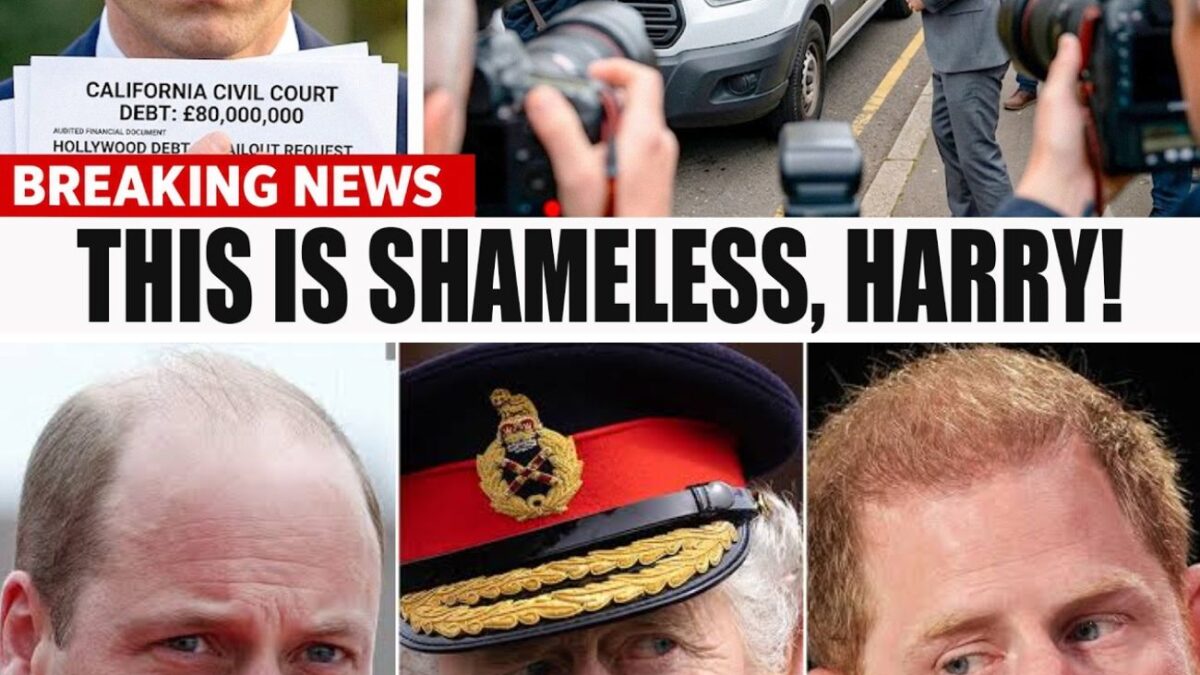
A dramatic security scare involving Prince Harry’s children has allegedly pushed King Charles into one of the most extraordinary financial decisions imaginable. What initially appeared to be a frightening incident outside a private school reportedly escalated into an £80 million demand, a tense confrontation inside Clarence House, and a stunning intervention by Prince William and Princess Anne.
According to the dramatic scenario presented in the video, everything began when two men in a white commercial van were spotted near the school attended by Prince Harry and Meghan Markle’s children. The appearance of the vehicle immediately attracted attention, but the situation became far more alarming after the Sussex side allegedly connected it with a counterterrorism investigation involving Royal Air Force Fairford.
The suggestion was chilling: could the children of the King’s son have been caught near a potential terrorist threat?
Inside Clarence House, the story portrays King Charles as deeply distressed by the reports. He was allegedly reading newspaper accounts when the seriousness of the situation began to sink in. Then came an urgent telephone call from California. Harry, according to the script, was emotional and furious, demanding that his father take immediate action to protect his grandchildren.
The conversation allegedly became so intense that Charles began considering an extraordinary solution.
An emergency authorization for £80 million was reportedly being prepared.
The proposed money, according to the storyline, would have been placed into a private security arrangement designed to protect Harry’s family. Charles is portrayed as believing that he had very little choice. If his grandchildren were genuinely facing danger, refusing to act could have haunted him forever.
But there was an enormous institutional problem.
The King of Britain does not personally command the police or decide who receives publicly funded armed protection. Those decisions are handled through established government and security processes. Harry’s real-world dispute over his security arrangements has included legal proceedings involving RAVEC, the committee responsible for assessing protection arrangements. The Court of Appeal later upheld the government’s position in that case.
In the fictionalized account presented here, however, that constitutional limitation becomes the key to the entire confrontation.
Harry allegedly knew that Charles could not simply order British police officers to California. Instead, the pressure supposedly shifted toward Charles’s private fortune. The message was devastatingly simple: if the state could not guarantee protection, perhaps the family patriarch should personally pay for it.
For Charles, the emotional pressure was enormous.
The story then reaches further back into the complicated history between father and son. It portrays Charles as someone who repeatedly attempted to preserve his relationship with Harry after Harry and Meghan stepped away from royal duties and established their lives in North America.
The narrative describes Charles as having provided financial assistance during their transition and as having hoped that the relationship could eventually be repaired. Yet years of interviews, commercial projects, legal disputes and public revelations allegedly transformed that hope into an increasingly painful family conflict.
The dramatic account argues that Charles’s greatest vulnerability was not his position as monarch, but his role as a grandfather.
That vulnerability supposedly became crucial when the school incident occurred.
Then the story takes a remarkable turn.
What initially appeared to be a terrifying security incident allegedly looked very different once the details were examined more carefully. The two men in the white van were reportedly European photographers carrying professional camera equipment. They were allegedly positioned on a public road outside the school rather than inside the school grounds.
The distinction mattered.
The photographers were accused of attempting to photograph Harry’s children, which would certainly represent a serious privacy concern. But according to the scenario, they had not breached the school perimeter, entered private property or physically threatened anyone. Security personnel allegedly recorded the vehicle and contacted local authorities, after which the photographers left.
The incident was therefore presented as something far more complicated than the original headlines suggested.
Instead of remaining an ordinary privacy complaint, the story claims that the incident was connected publicly to a nearby military installation and described in terms that dramatically heightened fears of terrorism.
That was the moment when Prince William allegedly became involved.
As Charles was supposedly preparing to authorize the £80 million payment, William and Princess Anne entered the room. William did not shout. He did not confront his father with an emotional speech.
Instead, he placed a thick red folder on the king’s desk.
According to the storyline, the contents of that folder changed everything.
William allegedly presented an urgent financial dossier prepared by corporate lawyers in Los Angeles. The documents supposedly suggested that the £80 million had little or nothing to do with school security.
Instead, the money was allegedly connected to financial problems surrounding the Sussexes’ commercial ventures.
The story claims that entertainment agreements were collapsing, contractual obligations were approaching deadlines, and potential legal disputes in California could expose sensitive financial information through court proceedings.
Suddenly, the frightening security story had a completely different context.
The question was no longer simply whether Charles should protect his grandchildren.
It was whether an alleged security emergency had been used to justify an enormous financial transfer.
The script then introduces another explosive element: the involvement of Princess Diana’s memory.
According to the scenario, William allegedly discovered private communications in which Harry invoked the circumstances surrounding Diana’s death in Paris while discussing the safety of his own children.
For William, this supposedly crossed a deeply personal line.
The story portrays him as refusing to allow his mother’s memory to become an emotional bargaining tool in a financial dispute. He allegedly reminded Charles that Diana’s death was an enormous family tragedy and that comparing it with a completely different incident involving photographers outside a school was profoundly misleading.
But the revelations allegedly did not end there.
The red folder supposedly contained another document involving a proposed entertainment project connected to the anniversary of Diana’s death. According to the storyline, Harry was considering a documentary featuring personal memories of his childhood and his mother.
That revelation reportedly devastated Charles because it suggested that while Harry was presenting himself as desperately concerned about his children’s safety, commercial negotiations involving the family’s history were allegedly happening at the same time.
The emotional atmosphere inside the library reportedly changed completely.
Princess Anne then allegedly stepped forward and made the decisive move. The authorization was stopped.
No £80 million would leave the royal accounts.
The story portrays the decision as the moment when Charles finally understood that emotion could not be allowed to determine an enormous financial decision without institutional scrutiny.
But the confrontation did not end behind closed doors.
Once the alleged transfer was blocked, the narrative claims that an aggressive media campaign began. Reports focused heavily on frightened children, suspicious vehicles and the supposed danger surrounding the Sussex family.
The strategy, according to the storyline, was intended to create enough public pressure that the palace would reconsider.
Instead, William and Catherine allegedly responded without making dramatic statements.
Catherine appeared at a community event in West Sussex, where she was shown boarding an ordinary local bus and helping a 94-year-old woman. William appeared at a charity event alongside rugby figure Kevin Sinfield.
There were no dramatic speeches.
No accusations.
No televised confrontation.
The contrast was deliberate within the story: while one side was surrounded by increasingly dramatic security headlines, the future king and queen were shown quietly continuing their public duties.
The narrative then claims that the security story began to lose momentum. The alleged terrorist interpretation faded, while the incident increasingly appeared to be a dispute involving intrusive photographers.
Meanwhile, the alleged commercial problems in California remained unresolved.
The £80 million had not arrived.
The royal purse had remained closed.
And whatever financial crisis the money was supposedly intended to solve was still waiting.
The final part of the story focuses on William’s alleged response after the immediate crisis had passed. Rather than treating the incident as an isolated family argument, he supposedly pushed for a permanent administrative barrier between the royal household and future financial demands originating from California.
Under the fictionalized account, requests involving money, security or property would have to be submitted formally and examined by advisers, lawyers and security professionals before reaching the King.
The purpose was straightforward: no more emergency decisions based solely on an emotional telephone call.
No more enormous transfers without documentation.
No more pressure on Charles to act before independent professionals had examined the evidence.
That is where the dramatic story ultimately places William’s confrontation with his father and brother. What began with a white van outside a school allegedly became a battle over money, family loyalty, institutional authority and the limits of royal responsibility.
Whether every element of the scenario is accepted or questioned, the central drama remains powerful: a frightened grandfather, an £80 million authorization, a son demanding immediate action, and another son arriving with a folder that allegedly changed the entire story.
By the end, the royal purse is portrayed as firmly closed.
And the most intriguing question remains unanswered: was the original security scare simply an alarming misunderstanding, or did the events surrounding that white van conceal a much larger financial battle?
That question is at the heart of the dramatic story—and it is precisely why the confrontation inside Clarence House has become so compelling.








