William’s Secret Palace Showdown With Camilla! The Document That Allegedly Triggered a Royal Power Crisis
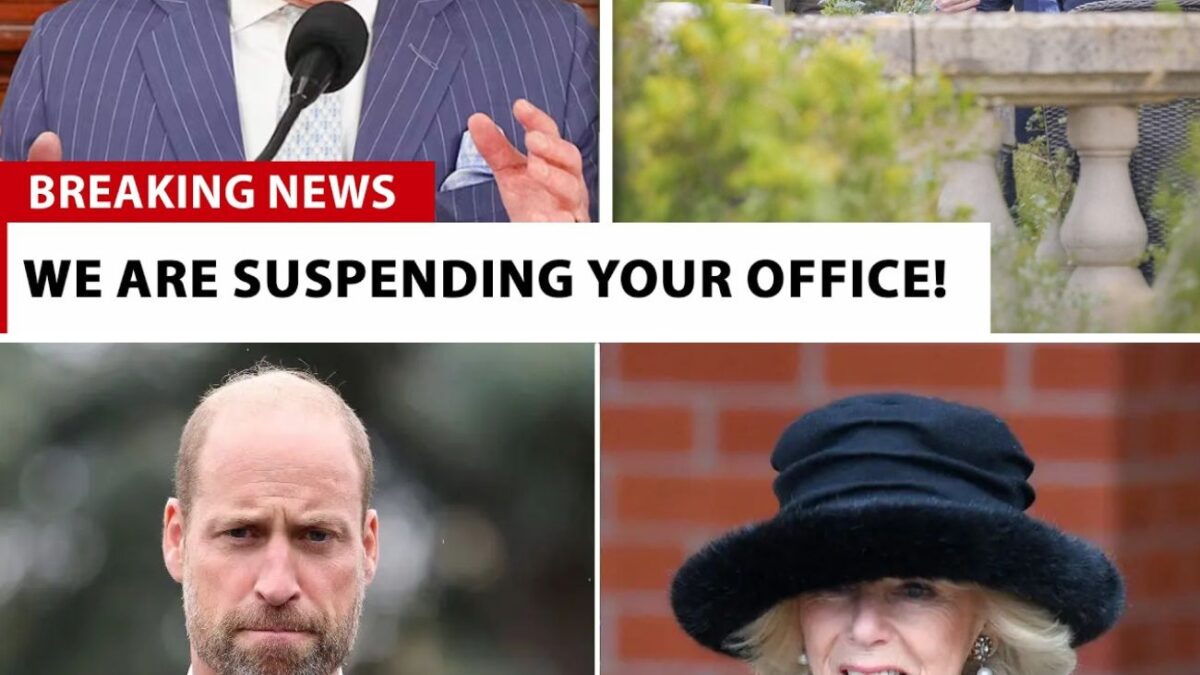
William’s Secret Palace Showdown With Camilla! The Document That Allegedly Triggered a Royal Power Crisis
A sealed envelope, an old divorce document, a mysterious office structure, and a confrontation involving Prince William, King Charles, and Queen Camilla.
That is the extraordinary scenario at the heart of the supplied story.
According to the script, the chain of events began during an autumn charity gala in Scotland in 2026. While Charles and Camilla attended the public-facing event, the real drama allegedly unfolded away from the cameras.
Waiting in a private library was Andrew Parker Bowles, Camilla’s former husband.
The story claims that Parker Bowles handed William a deep-blue envelope containing a financial settlement from his 1995 divorce from Camilla.
The document supposedly contained an indemnity clause designed to keep Camilla’s private finances separate from public royal funds.
That single piece of paper allegedly triggered a much larger investigation.
William, according to the narrative, became concerned that Camilla’s private office had developed beyond an ordinary administrative operation. The story claims that her staff were working independently from central palace structures, handling donors, photographers, communications, and patronages without the normal chain of clearance.
William allegedly did not confront Camilla publicly.
Instead, he took the document with him and instructed his private secretary to begin a comprehensive review.
The investigation reportedly focused on staffing, employment contracts, payroll records, and authorized positions across royal residences.
Then came the alleged discovery that transformed the dispute.
Four senior advisers working from Camilla’s private office were supposedly absent from official establishment registers. According to the script, they included communications advisers, a private diplomatic liaison officer, and a public-policy specialist.
The story claims their payments were routed through an independent Mayfair consultancy and ultimately connected to private trust arrangements.
That created an explosive question.
If the Sovereign Grant was not paying these people, who was?
The narrative presents this as the beginning of what it calls a “parallel power structure.”
Camilla’s office allegedly defended the advisers as part of her personal patronage work and therefore outside William’s authority.
William, however, supposedly became even more concerned.
The next confrontation allegedly involved transportation.
William had a scheduled engagement in Edinburgh, with security and vehicles arranged well in advance. Then, according to the story, Camilla’s office issued an urgent request for priority access to royal transport resources because of an unexpected engagement.
The request allegedly carried a red stamp identifying it as direct authorization from the Queen’s private office.
The story claims that officials questioned the authority behind the instruction because it had not passed through the normal centralized coordination system.
The situation supposedly escalated at RAF Northolt.
William’s aircraft was allegedly delayed while representatives from Camilla’s office attempted to secure additional transportation arrangements.
According to the script, William responded by requesting authenticated copies of the order and ensuring that the incident was officially recorded.
He then flew to Edinburgh.
But the dispute did not end there.
The next phase allegedly took investigators into the royal household’s internal technology systems.
According to the story, William authorized a forensic examination involving accountants and cybersecurity specialists. They supposedly discovered an encrypted auxiliary server associated with Camilla’s office.
The server was allegedly operating separately from the centralized financial and administrative systems.
The script describes an internal platform called “CR Privy,” which supposedly processed staffing, procurement, travel, and communications expenses without passing through the normal approval chain.
Then came the most sensational claim.
Investigators allegedly discovered a forty-page document titled Charter for the Restructuring of the Queen’s Household.
The document supposedly outlined plans to establish Camilla’s office as a permanently autonomous institution, including independent funding arrangements, security resources, and authority over certain external patronages.
If true, the implications described in the story would have gone far beyond an ordinary disagreement between palace offices.
The script portrays it as a potential constitutional conflict.
William allegedly took the evidence directly to King Charles.
The meeting supposedly took place at Birkhall, with Charles, William, and Camilla alone in a private study.
No advisers.
No lawyers.
No officials.
Just the three of them.
William reportedly presented three categories of evidence.
First came the 1995 divorce settlement.
Second was the alleged forensic dossier concerning the private-office financial system and transportation instructions.
Third was the draft charter supposedly designed to formalize greater independence for Camilla’s household.
Camilla, according to the story, defended her operation as a practical response to the demands placed on a modern Queen.
She reportedly argued that contemporary royal work required flexible communications, specialized staff, and faster decision-making.
She also rejected the suggestion that the advisers represented a rival court.
But William allegedly answered with a constitutional argument rather than a personal one.
He reportedly warned Charles that allowing two separate approval mechanisms to operate inside one monarchy would create competing centers of authority.
The story then reaches its decisive moment.
Charles allegedly looked at the old divorce document and the evidence placed before him.
He reportedly concluded that the royal household could not operate with two separate governing structures.
The script claims he then signed an order consolidating the administration under a unified system.
The following morning, two unmarked vehicles allegedly entered Clarence House.
According to the narrative, senior officials arrived carrying an executive instrument bearing the Privy Council seal.
They reportedly went directly to the basement.
The alleged CR Privy server was disconnected, its storage equipment secured, and the system removed from operation.
The four advisers were then supposedly summoned to a briefing room.
Termination notices were read.
Their security passes were cancelled.
They were escorted from the building.
The story claims that even Camilla’s distinctive private-office seal was taken into official custody.
Then came perhaps the most symbolic image of all.
A brass sign identifying Camilla’s office was reportedly removed from the corridor.
In its place appeared a much more bureaucratic designation: an auxiliary coordination section operating through the central Buckingham Palace liaison structure.
There was supposedly no dramatic announcement.
No public confrontation.
Just administrative changes behind palace walls.
Weeks later, according to the story, Charles and Camilla appeared publicly together at a national celebration.
To anyone watching, nothing appeared unusual.
Camilla stood beside the King and waved to the crowds.
But the story claims that the machinery behind her appearances had changed. Her transport arrangements were allegedly being coordinated centrally, while her public remarks were subject to the same centralized communications process as other royal engagements.
The crown remained visible.
The independent machinery supposedly did not.
The final scene returns to William.
According to the script, he placed the deep-blue envelope from Andrew Parker Bowles into a secure safe alongside constitutional documents and succession papers.
The alleged crisis was over.
But the story leaves behind a larger question about the difference between ceremony and administration.
The British monarchy is both a family and a constitutional institution, and the supplied narrative turns that tension into the central drama.
Was the old divorce document really the key to everything?
Did Camilla’s office actually become a separate power center?
Or is the entire episode simply a dramatic fictional reconstruction of what a palace struggle might look like behind closed doors?
Current official Royal Family material confirms that Camilla is Queen and that Clarence House has a long-standing historical connection with the King and Queen, while official Court Circular records document royal engagements. However, the extraordinary claims in this supplied script—such as a secret “CR Privy” server, four undeclared advisers, a forged authorization, or William ordering the dismantling of Camilla’s private office—are not established by those public records.
That distinction makes the story even more intriguing.
Because the most explosive palace battles are often imagined not in front of cameras, but in quiet rooms, behind closed doors, where one document can suddenly become more powerful than an entire public ceremony.








