“William’s SHOCK Royal Move: Why James Suddenly Stood at the Center of a Family Storm”
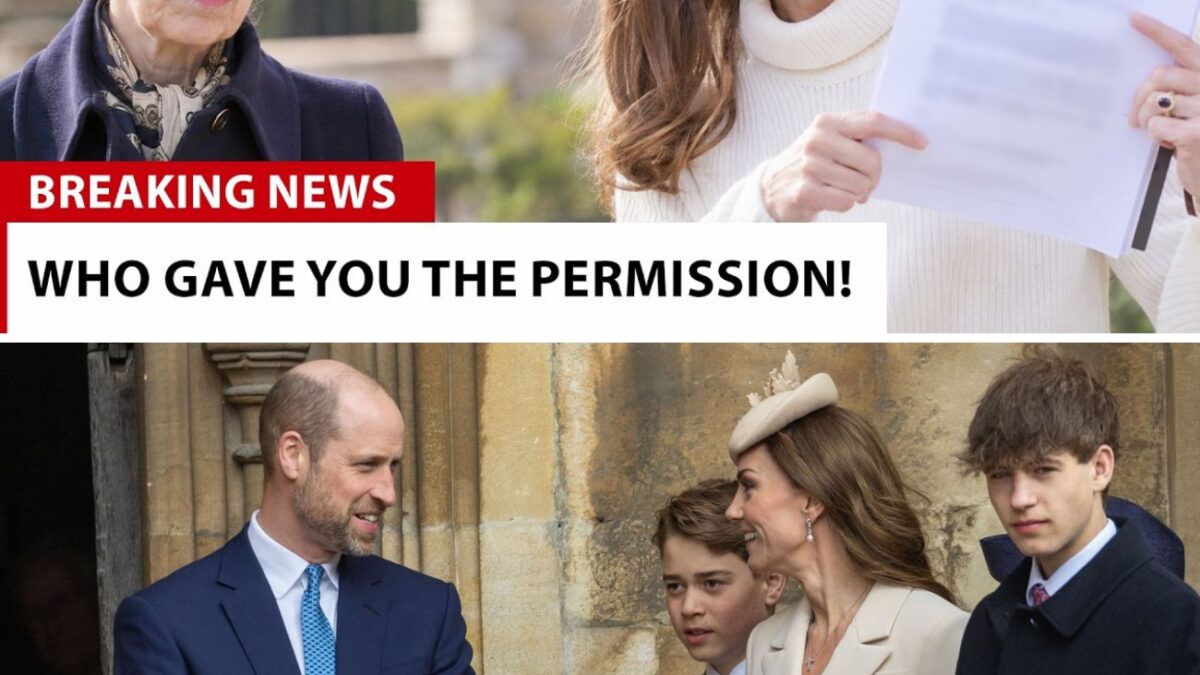
William’s SHOCK Royal Move: Why James Suddenly Stood at the Center of a Family Storm
There are moments in royal life when a single photograph can create more questions than a hundred official statements.
The story supplied for this article imagines one of those moments.
On a cold Sunday morning at Sandringham, Prince William is said to have appeared for the traditional church walk with Catherine and their children. But according to the dramatic scenario, attention quickly shifted toward another young member of the family: James Alexander, described in the script as the 18-year-old Earl of Wessex.
The image was supposedly striking.
William walked at the front. His family followed. And James appeared close beside him, wearing an understated tweed coat and an old watch said to have belonged to Prince Philip.
For royal watchers, the symbolism seemed almost too perfect.
Yet there is an important factual distinction. The Royal Family’s current official biography identifies Prince Edward’s son as the Earl of Wessex, previously James, Viscount Severn, and gives his date of birth as 17 December 2007. The official succession list currently places him 17th, after Princess Beatrice, her daughter Sienna, Princess Eugenie’s children and other relatives.
So the dramatic claim that James had suddenly been placed at the center of the monarchy’s constitutional future is not supported by the public record.
But within the supplied story, that is precisely where the intrigue begins.
A photograph becomes a message
The fictional narrative describes James standing beside William as something more than a family arrangement.
The old watch becomes a symbol.
It supposedly connects the young Earl with Prince Philip’s generation and with a style of royal service built around duty, restraint and privacy.
At the same time, the absence of Prince Harry and Meghan Markle is presented as conspicuous.
The script portrays their absence as evidence that William had decided to draw a permanent boundary between the working monarchy and the Sussexes.
That interpretation, however, should not be confused with documented palace policy.
In reality, Harry and Meghan ceased being working members of the Royal Family after stepping back from royal duties, while their relationship with the institution has remained a subject of continuing public interest. Reuters reported in September 2026 that King Charles had sent a letter to senior officials confirming that Harry and Meghan were no longer working members of the Royal Family and should be regarded as private citizens.
The letter
The story then introduces a mysterious letter.
According to the script, Princess Anne receives a lengthy handwritten message from Harry and brings it to a private meeting with William.
The letter supposedly expresses regret, a desire for reconciliation and hopes that Harry’s children could reconnect more closely with Britain.
But Anne, in the narrative, is suspicious.
Rather than concentrating on the emotional language, she allegedly studies the timing.
Why now?
Why this particular moment?
And what does Harry actually want?
The script portrays William as saying very little. Instead, he studies the succession documents on the table and eventually turns the conversation toward James.
That is the dramatic pivot.
The story suggests that William was not simply considering a person. He was considering a philosophy of royal service.
The Wessex example
The narrative then reaches back to Prince Edward and Sophie.
It presents their family as an alternative model of royal life: less theatrical, less dependent on titles and more focused on private responsibility.
The official Royal Family biography confirms that Edward and Sophie have two children, Lady Louise and the Earl of Wessex.
The script takes that real family structure and turns it into a larger argument.
James, it claims, represents a generation raised close enough to the monarchy to understand its responsibilities but far enough away to experience an ordinary childhood.
That contrast becomes particularly important when the story turns toward Harry and Meghan.
The supplied narrative makes sweeping claims about their commercial activities and motives. Those claims are not established facts and should be treated as part of the dramatic framing rather than as evidence.
There is, however, a documented commercial history. Reuters reported in December 2025 that Archewell was being restructured while Archewell Productions continued to hold a multi-year Netflix relationship.
The constitutional twist
Then comes the legal element.
The script invokes the Succession to the Crown Act 2013 as the mechanism behind William’s supposed strategy.
This part contains a real legal provision, although the story dramatically exaggerates what it means.
Under Section 3 of the Act, a person who is among the first six people in line to the Crown at the time of marriage must obtain the Sovereign’s consent. If that consent is not obtained, the person and descendants of that marriage are disqualified from succeeding.
But this does not mean William could simply use the provision as a personal weapon against Harry’s children.
The law applies according to the person’s position in the succession at the relevant time; it is not a mechanism giving William unilateral power over family members.
The distinction is crucial.
Two versions of royal duty
The supplied story nevertheless turns the legal provision into a dramatic metaphor.
On one side stands Harry and Meghan’s life outside working royal duties.
On the other stands the working monarchy represented by William, Catherine and the wider royal family.
James becomes the symbolic bridge between those worlds.
The script imagines him receiving briefings about royal estates, charitable responsibilities and institutional traditions.
It portrays him entering rooms once occupied by senior officials and learning how the machinery of the monarchy works.
But no reliable public source establishes that William has transferred operational control of the Crown Estate portfolio or diplomatic responsibilities to James.
Those claims therefore belong to the fictionalized scenario rather than the documented royal record.
The final image
And yet the story’s final scene remains deliberately powerful.
William walks ahead.
James is nearby.
The royal family moves toward the church while photographers watch every step.
Nothing dramatic happens.
No argument.
No announcement.
No confrontation.
That silence becomes the supposed message.
The story asks readers to look beyond titles and consider what the next generation might represent.
Harry and Meghan remain part of the wider royal story, but outside the working structure. William represents the future sovereign. George, Charlotte and Louis occupy the first positions immediately behind him in the published succession. James remains further down the list, despite the dramatic role assigned to him in the scenario.
That is where the story becomes less about one young Earl and more about the enduring question of what a monarchy expects from the people born into it.
Is royal influence created by a title?
By proximity to the throne?
By public visibility?
Or by the willingness to accept responsibility without demanding the spotlight?
The supplied narrative clearly favors the last idea.
But the real royal family is more complicated than any viral headline.
And perhaps that is exactly why a single photograph—real or imagined—can generate so much fascination.
Because when the Windsor family walks together, every position, every gesture and every face invites the public to wonder what comes next.








