A little girl found a dying Hells Angels boss – what she did changed everything.
A little girl found a dying Hells Angels boss – what she did changed everything.

It was one of those wintry Saturday mornings when the snow fell in thick, slow flakes, enveloping the whole world in a deep, almost reverential silence. Ellie stood at the door of the small wooden cabin on Miller Ridge. She was only seven years old, petite for her age, and her late mother’s green winter coat almost swallowed her up completely. Her grandmother Ruth had folded the sleeves up twice and sewn them fast.
“The wooden box is almost empty, my love,” Ruth called from the warm kitchen. “Get some more and watch out for the ice under the snow.”
Ellie nodded obediently, pulled on her mittens, and grabbed the old, stiff tarpaulin that served as a makeshift sled. The cold outside immediately bit her rosy cheeks. Suddenly, a terrible noise shattered the silence—a damp, crunching crash of metal. A sound that didn’t belong in this white, peaceful world. Ellie paused. She knew she shouldn’t go out onto the street alone, but a feeling of unease deep in her gut urged her on.
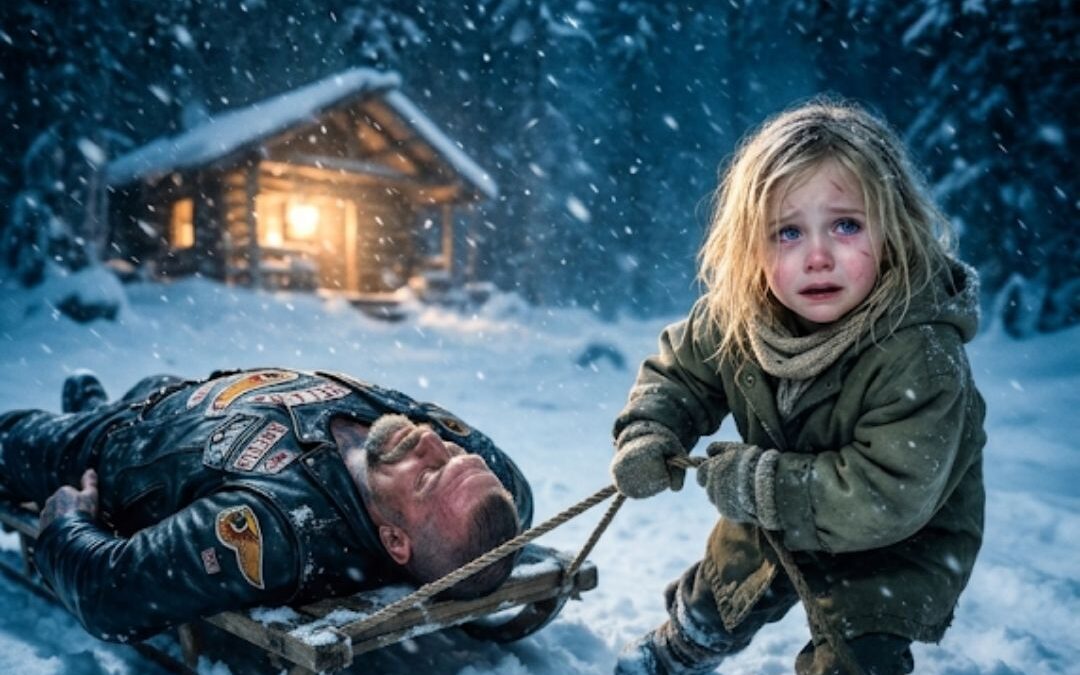
About fifty feet down the path, she spotted the dark outline. A heavy motorcycle lay wrecked in the ditch, its front wheel twisted unnaturally. A few feet away lay a man—massive, dressed in a black leather vest, his leg broken at a gruesome angle. His breathing was shallow and rapid, in small white puffs. Ellie weighed barely twenty kilos, but when she saw that the giant didn’t open his eyes, she knew: she couldn’t abandon him. She knew all too well what it felt like to wait for someone who would never come back.
Her heart pounding, she ran back to the shed, fetched the old wooden sled with the red runners, and dragged it through the deep snow back to the ditch. “Mister,” she whispered, touching his cold shoulder. “I’m going to pull you onto this sled. But you have to help me.”
Cade, as the man was called, blinked open his eyes. Together, with his last bit of strength and her indomitable childlike will, they made it. Ellie wrapped the rough pull rope around her wet mittens and pulled. Every step burned in her small legs, but she fixed her gaze on the warm, yellow light from the kitchen window. When they reached the porch, utterly exhausted, Ruth rushed out. Without hesitation, the resolute woman in her late sixties acted, administering first aid, instructing Ellie to apply pressure to the wounds, and alerting Sheriff Dale Puit and the ambulance.
Cade underwent emergency surgery at the hospital. His son Jesse, with whom he had a strained, distant relationship, rushed to his side. The air between father and son was thick with unspoken accusations. Cade, the president of a motorcycle club, was used to solving problems with money or his fists. From his hospital bed, he made Ruth an offer: he would repair the house, pay all the bills—a gigantic sum as a thank you.
But Ruth’s face closed like an iron door. “I don’t accept charity,” she said with an icy calm. “First it’s a kind gesture, then a favor, and finally a demand. I don’t sell my kindness. Neither mine, nor my granddaughter’s.” Cade was speechless. In his world, debts were settled quickly and cleanly. The fact that this woman was simply showing decency without asking for anything in return was beyond his comprehension.
Ruth’s unwavering pride was not unfounded. Her cousin Vern, a greedy and bitter man, had been trying for years to steal the property from her. He claimed Ruth had no proof of purchase, her papers were lost, and as an old, poor widow, she was incapable of raising a child. His goal: to put Ellie in a home and sell the valuable land.
To at least return the damaged sled to Ruth repaired, Cade sent his son Jesse to the cabin. As Cade examined the broken wooden slat of the sled, a rusty metal box suddenly fell out. Inside, carefully wrapped in wax paper, were the original, notarized deed of sale for the land, 22 years of unbroken tax receipts, and a handwritten letter from Ellie’s late mother. “Grandma, I’m hiding these papers here because the sled is the one thing Vern never borrows…” The little girl from back then had secured her family’s future out of fear of her own cousin.
Cade wanted to use his wealth immediately to pay Ruth’s lawyer, Mr. Hollis, and destroy Vern. But Mr. Hollis and Jesse stopped him. “If Vern’s lawyer sees a biker paying her bills,” Hollis warned, “he’ll claim Ruth is dependent on strangers and incapable of providing for Ellie on her own.” Cade understood painfully: his money was a curse, not a blessing. He had to learn to help in a different way. Without checks. Without ego.
When Vern, out of revenge, filed an emergency motion to remove Ruth’s parental rights, rumors began to swirl in the small town. People whispered in the Bluebird Diner and outside the church that Ruth was in cahoots with a biker gang. The pressure was immense. Cade withdrew completely to protect Ruth’s reputation. Instead, he and Jesse anonymously sent split firewood through the church and secretly repaired the broken porch steps. It was the quiet, unseen work of true remorse.
Meanwhile, Cade discovered a crucial detail on his torn leather jacket at a tailor’s: a bent fence staple and black horsehair. His accident hadn’t been a simple slip on ice. Vern’s stallion had escaped through a dilapidated fence and was out on the road at night. Vern had lied to avoid prosecution. Cade handed the evidence over to Sheriff Puit—not to seek revenge, but simply to ensure the truth was on record.
The day of the trial arrived. The courtroom smelled of floor wax and damp wool. Vern’s lawyer painted a picture of an overwhelmed woman living in a dilapidated shack that housed dubious characters. But Mr. Hollis countered masterfully. He presented the documents found in the sled, which proved Ruth’s ownership beyond doubt. Social worker Mrs. Ames testified that Ellie grew up in a loving, warm, and structured home. Ellie’s teacher, Miss Harmon, had already confirmed how much the girl had blossomed.
The turning point came when Sheriff Puit took the stand. He gave a blunt account of the broken fence, the runaway horse, and the evidence found in Cade’s jacket. “Did Mr. Vern lie to you?” Mr. Hollis asked. The sheriff’s answer brought Vern’s house of cards crashing down: “He did.”
Finally, Mr. Hollis played his last trump card: an old piece of mail, which Ruth had proudly never opened, that was also in the sled. It was the approval of a widow’s pension for her late husband’s service in the military. Not charity, but a legally binding right. A steady income. Judge Callaway looked over his glasses, firmly rejected Vern’s motion, and granted Ruth custody. Justice had prevailed.
A few days later, when the snow was once again falling gently on Miller Ridge, Cade and Jesse drove back to the cabin. Cade brought glue and oak lumber to finally finish repairing the sled. Ruth, whose proud facade had been tarnished by the two men’s selfless help, wouldn’t let them freeze outside. “Go into the shed, the stove’s lit,” she said with a hint of a smile.
While Jesse, Cade, and little Ellie sanded and repainted the sled together—a task that healed not only the wood but also the fractured relationship between father and son—Cade pulled one last, faded yellow envelope from his jacket. He had found it in the false bottom of the sled box. “This is for you, Ellie. From your great-grandmother.”
Ellie sat down on the repaired porch steps and read aloud in a clear, firm voice: “My little girl, I want to tell you something I learned the hard way. Helping others doesn’t have to cost a fortune. Wealth comes and goes; it makes some people arrogant and others small. But simply being there, that’s free. Being there when it’s cold and there’s work to be done. Being there on days when everyone else stays away. That’s all that matters. Your grandma is a proud woman; she gets that from me. Tell her it’s all right to let someone else help you carry the load sometimes.”
Ruth stood in the doorway, pressed her hand to her mouth, and finally let the tears she had held back for so many years flow freely. In that moment, surrounded by the white, silent snow, they all understood: family isn’t just the blood that binds us. Family is the people who choose to pull the heavy sled with us through the coldest winter.
You Might Also Enjoy

A millionaire beat his pregnant wife until she lost the baby – her father’s revenge shocked the public.

The doctor sent the inexperienced nurse away – but her combat skills, acquired in the Navy, revealed who she really was.

Nine nurses fled from the feverish mafia boss – his portly veterinarian opened the stab wound in his back.

The mafia boss had been unable to walk for eight years – then a single mother found a needle hidden in his wheelchair.
“My Skin Hurt” — German Woman POW Shocked as U.S. Army Medics Save Her From Losing Both Hands
“Eat This Brown Paste” – German Women POWs Shocked That Americans Ate Peanut Butter Every Day