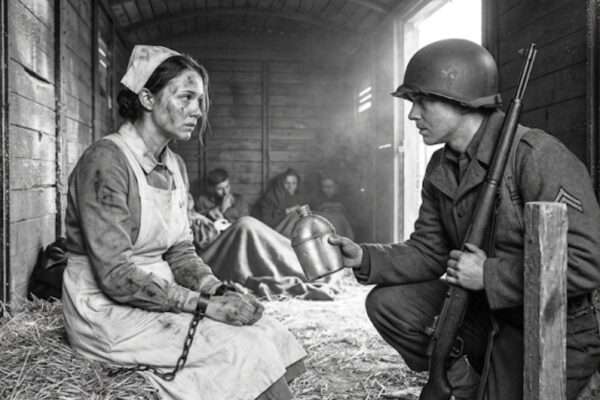
“My Skin Hurt” — German Woman POW Shocked as U.S. Army Medics Save Her From Losing Both Hands
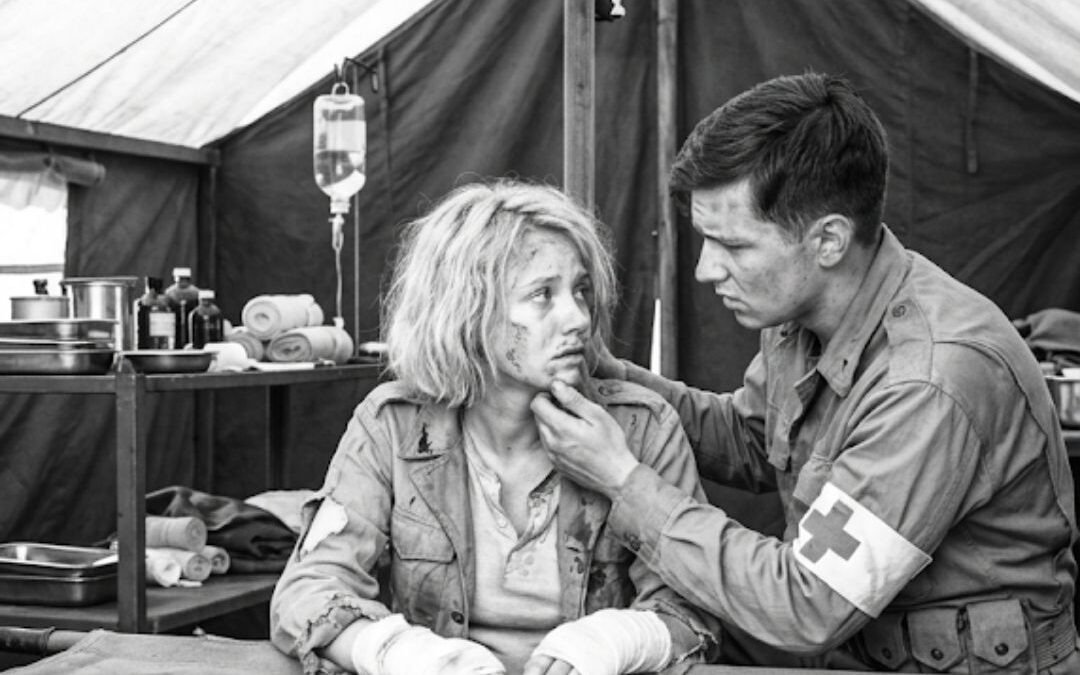
“My Skin Hurt” — German Woman POW Shocked as U.S. Army Medics Save Her From Losing Both Hands
In March 1945, at Fort Sam Houston, Texas, a seventeen-year-old German girl sat in a hospital examination room with her hands wrapped in stained bandages. Beneath the gauze, three fingers had turned black. The infection had spread towards her wrists, and Captain Aldrich Peton, the physician in charge, feared she might lose her hands—or her life.
“How are you still alive?” he whispered.
The girl, Ilsa Drestler, did not understand his words. She understood the concern in his expression. For weeks, she had expected nothing from her captors except punishment. Now American doctors were examining her wounds as though her life mattered.
Earlier that morning, forty German women had arrived at the military base. Captured in Belgium during the winter fighting, they had crossed the Atlantic aboard a cargo ship never intended to carry passengers. Sergeant Roy Kemp had expected German soldiers when the trucks entered the compound. Instead, forty exhausted women climbed down, their grey uniforms hanging loosely from their thin bodies.
Ilsa was among them. Her fair hair had been cut short, and she kept her eyes lowered while the guards checked the names on their list. The bandages around her hands were brown with dried blood. She had wrapped them herself, using whatever scraps of cloth she could find.
The Atlantic crossing had been miserable. Storms delayed the ship, and the women were crowded into a freezing metal hold. There were too few blankets and no proper beds. They took turns occupying the warmer space in the centre, huddling together to survive the cold. Ilsa had given her place to an older woman who was coughing blood. Soon afterwards, she began losing feeling in her own fingers.
First they became numb, then purple. By the time the ship reached Virginia, some had turned almost black. Two women died during the voyage. Their bodies were recorded as transport casualties and buried near Norfolk.
Ilsa barely managed to walk ashore. After several days of processing, she was sent to Texas. She had been taught that Americans were cruel, that captured Germans would be tortured or left to die. The suffering aboard the ship had seemed to confirm every warning.
At Fort Sam Houston, the hospital was bright, clean and strangely peaceful. Captain Peton had treated hundreds of German prisoners, most of whom arrived exhausted but in reasonable health. The women were different. They were undernourished and suffering from exposure.
When Peton began removing Ilsa’s bandages, the gauze stuck to her skin. She made a small sound of pain. He stopped immediately. Three fingers on her left hand showed severe frostbite. Both palms were cracked, and patches of dead tissue had turned grey and black. Red streaks ran towards her wrists, suggesting that infection was spreading.
Peton called for Emmett Pruitt, a young medic working in the adjoining room.
At twenty-two, Pruitt was tall and thin, with unruly dark hair and a strong Oklahoma accent. A childhood illness had left his left ear ringing constantly, making him unsuitable for combat service. He had once felt ashamed of being kept away from the fighting. Caring for wounded soldiers had gradually shown him that service did not always require a rifle.
He looked at Ilsa’s hands and understood how serious the situation was. Unlike soldiers who were usually treated soon after being wounded, this girl had endured weeks without proper medical attention. The infection could cost her fingers, perhaps her life.
Peton explained what needed to be done. Pruitt would have to remove the dead tissue, clean the wounds thoroughly and apply sulphonamide powder. The dressings would need changing twice a day, with close observation for signs of blood poisoning. Amputation remained a possibility if the infection had reached the bone.
Ilsa understood little English, but she recognised the serious tone. Before the war, she had studied nursing in Hamburg for two years. She knew when doctors were discussing a patient’s chances of survival.
A guard in Belgium had once laughed at her injuries and told her that Americans would never waste medicine on a German girl. She believed him. When Pruitt approached with surgical scissors, she flinched, certain he was about to remove her fingers.
He noticed her fear and immediately put the scissors down. Raising both hands, he pointed to the dirty bandages and then to a fresh roll of white gauze. He mimed removing the old dressing and replacing it with a clean one.
“All right,” he said gently. “This will hurt, but we’ll try to save them.”
His words meant nothing to her, but his manner was reassuring.
Pruitt worked slowly, cutting away the stiffened layers of cloth. Some had stuck to the damaged skin, and each movement caused Ilsa’s shoulders to tremble. She tried not to cry. He kept speaking softly, encouraging her to hold on.
He washed her hands with warm antiseptic solution. The liquid stung the exposed wounds, and tears slipped silently down her cheeks. Then he began removing the dead tissue, using tweezers and surgical scissors with great care. The grey-black skin had to come away, but the healthy flesh beneath it needed protecting.
The procedure lasted forty-three minutes. When he finished, the basin was clouded with blood and fragments of damaged tissue. Ilsa’s hands looked raw, but they were clean. Pruitt dried them gently, applied the medicine and wrapped each finger separately in fresh white gauze. He made sure the bandages were secure without being tight enough to restrict circulation.
“There,” he said. “That’s better.”
Ilsa stared at her hands, then at the young medic. In German, she asked, “Why are you helping me?”
Pruitt could not answer in her language. He simply smiled and continued checking the dressings. For the first time since her capture, she wondered whether everything she had been told about Americans might be untrue.
For the next twelve days, Ilsa returned to the hospital every morning. A military policeman escorted her from the women’s compound across the parade ground. The guards seemed more interested in their newspapers and coffee than in frightening the prisoners. The Texas air smelled of dust and mesquite, a word Pruitt taught her as her English slowly improved.
Each visit followed the same routine. He removed the old dressings, examined her fingers, cleaned the wounds and applied fresh medicine. The first few days were critical, but the red lines gradually faded and the swelling decreased. Healthy pink skin began appearing beneath the damaged areas.
By the fifth morning, Pruitt was smiling.
“Very good. You’re healing.”
Ilsa watched his face while he worked. He never hurried her or handled her roughly. He spoke even when she could not understand, and his expression brightened whenever her condition improved. She had expected cruelty from her captors. She had never expected such patience.
On the seventh day, she found the courage to speak.
“Danke,” she said, pressing one hand against her chest. “Thank you.”
“You’re welcome,” Pruitt replied.
She struggled to form the next sentence. “In Germany, they say Americans are cruel. They say you hurt prisoners. I thought you let my hands die because I am German. But you help me. Why?”
Pruitt paused. He had read reports of German atrocities, and the photographs emerging from liberated concentration camps were difficult to comprehend. American families had lost sons to German bullets and bombs. He could not forget that suffering. Yet the young woman sitting before him was not an entire nation or its government. She was a patient who needed help.
“Because I’m a medic,” he said. “We treat the person in front of us. Pain is pain. It doesn’t matter what uniform someone wears.”
Ilsa considered his answer.
“Maybe that is why America will win,” she said slowly. “Not only because you have more guns. Because you still see people as people.”
On 8 May 1945, news of Germany’s unconditional surrender reached Fort Sam Houston. Outside, servicemen cheered and lorries sounded their horns. In the laundry, where Ilsa had been assigned light duties after her hands improved, the German women fell silent.
Her fingers still ached after long shifts, and pale scars crossed her palms, but all ten fingers worked. She thought of Hamburg, her mother and her younger sister. Her father had been killed in 1943 when a bomb struck his school. She had no way of knowing whether the rest of her family had survived.
Consuelo Aguirre, the laundry supervisor, noticed her standing quietly beside a table of folded sheets. Consuelo was fifty-six, with iron-grey hair and hands roughened by years of work. She had lost a nephew at Normandy and a son-in-law in the Ardennes. She had every reason to resent the German prisoners, yet she approached Ilsa with a cup of cold water.
“You all right, dear?” she asked.
“I do not know,” Ilsa answered. “The war is finished. My country is destroyed. I do not know if my family lives.”
“They’ll send you home when the paperwork is finished,” Consuelo said. “And there’ll be something to do when you get there. People rebuild.”
That evening, the women gathered in their barracks. Waltraud, the oldest among them, had spent months warning the others not to trust American kindness. Now she admitted that they had survived and would have to face whatever came next. Ilsa thought of Pruitt’s careful hands, Consuelo’s water and the policeman who had learned to greet her with a badly pronounced “Guten Morgen”. Small gestures, she realised, could make a difference when the world seemed beyond repair.
A fortnight later, Pruitt received orders to report to California. American medical staff were preparing for the expected invasion of Japan. He and Ilsa met by chance near the camp commissary. Her hands were bare at last, the scars visible across her palms.
“You are leaving,” she said.
“New orders. They need medics out west.”
She held out her right hand, the one he had feared might be lost. He shook it carefully. Her grip was strong.
“Thank you for my hands,” she said. “And for showing me not all Americans are as we were told.”
“Take care of yourself, Ilsa. I hope you find your family.”
She watched him walk away, carrying the memory of a kindness she could never repay.
Ilsa returned to Germany in November 1945. This time the ship was heated, the passengers had blankets and proper meals, and medical staff checked on them regularly. Hamburg was almost unrecognisable. Streets had become passages through rubble, and families lived in cellars or damaged buildings. Eventually, she found her mother in a village thirty kilometres outside the city. Her younger sister had married a British soldier and was living in Manchester.
In 1946, Ilsa returned to nursing school. Despite shortages and makeshift classrooms, she completed her training and spent the next forty-two years caring for patients in Hamburg, Munich and, after reunification, Berlin. She married a teacher, Friedrich Weber, in 1952. They raised three children, teaching them never to judge people solely by their nationality or uniform.
She often told them about the American medic who had saved her hands. She lived to see the Berlin Wall fall in 1989, watching people celebrate a future that had once seemed unimaginable. The scars on her palms never disappeared completely. Whenever summer light reminded her of Texas, she remembered the white bandages and the gentle voice she had struggled to understand.
Pruitt remained in military medicine. Japan surrendered before the invasion for which he had been preparing, and he went on to treat veterans in American hospitals for thirty-three years. He married Dorothy Chen, a nurse at the San Diego Naval Hospital, and they had two sons, both of whom became doctors. He sometimes wondered whether Ilsa had reached home safely. In 1978, he tried to trace her through the Red Cross and military records, but the trail had gone cold.
He never learned that she had lived a long life, raised a family and remembered him until her final days. Ilsa died in 2009, aged eighty-one, surrounded by her children and grandchildren. Her last words, spoken softly in English, were: “Thank you, Emmett. I was all right.”
Pruitt had died thirteen years earlier, never knowing how far his kindness had travelled. It had not changed the course of the war or repaired the devastation left behind. But it had given one frightened girl a reason to question hatred—and a lesson in compassion she carried into every hospital ward where she later worked.
History remembers generals, governments and great battles. It has less room for a medic who spends forty-three minutes cleaning an enemy’s wounds. Yet for Ilsa Drestler, those minutes mattered more than any victory parade. In a hospital in Texas, a young man had looked beyond her uniform and seen a person in pain. Her hands healed. The scars remained. And the kindness she received became something she could pass on, long after the guns had fallen silent.
You Might Also Enjoy


A millionaire beat his pregnant wife until she lost the baby – her father’s revenge shocked the public.

The doctor sent the inexperienced nurse away – but her combat skills, acquired in the Navy, revealed who she really was.
Nine nurses fled from the feverish mafia boss – his portly veterinarian opened the stab wound in his back.

The mafia boss had been unable to walk for eight years – then a single mother found a needle hidden in his wheelchair.
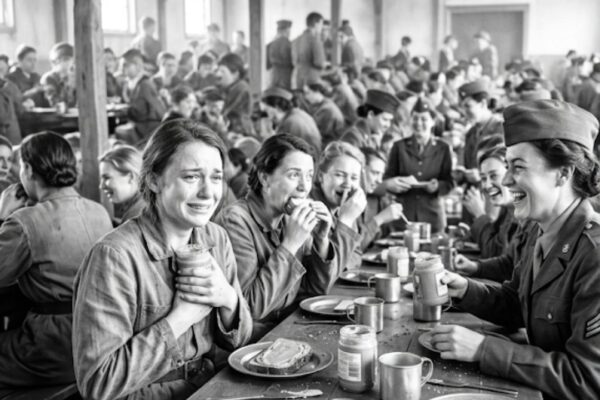
“Eat This Brown Paste” – German Women POWs Shocked That Americans Ate Peanut Butter Every Day