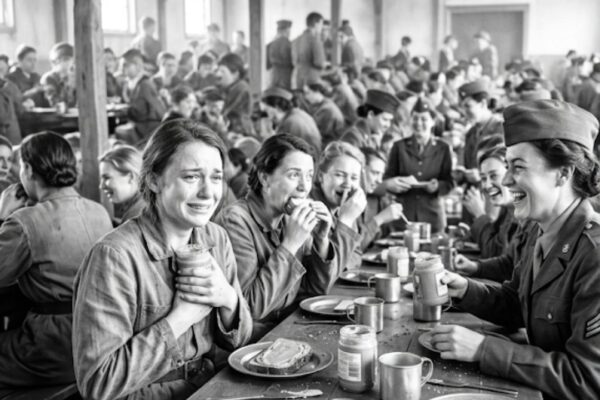
“When Did You Last Eat?” – German Woman POW in Chains Breaks Down at US Soldier’s Question
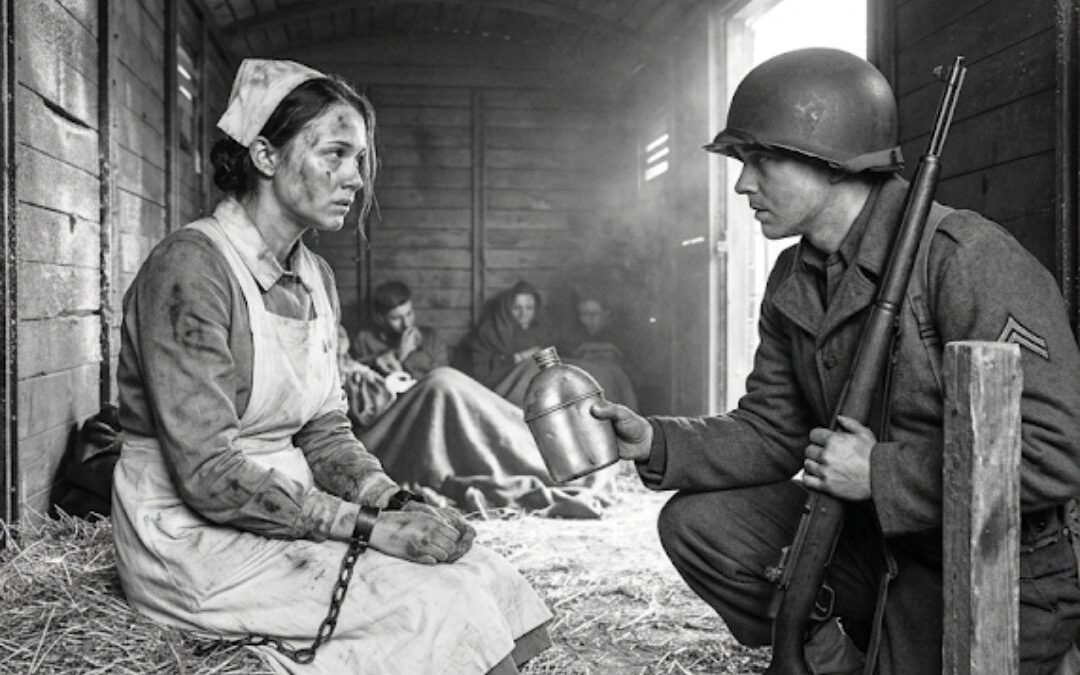
“When Did You Last Eat?” – German Woman POW in Chains Breaks Down at US Soldier’s Question
On 17 April 1945, in a deserted railway yard outside Munich, a young German nurse had almost given up hope. For five days, she had been chained inside a cattle wagon without proper food, water or shelter. Her crime was not espionage or sabotage. She had simply told fellow Germans that the war was lost and that they should surrender before more lives were wasted.
For expressing that opinion, she had been treated as a traitor. Now, with her wrists bruised by iron shackles and her body weakened by hunger, she waited for whatever fate awaited her.
Twenty-three other women were imprisoned in the same wagon. Most had served as nurses, clerks or auxiliary workers for the German armed forces. They had been told that capture by the Americans meant humiliation, torture and death. Nazi propaganda had repeated those warnings so relentlessly that many had come to believe them.
Then an American patrol arrived.
Sergeant Emmett Krenshaw, an Alabama soldier who had spent three years fighting across Europe, noticed that one of the railway wagons had been chained shut from the outside. Something about it troubled him. German forces were abandoning equipment everywhere, but there was no obvious reason to lock an ordinary cattle wagon so securely.
He ordered his men to cut the chain.
When the heavy doors finally opened, a terrible smell escaped into the cold morning air. Inside, twenty-three frightened women stared towards the light. Some covered their faces. Others remained motionless, too exhausted to react.
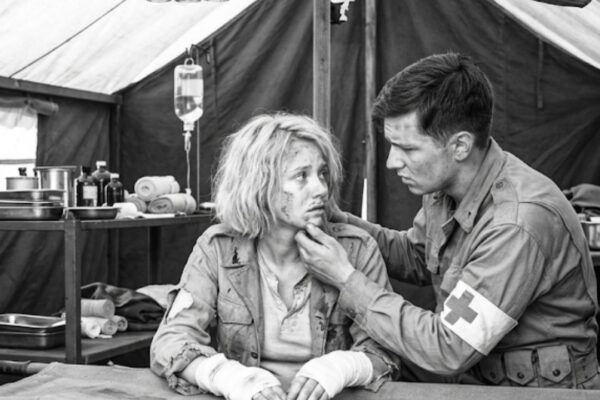
Krenshaw immediately noticed the young nurse in the middle of the wagon. Her wrists were shackled to a metal support, forcing her to remain in an uncomfortable crouch. She could neither stand properly nor sit down.
He lowered his rifle, placed it beside the doorway and approached her slowly. Then he crouched until they were looking directly at one another.
In simple English, he asked, “When did you last eat?”
The woman stared at him. She had prepared herself for insults, threats and violence. Instead, the first question from the enemy concerned whether she had eaten.
Her name was Analisa Fogle, and suddenly the walls she had built around herself began to collapse.
She tried to answer, but her voice failed. Tears ran down her dirty cheeks. After five days of suppressing her fear, hunger and humiliation, she began to sob uncontrollably.
Krenshaw did not hurry her. He simply remained where he was, allowing her time to cry.
Behind him, Private Ronaldo Estrada and the other soldiers watched in silence. They had expected resistance or hostility, not this extraordinary moment of human vulnerability.
When Analisa finally regained some composure, Krenshaw turned towards his men. He ordered them to fetch bolt cutters and radio headquarters for medical assistance. The women needed immediate attention.
Estrada carefully cut the chain connecting Analisa’s shackles to the metal support. The moment she was free, her exhausted legs gave way. She sank onto the straw-covered floor, unable to stand.
Krenshaw offered her his canteen.
“Water,” he said, pointing towards his mouth.
She accepted it with trembling hands. The water was slightly warm from resting against his uniform. She took several cautious sips, each one bringing a little strength back into her body.
Around them, the other women were being helped from the wagon. One elderly prisoner, Waltraud Sidel, struggled down with assistance. At forty-four, she had four sons who had been conscripted into the Wehrmacht. None had contacted her.
A nineteen-year-old named Sieglinde remained frightened, pulling away whenever a soldier approached. Eventually, she accepted an outstretched hand. Another woman, nurse Helma Rothenberg, was so dehydrated that she had to be carried on an improvised stretcher.
Within an hour, American medical personnel arrived. Captain Vivian Callaway, a thirty-six-year-old army doctor from Richmond, Virginia, immediately organised treatment.
She examined Analisa’s wrists and frowned. The metal cuffs had cut deeply into her skin, leaving painful, infected-looking wounds. With Estrada’s help, she removed the remaining shackles and cleaned the injuries.
The women were given blankets, medical attention and, eventually, hot food. Krenshaw personally brought Analisa a cup of soup. She hesitated before accepting it, uncertain whether there might be some condition attached to the gesture.
“It’s all right,” he reassured her. “You need to eat.”
The soup was simple, mostly broth, vegetables and a little meat. Yet to Analisa, it tasted extraordinary. She held the cup between both hands, appreciating its warmth as much as its contents.
For the first time in days, she was not being punished for being hungry.
That afternoon, the women were transported to a temporary camp in an abandoned German military barracks. There were proper beds, clean blankets, running water and facilities for washing. Compared with the cattle wagon, the place seemed almost luxurious.
Captain Callaway explained the arrangements through a German-speaking interpreter. The prisoners would receive regular meals, medical examinations and suitable clothing. Those with useful skills could assist with light duties.
Analisa, having trained as a nurse before the war, was eventually assigned to the camp infirmary. She worked under Callaway’s supervision, helping care for wounded German prisoners.
The two women developed a quiet professional respect. Callaway admired Analisa’s patience and competence, while the German nurse gradually discovered that kindness did not have to depend on nationality.
Her own story emerged through conversations with the interpreter. She had grown up outside Stuttgart, the daughter of a baker. Her father, Conrad, had run a small family bakery, and her mother, Matilda, had hoped her daughter would enjoy a peaceful life.
But the war had changed everything. In 1943, Analisa had been recruited into military medical service. After years treating wounded soldiers, she had tried to return home as Germany collapsed.
Instead, military police arrested her for encouraging surrender. The officer responsible considered her words an act of disloyalty. Her punishment had been five days in the cattle wagon.
Life in the American camp slowly became predictable. There were meals, work, medical checks and opportunities to rest. Yet safety did not protect the women from the painful realities awaiting them outside.
Three weeks after arriving, Analisa received a letter from her mother.
The bakery had been destroyed during an air raid. Her father was dead, and her younger brother, Gustl, who had been conscripted at sixteen, was missing. Matilda was living with several other families in the basement of a damaged building. Food was desperately scarce.
Analisa read the letter repeatedly. She had a warm bed and regular meals while her mother struggled to survive among the ruins.
That evening, she could not bring herself to eat.
Captain Callaway noticed and asked what was wrong. After reading the letter, she returned it gently.
“I know it doesn’t seem fair,” she said, speaking slowly. “But starving yourself won’t help your mother. You must stay strong. One day, you may be able to help her.”
Analisa understood, although the guilt remained.
Then came another experience that changed her understanding of the war.
One month after their arrival, the women were gathered in the main hall. An American officer explained that they would be shown evidence of what the Nazi government had done in their name.
The lights went out, and a projector began displaying footage from liberated concentration camps, including Bergen-Belsen, Dachau and Buchenwald.
The images were almost impossible to comprehend. Emaciated prisoners, mass graves, piles of belongings and the remains of people murdered on an industrial scale filled the screen.
Some women covered their faces. Waltraud fainted. Others wept openly.
Analisa could not look away.
She had heard rumours about deportations and disappearances. Jewish families who had lived in her hometown for generations had vanished. She had sometimes wondered where they had gone, but had accepted the convenient explanations offered by the authorities.
Now she understood the terrible consequences of that silence.
When the lights returned, the room remained quiet. Someone whispered that they had not known. Through the interpreter, the American officer replied that ignorance could no longer be claimed now that they had seen the evidence.
That night, Analisa barely slept.
The following morning, she found Sergeant Krenshaw sitting outside the infirmary. He recognised her troubled expression and sat beside her, leaving enough space for her to feel comfortable.
She asked how anyone could forgive such things.
“I don’t forgive what was done,” he answered. “Nobody can simply forget it. But you can decide what you do from here.”
Analisa admitted that she should have asked more questions before. Perhaps she had been too frightened, too occupied with surviving, or too willing to believe what she was told.
Krenshaw did not pretend that her regret was unreasonable.
“You can’t change what happened,” he said. “But you can make sure you never stay silent again.”
After a pause, Analisa asked why he had spoken to her so gently in the cattle wagon. Why had he asked whether she had eaten instead of demanding information or accusing her of supporting the enemy?
He smiled.
“Because you looked hungry. Everyone deserves food, even prisoners. Even enemies.”
She remembered those words long afterwards. They had revealed something that years of propaganda had tried to erase: the humanity of another person.
Six months later, preparations began for the repatriation of German prisoners. Analisa was informed that she could return home. Her mother was still alive, and arrangements had been made for her journey.
Before leaving, she found Krenshaw outside headquarters. She thanked him for freeing her, for treating her wounds and, above all, for asking that simple question.
“You don’t have to thank me for basic decency,” he replied. “That should be normal.”
She looked at him thoughtfully.
“In Germany, it became something unusual,” she said.
Their conversation ended quietly. Neither knew whether they would ever meet again.
The journey home took three days. When Analisa finally reached her hometown outside Stuttgart, she barely recognised the streets. Buildings had become heaps of rubble, the church was badly damaged, and her father’s bakery had disappeared.
She found Matilda in the basement described in her letter. Her mother looked much older than forty-eight, her face thin and her hair almost entirely grey.
For several moments, they simply held one another and cried.
Later that evening, while sharing the food Analisa had brought from the camp, Matilda asked what the Americans had been like. Had they treated their prisoners cruelly?
Analisa could have repeated the familiar stories. Instead, she chose honesty.
“No, Mama. They were kind. They fed us, cared for our wounds and treated us like human beings.”
Her mother lowered her eyes.
“Then they lied to us about that, too,” she murmured.
Analisa remained in Germany and found work in a makeshift hospital, treating civilians with limited supplies and little warmth. The work was difficult, but she knew it mattered.
In later years, as the country rebuilt, she married a local teacher and raised two children. She spoke to them about the war, not to burden them with hatred, but to help them understand the dangers of unquestioning obedience.
She taught them to challenge cruelty, to recognise propaganda and never to judge another human being solely by their uniform or nationality.
She never saw Sergeant Emmett Krenshaw again. She did not know where his life took him after the war. Yet she remembered him whenever she faced a difficult choice.
Many years later, she told her grandchildren that she had expected hatred when the wagon doors opened. Instead, she had encountered compassion.
The war had ended, the prisoners had returned home, and the world had slowly begun to rebuild. But the question asked in that railway yard remained with her.
“When did you last eat?”
It had been an ordinary question, spoken by an ordinary soldier. Yet it had challenged everything she believed.
Sometimes, the greatest change begins not with a grand gesture, but with someone choosing to recognise another person’s suffering. And sometimes, a little kindness can accomplish what years of hatred never could.
You Might Also Enjoy

A millionaire beat his pregnant wife until she lost the baby – her father’s revenge shocked the public.

The doctor sent the inexperienced nurse away – but her combat skills, acquired in the Navy, revealed who she really was.

Nine nurses fled from the feverish mafia boss – his portly veterinarian opened the stab wound in his back.

The mafia boss had been unable to walk for eight years – then a single mother found a needle hidden in his wheelchair.
“My Skin Hurt” — German Woman POW Shocked as U.S. Army Medics Save Her From Losing Both Hands