The doctor sent the inexperienced nurse away – but her combat skills, acquired in the Navy, revealed who she really was.

The doctor sent the inexperienced nurse away – but her combat skills, acquired in the Navy, revealed who she really was.

At 1:16 a.m., four men stormed through the entrance doors of Harlo General Medical Center in Ohio. A young woman in a ripped gray sweatshirt staggered among them. Her eye was swollen shut, her lip split. One of the men held her arm as if she were his property. Only one person stood in his way: Dana Row, an unassuming nurse in blue scrubs.
“Let them go,” Dana said.
The man, Bryce Tallow, eyed her dismissively. “We’re just bringing her in for an examination.”
“Then you can register. But you let go of your arm.”
Tallow laughed and tried to walk past her. Dana didn’t budge an inch. In the injured woman’s gaze, she recognized something she knew all too well: the quiet hopelessness of someone who had long since stopped expecting help.
Dana had worked in emergency medicine for eleven years. She had spent three of them at Harlo General. She knew the sounds of a hospital, the brief pauses between alarms, and that uneasy silence that preceded a disaster. What hardly anyone knew: Before becoming a nurse, she had served in the Navy. She had learned to assess people under pressure and to act in seconds. She rarely spoke about those years.
“Dana, what’s going on?” called Dr. Marcus Felt, the on-duty trauma surgeon. He came out of the treatment corridor and turned to Tallow first. With a polite expression, he offered to take over the matter.
Dana calmly explained that the woman’s injuries appeared to be the result of repeated violence. She needed to be separated from her companions and examined in a secure environment. Felt interrupted her, telling her to focus on her own tasks and leave the examination to the medical staff.
Dana acted before anyone could stop her. The first man swung at her. She dodged, redirected his momentum, and sent him flying over a waiting room chair. A second man grabbed her throat from behind. Dana lowered her chin, pushed back her elbow, and twisted out of his grasp. As Tallow charged at her, she crashed into the wall but managed to grab his arm and hold on tight.
The man reached into his jacket. Dana was faster. In his pocket lay a heavy, worn coin. When she recognized the emblem, her breath caught in her throat: the badge of SEAL Team 7. A call sign was engraved beneath it.
Harrier.
That had been the name of Travis Pulk, her comrade during a deployment. They had served together for fourteen months. Travis had survived three serious injuries and, shortly before his death, had promised her that she should keep his challenge coin if she ever found it. He was always losing things and laughing at his own clumsiness. Dana had stood facing his family at the memorial service and seen his mother accept the folded flag. She had thought the coin was gone forever.
At that moment, a police team burst through the entrance doors. Orders echoed through the hall. The men fell to the ground. Behind the officers, a man in civilian clothes entered. He didn’t move like an ordinary visitor. His gaze took in the injured, the attackers, and finally the coin in Dana’s hand.
“Doc Row,” he said incredulously.
It was Chief Petty Officer Grant Mercer. Dana hadn’t seen him in years. Mercer took Tallow from her, handed him over to the officers, and saluted her. Silence fell over the hospital. Dr. Felt stood frozen in the doorway.
Dana didn’t ask about the salute. She wanted to know why a man from a burglary gang was carrying a fallen comrade’s coin. Mercer explained that his unit was working with the Harlo Police Department on a series of thefts. The perpetrators had been specifically targeting the families of former and active-duty soldiers. Military memorabilia, decorations, and personal belongings had ended up on the black market.
The injured woman’s name was Lena Marsh. Dana turned her attention back to her patient. Lena needed imaging, a thorough examination, and above all, a female confidante. She shouldn’t be forced to tell her story in front of the men who had hurt her. Dana arranged the care and then gave her statement.
The investigation led to Garrett Fals, a former logistics coordinator who had access to sensitive military and institutional data. This information had allowed the perpetrators to obtain the names and addresses of soldiers’ families. In a storage room, investigators found a list with fourteen names, including Travis Pulk and three other men from Dana’s former unit. The list also included family members, among them the address of Travis’s mother in Provo.
Then one morning, Dana found an envelope on her apartment door. Her name was printed on it in large, bold letters. Inside was a short note that made it clear someone knew her whereabouts and her past. Mercer took the threat seriously. Only a few people had learned who Dana really was and what name she had previously gone by on the night of the attack.
When an associate from Fals’s former circle voluntarily appeared at the hospital’s security office, he brought a second envelope. His name was Marcus, and he had previously organized logistics. He claimed not to have been part of the actual gang. He said he withdrew when he understood what the access points were being used for. However, he knew of a partner who had protected Fals at an institutional level.
The document bore the name Richard Okafor, CEO of Harlo General Medical Center. Okafor had facilitated Fals’s contract and extended it multiple times. Internal audits had been ignored under his supervision. Investigators later found payments totaling $412,000, distributed in smaller amounts over five years. Okafor had been aware of these activities and had profited from them.
Dana called Mercer. He returned with two federal agents and took Marcus’s statement. A few hours later, Okafor was arrested. Dana wasn’t there. She was treating a patient with respiratory problems in the ER when Mercer’s message arrived: Okafor was in custody. She put the phone down and finished her documentation first.
In the following weeks, much came to light. Tallow and several members of the gang were charged. Fals cooperated with investigators and provided a list of forty-seven names. The stolen items were to be returned to the families after examination. The military records were also re-evaluated. The operation in which Travis and two other soldiers died was no longer considered a unit error, but rather the result of a deliberate information leak.
For Patricia Pulk, Travis’s mother, this correction meant more than Dana had realized. After seven years, she finally had the certainty that her son and his comrades had not died through carelessness. Mercer called Patricia and told her about the coin. She wanted to meet Dana and asked her to return the memento in person later.
Furthermore, the clinic asked Dana to participate in developing a new security concept for the emergency room. This would include clear reporting procedures, improved protective measures, and training on how to deal with threatening visitors. Dana agreed, but only outside of her regular working hours. She wanted to remain a nurse. Not every injustice could be fought with a grand gesture. Sometimes change began with someone not looking away at the right moment.
Lena later testified in court. Despite the doubts raised against her, she stood by her statement. She had memorized a phone number that led to the gang and gave it to the investigators. Two days after the hearing, she entered a witness protection program. Through a staff member, she sent Dana a message: Dana had been the first person to make Tallow back down. She wanted to be that kind of person for others someday.
Three weeks after that night, Mercer returned to the hospital without his badge or uniform. He found Dana at the reception desk of the nursing ward. In his hand lay Travis’s Challenge Coin. Patricia had decided that the coin belonged to the person who had truly kept her son’s promise.
Dana accepted it. She felt the weight of the metal and, at the same time, something she had carried with her for years. Mercer asked if, after everything that had happened, she wouldn’t want to return to the Navy. Her record could now be amended; a return would be possible.
Dana shook her head. She hadn’t left back then because she had nothing left to give. She had needed to figure out who she was outside of work. In Harlo, she had found a life she enjoyed: the night shifts, the familiar routes through the hospital, the people she could help. She wanted to remain that person.
Mercer understood. He mentioned a Vietnamese restaurant Dana had once recommended. They could have breakfast there the next morning before his flight to Virginia. Dana agreed. It wasn’t a grand declaration or a promise for the future. Just a shared table and a little time together.
After Mercer left, Dana slipped the coin into her jacket pocket next to Lena’s letter. Then she picked up the next patient file and went into the treatment room. Outside, the November morning over Ohio was slowly getting brighter. Inside the hospital, new people, new worries, and small moments when someone depended on another person to stay alert were already waiting.
No one saw Dana as an ordinary night nurse after that. But she didn’t make a story out of her past that she constantly had to recount. She wore no medals, nor did she talk about her years in the Navy unless asked. What remained was her work: listening calmly, observing closely, and acting when someone needed help.
Because sometimes it doesn’t take loud words to give someone their life back. Sometimes it’s enough for just one person to stand between them and their fear – and not turn away.
You Might Also Enjoy

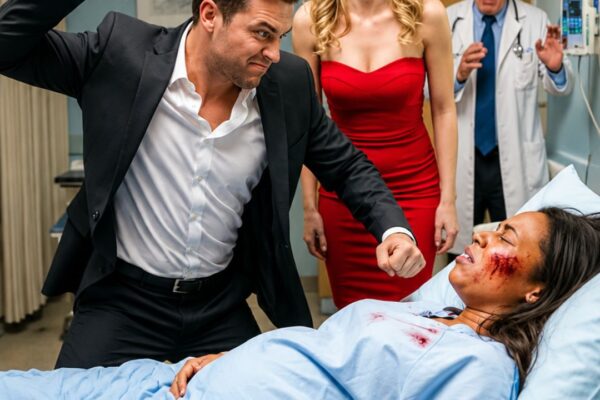
A millionaire beat his pregnant wife until she lost the baby – her father’s revenge shocked the public.
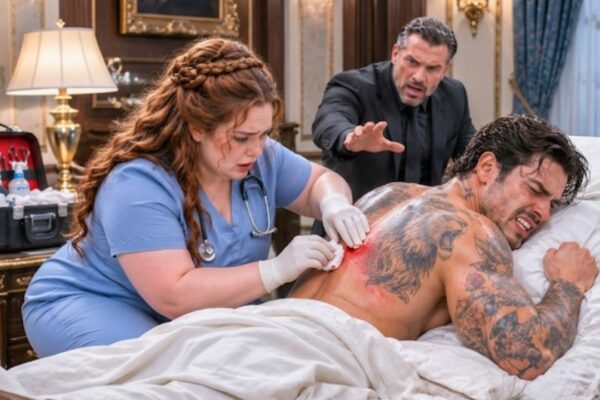
Nine nurses fled from the feverish mafia boss – his portly veterinarian opened the stab wound in his back.
The mafia boss had been unable to walk for eight years – then a single mother found a needle hidden in his wheelchair.
“My Skin Hurt” — German Woman POW Shocked as U.S. Army Medics Save Her From Losing Both Hands
“Eat This Brown Paste” – German Women POWs Shocked That Americans Ate Peanut Butter Every Day