A multimillionaire rancher asked the waitress to laugh in French – little did he know that she spoke seven languages.
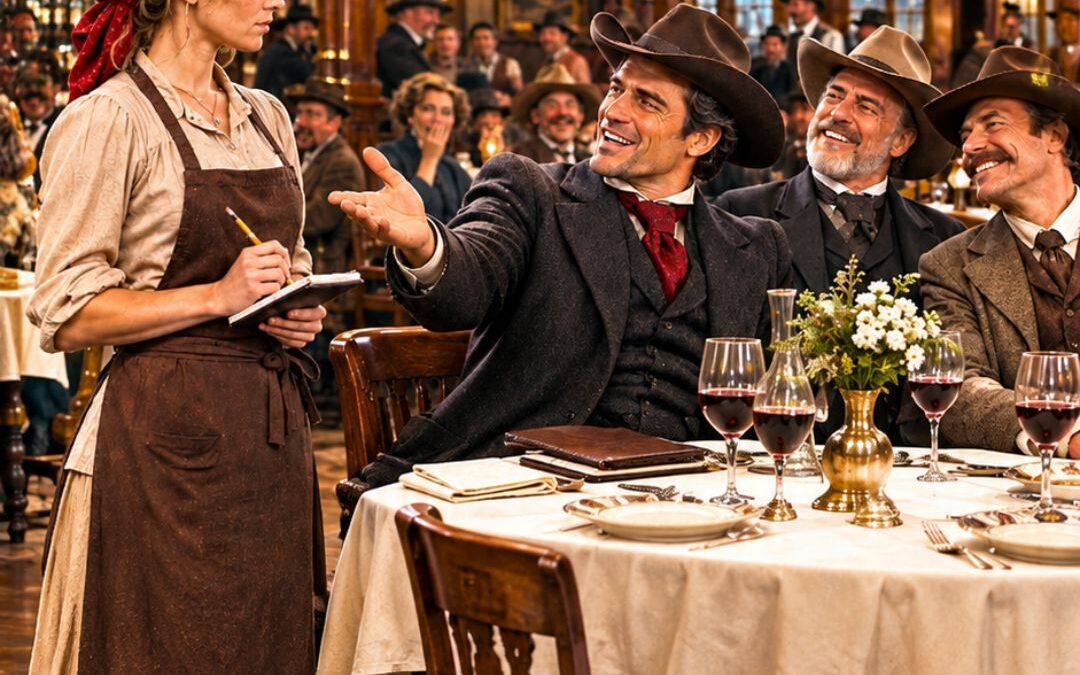
A multimillionaire rancher asked the waitress to laugh in French – little did he know that she spoke seven languages.
Nevada, 1885. Pearl Mason had been working at the Cattleman’s Exchange for eight months. She carried plates, endured insults, and counted every paycheck twice, for debts remained after her husband Arthur’s death. No one suspected that the quiet, blonde widow was fluent in seven languages. She had learned to downplay her abilities because a single woman in this rough town offered little protection.
Arthur had been a miner, hoping to find silver in the hills. Instead of riches, the mine gave him a ruined lung. When he died, bills for tools, explosives, lodging, and medicine remained. Pearl had buried him on the outskirts of town and gone looking for work the next morning. Grief could wait; rent and bread could not.
One hot evening, Virgil Holden and two European businessmen entered the restaurant. Virgil was the heir to the largest cattle ranch in the territory. His dark suit was immaculate, his boots gleaming. He moved as if he owned the room. The men wanted to invest in a major beef export business. Virgil needed their capital, but more than that, he needed their approval.
Emmett showed Pearl to the best table. “Good evening, gentlemen. May I bring you something to drink?” Virgil examined her worn hands and then turned to his guests. In French, he complained about the simple establishment and called the locals uncouth. The waiter, he sneered, probably didn’t understand a word. Then he ordered steaks and wine and compared the kitchen to a blacksmith’s shop.
Pearl understood everything. She used to work in a prestigious hotel in San Francisco. A French woman had taught her the language, and she had learned German from Bavarian textile merchants. She spoke Spanish with guests from California and Italian with chefs. She had also learned enough Japanese and Russian to help travelers.
She knew, however, how dangerous it could be to expose a powerful man in front of his guests. She calmly recommended the roast ribeye and a glass of red wine. Virgil grinned and explained to his companions that the locals might not understand the words, but they certainly understood the tone of voice. One of the investors, a burly man with a thick mustache named Strauss, seemed uncomfortable but remained silent.
While Pearl poured wine, the men discussed transportation costs and train connections. Virgil answered confidently in French, but Pearl overheard the investors questioning his figures. They switched to German to talk about discounts. Virgil didn’t understand everything. Pearl put down the tray and left without letting on.
On Thursday, Virgil arrived at the Exchange alone. In a back alcove, he spread out contracts and ordered coffee and whiskey. When Pearl brought the glasses, he muttered in French that the investors were taking advantage of him. He was going to lose his father’s fortune to two foreign businessmen because he didn’t see through their intentions.
Pearl set the empty glass aside. “If they take advantage of you, Monsieur Holden, perhaps you’re showing them your insecurity too clearly.” She spoke fluent French. Virgil froze. Slowly, he raised his head. He switched to German; Pearl answered without hesitation. Then he tried Spanish. She spoke that language fluently, too.
“You understood me the other day?” – “Every word.” – “Why didn’t you say anything?” Pearl looked at him calmly. “You didn’t want an answer. You wanted to entertain your guests. I let you.” Her voice was quiet, but for the first time, Virgil had to listen to her.
He explained that the men represented a trading group from Frankfurt and Paris. The export contract was to be signed at the bank the following morning. New clauses kept appearing; as soon as discounts and liability were mentioned, the investors switched to German. One signature could ruin the ranch.
“I need your help,” he said. He offered her three times her monthly wages for four hours. Pearl thought of Arthur’s debts. “I’m not your servant. I won’t refill your coffee or be belittled. When I come, I’ll be at the table as an advisor.” Virgil agreed. Emmett gave her the morning off and told her to leave if she wasn’t respected.
The next morning, Pearl appeared at the bank in her best dark blue dress. Strauss and his colleague were waiting in the conference room. Their polite expressions changed when Virgil introduced the widow as an advisor. Strauss asked if a woman would be familiar with such matters. Pearl sat down and, speaking in German, requested that they first examine the transport liability clause in section four.
For three hours, she didn’t just translate. She compared figures, explained terms, and pointed out hidden costs. When the investors discussed a lower purchase price in French, she reminded them of increased feed prices and longer commutes to train stations. She had unclear liability rules clarified. She wasn’t bluffing. When a veterinary question arose, she asked Virgil to explain the herd’s health checks himself.
It was precisely this honesty that convinced Strauss. The negotiations became more objective. By midday, the unfavorable clauses had been removed, and the obligations of both sides were clearly defined. The men signed. Strauss took his leave respectfully. Virgil had saved the ranch but knew he couldn’t have done it without Pearl.
He offered her a permanent position as head of the company. She would be responsible for international contacts, reviewing contracts, and organizing the books. The salary would allow her to pay off Arthur’s debts in a few months. Pearl accepted, but on one condition: Virgil had to respect the people whose work made his wealth possible. He promised he would.
The Holden ranch was located five miles outside of town. There Pearl met the manager, Gideon Cross. The older man had served under Virgil’s father and regarded her with disdain. “This operation requires experience with cattle and men,” he said to Virgil without looking at Pearl. Virgil confirmed her responsibilities. Pearl demanded the sales and expenditure ledgers for the past three years.
She worked meticulously. She wrote directly to European shipping companies in German and spoke with the vaqueros on the southern pastures in Spanish. She uncovered overpriced middlemen and double-charged deliveries. The ranch became more profitable, and the workers realized their concerns were finally being heard.
While sorting through older documents, Pearl stumbled upon a curious source of income: the Western Horizon Trust. The ledgers showed considerable earnings, but there were no corresponding cattle sales or lease agreements. After a lengthy search, she found three black ledgers in Gideon’s filing cabinet. She opened them with a key from the trust’s trust, which Virgil had entrusted to her.
The records revealed a disturbing system. The trust managed loans, mortgages, and receivables. It owned promissory notes from numerous businessmen, the Exchange mortgage, and shares in the Black Ridge Mining Company. The silver veins had long since been exhausted. Nevertheless, the mine charged exorbitant prices for tools, explosives, housing, and medicine. Workers received part of their wages in vouchers that could only be used in the company store.
On one page, Pearl found her husband’s name: Arthur Mason. His medications had been billed at a 300 percent markup. Interest had continued to accrue even though he had long since been buried. The Holden family also held the debt that Pearl had been trying to settle for months. The fortune she had saved had been built, in part, on her husband’s suffering.
She sat motionless in front of the books for a long time. Arthur had believed he was to blame for his own failure. Now Pearl knew his hopes had been exploited. When Gideon entered and saw the open documents, he demanded they be put back. Pearl remained calm. The books concerned the business and, above all, the people whose labor sustained the ranch.
Gideon defended the system as a necessary business practice. The income had saved the ranch from droughts and cattle epidemics. Then he called Arthur a weak man. Pearl stood up. “My husband worked until his lungs gave out. Your books don’t show strength, they show exploitation.”
At that moment, Virgil entered. Pearl presented him with the receipts and pointed to Arthur’s name. He went pale. He knew his father had held local interests but had never inquired about the source of the income. Gideon had managed the affairs, he said. “And you lived off it,” Pearl replied. “While I carried plates to pay off a debt that artificially inflated your family.”
Virgil read the entries. He then realized that his desire to appear more cultured than his father was meaningless as long as he perpetuated his father’s injustices. Pearl explained that she could not work for a man who profited from his neighbors’ misery. She placed her keys on the table and resigned.
“Wait,” Virgil said. This time it didn’t sound like an order. He turned to Gideon and admitted that his father had amassed the fortune at the expense of others, and that he himself had profited from it for far too long. He would have the books audited, suspend the trust’s claims, and contact the sheriff. Virgil dismissed Gideon and let him leave the estate. The documents were to be preserved as evidence.
Then he turned to Pearl. He promised to immediately drop Arthur’s claim and have all the trust’s other debts independently audited. No one should have to pay for medicines or tools that had been charged at exorbitant prices. He also asked her to continue running the business—with real decision-making authority and a clear contract.
Pearl took the keys back. She knew that a promise wasn’t justice. It would take time to open the books, compensate the workers, and regain the town’s trust. “Then we’ll start with the wages on the southern pastures,” she said. “After that, we’ll talk to the miners’ families.” Virgil nodded. For the first time, he didn’t seem concerned about how he appeared to others.
The air was cool on the way home, and the first stars were appearing over Nevada. Pearl thought of Arthur, his dreams, and the injustice that had cost him his life. She couldn’t bring him back. But she could ensure that other families didn’t have to go through the same thing. Her languages had opened doors for her; her persistence had led her through them. For the first time in a long time, the future no longer felt like a debt she alone had to pay.
Perhaps a different, more just life began there for many other people.
You Might Also Enjoy


A millionaire beat his pregnant wife until she lost the baby – her father’s revenge shocked the public.

The doctor sent the inexperienced nurse away – but her combat skills, acquired in the Navy, revealed who she really was.
Nine nurses fled from the feverish mafia boss – his portly veterinarian opened the stab wound in his back.

The mafia boss had been unable to walk for eight years – then a single mother found a needle hidden in his wheelchair.

“My Skin Hurt” — German Woman POW Shocked as U.S. Army Medics Save Her From Losing Both Hands