“Count Every Round, Limey” — US Audit Officer Sent to Inspect SAS Armoury, Flown Home in 5 Days
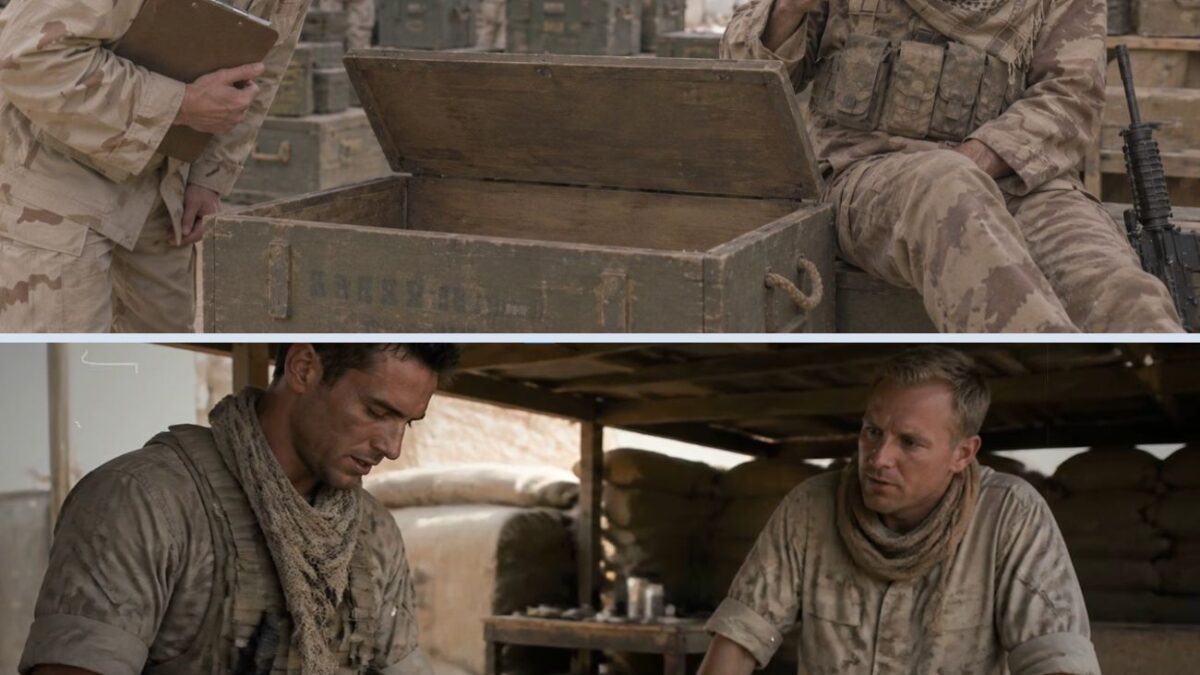
There is a sentence that a United States Army Lieutenant Colonel named Raymond Vollmer said out loud in daylight inside a brick and concrete block in southern Iraq to the senior British soldier sitting opposite him across a plywood counting table. He said it with his pen in his hand and his laminated inventory card clipped inside his notebook and he tapped the card twice before he spoke the way he always did when he was about to say something he had rehearsed in his head on the flight in.
“Count every round, Limey. Every single one because I don’t trust you people to run a corner shop, let alone an armory.”
He said it to the officer commanding of a British Special Air Service Sabre Squadron forward element. He said it in front of two of his own officers and three of the squadron’s own. In the heat of a late summer morning with a generator humming on the far wall and the first fly of the day working the rim of a chipped enamel mug, nobody at the table said anything back. One of the SAS men, a Welshman with a quiet voice and a pencil in his hand, wrote the time of the remark in the top margin of a green Army notebook in pencil and underlined it twice. He would remember saying it. He would be made to.
In 5 days, Lieutenant Colonel Vollmer would stand on a dust-swept strip at the same forward operating base and watch his own kit go onto a C-130 ahead of him. With his notebook sealed in a plastic evidence bag, with his laminated card no longer clipped inside it, and with a signed reconciliation document in his hand that he could not argue with and could not fold small enough to make disappear, he would not shout about it. He would not be able to. The number on the bottom of that document would answer the sentence he had said at the counting table so completely that his mouth would not quite work when the loadmaster asked him politely whether he had any ammunition on his person.
This is the story of what happened in those five days. It is the story of a credentialed, decorated, entirely serious American auditor who walked into a British armory expecting to find 300 unaccounted rounds and walked out with a reconciliation to zero, a flight home, and a sentence he had said out loud in front of witnesses that would be read back to him in his own voice by the man he had called a limey. He had asked for every round counted. They counted every round, and then they counted the ones he did not know existed.
Raymond Volmer was not a clown, and he must not be mistaken for one. He had been 22 years in the United States Army by the summer of 2006 with a first tour in the invasion phase of 2003 as a company commander and a second as an operations officer with a brigade combat team in Diyala, and he wore a bronze star on his class A tunic that was not for showing up. He had done the United States Army Inspector General School at Fort Belvoir. He had done an attachment to the Defense Logistics Agency between tours, and in the quarter before his third rotation, he had, by his own paperwork, closed three battalion armories inside the United States for discrepancies that ran from unaccounted magazine followers at the small end to a missing M4 lower receiver at the end that ended careers.
He was the man his two-star general sent when a two-star general wanted an armory broken open and read like a book. He was good at it. He did not lose. His own master sergeant, a toothpick-chewing veteran named Harlan Oaks, who had been in uniform longer than most of the junior officers had been alive, would say later, carefully, that in a straight audit, Colonel Volmer could find a round that had been fired in 1991 and account for the brass. He meant it as professional respect. He also meant it with a small reserve of a man who had already noticed between the plane and the gate that his colonel had not asked a single question about who, specifically, he was going to be auditing.
And he had reasons for his contempt. He had walked into armories, real ones, run by real units in his own army, and found cages left open, keys taped under desks, pistols signed out to men who had been dead for a year on paper, grenade fuses stored above the primary charges, and in one case in Kuwait, a sea container of mixed small arms ammunition that had been accepted on a signature nobody could read and reconciled against a tally sheet somebody had completed in the dark. He had, more than once, found the thing a theft eventually becomes, a weapon in a civilian’s hands, with a serial that traced back to a cage somebody had been too lazy to lock. He hated it with the hatred of a man who had buried the consequences. When he said he did not trust an armory he had not inspected, he was telling the simple professional truth of his life.
What he had not done before that August was inspect a British Special Air Service Armory. He had read about them. He had, he thought, understood them. He had an opinion, held firmly, that elite units were among the sloppiest armories in any army, because elite units ran on exceptions, and exceptions were how rounds walked. He said this to his two captains and his master sergeant on the flight in, with the laminated inventory card out on his knee and the pen in his hand. He said it twice.
The counting table at the forward operating base was a sheet of unpainted plywood on two carpenter’s trestles, pushed against the near wall of the armory’s outer room, under a strip light that buzzed. The officer commanding of the forward element, a dark-haired major named Edwin Harland, Teddy to his own men, with a chipped enamel mug and a faded squadron crest on it, sat opposite him with his hands flat on the plywood, the squadron sergeant major, warrant officer class two Douglas Price, sat at Harland’s right shoulder with the green army notebook open and a sharpened pencil balanced across the top of it. The armorer, Sergeant Owain Trahan, stood behind them humming something very quietly that the American captain to Volmer’s left kept trying to place and could not.
Volmer tapped his laminated card twice. He said the sentence:
“Count every round, limey. Every single one. Because I don’t trust you people to run a corner shop, let alone an armory.”
Nobody laughed. The Welsh armorer stopped humming for 1 second as if he had reached the end of a verse and then started again, softer. Price wrote the time of the remark in the margin in pencil and underlined it twice. Harland lifted his mug, drank the top off his tea, and set it back down on the plywood with no particular hurry at all.
“Right you are, sir. Shall we begin?”
The forward operating base sat inside a double wall of HESCO bastion on a plane of baked gray dust, 40 minutes drive from the nearest named town, and the armory was the only two-story structure inside the inner wall. It was a brick and concrete block the Iraqi army had used for the same purpose and left standing when they left. It had slot windows at head height, a steel outer door on a padlock, a steel inner door on a combination lock, and a third door at the back of the inner room, a plain plywood door with two keyholes in it. That was not opened on the first morning and was not opened on the second.
The outer room held the counting table, the ammunition shelving, and the day-use rifle rack. The inner room held the serialized long weapons on numbered pegs. The back room with the two keyholes held the sensitive items. The second key was in the officer a safe in a different building, and the signature book for its opening was in a locked drawer in the squadron sergeant major’s office, and nobody opened the back room on their own for anything, ever, including fire.
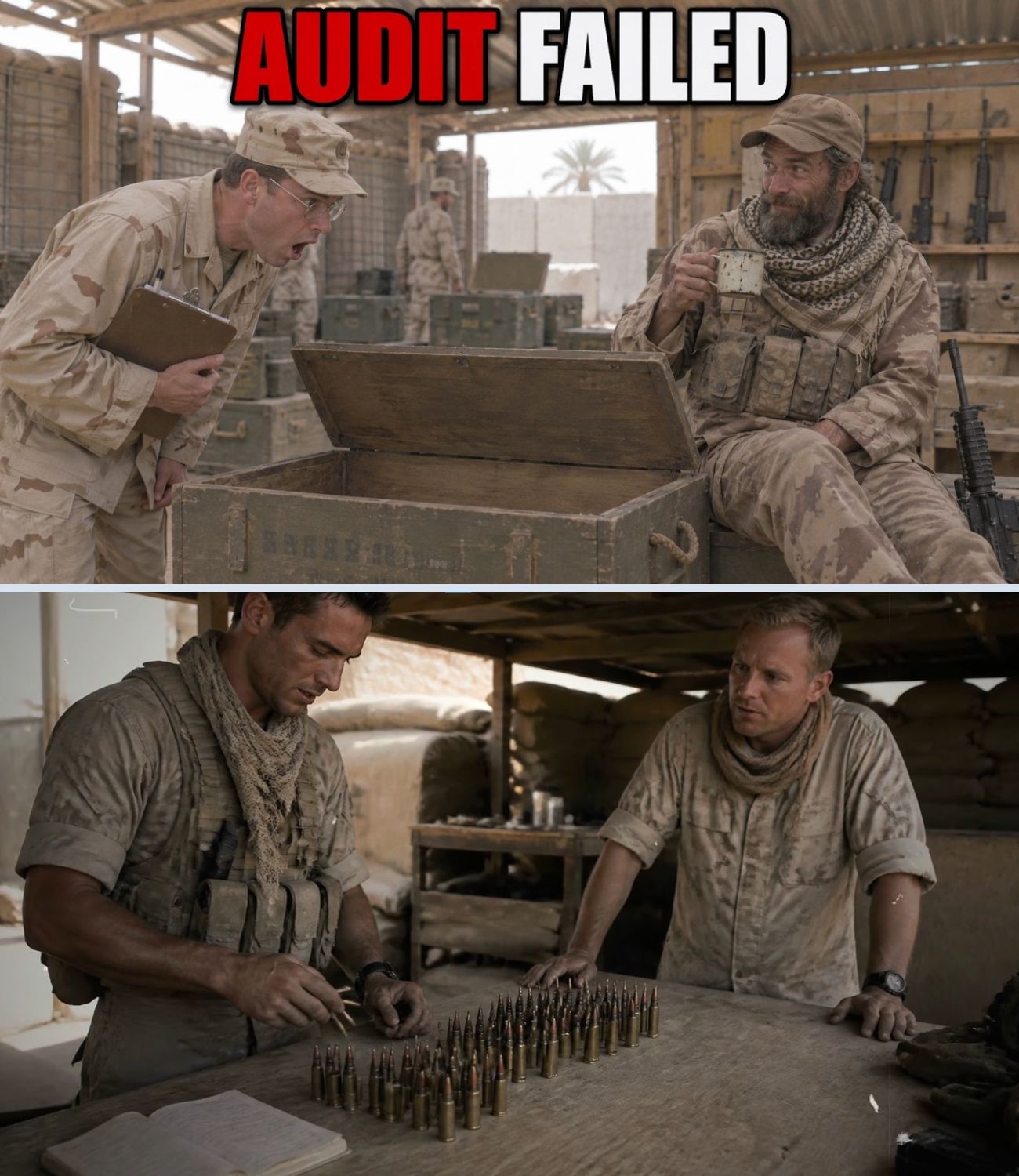
Owain Treharne, the armorer, was a slight man in his middle 30s with pale forearms and the quiet hands of somebody who had been taking small things apart for most of his life. He ran the armory the way he had run his grandfather’s chapel organ loft as a boy, on routine, in silence, with the hymns to himself. He had a workbench along the far wall of the outer room with his tools in exact order, his cleaning solvents in the shadow of a cardboard baffle, so they did not sit in the sun, and two ledgers on the shelf above the bench.
The upper ledger was the official one, a buff army book with its page corners stamped, the kind the Inspector General’s office in London would recognize on sight. The lower ledger was a plain black hardback notebook with a cheap elastic strap around it, with every page ruled by hand and dated in Treharne’s small, careful print, and every line signed in two different inks by two different men. It was not an unofficial book. It was not a secret book. It was Treharne’s own cross ledger, kept because he had been taught as a young armorer that a book you only wrote in when something official happened was a book you could not trust, and he had never stopped.
In it, in his small hand, was every round that had come onto the base and every round that had left it, broken down by batch and lot, by weapon, by date, by signature. Every battlefield recovery of enemy small arms that had been brought back for examination before destruction, with its serial where it had won and its date of recovery where it did not. Every expended casing bagged after a contact weighed on a mail scale he kept on the bench and reconciled by the known mass of a 5.56 case at 10 and 1/2 g and a 7.62 case at 12 and 1/2 cross-signed against the operator’s own count of rounds fired.
Vollmer, standing with his notebook in the outer room on the first afternoon, saw the top of the official ledger and tapped his pen against his laminated card.
“That the main book?” he asked.
Trahan said, “Yes, sir. That was the main book.”
Vollmer did not ask what the other one was. He thought he could see what it was. He thought it was a daybook, a scratch pad, the kind of thing a lazy clerk kept to copy from in the evening. He wrote the thought in his own notebook:
“Daybook, cross-ref expected sloppy.”
And he moved on. Behind him, Trahan started humming again very softly, something a Welsh congregation would have known in 1950 and nobody in that room had been born for, and he opened the lower ledger to the day’s page, and he waited.
Warrant Officer Price was a left-handed man in his early 40s who wrote everything in pencil in a green army notebook. “Because,” he said once to a young trooper, “pencil did not run in the rain and did not vanish in the sun and could be sharpened with any knife on earth.” He walked Vollmer through the outer room shelving on the first afternoon with the patience of a man showing a tourist around a cathedral he had cleaned every day for 15 years. He named the lot numbers of the ammunition without consulting a sheet. He named the dates each pallet had come in.
He walked past the plywood door at the back of the inner room and did not touch it, and he did not mention it, and when Vollmer stopped in front of it and asked, “What’s behind that?” Price said, “Sensitive items, sir. Two keys, two signatures. The officer commanding has the second key. We can open it when it suits your schedule.”
Vollmer wrote that down. He did not ask to open it then. He thought, as he wrote, that two keys and two signatures was a reasonable control, and he underlined the word reasonable with a small irritation that he could not quite name.
The gun was loaded at the end of the afternoon. Volmer walked out of the block with his two captains and his master sergeant and said in the dust outside that the official ledger looked clean on the surface, but that surfaces lied. That he intended to count every round of 5.56 and 7.62 and 9 mm on the base by his own hand before the week was out, and that if there was so much as a round short, he would personally see this armory closed.
Oaks, the master sergeant with the toothpick, said, “Yes, sir.” He had already seen the lower ledger. He did not say so.
On the morning of the second day, Volmer walked into the outer room at 7 minutes past 8 with his two captains behind him, his master sergeant behind them, and his laminated inventory card already out of his notebook. He pointed without preamble at the second shelf from the top on the central ammunition stack. 10 green metal boxes of 5.56 ball, lot numbered, sealed, dated to a receipt 3 weeks earlier.
“That one,” he said. “Open them. All of them. Count them in front of me. I want the lot number, the batch number, the seal condition, and the physical round count on every box. Read out loud in English by one of your men in the order I point to them.”
Harland said, “Of course, sir.”
Trahan, already standing at the workbench with his hands behind his back, nodded once. Price opened the green notebook and wrote the time at the top of a fresh page in pencil. They opened the first box. Trahan broke the seal with a small knife he took from a drawer, laid the two halves of the seal on the plywood with the box number upwards, and tipped the contents in their cardboard inserts onto a clean tray.
Trooper Rodri Marion, a young assaulter from air troop with a tin of boiled sweets in his smock, came in from the inner room, nodded at Volmer without expression, and offered the tin, a small ordinary gesture, the way a Welshman offers something before work. Volmer looked at the tin. He did not take one. Marion put the lid back on, slid the tin into his pocket, and sat down at the plywood with the tray in front of him. He counted the rounds in blocks of 10 with his finger moving once per block, called 100, opened the next insert, called 200, and when the last insert was empty and the last rounds in his palm, he counted them in a single breath, and said:
“And 19.”
And set them down.
“919,” said Trajan, “against a stated 920, minus the single round noted in the receipt as damaged on arrival, discarded under witness, signed by Corporal Vass and myself on the fourth. Reconciled.”
Captain Marcus Dellahey, Volmer’s number two, was standing at the end of the plywood with his own pens arranged in a line in front of him, the way he arranged them when he was uneasy. He had been watching the lower ledger. He had seen Trajan open it in the first minute of the count, run a finger down two lines, and lay it flat beside the upper one. He saw now that the two lines agreed down to the discarded round and the date and the signatures, and that the lower ledger had been written three weeks earlier in two different inks by two different hands. He realigned his pens. He said nothing.
His colonel at the near end of the plywood said, “Next box.”
They did 10 boxes. Every box reconciled. Every box reconciled against both ledgers, and after the fourth box, Trajan, without being asked, began to turn the lower ledger towards Delahey, so that the American captain could read the entry before the round count was called. Delahey, by the eighth box, had stopped re-aligning his pens and was simply reading. By the 10th box, when the final count was called, 9,192 against a stated 9,200 minus eight discarded on receipt minus zero expended reconciled. Delahey looked up at his colonel for the first time in an hour and did not quite catch his eye and looked back down.
Volmer picked a sniper’s shelf next, a short stack of 7.62 match grade boxes used by mountain troops sniper pair. He asked for the operator in question.
Trahan said, “Corporal Vass, sir, is in the troop lines. I can send for him.”
Price stepped out and came back inside a minute with a thin man in his late 20s who had a dog-eared Patrick O’Brian paperback folded open in his left hand with a thumb keeping the page. Volmer looked at the paperback and said, “Put the book down.”
Corporal Finlay Vass put the book down on the plywood, pages open, his thumb still marking the place. He counted his match rounds by hand, calling the lot and batch for each box. He reconciled every round he had drawn in the last six weeks against the lower ledger in Trahan’s hand. When he was asked to account for 40 rounds expended on a specific date in a specific contact, he gave the grid, the time, the distance, and the number of enemy wounded. And he produced from his burgan a plastic bag of 47.62 brass cases weighed and labeled and signed off by Trahan.
Volmer said, “You keep the brass.”
“Yes, sir.”
“Why?”
“Because the sergeant has us keep the brass, sir.”
Trahan said into the pause that he had the mail scale on the bench and the batch mass written in the lower ledger if the colonel wished to weigh the bag. The colonel did not wish to weigh the bag, not yet. Volmer closed his own notebook at 11:00 in the morning on the second day. He did not say anything. Delahey picked his pens up and put them in his pocket. Oaks by the doorway moved his toothpick from the left side of his mouth to the right.
Outside, a Chinook came in low over the inner wall with its ramp already down and the Welshman at the bench started humming again. A different hymn. Something slower. That was the first time that day the colonel would be wrong. It was not the last.
On the morning of the third day, Volmer walked into the outer room without his laminated card out and without his captains behind him. And he said, “The back room now.”
Harland set his mug down and said, “Right you are, sir. Mr. Price, if you would.”
Price opened a drawer in his office across the corridor, took out a leather-bound signature book, laid it on the plywood table, and signed and timed a line at the top of a new page. Harland walked to the officer commanding safe in a different building with Delahey at his shoulder as the American witness, and came back inside 4 minutes with the second key on a brass ring. He signed under Price’s line. He asked Volmer politely to sign as the external auditor present at the opening. And Volmer, with no expression at all, signed.
The signature book was closed and placed on the shelf above the workbench next to Trehan’s two ledgers. The two keys went into the two locks together. Price turned his, Harland turned his. The plywood door opened without a sound, and the back room on the far side of it was lit by a single low-wattage bulb and smelled of light oil and nothing else. It was not large. It was perhaps three paces deep and four across. The walls were lined floor to ceiling with numbered pegs and numbered racks. Every peg and every rack marked with a weapon serial in white paint stenciled onto a brass plate screwed to the wood.
There were no empty pegs. There were no weapons out of place. There were no cardboard boxes on the floor and no loose kit on any surface. On a shelf at the back were four gray plastic cases with their lids closed and their padlock hasps aligned. And above the shelf in Trahan’s hand was a laminated sheet listing the contents of each case and the two signatures required to open it.
Staff Sergeant Niall Beresford was waiting in the back room because the sensitive items opening required the troop staff sergeant to be present when his own troops’ weapons were examined. He was a tall man in his late 30s with pale eyes and a quietness that was not shyness. He wore his belt kit even in the compound and when he turned to let Volmer past him in the narrow space between the racks, a folded corner of paper, no bigger than a playing card, showed inside the top of the kit’s left pouch and he put a thumb back over it without thinking. It was a child’s drawing. It was a stick figure father in a bergen and a stick figure smaller person at his elbow. And it had the word dad written in capitals at the top in a hand that was five years old.
Beresford did not mention it. Volmer, who had seen it and understood what it was, did not mention it either. Beresford took down his weapons in the order the audit required: his primary, his secondary, the suppressor from its separate peg with its own serial card, the night sight from its padded case with the lens caps intact, the laser unit, the magazines from their numbered rack. Each one empty. Each one signed in last at 17:30 hours the previous day.
He read the serial from each item without looking at the pegs. Trahan, at the open door with the lower ledger in his hand, read the same serials from the lower ledger. Price, at the plywood table in the outer room, read the same serials from the official book. All three serials matched on every item.
Beresford said, “Sir.” at the end of each read back. He did not add anything else.
Volmer stood in the narrow space with his notebook open and his pen very still. He had, in the United States, closed an armory in a battalion of light infantry 3 months earlier for a sensitive items control that was, on paper, more or less what he was looking at here, and that had, in practice, been a drawer of unsigned chits and a key kept on a hook in a corridor. He wrote in his notebook:
“Control works in practice. Sample too small. Expand.”
He underlined “Expand.” He put his pen away. He walked out of the back room with Harland behind him and Price behind Harland, and he said in the outer room, with Delahey and Oaks within hearing, “That was adequate. I want the second troop’s cases open after lunch.”
Delahey, by the plywood, nodded. Oaks moved his toothpick again. Harland said, “Right you are, sir.”
The callback came after lunch when Volmer picked up his laminated card again and tapped it twice before he spoke, out of habit.
“The corner shop line, sir?” said Harland politely in his quiet way, as if clarifying a point of procedure. “Would you like us to run the second troop with the same two key protocol as the first?”
Volmer looked at him. He said, “Yes, with the same protocol.”
He did not look at Price, who was writing the time in pencil in the green notebook and who did not underline it this time because he had already underlined it twice on the first morning and the record did not need it twice more.
By the afternoon of the third day, Volmer had understood that the lower ledger was not a daybook and he had moved his line of attack. He stood at the plywood table with Delahey at his left shoulder and Oaks at his right, and he said, “The brass count. I don’t accept it. Weighing the expended casings in bulk is a dodge. A clever man can doctor the mass by 6 g and hide 10 rounds inside a weigh-in. I want a stressed test. Pick a contact, any contact, weigh the bag in front of me, count the rounds out of it in front of me. If the two don’t match to the integer, I close your armory.”
He had not raised his voice. He was tapping his laminated card again, slowly, once per word. Trahan, who had been humming, stopped humming.
He said, “Yes, sir.”
He walked to his workbench, took down the mail scale, cleaned the pan with a cloth, set the zero, and asked Volmer to pick the contact. Volmer deliberately picked the Vaz contact from the second day, 40 rounds, 7.62, a specific grid, a specific time. Trahan took the plastic bag of 40 cases from the lower shelf, where it had been signed in 2 days earlier, and had not been touched since. He laid it on the plywood. He slit it open with his small knife, tipped the brass onto a clean tray, and asked Oaks politely to witness the empty bag.
He laid out the 40 cases in rows of 10. He weighed them in blocks of 10. He wrote the mass of each block in pencil on a scrap of paper in front of Volmer, and Volmer, in his notebook, wrote the same four numbers in ink. Four blocks of 10, each block within half a gram of 125. Total mass, 500 g, to within a gram and a half.
Trahan said, “Nominal mass of a once-fired 7.62 case by this lot is 12.47 g, measured on this scale against a known reference. The reference being a sealed unfired round weighed on this scale on receipt and recorded on the receipt page. Signed, 40 cases nominal 498.8 g, observed 500.1, delta 1.3 g accounted for by residual propellant and dust.”
He slid the lower ledger across the plywood. On the vast page, in two different inks and two different hands, was the same figure written 2 days earlier before Volmer had chosen the test.
“The method, sir,” he said, “does not hide 10 rounds. The method hides nothing. The method is cross-signed.”
He started humming again. It was a slower hymn, one that Delahai who had grown up in a Methodist chapel in Pennsylvania almost placed and did not want to.
Volmer said, “The recovery drawer.”
Trehan said, “Yes, sir.”
He went to a cabinet at the back of the outer room under the main shelving, and he unlocked a long shallow drawer with a key from his own belt. Inside the drawer were four AK-pattern rifles, two PKM barrels, a small folder of serial-stamped pistols, and a stack of white forms. Each weapon had a brown paper tag wired to the trigger guard with its date of recovery, its grid of recovery, the operator who had recovered it, and the signature of the squadron sergeant major accepting it into the drawer.
Each weapon had a serial where the serials still existed, and where the serial had been filed off, there was a note in Trehan’s hand recording the filing and the state of the metal. The stack of white forms were destruction certificates countersigned by a representative of the host nation’s forces where the local protocol required it, and by the officer commanding where it did not. There were 26 certificates in the stack. There were six weapons in the drawer. The 26 and the six, taken together with the running total on the first page of the lower ledger, accounted for every battlefield recovery the forward element had brought back inside the wire that calendar year.
Volmer looked at the drawer for a long time. He looked at the stack of certificates. He looked at the plywood table where Vass, who had been called back in to witness the brass weigh-in, had set his dog-eared paperback down on the edge of the plywood with his thumb still marking the page. He looked at Delahaye. Delahaye looked at him. Oakes in the doorway did not look at him. He looked at the ceiling.
The man who had closed three armories in a single quarter closed his notebook. He put his pen in his breast pocket. He did not tap his laminated card.
He said quietly, “All right.”
Harland, who had been standing at the far end of the plywood with his mug in his hand, took a drink of cold tea and set the mug back down. The Welshman at the bench went on humming.
It is the fourth morning. The strip light buzzes. The chipped enamel mug sits in the middle of the plywood table with a fresh pour in it, and the steam goes straight up because the generator is off and the air in the outer room is still. The two ledgers are open side by side on the plywood. The signature book is open at a fresh page. The destruction certificates are stacked on the right of the plywood held down by a brass case. On the left of the plywood is Volmer’s own notebook closed with the laminated card no longer clipped inside it. The card is on the plywood face down.
The officer commanding sits at the near end. The squadron sergeant major sits at his right shoulder pencil in hand. The armorer stands behind them not humming. The three troop representatives, Beresford, Vass, and Marion, stand along the back wall with their belt kits on. At the far end of the plywood sits Lieutenant Colonel Peter Chenery, the Special Air Service Commanding Officer Forward, who has flown in from the main base that morning with his very fine black pen in his breast pocket. On the right of the plywood in a line sit Volmer, Delahaye, and Oakes.
Trahan reads the totals. He reads 5.56 ball, lot by lot, received, expended, destroyed, present. He reads 5.56 tracer, 5.56 blank, 7.62 match, 7.62 link, 9 mm, 12 gauge, 40 mm high explosive, 40 mm smoke, flash bangs by serial, fragmentation grenades by serial, white phosphorus by serial. He reads every number from the lower ledger first and the official book second. Price in pencil in the margin, checks each one off in the green notebook. Delahaye, who has not re-aligned his pens for a day and a half, writes the figures into Volmer’s open template on the plywood with a steady hand.
Trahan reads the serialized long weapons, 192 items. He reads them peg by peg. He reads them in the order Volmer picks, not in the order they sit on the wall. He reads them for 22 minutes without once consulting the official book. And when at the end of the 22 minutes, Volmer asks him to read the last six again in reverse, he reads them in reverse. And the serials match the pegs and the pegs match the lower ledger and the lower ledger matches the official book.
He reads the recoveries, 26 destroyed under certificate, six in the drawer pending certificate. He reads the dates. He reads the signatures. He reads the host nation countersignatures where they exist. He stops. He puts his finger on the last line of the lower ledger under the last entry, under the day’s date and the time Price has written in the green notebook.
And he says, “Reconciliation.”
Price reads it aloud from the pencil. “Rounds all natures, 11,864, received, expended, destroyed, and present reconciled to zero discrepancy. Serialized long weapons, grenades, and controlled sensitive items, 214 reconciled to zero discrepancy. Battlefield recoveries this calendar year, 32, of which 26 destroyed under countersigned certificate, and six held pending in the recovery draw, reconciled to zero discrepancy. Total variance against stated inventory, zero.”
Nobody says anything. Volmer, on the fourth day in the outer room of a British Special Air Service forward armory in southern Iraq, hears a sentence that is the exact arithmetic opposite of the sentence he said on the first morning. He has predicted in his own notebook at least 300 unaccounted. The reconciliation reads, “Zero.”
He looks at the laminated card face down on the plywood. He does not pick it up. He does not tap anything.
He says, “Read the total variance again.”
Price reads it again from the pencil. “Zero, sir.”
Lieutenant Colonel Chenery, at the far end of the plywood, takes the very fine black pen from his breast pocket. He signs the reconciliation at the bottom in his small, exact hand. He slides the signature book across to Volmer.
He says politely, “Would you countersign as the external auditor, Colonel, so that the record is complete?”
Volmer signs. His signature is tidier than it was on the first morning. He slides the book back. Chenery, without a flourish, closes the lower ledger, hands it to Trahan, and says, “Sergeant Trahan will produce a certified photocopy for Colonel Volmer’s team to carry back, along with a certified photocopy of the official book signed by myself and the officer commanding. The originals remain here.”
Volmer nods. He does not speak. The man who had told them to count every round has been shown every round. He has been shown the ones he did not know existed. He has been shown the method, the ledger, the two keys, the brass weight, the recoveries, the certificates, and the counter signatures, and he has signed in his own hand under a sentence that reads, “Zero.”
The Welshman at the bench starts humming again, very quietly. And the sentence from the first morning sits in the air between the plywood and the strip light like a thing that has been weighed on the mail scale and found to mass exactly as much as it did when he said it. He will not get to leave it in that room. It is going to be read back to him before he flies.
Major Harland did not raise his voice. He waited until Chenery had signed, and until the signature book had been closed, and until Volmer had put his pen in his breast pocket, and his laminated card into the inside flap of his notebook, face down. Then he opened the green pencil notebook to the margin where Price had written the time of the remark on the first morning. He turned the notebook 90° so that it faced across the plywood.
He said quietly, “For the completeness of the record, sir, you said this at 8:11 on Tuesday in this room at this table.”
He read it word for word in the same flat voice he had used for ammunition totals:
“Count every round, Limey. Every single one because I don’t trust you people to run a corner shop, let alone an armory.”
He let the sentence sit there for 1 second. He said, “The record is now complete.”
He closed the notebook. He slid it back to Price. He did not look at Volmer. He lifted the chipped enamel mug, drank the cold half of his tea, and set the mug back down in exactly the circle of damp it had left on the plywood on the first morning.
Volmer had nothing to say. Not from pride, not from anger. He had inside the 20 seconds while his own first morning sentence was being read back to him run through every answer a career spent in audit had taught him to run through and he had run out of them in front of men who were watching him do it. He could not accuse the method because he had stressed the method and the method had held. He could not accuse the ledger because the ledger had been signed in two inks by two men three weeks before he landed. He could not accuse the control room because he had opened the control room on his own schedule under his own witness and the control room had been better than his own. He could not accuse the people because the people had read him their serials in reverse without looking at the pegs.
He opened his mouth. He closed it. The card went into a trouser pocket. He left it there.
Master Sergeant Harlan Oaks, who had been in uniform longer than most of the officers in the room had been alive, moved his toothpick for the last time that week from one side of his mouth to the other, looked at the ceiling, looked at the plywood, looked at his own colonel and said with great carefulness in the direction of Captain DelaHaye, “That is as clean a book as I have ever seen, sir, in any army.”
He said it loud enough that the Welshman at the bench stopped humming for 1 second as if he had reached the end of a verse and then started again. He said it loud enough that Volmer heard it. Volmer did not turn his head. Oaks did not say it twice.
Five days after the sentence had been said on the dust-swept strip at the forward operating base with a C-130 on the ground and its ramp down and its engines turning, Volmer’s personal kit went up the ramp ahead of him. His notebook was in a plastic evidence bag inside his own day sack because he had put it there himself. The certified photocopies of both ledgers, each page signed by Chenery and Harlan, were in a sealed envelope in the hand of Captain DelaHaye. The laminated inventory card was in Volmer’s trouser pocket where it had been since the fourth morning.
Trooper Marion, standing at the edge of the strip with his tin of boiled sweets in his smock, offered the tin to Delahey, who took one, and to Oakes, who took one, and did not quite offer it to Volmer, which was its own form of answer.
The loadmaster, at the top of the ramp, said in the shout the engines required, “Any ammunition on your person, Colonel, sir?”
Volmer’s mouth moved. It did not quite work on the first attempt. He said on the second attempt, “No.”
He walked up the ramp. He did not look back. He had come to count every round. He had been shown every round. He was going home with the number zero in an envelope. Five days after he had said the sentence that the number zero answered.
He was not wrong about everything. He was right that armor is lie. He was right that elite units run on exceptions, and that exceptions are how rounds walk. He was right that a laminated inventory card in the hand of an unsentimental man had closed careers in his own army, and would close them again. He had, in 22 years, called real theft and buried real consequences. And he had earned the pen he tapped against the card.
He was right about the tea. He was wrong about the men who drank it. The sentence he had said on the first morning about corner shops, about counting every round, about not trusting these people with either, was not false in its parts. It was false in its direction.
The man he had called a corner shop had kept, in a plain black hardback notebook on a shelf above a workbench, the cleanest running account of lethal material he had seen in his professional life. They had not kept it because an auditor was coming. They had kept it because an armorer in his middle 30s, who hummed hymns while he worked, had been taught as a young man that a book you only wrote in when something official happened was a book you could not trust. And he had never stopped.
The two keys and the two signatures and the brass on the mail scale and the stick figure father in a Bergen folded inside a staff sergeant’s belt kit were not an exception to how those men ran a war. They were how those men ran a war. The armorer did not hum louder when the colonel walked in and he did not hum quieter when the colonel walked out. The pencil in the green notebook did not change hands. The mug stayed on its own circle of damp on the plywood. Nobody performed anything for the audit. The audit found what was there on an ordinary morning in southern Iraq and the ordinary morning was the thing it had never occurred to the colonel to be afraid of.
The forward operating base is no longer there. The HESCO has been pulled up and the brick and concrete block has been handed on and the plywood counting table has been burned for firewood by somebody who never knew what had been counted on it. The green pencil notebook is in a box in an archive in Herefordshire. The lower ledger in two inks and two hands is in the same box. The laminated card is not in the box. The laminated card went home in a trouser pocket on a C100 and nobody who was in the outer room on the fourth morning knows what was done with it after that and nobody who was in the outer room on the fourth morning has ever asked.
“Count every round,” the colonel had said.
They had counted every round. They had counted the ones he did not know existed. And when the arithmetic was done, the sentence he had said on the first morning weighed exactly as much as a once fired brass case on a mail scale, 12 and a half grams and no more.
You Might Also Enjoy

“We Thought They Would Negotiate”—What Argentine Soldiers Said When The British Attacked Goose Green