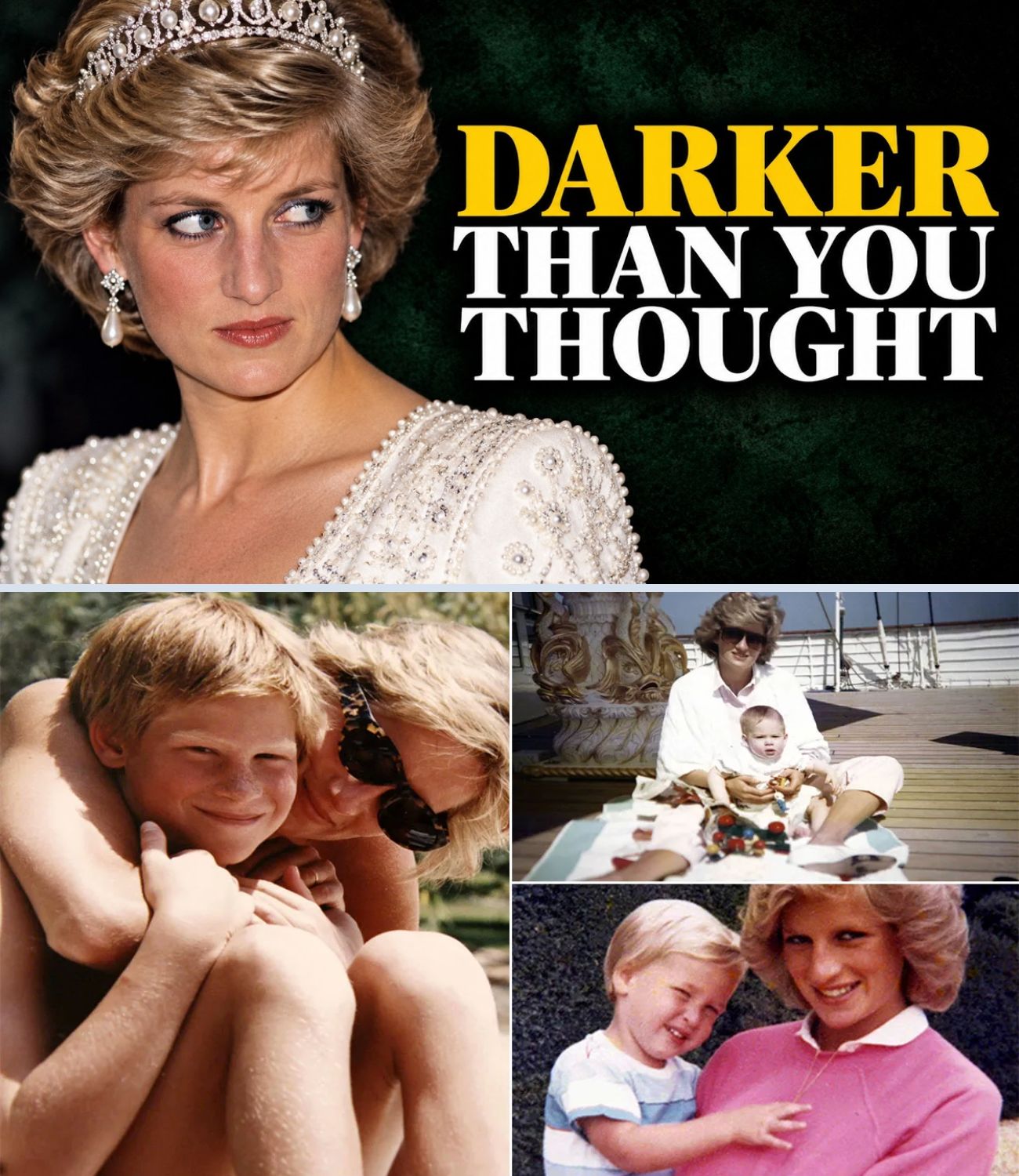
Princess Diana’s Secret Life Was Much Nastier Than You Thought
In 1968, a grandmother walked into a London courtroom and gave evidence against her own daughter. The daughter lost custody of her four children. That daughter was Diana’s mother. Diana’s eldest sister dated Prince Charles first, then destroyed it in a magazine interview. Diana’s other sister married the Queen’s private secretary, so the family had someone inside the enemy camp. Then, a forged bank statement waved in front of Diana’s brother unlocked the most famous television interview in British history. And by the summer of 1997, Diana reportedly wasn’t speaking to her mother. Her brother had already told her no.
Start with the baby. Almost nobody does. On January 12th, 1960, Frances, Viscountess Althorp, gave birth to a son at Park House on the Sandringham estate. He was named John. He lived about 10 hours. There is no famous photograph of him, no documentary footage, nothing for the public to look at. But his death is the hinge the whole Spencer story turns on, because this family did not simply want a boy, it legally required one. The Spencer Earldom and Althorp, the house, the land, the paintings, all of it, could only pass to a male heir. Frances was 23. She already had two daughters, Sarah and Jane. According to several biographies, after John’s death, she was sent to Harley Street clinics for tests to find out what was wrong with her. Her husband, Johnny Althorp, was not tested. That was how it worked then. If an aristocratic marriage failed to produce a son, the fault was assumed to sit with the wife. Imagine being examined by specialists because your baby died and your family’s property arrangements needed explaining.
18 months later, she was pregnant again. On July 1st, 1961, she had another girl. That girl was Diana. And here is the small detail that tells you everything about the welcome. Her parents had not chosen a girl’s name. It took about a week to register her as Diana Frances Spencer. A week. Three years after that, the son finally arrived, Charles, and the pressure lifted. But something in the marriage had already broken, and it never came back.
By 1967, the household at Park House was not a happy one. That autumn, Frances left. She was 31 years old, and she had decided she was not going to stay. She had met a man called Peter Shand Kydd. He was married, too. He sold wallpaper, which sounds like a joke until you understand what it meant inside that world. He was in trade. He was funny. He was not an earl, and he was nothing like Johnny. Frances went to London and took the two youngest children with her. Diana was six, Charles was three. The arrangement was supposed to be temporary. Over Christmas 1967, the children went back to Norfolk to see their father. Then, Johnny refused to send them back, and the fight began.
Diana remembered pieces of that autumn for the rest of her life. In the tapes she recorded in the early ’90s, she described the sound of her mother’s car on the gravel drive going away. She described lying awake and listening to her little brother crying for their mother down the corridor, and not going to him. She was six. She said she could still hear it decades later. That is the first thing worth holding on to, because when people talk about Diana and the press, and Diana and secrets, they almost never start here. This is where it starts.
The custody fight went to court in 1968. Frances, by every ordinary expectation of the time, should have won. Mothers of small children usually did. Her husband’s side had money and a title, but she was the mother and she was fighting hard. Then her own mother took the stand. Ruth, Lady Fermoy, was not an ordinary witness. She was a lady-in-waiting and close friend of Queen Elizabeth the Queen Mother. She was part of the royal circle at Sandringham and she gave evidence in support of her son-in-law against her daughter. Frances lost. She lost custody of all four children.
In 1969, the marriage was dissolved with Frances named as the one at fault for the affair and she married Peter Shand Kydd that same year. The newspapers did the rest. She became the woman who walked out on her babies, the bolter, the one who chose a wallpaper heir over an earl and left four children behind in a cold house in Norfolk. That version stuck for the next 35 years. It was also, in one crucial sense, wrong. She did not choose to leave them. A court took them.
Here is the part that makes this family so uncomfortable to write about. The children grew up inside the wrong version. They were in their father’s house hearing their father’s side. And when Diana finally told her own story to the world through Andrew Morton’s book in 1992, the wounded little girl at the center of it had a mother who had gone. Frances read that. Then she watched the whole country read it. She had already lost the custody case once in a courtroom. Now she lost it again in a best-seller with her daughter’s voice behind it.
Rewind briefly because one more thing happened to those children while they were still young. In 1975, their grandfather died. Johnny became the eighth Earl Spencer and the family moved from Park House to Althorp, a vast house in Northamptonshire that none of them had lived in. Diana, at 14, became Lady Diana Spencer. A year later, her father married again. His new wife was Raine, Countess of Dartmouth, daughter of the romantic novelist Barbara Cartland.
The Spencer children did not take to her. The nickname they used, and it became public, was “Acid Raine”. That hostility was not just teenage sulking. Raine and Johnny sold works of art and furnishings from Althorp to pay for repairs, a decision the children side of the family never forgave. Charles Spencer, the youngest, would spend much of his adult life talking about what left that house. Remember that, because the house itself becomes the last word in this story. For now, hold this picture. Four children, one mother removed by a judge, one stepmother they resented, and a father they adored, but who had, in a courtroom, taken their mother away from them.
So, what happened to Frances? She did something unexpected. She went as far away from all of it as she could get. She and Peter Shand Kydd bought a farm, then moved to the Isle of Seil, a small island off the west coast of Scotland, reached by a single stone bridge. She ran a gift shop in Oban. She kept sheep. She drove herself around in a Land Rover, bought her own groceries, and lived, by every account from her neighbors, like an ordinary woman on an island where nobody cared what a viscountess was. That lasted about 12 years.
Then, in February 1981, her 19-year-old daughter got engaged to the Prince of Wales, and the quiet island life ended. Reporters came over the bridge. Frances was suddenly the mother of the future queen, and also, in print, the bolter who had abandoned her. Both stories ran at once. She gave a handful of interviews defending herself. Few people listened.
And in the middle of the wedding build-up, something happened that almost nobody noticed at the time, and that tells you exactly how this family operated under pressure. Ruth, Lady Fermoy, the grandmother who had given evidence against her own daughter, was one of the people credited with helping bring Diana and Charles together. She was the Queen Mother’s close friend. The Queen Mother was Charles’s grandmother. Two grandmothers, one friendship, one teenage girl in the middle. Diana later said her grandmother had warned her that royal life would not suit her, that their sense of humor and their way of life were different. Whether that warning was given with any force is disputed. What is not disputed is what Ruth did in 1968.
Through the marriage years, Frances stayed mostly out of the frame. She was not invited into the palace machinery. She turned up for the big occasions and went back to Scotland. When the marriage started to fail in public, she defended her daughter in the few interviews she gave, and she said very little else.
In 1990, her second marriage ended as well. Peter Shand Kydd left her. So, Frances was alone again on a Scottish island, divorced twice, watching her daughter become the most photographed woman on Earth, and unable to do a single thing to help her.
In 1994, she was received into the Catholic Church. People who knew her said the faith gave her something steady to stand on, and she began doing quiet charity work, including trips to Lourdes with sick pilgrims. Then, in 1996, she was convicted of drink-driving near her home and banned from the road. On a remote island, losing your license is not a small embarrassment. It removes your independence. She stood outside the courthouse and took the coverage.
And then, the worst year of her life arrived, and it was not 1968. In the final months of Diana’s life, mother and daughter were reportedly not speaking. Accounts of why differ. Some biographies point to an interview Frances gave to a magazine. Others describe a phone call and a remark about Diana’s private life that Diana would not forgive. Frances herself never set out the full story in public. What is clear is that when the call came in the early hours of 31st of August, 1997, the last conversation between them had not been repaired. She would spend the next 7 years answering for that in her own way.
We will come back to Frances, because how she died and where she chose to be buried closes a circle that began in that 1968 courtroom. But there is something else buried in her story that nobody says out loud. Diana grew up watching what a well-placed word in a newspaper could do to a woman. She watched a family narrative get fixed in print and stay fixed. And the first Spencer sister to test that weapon on herself was not Diana at all. It was the eldest.
Lady Sarah Spencer was the one everyone noticed first. Clever, red-haired, fast-talking, thrown out of West Heath school after being caught drinking, and in 1977, a girlfriend of Prince Charles. Not Diana, Sarah. She was 22. She went skiing with him at Klosters. She was photographed with him at Ascot. The papers had her down as the next Princess of Wales. And inside the Spencer family, where a royal marriage was not a fantasy, but a realistic social possibility, nobody was laughing at the idea. It was Sarah who brought Charles to Althorp for a shoot in November 1977. It was Sarah who introduced him in a plowed field to her 16-year-old sister.
Then Sarah did something no girl in her position was supposed to do. She talked to a journalist. In 1978, she sat down with the royal reporter James Whitaker and gave an interview about the prince. She said the relationship was not a romance, that she thought of him as a brother. And then she delivered the sentence that ended it. She would not marry him if he were the dustman or the king of England. She also spoke openly about the eating disorder she had been treated for, which simply was not done. The interview ran. By her own later account, Charles told her she had just done something very stupid, and that was that. The girl tipped to marry the heir to the throne had talked herself out of it in a magazine. Three years after that, she stood in Westminster Abbey and watched her little sister take the job.
Then it got stranger. Sarah could have spent the next 16 years quietly resenting her sister. She did something else. She turned up. In 1980, she married Neil McCorquodale, a Lincolnshire landowner, and moved to a farm. Her husband’s family connection is a small curiosity on its own. The McCorquodales were linked by marriage to Barbara Cartland, the mother of the stepmother the Spencer children could not stand. Sarah stepped out of the London spotlight entirely. She raised three children. She hunted. And when Diana’s life began to come apart, Sarah was one of a very small number of people allowed all the way in.
Here is the reversal. The sister who was disqualified from the royal family by her own big mouth ended up working for it. Sarah became one of Diana’s ladies-in-waiting, which in practice meant traveling with her, standing just outside the photographs, carrying the flowers people threw, and absorbing whatever happened when the cameras stopped. She went to Nepal with her in 1993. She was on the plane, in the hotel corridors, in the rooms where Diana was not performing. Of everyone in this story, Sarah saw the most and said the least.
The middle sister went the other way. In 1978, Lady Jane Spencer married Robert Fellowes. And if you want one fact that explains why this family was impossible, it is this one. Fellowes was an assistant private secretary to the Queen. He rose to become her private secretary, the most senior official in the royal household, the man who sat between the monarch and the rest of the world. So, when the Wales marriage collapsed, the Spencer family had a member inside Buckingham Palace whose entire job was to protect the institution Diana was fighting.
Before any of that, Jane had been the steady one. She was the sister who did not make headlines, who married well and quietly, who kept a flat inside the Kensington Palace complex because of her husband’s job. Diana stayed with her there in the weeks before the wedding. And it was in those weeks that the most repeated line in the whole Spencer story was supposedly spoken. By Diana’s own account on the Morton tapes, she told her sisters she could not go through with it. And Sarah replied that it was too late. Her face was already on the tea towels. People repeat that line as a joke. Look at it again and it stops being funny. Three sisters raised by a court order and a cold house and the eldest tells the youngest that the merchandise has already been printed. Nobody in that room thought stopping the wedding was possible.
The Spencers were not spectators to the monarchy. They lived next door to it, worked for it, had been ladies in waiting to it for generations, which is exactly why 11 years later, when Diana decided to fight back, she could not tell a single member of her family what she was doing. Here is where the title of this story earns itself. Not a secret life of crime, something more interesting, a secret operation.
In 1991, Diana began recording answers to questions sent to her by the journalist Andrew Morton. She never met him. The go-between was Dr. James Colthurst, an old friend who cycled into Kensington Palace with a tape recorder, asked the questions, and cycled out again with the cassettes. Morton has said he used a public phone box and a lawyer’s safe. The result was Diana: Her True Story, published in June 1992, and it detonated.
Then she denied it. This is the part people skip. Diana told her family and the palace she had not cooperated. Her brother-in-law, Robert Fellowes, passed that assurance on and the chairman of the Press Complaints Commission, Lord McGregor, went public with a furious attack on newspapers for dabbling their fingers in the stuff of other people’s souls. He had been given a false assurance. When it became clear the princess had helped the book, McGregor said he felt used. Fellowes had misled a public body on his sister-in-law’s word and he offered the Queen his resignation. The Queen did not accept it. He stayed in the job for another 7 years. But think about what that did to a marriage. Jane was living with a man whose professional credibility had been damaged by her own sister and whose office spent the next 5 years managing the fallout. Reporting at the time described a long cooling between the two sisters. Jane did not give interviews about it. She has never given interviews about any of it. What is documented is that when Diana needed her at the very end, Jane came. And we will get to that.
2 months after the book, the tapes arrived. In August 1992, The Sun printed a transcript of a phone conversation recorded on New Year’s Eve 1989 between Diana and James Gilbey, who called her “Squidgey”. The paper set up a phone line so readers could pay to listen to it. Hundreds of thousands did. A retired bank manager and radio enthusiast, Cyril Reenan, said he had picked it up on a scanner, but the recording’s date and quality raised questions that have never been settled. Theories about who was really listening have circulated for 30 years. Nothing has been proved. So, yes, she was hunted. Surveillance, leaks, a tabloid press that treated her private life as a paid service.
Hold on to that because the next part is the reason this story is uncomfortable. In 1994, the News of the World reported that police had traced a series of silent nuisance calls to the home of the art dealer Oliver Hoare, a married friend of Diana’s, and that the calls had come from her private lines. Hundreds of calls. No charges were brought. Diana gave an interview to the Daily Mail and flatly denied making them. Her denial was absolute. She said the story was absurd, that she had been used as a scapegoat. Hoare’s side said very little. The police never produced a public conclusion. Accounts still differ, and anyone who tells you they know exactly what happened is guessing.
But the pattern around it was visible to everyone who worked for her. Patrick Jephson, her private secretary for 8 years, resigned in 1996 and later wrote a memoir describing a woman who could be enormously warm and then, without warning, cut someone out completely. He used the word ruthless about his own employer. The turnover was extraordinary. Butlers, secretaries, press officers, protection officers, people who adored her and then found themselves outside. Her detective, Ken Wharfe, who had protected her for 6 years and was close to both boys, left in 1993 after she decided she no longer wanted police protection. Friends were dropped, too. Sometimes after years, sometimes over a single perceived betrayal. None of this makes her a villain. It makes her a person under extraordinary strain, who treated loyalty as something that could be withdrawn instantly.
And in December 1995, that instinct produced a scene that required lawyers. The occasion was a royal staff Christmas party at the Lanesborough Hotel in London. Alexandra Legge-Bourke, known as Tiggy, was the young woman Prince Charles had hired to help look after William and Harry. The boys adored her. According to multiple accounts, Diana approached her and made a remark referring to a baby. The implication was unmistakable, and as far as anyone has ever established, untrue. Tiggy left the party in tears. Her solicitors, the libel firm Peter Carter-Ruck and Partners, wrote demanding an apology for what they called false rumors. Kensington Palace did not confirm the words. Both things are true at once, and this is where most retellings pick a side. She was the victim of an organized, invasive, sometimes criminal press operation. She also said something cruel to a young woman at a Christmas party and refused for years to let go of a story about her.
Here is the detail that reframes it. Years later, an investigation found that someone had been feeding Diana false claims about the people around her. Claims designed to frighten her, isolate her, and make her distrust everyone. That someone was a television journalist.
To understand how that worked, you have to meet the last Spencer. Charles, the boy who had cried for his mother down the corridor, grew up into the only son of an Earl, which in England means the only one of the four children who inherited anything. Eton, Oxford, then a job as an on-screen reporter for American television. In March 1992, age 27, his father died suddenly of a heart attack, and he became the ninth Earl Spencer. He got the house, the land, the paintings, and the debts. His sister got the headlines.
1992 was the year everything in this family broke at once. Their father died in March, the Morton book landed in June, the prince and princess separated in December, and Charles Spencer’s own marriage was heading towards a public collapse of its own. He had married the model Victoria Lockwood in 1989 with Diana at the wedding. By the mid-90s, he had moved the family to South Africa, and the marriage was failing. He had a vast, cold house in Northamptonshire he could barely afford, a dead father, four small children, and a sister who kept ringing.
In September 1995, a man flew out to see him. Martin Bashir was 32, a reporter on the BBC’s flagship current affairs program Panorama, and almost unknown. He wanted an introduction to the Princess of Wales. He did not have one. What he had instead was a folder, and in that folder were documents that did not exist until a BBC graphic designer had been asked to make them. They were bank statements. They appeared to show payments from a newspaper group and an offshore company to a former employee of Earl Spencer’s. The message they carried was simple and poisonous. Your staff are being paid to inform on you.
Spencer took notes of what Bashir told him. He kept them. Those notes, written down at the time by a man who had been a reporter himself, would eventually bring down the career of a BBC director general and force the corporation into an apology nobody expected to hear. But that was 25 years away. In the autumn of 1995, all that happened was this. A grieving isolated earl believed a persuasive young journalist and agreed to introduce him to his sister.
They met at Althorp on September 19th, 1995. Diana was there. So was Bashir. Within weeks, he was talking to her alone, and according to what she later told her brother, and what the 2021 inquiry established, the claims escalated. Security services were bugging her. People in her own household were being paid. There were stories about those closest to her, including the young woman who looked after her sons. Spencer said later that he had watched his sister become frightened.
Then, on November 20th, 1995, 23 million people in Britain switched on their televisions. What they saw has been replayed so often, it has stopped being strange. The dark eyeliner, the lowered head, the sentence about three people in the marriage. For a generation, it was Diana finally telling the truth. It was also the moment the trap closed, because she had been talked into it by a man holding fake paperwork, and everything she believed about the people around her had been poisoned on purpose.
Within weeks of it going out, the Queen wrote to both the Prince and Princess instructing them to divorce. Her private secretary, the man who signed the arrangements that followed, was Diana’s own brother-in-law, her sister’s husband. And the brother who had opened to Bashir was about to be asked for one more favor, this time involving a house.
What he said is the reason some people in that family still cannot talk about it. The house she wanted was not grand. In the summer of 1996, as her divorce was being finalized, Diana asked her brother whether she could move into the garden house on the Althorp estate, a modest property on the land where she had grown up. She was about to lose her royal title, her place in the family that had defined her adult life, and the protection officers who went with it. She wanted somewhere to go. Charles Spencer said no. His stated reasons were practical. Letters quoted in later reporting describe his fear that the press pack would follow her onto the estate and ruin the privacy of everyone living there, and his worry that without royal protection, security at Althorp would be impossible. There was also a line about her mental state that, when it surfaced years afterwards, did him no favors at all. Accounts of how the exchange was handled differ, and he has disputed the harshest characterizations. What is not disputed is the outcome. She did not come home.
So, picture the position she was in by the autumn of 1996. Divorced in August, stripped of the style Her Royal Highness, no longer part of the royal family’s official structure, though her sons kept her in it by blood. Her private secretary gone, her police protection gone at her own insistence. A sister married to the man administering the divorce on the Queen’s behalf. A brother who had just turned down the only request she had made of him. And a mother she had stopped speaking to.
The silence with Frances is the hardest part of this to pin down, because the two people involved never explained it fully. Biographies point to an interview Frances gave to Hello magazine in 1996, in which she spoke about Diana losing the HRH, and suggested she might manage perfectly well without it. Other accounts describe a telephone call later that year, in which her mother said something about the men in her life that Diana would not forgive. Friends of both women have offered different versions. Frances herself later said only that they had not spoken for a period. What everyone agrees on is the timing. Months, not years.
And then, the phone rang in Scotland in the early hours of a Sunday. On the 31st of August, 1997, the two sisters did what sisters do. Sarah and Jane flew to Paris with the Prince of Wales to bring her body back. They were photographed at Villacoublay Air Base in the afternoon light standing on the tarmac and the image is one almost nobody looks at properly because everyone is looking at the coffin. Sarah had been her lady in waiting. Jane was married to the man whose job it now was to organize the biggest public funeral in modern British history.
Charles Spencer was in South Africa. He flew home and within days the family that had spent decades living alongside the monarchy working for it, being ladies in waiting to it, marrying into its administration, produced the most direct public attack on it anyone had heard in living memory. The funeral was on the 6th of September 1997. Westminster Abbey. The Spencer family had agreed that Diana would be buried on the island in the middle of the round oval lake at Althorp rather than in the family vault at the local church and the stated reason was security. On the island, no one could reach the grave. It is worth sitting with that for a second. The family’s solution to press intrusion was to surround her with water.
Then her brother stood up and read his tribute. He called her the most hunted person of the modern age. He said the very opposite was true of the image the family had of her and then he delivered the sentence that made the Abbey go still. A pledge on behalf of her blood family that they would continue the imaginative way she was raising her two boys so that their souls were not simply immersed by duty and tradition. He was speaking a few feet from the royal family about the royal family at a royal funeral. Outside in Hyde Park and along the route, the crowds applauded. The sound traveled in through the Abbey doors. Inside, according to multiple accounts, the applause was picked up by the congregation and rolled forward towards the altar.
The Queen’s private secretary was sitting in that building. He was married to the dead woman’s sister. Nobody has ever recorded what Robert Fellowes thought of the speech, and he has never said. The pledge about the boys was not kept in the way it sounded. William and Harry were raised by their father inside the institution, as was always going to happen. Spencer later acknowledged in interviews that he had been in a state in which he was not making careful calculations. He has also said he does not regret the substance of it. Whether a grieving brother should be judged for a eulogy written in six days is a question people are still arguing about.
So, where did each of them land? Sarah took on the work. She became president of the Diana, Princess of Wales, Memorial Fund, which collected an extraordinary amount of money, tens of millions of pounds from donations and licensing, and turned it into grants for the causes her sister had cared about: landmines, hospices, refugees, young people. It should have been the clean ending. It was not. In 1998, the fund sued the American Collectibles Company, Franklin Mint, in California over unauthorized Diana memorabilia. It lost. Franklin Mint countersued for malicious prosecution. Legal costs ran into millions. Grant making was frozen while reserves were held back, and the case was finally settled in 2004 with the fund paying a substantial sum to charity to end it.
Think about that outcome. The sister who had been destroyed by one magazine interview spent seven years in American courts trying to control the commercial use of her sister’s face, and the attempt cost the charity money that was meant for hospices. The fund wound up its grant making in 2012, having distributed well over a hundred million pounds. Sarah went back to Lincolnshire and stayed there.
Jane did the opposite of everything. She never wrote a book, never gave an interview, never sold a line about her sister, and she stayed married to the man at the center of the institution. Robert Fellowes retired in 1999 and was given a life peerage. She became Baroness Fellowes. For 20 years, she was simply absent from the story. Then, on the 19th of May, 2018, she walked up to the lectern in St. George’s Chapel at Windsor and read a lesson at Prince Harry’s wedding, the only one of Diana’s siblings given a formal role that day. Harry had asked for her. The quiet sister turned out to be the one both boys stayed closest to. Her daughter, Laura, is a godmother to Prince William’s daughter. The same summer, Sarah’s daughter, Celia, got married in Lincolnshire, wearing the Spencer tiara, the same tiara Diana wore in 1981. Small thing, but it is the only moment in this entire story where an object from that wedding reappears without a camera crew attached.
Frances got seven more years. She stayed on Seil, kept up the charity work and the Lourdes pilgrimages, and gave almost nothing to the press beyond a handful of careful statements. She did one thing publicly that mattered. She spoke, more than once, about having lost her children in a courtroom, rather than having walked away from them. Not many people were interested in correcting a story 35 years old. She died at home on the 3rd of June, 2004, aged 68, after a long illness. Her four grandsons, William, Harry, and Charles Spencer’s sons, helped carry her coffin. She was buried near the island where she had made her second life, a long way from both Althorp and Park House.
Ruth, Lady Fermoy, the grandmother in the witness box, had died in July 1993, 4 years before Diana. Accounts of whether the two of them repaired things near the end differ. Some say Diana visited her, some say the breach held. What is certain is that Ruth never publicly explained why she gave evidence against her own daughter, and she died while the family was in the middle of its second public catastrophe.
And Charles Spencer? His own marriage ended in a Cape Town courtroom in December 1997, 3 months after the funeral, in a case reported worldwide, with his admitted infidelities aired in open court, and his wife’s treatment for addiction and an eating disorder discussed in evidence. He married again in 2001 and divorced in 2007. He married a third time in 2011. That marriage ended, too. He opened Althorp to paying visitors and ran a Diana exhibition in the stable block, which brought accusations that he was selling the thing he had promised to protect. He pointed out that the house costs a fortune to keep standing.
Then came the reckoning he had been waiting 25 years for. In 2020, he produced his contemporaneous notes from the 1995 meeting with Martin Bashir. In May 2021, Lord Dyson, a former Master of the Rolls, published his findings. Bashir had commissioned the fake bank statements, had acted in a deceitful way that breached BBC rules, and the BBC’s own 1996 internal inquiry had been woefully ineffective. The corporation apologized, returned the awards the program had won, and the former director general, Lord Hall, was widely condemned. Bashir, who had resigned from the BBC days before the report, apologized for the documents while maintaining the interview reflected what Diana wanted to say.
Prince William went on television and said the interview had contributed to making his parents’ relationship worse and had fueled his mother’s fear and paranoia. Spencer said flatly that the chain that ended in a Paris tunnel began with him introducing his sister to that man. That is his interpretation, and it is contested, but it is also the sentence he has to live with because he is the one who made the introduction, and he is the one who then refused her a house.
Put the four of them side by side, and the pattern is almost unbearable. The same event made all of them. A courtroom in 1968, a grandmother’s evidence, a mother removed. From that one morning came a girl who learned that the newspapers decide what your family is, and who, as an adult, tried to seize the pen herself, and who, in seizing it, hurt people and was hurt far worse in return. A second sister who tried the press once and spent the rest of her life in silence on a farm, then spent 7 years in court trying to protect an image. A third who married the institution and never said a word. A brother who inherited everything and could not keep any of it.
The nastiness in this story was never really a hidden life. It was a family that had been told very early that private things get decided in public rooms by people who are supposed to love you. Go back to the grandmother in the witness box. She testified, and a mother lost four children, and the press wrote the version that stuck for 35 years. Everything that followed, the magazine interview that ended a romance, the tapes smuggled out by bicycle, the denial, the forged paperwork, the Abbey, was the same thing happening again, bigger each time.
Which leaves the island. She is still there in the middle of the lake at Althorp, where no photographer has ever reached her. Her brother owns the ground. He decides who crosses the water, and the answer almost always is nobody. The family’s final solution to a lifetime of exposure was a few square meters of grass surrounded by water and a locked gate and a man standing on the shore saying:
“No.”
Which is the first thing he ever told her, and the last thing he can still do for her.
You Might Also Enjoy

“We Thought They Would Negotiate”—What Argentine Soldiers Said When The British Attacked Goose Green

“You’ll Never Finish My Ruck March, Limey” — US Sergeant Who Challenged the SAS, Then Fell Out First