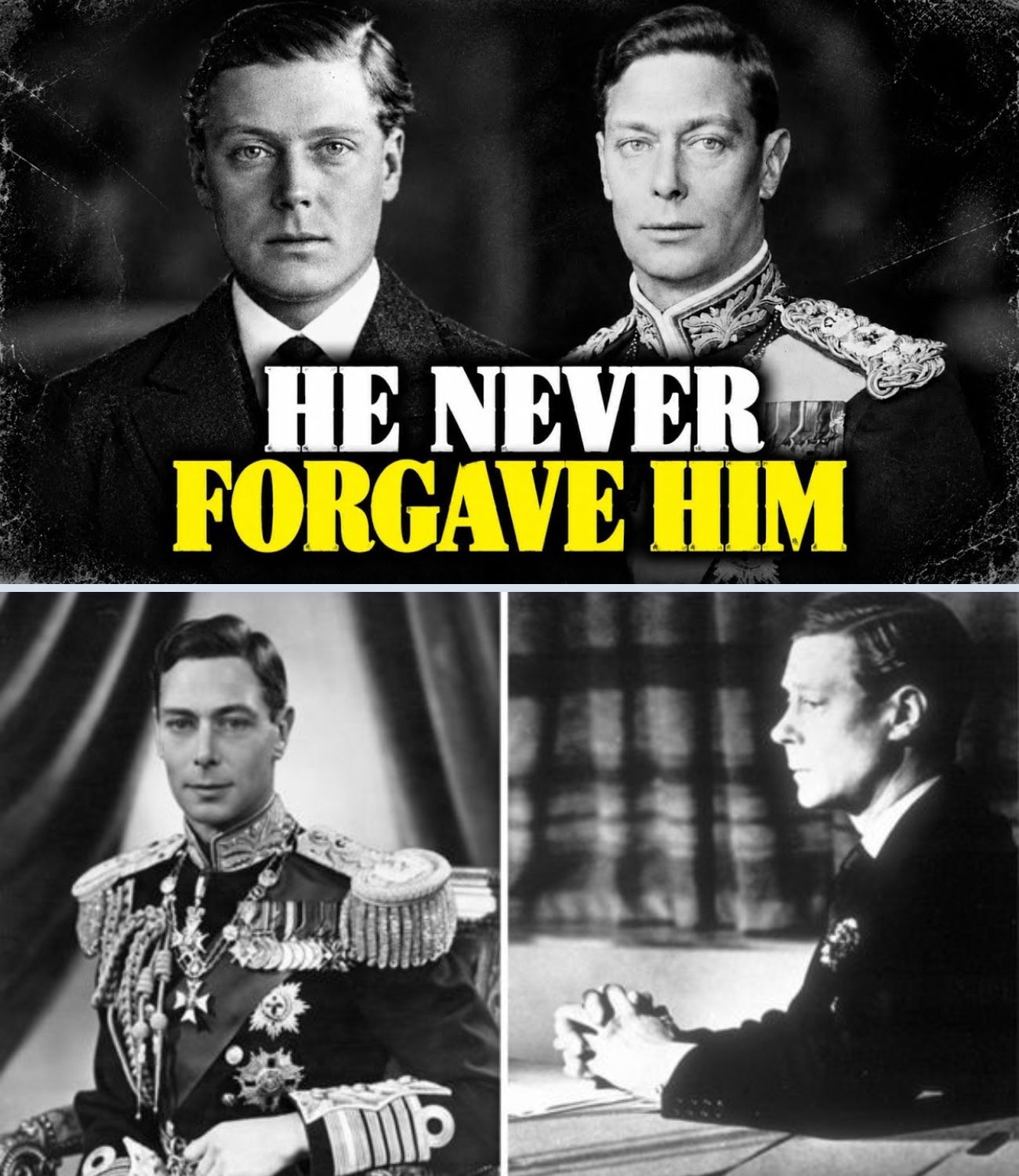
Edward VIII ABSOLUTELY Despised His Brother George VI, Here’s Why
Pull open the guest register at Sandringham House, Norfolk. The date printed at the top of the page reads January 1936. One column down, written in the hand of a household clerk working quickly. Edward Albert Christian George Andrew Patrick David, the Prince of Wales, 41 years old, arriving at the family estate because his father, King George V, was dying in the rooms above. Now look at the next column over. Albert Frederick Arthur George, the Duke of York, known to everyone who mattered as Bertie, second son, the one nobody prepared for the throne, the one with the stammer, the corrective leg braces bolted to his childhood legs, the perpetual weight of a more magnetic elder brother pressing down on everything he attempted. Two names on the same page, two brothers inside the same house, and hidden somewhere between those two ink entries, invisible to the household clerk, invisible even to the men themselves, the very first coordinates of a resentment so specific, so meticulously documented, and so sustained over 35 years that it would eventually require an act of government suppression to keep it from the public record.
Here is the detail that most accounts leave out. In the years after the abdication, the man who had been the most famous royal in the world discovered that his younger brother, George VI, the shy, stammering Bertie, who had sobbed like a child when he learned the throne was coming to him, had signed a legal instrument designed to keep Edward VIII’s wife from ever holding a royal title. That George VI had banned every member of the royal family from attending Edward VIII’s own ceremony. That George VI had issued a classified military directive ordering that the former king of England, a man who had once received the full intelligence briefings of a reigning monarch, must not be shown secret documents, and that the private secretary George VI trusted most, writing in a classified memo, now held at the Churchill Archive Centre in Cambridge, had advised the government to treat Edward VIII as, and this is the recorded phrase from the document itself, “a petulant baby”. Edward VIII spent the rest of his life knowing all of that.
George V died at Sandringham on January 20th, 1936 at 11:55 in the evening. Lord Dawson of Penn, his physician, recorded the precise time. We now know from Dawson’s own private diary entries, sealed until after his death and subsequently examined in published academic studies, that Dawson administered a fatal combination of morphine and cocaine to accelerate the king’s passing in time for the announcement to reach the morning edition of The Times rather than the lesser evening papers. David, the family name for Edward, became King Edward VIII within the hour. The throne arrived without preparation and without grace.
By the following morning, the red government dispatch boxes were waiting at York House in St. James’s Palace, where the new king had chosen to remain rather than move to Buckingham Palace. Cabinet summaries, intelligence reports, and diplomatic cables were pressing inward from every direction. The question of Wallis Simpson, an American, twice divorced, introduced to Edward VIII through the country house circuit of the early 1930s, was entirely inadmissible in the view of Prime Minister Stanley Baldwin, the senior clergy, and, quietly with controlled devastation, the royal household.
Bertie watched from the edge of every gathering that January. He said very little. He did not need to. Within 11 months, Edward VIII would be gone. The crown would fall to Bertie, who took the name George VI and spent the rest of his reign attempting to repair the institution his brother had nearly unraveled inside a single year. And Edward VIII, now titled the Duke of Windsor, living in permanent exile in France, would spend the next three and a half decades building, with the patient precision of a man who has nothing left but time, a documented case against the brother who now occupied his throne.
This is not a story about an abdication. This is a story about what happened in the 35 years that followed. And the specific details, when you read the primary files, are more methodical than anyone who heard the sanctioned version was ever meant to know. The resentment did not begin at the moment of abdication. It began much earlier than that. And to locate its roots precisely, you need to step inside York Cottage, not the main house at Sandringham, but the secondary residence on the estate’s grounds, a cramped and unremarkable building where George V and Queen Mary installed their six children and left them largely to be administered by staff.
George V and Queen Mary appeared before their children twice each day: morning and afternoon. The intervals between those appearances belonged entirely to the nannies assigned to the household. One of those nannies, her name is preserved in contemporaneous accounts examined by biographer Frances Donaldson for her 1974 authorized study, was deliberately mistreating the two eldest boys. Pinching, deliberate destabilization, and sustained emotional cruelty were directed at David and Bertie inside the rooms of their own home. George V and Queen Mary did not discover this for years. It proceeded under the roof they governed with the mechanical precision of a military barracks.
The two boys came out of that shared experience with markedly different wounds. David, golden, restless, and built for agitation, pushed the pressure outward and learned to perform his way through it. Bertie drove it inward. His natural left-handedness was corrected by force. Steel braces were clamped to his legs to address a slight knock, an intervention applied through sustained physical discomfort, with no consultation and no visible warmth from the parent who ordered it. His pronounced stammer, which deepened under George V’s barely concealed impatience, would define his public life until Australian speech therapist Lionel Logue began working with him in October 1926 at Logue’s consulting rooms on Harley Street in London.
Here is what matters for this story. Before Wallis, before the abdication crisis, before any of it, the two brothers had shared something that created, briefly, a genuine underground bond between them. Through the early 1920s, both David and Bertie were managing relationships that required institutional discretion. David with Freda Dudley Ward, Bertie with Freda’s close friend, Sheila Chisholm, Lady Theyl. Their social circle described themselves informally as the four duces, two princes and two women navigating parallel private lives inside a system that would not have sanctioned any of it. That shared experience of living a doubled existence behind palace protocols gave the brothers, for a specific window of time, something very close to genuine solidarity.
It dissolved the moment their trajectories diverged. Bertie married Elizabeth Bowes-Lyon at Westminster Abbey in April 1923. His household stabilized. His public obligations expanded. His stammer improved steadily under Logue’s instruction. David’s private world contracted year by year around one person: Wallis Simpson. By 1935, the surveillance around the heir to the throne had become near total. Once Edward VIII assumed the throne following George V’s death in January 1936, his private secretary, Alexander Hardinge, maintained active oversight of correspondence channels.
The king’s movements between York House and Fort Belvedere, the Gothic Revival retreat on the Windsor Estate where he spent his weekends in Wallis Simpson’s company, were logged by household attendants. Sir Alan Lascelles, who had served as Edward VIII’s assistant private secretary in the early 1920s, had already concluded by 1927 that the future king was fundamentally unfit for the role. He recorded in his diary that the king’s first question about any formal obligation was invariably:
“Can I get away with it?”
Government dispatch boxes occasionally sat on tables at Fort Belvedere, opened but left unread. Their contents were discussed at dinner tables that included guests whose presence alarmed the Foreign Office. On November 13th, 1936, Alexander Hardinge wrote directly to the king at Buckingham Palace. The letter is held in the royal archives at Windsor Castle. It stated plainly that the British press was within days of breaking its silence on the Simpson relationship, that Prime Minister Stanley Baldwin’s patience had reached its outer limit, and that the path forward was narrowing to a single decision.
Edward VIII read the letter. He told Hardinge to his face that he was furious. Three weeks later, on the morning of December 10th, 1936, he walked into the octagonal drawing room at Fort Belvedere and signed the instrument of abdication. His brothers, Albert, Henry, and George, signed below him as witnesses. The pen crossed the page at approximately 10:00 in the morning.
The following morning, before the ink on that document was even fully absorbed into the paper fibers, George VI’s household had already begun preparing the mechanism that would define his brother’s resentment for the next three and a half decades. The legal consultation about Wallis Simpson’s title had started. Edward VIII would not learn the outcome for another 5 months. When he did, his closest ally would describe his reaction as that of a man who felt he had received the news of a sentence rather than a settlement.
Let us pause the historical analysis for a moment to speak plainly. I have been in these files for hours today: the Hardinge letters, the Lascelles diaries, the Churchill archives cables, the Wallis correspondence. And I want to say something directly before we continue. There is a specific, accumulating exhaustion to reading the paper trail of a person being managed out of their own life. Every communication Edward VIII received after December 1936 passed through at least one intermediary before reaching him. Every request he sent upward was filtered, delayed, or redirected. His mail was noted. His telephone calls were monitored during the crisis months. His movements through Austria and France in the weeks after the abdication were tracked by British intelligence personnel who filed reports upward through a chain that ended inside his brother’s palace. When you read enough of these documents in sequence, you feel the compression of it. A man who had been king of the United Kingdom for 11 months was now reduced to sending letters he knew were being opened before they arrived. Whatever you think of the choices he made, the paper trail of what was done to him afterward is genuinely difficult to sit with.
The abdication broadcast left Aughnacloy Tower at Windsor Castle at 10:00 in the evening on December 11th, 1936. Lord Reith of the BBC introduced him as His Royal Highness Prince Edward—precisely the form of address George VI had himself used in his written instructions to Reith. It was an inadvertent confirmation of the royal style that George VI’s own letters patent would formally manage six months later. David’s voice reached every corner of the British Empire. He said he had found it impossible to discharge the responsibilities of the throne without the woman he loved beside him. Then he crossed the English Channel before dawn aboard HMS Fury and did not return to Britain for 7 years.
George VI told his mother, Queen Mary, that when he finally understood the abdication was irreversible, he had broken down and sobbed like a child. That account is documented in contemporaneous correspondence. The grief was genuine, but the actions that followed the grief were something else entirely. George VI had been king for 6 days when his attorneys began working on the instrument that would define his brother’s life in exile. The legal question on the table was the title. Those advising the new king held two incompatible positions. One argument held that Edward VIII retained his royal rank automatically—that as a prince of the blood, the style, His Royal Highness, attached to him by birth, and no act of abdication could strip it. The counterargument was blunter: an abdicated king forfeited all royal rank and should be addressed going forward simply as Mr. Edward Windsor.
George VI resolved the ambiguity himself. On May 27th, 1937, he issued letters patent. The document reconferred the style His Royal Highness upon the Duke of Windsor by name, but then it added a second provision drafted with surgical precision by Attorney General Sir Donald Somerville, reviewed by Home Secretary Sir John Simon, and signed off by the new king personally: the style would not extend to his wife, nor would it extend to any descendants. One sentence of typed legal language, and Wallis Simpson would never be Her Royal Highness.
Edward VIII received word of this before the ceremony. The accounts from guests present at Château de Coudray—the substantial 16th-century Loire Valley estate of Franco-American industrialist Charles Bedaux near the town of Tours—describe his reaction as barely controlled fury. He described the denial to one correspondent as a nice wedding present.
Wallis had already anticipated the outcome. Writing privately in December 1936, she referred to George VI by his former family title with undisguised contempt:
“I suppose we will have difficulty about a name for poor me as York. I don’t suppose they will make me HRH.”
She was correct. They did not. The ceremony at Château de Coudray on June 3rd, 1937 was attended by 16 guests. Not a single member of the British royal family appeared. George VI had issued an explicit prohibition against any of them attending. Edward VIII had specifically requested the presence of his brothers, the Dukes of Gloucester and Kent, and his second cousin, Lord Louis Mountbatten. The refusal was absolute and without negotiation. The only Church of England clergyman willing to conduct the service was the Reverend Robert Anderson Jardine, vicar of St. Paul’s in Darlington, County Durham, who defied the express disapproval of his ecclesiastical superiors to do so. Jardine lost his clerical living in England as a direct consequence of that decision and immigrated to California.
The photograph of Edward VIII and Wallis leaving Château de Coudray that afternoon—he in morning dress, she in a blue crepe gown made by American designer Mainbocher—captures two people who had already absorbed with complete clarity the terms of their exclusion. Inside the shadows and later at the Villa Windsor in Paris, the household staff began addressing Wallis informally as Son Altesse Royale (Her Royal Highness) in French. The title her husband’s own brother had constructed a legal instrument to prevent her from holding. That specific detail—the French title given privately by servants in a house borrowed from the city of Paris across the channel from the family that refused to grant it—persisted without interruption from 1937 until Wallis died in 1986. Forty-nine years.
George VI’s advisers were aware of it throughout, yet no formal objection was ever recorded. Now consider the financial dimension, because this is where Edward VIII’s resentment acquired its hardest specific edge. The post-abdication settlement, negotiated through Edward VIII’s personal adviser Walter Monckton and solicitor George Allen, established a private annual allowance of £21,000 from George VI. In exchange, Edward VIII transferred the ownership of Sandringham House and Balmoral Castle to the crown. Both estates had been inherited by Edward VIII personally from George V; they were private properties outside the formal royal estate and therefore his to sell or keep as he chose. George VI needed to purchase them, and he did so with borrowed funds.
What came to light in the years that followed—examined in detail by historian Alexander Larman for his 2023 study, The Windsors at War, and confirmed through research conducted by Sally Bedell Smith during three months in the royal archives at Windsor Castle—was that Edward VIII had deliberately misrepresented the state of his private finances during those negotiations. The Duke held considerably more in liquid capital than he disclosed to his brother’s representatives at the time. George VI discovered the gap. It introduced a specific, documented layer of financial betrayal into a relationship already straining under the weight of the title dispute, the exclusion, and the accumulating institutional pressures of a new reign built partly on the ruins of the old one.
In October 1937, 10 months after the abdication, Edward VIII and Wallis traveled to Nazi Germany. The trip had been arranged by Charles Bedaux, their host at Château de Coudray, a man whose connections to the German industrial establishment were well known to British intelligence. The Duke and Duchess arrived at Adolf Hitler’s Berghof retreat on October 22nd, 1937. Biographer Frances Donaldson, drawing on contemporaneous accounts in her 1974 study, recorded that Edward VIII extended full Nazi salutes during the meeting. German newsreel footage documented the visit and was widely circulated. British press coverage was extensive and almost uniformly critical.
Winston Churchill, who had been among the most prominent voices defending Edward VIII during the abdication months, had written personally to urge the Duke not to make the journey. Edward VIII went regardless. The reaction inside George VI’s household was controlled, deliberate, and permanent. Queen Elizabeth, George VI’s wife, who had never concealed her view that the abdication had laid an unjust burden on her husband, described the Duchess of Windsor in private from this point forward as “that woman”. The phrase appears in multiple separate contemporaneous accounts from people close to the household. It was never qualified and never retracted.
In September 1939, Britain entered the Second World War. From September 4th, 1939, the day after the declaration, until November 4th, 1946, George VI’s personal diary at the Royal Archives contains 50 separate entries about his brother. Historian Sally Bedell Smith, after spending three months reading those wartime diaries at Windsor Castle, described the Duke of Windsor in those pages as “a chronic pest”, issuing unrealistic demands and lodging complaints that were, in the king’s recorded assessment, frequently petty.
Among the documented restrictions imposed on the Duke in his military liaison role in France was a classified directive recorded by General Edmund Ironside, Chief of the Imperial General Staff, stating that Edward VIII was not to be shown secret documents. The man who less than three years earlier had received the complete intelligence briefings of a reigning monarch was now operating in a military environment under a security clearance limitation placed there by his own brother’s government.
And then there is the memo. Pause here and read this carefully, because this is the specific document that the formal account has never fully absorbed. On July 20th, 1940, John Peck, assistant private secretary to Winston Churchill, filed a note at the Colonial Office. It is preserved at the Churchill Archive Centre in Cambridge under reference code GBR/0014/CHAR 20/9A-85. The note summarized the positions of Lord Lloyd, Secretary of State for the Colonies, and two senior advisers on how the British government should respond to the Duke of Windsor’s continuing flood of demands and complaints from his posting in Lisbon, where he was delaying his departure for the Bahamas.
The two advisers who weighed in were Lord Lascelles and Sir Walter Monckton. Lascelles was the man who had served as Edward VIII’s own private secretary and had since become George VI’s most trusted household official. Monckton was the barrister who had been Edward VIII’s closest personal adviser throughout the entire abdication crisis—the man Edward VIII trusted above nearly any other, his intermediary with the palace, his channel to the brother who now held the crown. Both of them, writing in a classified government document, advised that the Duke of Windsor should be treated as “a petulant baby”, not managed carefully, not handled with discretion, but treated as a petulant baby. Those are the recorded words. Monckton, his most loyal ally. That is what Monckton wrote when he was writing for an audience that did not include the Duke. That document sat in the Churchill archives for decades before historians brought it into the open.
Edward VIII, in exile in France, then Nassau, and then France again, almost certainly never saw it. The Bahamas posting followed in August 1940. Churchill arranged it with the explicit purpose of placing the Duke somewhere geographically irrelevant to the European theater. Government House in Nassau was comfortable, properly staffed, and roughly 4,000 miles from any decision that mattered. Edward VIII accepted the appointment. In private correspondence with Monckton, his characterization of the role was unmistakable: he had once held diplomatic communications from every territory in the British Empire, but now he administered a Caribbean colony of 70,000 people and attended tropical ceremonial functions in dress uniform.
In the summer of 1940, before the Bahamas posting was finalized, German intelligence operatives acting under Joachim von Ribbentrop’s direct orders had been approaching intermediaries close to the Duke and Duchess while they were stranded in Portugal. The operation was codenamed Willi. Its objective was to prevent the Windsors from leaving the Iberian Peninsula, position the Duke as a potential intermediary in peace negotiations, and, in the event of a German military breakthrough in Britain, make him available as a restoration figure under German conditions.
The files recovered from Marburg Castle in May 1945—60 key documents embedded in 400 tons of German Foreign Ministry papers near the Harz Mountains—documented in specific telegrams what German officials believed they were hearing from the Duke’s circle. One document alleged that the Duke had indicated to a trusted intermediary that sustained aerial bombardment of Britain would bring the government to the negotiating table. German operational notes further described an attempt to convince the Duke that his own brother, George VI, was plotting to have him killed. Whether the Duke communicated those positions or was simply the subject of German intelligence optimism about what they might extract from him is debated by historians.
What is not debated is what George VI did with the files when they reached British hands in 1945: he had them suppressed. The Marburg files were transferred to Wotton House in Buckinghamshire in 1948. Churchill subsequently wrote to President Dwight Eisenhower seeking American agreement to prevent their publication. The files were not released in any partial scholarly form until 1957, and full historical examination extended into the late 1990s.
The resentment Edward VIII carried out of Nassau in 1945 had by that point been compounded by six distinct documented injuries delivered specifically by his brother’s administration: the HRH denial, the exclusion, the financial misrepresentation discovered in reverse, the Germany visit’s permanent effect on his reputation inside the family, the “not be shown secret documents” directive, and the Bahamas posting. He returned to France with all six of them intact and entirely new grievances waiting.
Let us look at the final letters. This is where the formal account wants you to believe the story softens—that the Duke and Duchess of Windsor settled into their borrowed Paris residence, attended their dinner parties, traveled to the south of France, and lived out a comfortable, if diminished, retirement, and that time did what time does to grievances between brothers. The private files tell a different account.
The house at 4 Route du Champ d’Entraînement on the northern edge of the Bois de Boulogne, offered to the couple by the city of Paris at a nominal rent, became the Villa Windsor. They also acquired Le Moulin de la Tuilerie, an 18th-century converted mill in the Chevreuse Valley southwest of the city, as a weekend property. The domestic arrangements were grand, the wallpaper was expensive, the silver was polished on a fixed schedule, and beneath every surface of that curated French life, the register of specific grievances was still accumulating interest.
In October 1945, Sir Alan Lascelles, now serving as George VI’s principal private secretary, traveled to meet the Duke. The meeting is recorded in Lascelles’ own diary and referenced in accounts examined by Philip Ziegler. Lascelles urged Edward VIII directly: stop pressing George VI over Wallis’s title, stop demanding a formal role, stop the stream of complaints and unrealistic requests consuming the king’s attention during a period of national reconstruction, accept the arrangement, and leave your brother alone. The Duke declined to commit to any of it.
There is a reason the resentment did not soften. Edward VIII understood, with the clarity of a man who had spent 9 years tracking every specific mechanism of his exclusion, that every single grievance he carried could be traced to a deliberate decision made inside his brother’s household—not to circumstances, not to public pressure, not to the government of the day operating independently, but to specific named decisions by a specific person who sat on the throne Edward VIII had vacated.
Some historians, including Vernon Bogdanor in his assessment of the Monckton papers, have argued that many of the decisions Edward VIII attributed to George VI were actually taken by ministers and advisers acting on broader considerations, with the king functioning as the formal authority behind institutional choices he may not always have fully initiated. That argument has merit in specific cases, but it does not account for the letters patent of May 27th, 1937. That document—the one that carved Wallis out of the automatic entitlements of a royal duke’s wife—was personally examined, personally refined, and personally signed by George VI. The legal mechanism that kept the Duke and his wife separated from Britain was George VI’s construction, built with his hands and maintained by his silence: a lock with his brother’s signature acting as the key.
In 1939, before the war had fully consumed everything, Edward VIII had written to his mother, Queen Mary, in language that removed all diplomatic cushioning. The letter, cited in multiple authorized historical studies, informed her that her most recent written communication had destroyed the last vestige of feeling I had left for you, and had made further normal correspondence between us impossible. He was responding to her continued refusal to receive Wallis socially, her refusal to press George VI on the HRH question, and her sustained institutional silence on the treatment of the woman Edward VIII had surrendered his crown to be with. Queen Mary did not yield. George VI did not yield.
One contemporary historian writing in the journal History of Royal Women in January 2020 stated plainly that George VI had acted illegally in denying Wallis the style of Her Royal Highness; that under the established conventions of English common law, a royal duke’s wife automatically acquired the rank of her husband; and that the letters patent issued to override this convention exceeded the normal legal authority of such an instrument. Whether every legal scholar accepts that conclusion is debated. What is not debated is that George VI went to the specific, considered effort of constructing a legal document to prevent Wallis from holding a title she would otherwise have held by default. He did not simply fail to grant her something; he actively removed it before she could claim it.
The personal and institutional consequences of that choice extended across everything that followed. Edward VIII had stated repeatedly and consistently through the 1940s and 1950s that he would not make a permanent return to Britain unless Wallis was formally recognized as Her Royal Highness. George VI knew this. Queen Elizabeth—the woman who would eventually become the Queen Mother and who referred to the Duchess of Windsor without qualification as “that woman”—knew this. The HRH denial was not simply a matter of protocol. It was the mechanism by which two human beings were permanently contained on the other side of the English Channel: a policy instrument functioning as a geographic one.
George VI died at Sandringham on February 6th, 1952. He had undergone a lung operation in September 1951, shown apparent signs of recovery, and then died of coronary thrombosis in the early hours of a Thursday morning. He was 56 years old. The war, the abdication’s aftermath, and the sustained pressure of a reign he had never prepared for and never wanted had used him up.
The Duke of Windsor was in New York when the news reached him. He returned to England for the funeral alone. The Duchess was not invited. The household of the new queen, Elizabeth II, George VI’s daughter, had no intention of beginning a new reign by reopening any of the questions her father had spent 16 years holding closed. The Duke stood in the nave of St. George’s Chapel, Windsor, beside the family that had managed him since 1936. He returned to France that week without his wife, and without any resolution to the questions that had structured every private letter he had written for the past 15 years.
In June 1953, Queen Elizabeth II was crowned at Westminster Abbey. The Duke did not attend. He was not invited in any capacity. The auxiliary question—whether Wallis might attend in some limited form, in some seat that acknowledged some version of her position—was never seriously considered. Any such appearance would have required the palace to publicly navigate the HRH question it had spent 16 years refusing to address. He watched the coronation on a television set at the Villa Windsor in Paris. At 58 years old, the man who had been king of the United Kingdom and Emperor of India for 326 days sat in his borrowed French house and watched his niece crowned in the abbey his family had occupied for centuries.
The Monckton papers deposited in the Bodleian Library at Oxford after Walter Monckton’s death in 1965 held correspondence between both brothers from 1936 through 1951. When journalists were granted limited access in March 2000, Box 24 of the collection was absent. Bodleian archivists denied any responsibility for the disappearance, and one staff member estimated the removal had occurred as early as the 1970s. The palace acknowledged that certain materials from Monckton’s trove had been transferred to the Royal Archives at Windsor Castle for, in their stated phrasing, safekeeping. Historian Andrew Roberts noted publicly at the time that those documents were unlikely to see release before 2037. Box 24 of the Monckton collection has never been published. Whatever correspondence it contains between Edward VIII and George VI across the 15 years of their mutual administration remains sealed somewhere inside the Windsor Castle archive system as of the time this script was researched.
The Marburg files saw partial publication in 1957. The full scholarly context of those 60 documents was not properly examined until the late 1990s. Churchill had already written to Eisenhower seeking American agreement to suppress them, and George VI had personally insisted they be withheld from public release when they arrived at Wotton House in 1948.
His memoir, A King’s Story, had appeared in 1951. It was ghostwritten, commercially successful, and, to the observation of every reviewer who read it carefully, almost entirely free of direct recrimination against any member of the royal family. It was the work of a man who understood that any public accusation would be met with institutional resources he could not match. The private correspondence he could not control told the other story.
The Duke’s health began its final decline in 1971 due to inoperable throat cancer. Queen Elizabeth II visited him at the Villa Windsor on May 18th, 1972 during a scheduled state visit to France. He received her in his upstairs study. He was visibly diminished. He died 10 days later on May 28th, 1972, at the age of 77.
His body was brought to England. He lay in state at St. George’s Chapel for 2 days, and more than 57,000 people passed the coffin. The Duchess traveled from Paris for the funeral and was housed at Buckingham Palace during the brief stay—the first time she had slept inside those walls. Those present at the chapel service reported that she appeared fragile and at moments barely oriented to where she was. She died on April 24th, 1986 at the Villa Windsor in the house that still carried his name. She was buried beside him at the royal burial ground at Frogmore, within sight of the castle that bore their title and held their sealed correspondence. She was never made Her Royal Highness—not by George VI, not by the governments and institutions that succeeded him, and not by the royal family that outlived them both.
The household staff at the Villa Windsor called her Son Altesse Royale from 1937 until she drew her last breath in 1986: 49 years of a title given privately in French in a borrowed house by the people who cleaned the rooms and laid the table, because the only people who could have made it real had decided in a single provision of a typed legal instrument signed in May 1937 that she would never hold it.
Edward VIII resented George VI for reasons that are not interpretation. They are not dramatization. They are not the retrospective sentiments of biographers reading an emotion into distance. They are itemized in the archival record: the letters patent, the ceremonial prohibition, the financial concealment discovered in reverse, the “not be shown secret documents” directive, the Nassau exile, the classified memo where his closest ally described him in terms he would never have accepted to his face, the 50 wartime diary entries from the brother who called him a chronic pest, the sealed Box 24, the suppressed Marburg files, and the television set at the Villa Windsor tuned to a coronation he was not invited to attend. The resentment was not a rumor. It was not a dramatized inference. It was filed.
You Might Also Enjoy

“We Thought They Would Negotiate”—What Argentine Soldiers Said When The British Attacked Goose Green

“You’ll Never Finish My Ruck March, Limey” — US Sergeant Who Challenged the SAS, Then Fell Out First