“Beat me at chess, and I’ll be your wife!” – with this challenge, the managing director addressed a single father. His answer astonished her.
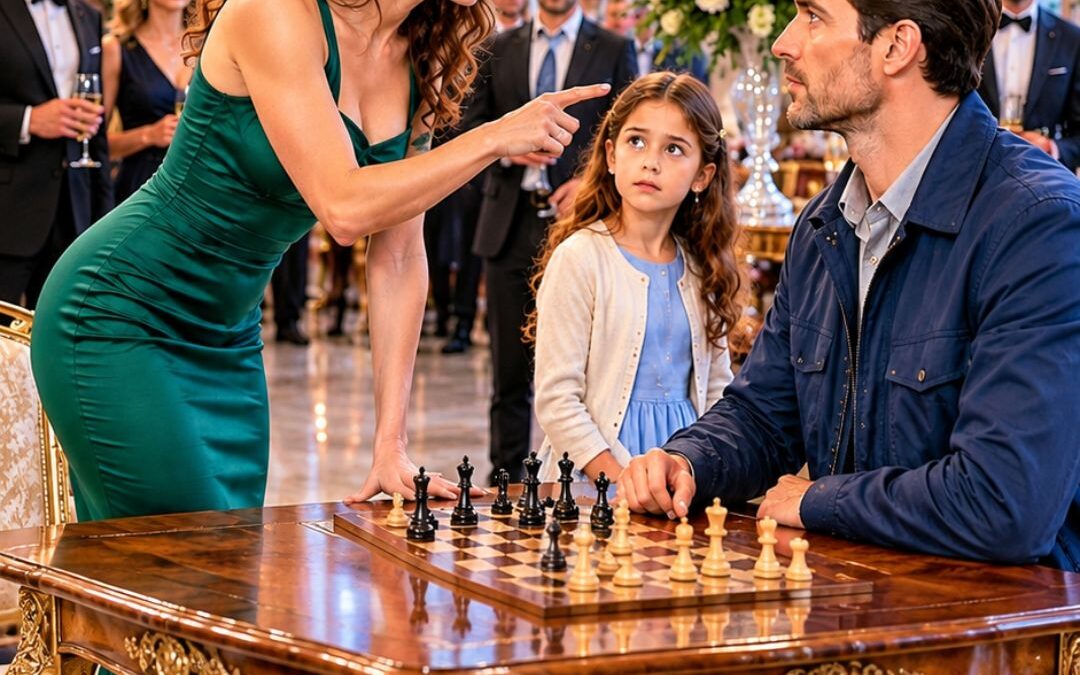
“Beat me at chess, and I’ll be your wife!” – with this challenge, the managing director addressed a single father. His answer astonished her.
Victoria Hail had just promised marriage to a man she had known for only eleven minutes. Three hundred guests watched with amusement as the youngest female CEO in the history of a prestigious Manhattan investment firm placed a black chess piece on the table and smiled at the exhausted single father.
“Beat me at chess, and I will become your wife.”
Laughter rippled through the festively decorated ballroom. Daniel Brooks was still wearing his delivery jacket. His eight-year-old daughter, Sophie, slept on his shoulder, her head resting against his neck. He had only been supposed to deliver a forgotten package. Now he suddenly found himself at the center of a gathering to which he clearly did not belong.
Victoria expected him to become embarrassed or withdraw. But Daniel carefully sat his daughter down on an empty chair, sat opposite her, and studied the chessboard.
“One condition,” he said.
Victoria raised an eyebrow in surprise.
“If I win, you will listen to someone you have previously ignored.”
For the first time that evening, her confident smile disappeared.
“Whom?”
Daniel advanced a farmer.
“Someone who taught me how to lose.”
Suddenly it became quiet.
Six months earlier, neither of them would have believed that a chessboard would change their lives.
Daniel was thirty-eight and knew the daily life of a single father all too well. His life consisted of school runs, bills, repairs, and long workdays. He delivered medical supplies across New York City and took every extra shift he could get.
His wife Emily had died three years earlier from a sudden brain aneurysm. Her death had caught him completely unprepared. Since then, he had raised Sophie alone.
Daniel had never indulged in self-pity. Nevertheless, there were mornings when loneliness weighed heavier than tiredness. Especially when Sophie asked about her mother, or when he sat in the small kitchen in the evening and noticed that no one was waiting at the other end of the table.
Sophie loved chess. Emily had taught her the game during their last summer together. After Emily’s death, Daniel had tried to learn the rules himself. He watched videos and read instructions, but his daughter discovered every mistake with great enthusiasm.
He wasn’t particularly talented. But he always played along.
Every Sunday, the two of them sat at their small kitchen table. Once, Daniel had asked why Sophie placed so much importance on finishing every game.
“Because then we can play again next week,” she replied.
He had memorized this simple sentence.
Victoria Hail, on the other hand, lived in a completely different world. At forty, she headed a major investment company that managed the assets of hospitals, schools, and non-profit organizations. Her father had founded the company. After his death, Victoria had to fight for seven years to be taken seriously as his successor.
Every mistake was interpreted as proof of her lack of experience. Every moment of uncertainty was used by others to question her leadership abilities. Therefore, she had learned to make quick decisions and never show weakness.
But by now her position was also at stake. The supervisory board was about to vote on her removal. A rival investment group planned to take over the company and dissolve its non-profit division.
Victoria wanted to prevent this. A major partnership with a philanthropic foundation was intended to secure the social projects in the long term. But on the very afternoon of the gala, this agreement fell through.
Her carefully prepared speech had become useless. While she tried to hide her feelings, the evening became a stark reminder that even she couldn’t control everything.
When Daniel entered the ballroom with a package, a board member made fun of the supplier.
Perhaps, he joked, this man could give the managing director better advice than her highly paid consultants.
Victoria was hurt and irritable. Her gaze fell upon a decorative chessboard on the reception table. Spontaneously, she challenged Daniel.
She hadn’t expected him to agree. Even less had she anticipated his condition.
Now they sat facing each other. The guests formed a circle and took out their cell phones. Victoria started aggressively. She brought her queen into play early and put Daniel’s pieces under pressure.
After four moves, his knight seemed lost. Victoria smiled contentedly.
Daniel examined the board and then looked at Sophie. The girl was awake by now and attentively followed every movement. She subtly raised two fingers, then three.
Daniel understood the sign.
He deployed his runner.
Victoria frowned. The move seemed to have little effect. She advanced her queen further and prepared the decisive attack.
But Daniel sacrificed his tower.
A murmur rippled through the circle. Victoria stared at the board. The loss of such an important piece seemed unnecessary. Only a moment later did she realize that it had opened a direct path to her king.
Their queen, who had previously dominated the game, was suddenly no longer the greatest threat to their opponent.
Victoria leaned forward. For the first time that evening, she wasn’t thinking about the cameras or the spectators. She was concentrating solely on the game.
Then Daniel noticed an old photograph beneath the transparent chessboard. It showed a young man and an older gentleman standing in front of a small community center. The older man’s face looked familiar.
“Where did you get this picture?” he asked.
Victoria followed his gaze.
“This is my father. He recorded it many years ago.”
Daniel carefully picked up the photo.
“I played chess for the first time in this building.”
Victoria paused mid-movement.
Her father had founded a free afternoon program in a disadvantaged neighborhood of Brooklyn. He had funded it for years. For Victoria, it had previously been little more than a small item in the company’s charity reports.
Daniel told her about a retired teacher named Mr. Ellis who had run the chess club.
When Daniel was sixteen, his mother was in the hospital. To support the family financially, he worked evenings in a grocery store and increasingly missed school.
Mr. Ellis had let him stay after class. He had given him sandwiches, helped him with his studies, and taught him to play chess. He had never asked for anything in return.
Instead, he had repeatedly told Daniel that one day he should help another person when he himself was able to do so.
“Mr. Ellis was my father’s closest friend,” Victoria said quietly.
Daniel nodded.
“He taught me something that even your father might not have known.”
“What?”
“That one can be clever without necessarily being wise.”
Some guests exchanged embarrassed glances.
Victoria turned back to the chessboard. Slowly, she realized she might lose the game. With a cautious move, she might still have been able to force a draw. Daniel’s king seemed vulnerable, and her rook continued to threaten him.
But Daniel made another unexpected move. He placed his king directly within range of their rook.
Victoria paused. It looked like a mistake. She removed the piece from the board.
Daniel deployed his last runner.
“Checkmate.”
For a few seconds, no one said anything. Victoria examined the board from different angles, searching for a possible way out. There wasn’t one.
She had lost.
A guest reminded her of her promise with a laugh. Victoria looked at Daniel, waiting for him to make an unusual request. Perhaps he wanted money, a job, or indeed the spectacular wedding that the newspapers would be reporting on the next morning.
But Daniel simply took Sophie’s hand.
“My wife died three years ago,” he said calmly. “I’m not looking for anyone to take her place. And my daughter doesn’t need a stranger who promises to be her mother just because she lost a game of chess.”
Victoria swallowed.
“What would you like from me then?”
Daniel pointed at the photo.
“Find out what became of Mr. Ellis and his chess club.”
Victoria suddenly understood what he was getting at. The neighborhood center had been closed eight months earlier. She herself had approved the budget cut.
The building needed repairs, attendance had declined, and the required documents hadn’t been submitted on time. Her finance team had submitted a corresponding report. Victoria had signed it without ever having visited the center or spoken to those in charge.
Daniel explained that Mr. Ellis had suffered a stroke shortly before the deadline. His niece had tried to continue the program, but important documents were lost during the medical emergency.
The children had been distributed among other activities. Some eventually stopped participating in recreational programs altogether.
Sophie had been to the center twice with her father. Both times they had found only locked doors.
Victoria gazed through the large windows at glittering Manhattan. In the ballroom, wealthy people celebrated their generosity, while she herself had closed the place where a boy had once been given a new perspective.
“I didn’t know that,” she whispered.
Daniel remained calm.
“No. They didn’t ask for it either.”
The next morning, Victoria went to the closed community center alone. There were no cameras, no guests, and no prepared speech. Just peeling paint, dusty windows, and an old chessboard still sitting on a shelf.
In the afternoon, she visited Mr. Ellis, who was now living with his niece in Queens. His movements had slowed after the stroke, but his eyes lit up as Victoria told him about her plans.
The supervisory board warned her that reopening the center could jeopardize her position. Nevertheless, she approved the necessary repairs.
She didn’t want to make Daniel the public face of the project. He hadn’t asked for recognition, and the children didn’t need an advertising campaign.
Instead, Victoria hired a local coordinator, simplified grant applications, and organized transportation for children who had lost access to the services after the closure.
Daniel continued working as a delivery driver. His bills didn’t disappear, and the memory of Emily remained a part of his daily life. But every Sunday, he returned to the chessboard with Sophie.
A few months later, the community center reopened its doors. The walls were freshly painted and shone in a cheerful yellow. New windows let in daylight, and numerous chessboards stood on a long table.
Mr. Ellis was sitting by the window. Sophie immediately ran to him.
Victoria appeared without much fanfare. She wore an ordinary coat and carried a small box containing twelve new chess clocks.
Daniel smiled.
“You do realize that this won’t make you play any better?”
“I hope the children will.”
Later, Victoria told him that the board of directors had decided to keep her on as CEO. But this success felt different from her previous victories. She no longer wanted to prove that she could win every argument. She wanted to learn to make decisions without forgetting the people involved.
Daniel listened to her.
“Have you learned by now not to sacrifice your lady too soon?”
“I’m still working on it,” she replied.
He laughed heartily.
Victoria looked at the chessboard between them.
“What about my marriage proposal?”
Daniel raised his eyebrows in surprise.
“Was he serious?”
“I had a terrible evening.”
“That at least explains your first move.”
They both laughed. Then Victoria became thoughtful.
“I don’t want to make promises just because I’m afraid of being alone. And I don’t want you to say yes because you think you owe me something.”
Daniel looked at Sophie, who was explaining to another child how to protect their own king.
“Then we simply won’t promise anything today,” he said.
Victoria nodded. For the first time, waiting didn’t feel like a defeat to her.
A year later, Daniel was still delivering medical supplies, but he also volunteered at the community center on Sundays. Victoria came by whenever her schedule allowed. Sometimes she played with the children, sometimes she lost by a landslide.
Gradually, a relationship developed between her and Daniel. Without lengthy explanations or hasty decisions, they got to know each other.
Sophie never called Victoria “Mama.” Nobody asked her to.
One evening, the girl placed three cups of hot chocolate on the kitchen table and asked Victoria if she would come back next Sunday.
Victoria looked at Daniel. He didn’t answer for her.
“Yes,” she said, smiling. “If you want.”
Sophie pushed a chessboard towards her.
“Good. Dad says you’re still terrible in the final.”
Victoria burst out laughing. Daniel shook his head in mock indignation.
Outside, the rain gently tapped against the windowpanes. Inside, the chess pieces moved across the board, move by move, with deliberation and mutual trust.
Victoria had once challenged a stranger to prove she could win. Daniel had accepted the challenge to remind her that winning isn’t always the most important thing.
Between an ill-advised challenge and a sincere apology, two people discovered something neither of them had been looking for.
Not a perfect love and not a fairytale ending, but the opportunity to give each other space.
Because sometimes the greatest victory is not about checkmating the opponent.
But rather in realizing at some point that the person on the other side of the chessboard was never an opponent.
You Might Also Enjoy

A millionaire beat his pregnant wife until she lost the baby – her father’s revenge shocked the public.

The doctor sent the inexperienced nurse away – but her combat skills, acquired in the Navy, revealed who she really was.

Nine nurses fled from the feverish mafia boss – his portly veterinarian opened the stab wound in his back.

The mafia boss had been unable to walk for eight years – then a single mother found a needle hidden in his wheelchair.

“My Skin Hurt” — German Woman POW Shocked as U.S. Army Medics Save Her From Losing Both Hands