“Hand the six rangers over to the new nurse,” mocked the chief surgeon – but then her commander recognized them.
“Hand the six rangers over to the new nurse,” mocked the chief surgeon – but then her commander recognized them.
In the emergency room at Mercy General Military Medical Center, Ren Tully went largely unnoticed. That was exactly how she wanted it. She wore blue scrubs, pulled her light brown hair back tightly, and rarely asked questions. She restocked the ambulance carts, checked the defibrillators, and meticulously monitored every detail, as if more than just a successful shift depended on it.
At 1:47 a.m., the secure line at the station rang. A military transport was approaching. Dr. Preston Wakeley, head of emergency surgical care, arrived a few minutes later.
“A black flight from Fort Bragg, via Ramstein,” he said. “A diplomatic passenger and six Rangers after a failed mission in the Horn of Africa. The VIP arrives at the first operations area. My entire surgical team accompanies him. The soldiers go to alternate station six.”
Dolores Mack, the experienced ward nurse, frowned. “Six seriously injured people need immediate care. We don’t have the same equipment there.”
Wakeley waved it off. “They’re rangers. They’ll last twenty minutes.”
Then he pointed to Ren, who was preparing an IV stand. “The new one will take care of that.”
Dolores wanted to object. Wakeley wouldn’t let her. “She’s a nurse. The soldiers are trained. Together they’ll find a pulse.”
Ren said nothing. She simply asked Dolores for two medical technicians, an experienced respiratory therapist, and the rapid infusion pump from the warehouse. There was something in Ren’s calm voice that expected no argument.
Eight minutes later, the doors opened. The diplomatic passenger was escorted to the left by Wakeley’s team. The six rangers arrived on stretchers at station six. Blood, wet uniform remnants, and the smell of burnt equipment filled the room. One was convulsing, another was gasping for air, and blood was seeping through the makeshift bandage of a third.
Tomas stopped. “Where is the surgical team?”
“Here,” said Ren.
Her voice hadn’t gotten louder. Nevertheless, the room had changed. “Tomas, cut open the equipment. Casey, the emergency cart between beds one and two. Start with bed three. I suspect a tension pneumothorax.”
Casey, a respiratory therapist with twelve years of professional experience, hesitated for only a moment, then he moved.
The first ranger, Sergeant First Class Ruben Holt, had had his tourniquet slip on his thigh. His blood pressure dropped. Ren applied an additional combat tourniquet higher up his leg, tightened it, and had the time recorded. Then she moved on to the next bed.
Specialist Marcus Dune, barely twenty-three, could hardly breathe. His oxygen saturation was dropping, and his trachea was visibly displaced. The signs were clear: air was pressing on his lungs and heart in his chest cavity.
“He needs a doctor,” said Tomas tensely.
“He needs relief now,” Ren replied.
She acted according to the emergency protocol for life-threatening emergencies and her previous military medical qualifications. She performed the decompression. A hiss was heard, Dune’s chest rose again. His oxygen saturation increased.
Casey stared at her in disbelief. “I’ve seen paramedics who weren’t so confident in doing that.”
Ren was already with the next patient. She tended to wounds, secured IV lines, and delegated tasks without wasting a word. It wasn’t haste, but a precision born of years of experience in conditions where mistakes offered little chance of a second chance.
Lieutenant Colonel Declan Orin, the unit’s commander, lay on the sixth stretcher. Shrapnel had struck his left shoulder, several ribs were broken, and he had suffered a concussion after his vehicle overturned. Through the pain and the medication, he watched the nurse.
She moved between the beds like a seasoned paramedic. As she checked his pupils, she gently held his head.
“Follow the light. Stay with me. Breathe slowly. You are not alone.”
Declan froze inside. He knew that voice. Six years earlier, his unit had come under fire during an operation in northern Syria. He had been wounded in the thigh and had lost a lot of blood. A woman in inconspicuous gear had applied pressure to his wound for forty minutes and kept him awake. The men called her “Ghost.”
“Ghost,” he whispered.
Ren’s hand paused briefly. “Stay calm, Colonel. You have a concussion. Don’t move your neck.”
Fourteen minutes after arrival, all six men were stable enough for further treatment. Dune needed a chest drain, Holt surgical hemorrhage control. The others received IV fluids, dressings, and close monitoring.
Wakeley entered the ward with his clipboard. But when he saw the stabilized patients and the catheter in Dune’s chest, he stopped.
“Who ordered this?”
“I did,” said Ren, pulling off her bloody gloves. “He had a tension pneumothorax and was in immediate danger of death.”
Wakeley stepped close to her. “You’ve been here for four weeks. You have neither the authority nor the experience to perform such a procedure. Give me your identification. You are dismissed with immediate effect.”
Ren didn’t back down. “His blood pressure was sixty. His trachea was dislocated. He might not have survived the next minute.”
“You have no idea what you’ve done.”
“I know what would have happened if no one had acted.” She looked at him calmly. “You sent six seriously wounded soldiers to an inadequately equipped station while your team treated a diplomatic guest with a minor cut. That’s a triage problem, not mine.”
Wakeley’s face hardened. “I want you removed from this hospital.”
Declan struggled to his feet on his stretcher. “Do not touch this ID.”
“If you dismiss them, I will have your facility inspected by the relevant regulatory authority before the end of their shift.”
Wakeley turned to him. “Colonel, you have a head injury. You shouldn’t interfere.”
“I know exactly what I saw. This woman just saved six lives. And she saved Marcus Dune with a measure she has taken before.”
The doors opened again. Hospital director Samuel Gourd entered, accompanied by Vice Admiral Constance Ree.
Her gaze swept over the stretchers, the monitors, and the carefully treated injuries. Then she looked at Ren and stopped.
“Major Tully.”
The room fell silent.
Ren sat up almost imperceptibly. “Admiral. I didn’t know you were coming.”
“I followed the transport. Are all six stable?”
“Yes. Dune needed immediate relief. Holt had an arterial hemorrhage. The others are being cared for and monitored.”
“Do you know who is standing in front of you?”
Gourd glanced at Ren’s fresh name tag. “A new nurse. She came through the Johns Hopkins University accelerated nursing program.”
“This is Major Ren Tully, formerly with the U.S. Army Medical Corps. She left the service fourteen months ago after a deployment in the Fergana Valley, where her team lost three members. She received the Distinguished Service Medal, the Bronze Star, and commendations from the Joint Special Operations Command.”
Ree let his gaze rest on Wakeley. “During her active service, she performed more decompressions for tension pneumothorax than many trauma surgeons do in their entire careers.”
Wakeley clutched his clipboard tightly. “There’s nothing about that in her personnel file.”
“Her discharge papers are subject to a security clearance level to which your HR department has no access,” the admiral replied. “Ren has chosen to leave operational duties behind and pursue a civilian career. That is her right. It does not give you the right to treat her like a helpless novice without knowing her qualifications.”
Then Ree spoke about the six injured and the decision to assign the experienced team to a patient with a minor cut. Her voice remained calm. That’s precisely why everyone listened.
Director Gourd stepped forward. “Dr. Wakeley, you have violated basic emergency care protocols. Furthermore, you sought to punish a staff member who saved multiple lives. I require your identification. You are suspended pending a full investigation.”
Wakeley opened his mouth, closed it again, and finally removed the gold-rimmed identification badge from his clothing. He placed it on the supply table. Without looking at Ren, he left the station accompanied by two military police officers.
For a moment, no one said anything. Then the Admiral turned back to Ren. “Should I fly in a surgical team?”
Ren glanced at the six stretchers. Tomas was working intently on establishing a second IV line. Casey was checking the ventilator settings. No one was waiting for someone else to take charge anymore.
“No, Admiral. My team can handle this. Dune needs to be prepared for a regular chest drain. Casey, please set up the rapid infusion pump for bed three. Tomas, insert a second IV line for Holt.”
The station started moving again, this time driven by trust.
Declan held out his uninjured hand as Ren walked past his stretcher. “Six years,” he said quietly. “I never knew your name.”
Ren took his hand. “That wasn’t necessary back then either.”
He let go and closed his eyes, exhausted. His breathing was calm and regular.
Vice Admiral Ree paused once more at the door. She looked at the six stabilized men and at Ren, who continued working with her small team.
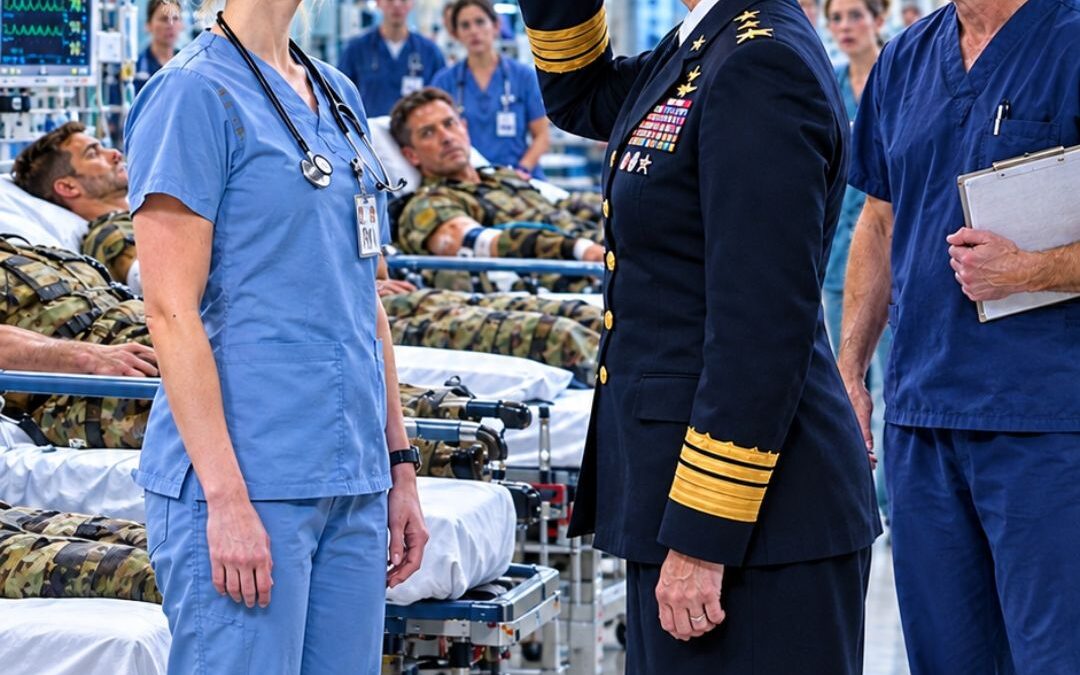
Ree gave a brief salute. Ren returned the greeting just as precisely and turned back to the patients.
Outside, the rain eased. Ren knew the memories wouldn’t disappear. Some nights would still take her back to those missions she wanted to leave behind. But this morning, she had rediscovered something she thought she had almost lost: not her rank, not the recognition of others, but the feeling of being where she belonged.
She didn’t need applause. It was enough that six people had a future.
You Might Also Enjoy

A millionaire beat his pregnant wife until she lost the baby – her father’s revenge shocked the public.

The doctor sent the inexperienced nurse away – but her combat skills, acquired in the Navy, revealed who she really was.
Nine nurses fled from the feverish mafia boss – his portly veterinarian opened the stab wound in his back.

The mafia boss had been unable to walk for eight years – then a single mother found a needle hidden in his wheelchair.
“My Skin Hurt” — German Woman POW Shocked as U.S. Army Medics Save Her From Losing Both Hands