15 Hidden Facts About Diana’s Wedding: The Last One Will Change Everything You Thought You Knew
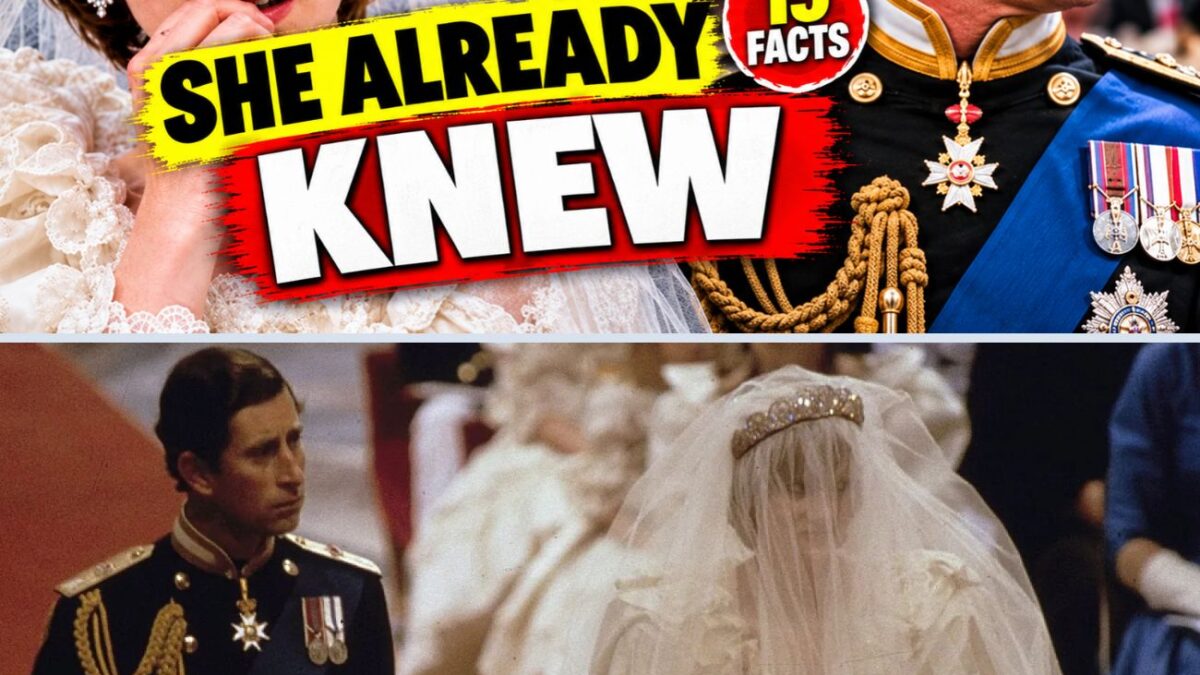
On July 29, 1981, Diana Spencer entered St. Paul’s Cathedral wearing an ivory silk dress, a train that seemed to go on forever, and an expression that the whole world learned to recognize. It wasn’t just nervousness; she was 20 years old. Standing before her was the man who would one day be king. Behind it all, a family steeped in centuries of tradition. Outside, London had stopped, and in millions of homes people didn’t see a young woman entering a church, they saw the beginning of a fairy tale. But that day, the most viewed in Diana’s life, holds details that almost never appear when we look at the images again. Some are small, others completely change the way we understand that wedding, because beneath the silk, the flowers, the music and the greetings from the balcony, there was a very young girl entering the most guarded institution in the world. And the last piece of information doesn’t talk about a dress, a jewel or a cake, it talks about what that wedding really meant to Diana.
The first fact is that the wedding did not come from a long and peaceful relationship; it came from a silent haste. Charles and Diana had only known each other for a short time when the engagement was announced on February 24, 1981.
Diana already belonged to a social world close to the royal family. Her older sister, Sarah Spencer, had previously dated Charles. Diana knew the codes, the surnames, the country houses and the way duty was discussed in British aristocratic circles. But knowing that world was not the same as being prepared to be absorbed by it. Diana was 19 when the engagement was made public. Charles was 32. The age difference was not the only contrast between them. He had been under the weight of being an heir for years. She had lived through an adolescence marked by her parents’ separation, boarding schools, changes of home, and a deep need to feel chosen and safe. Suddenly, that young woman who worked with children and shared a flat in London became the future Princess of Wales. The country saw a perfect image: a young, elegant, shy bride from an aristocratic family. The press saw the story they had been waiting years for. The monarchy saw a future mother for the heir to the heir. But very few people seemed to wonder if Diana was prepared for everything that was coming her way.
That commitment was celebrated as a response. Actually, it opened up a lot of questions. The first one was simple and at the same time impossible to answer from the outside: How well did they really know each other? In the engagement interview, the journalist asked them if they were in love. Diana responded with a smile.
“Of course.”
Charles added that phrase which became a shadow over history.
“Whatever love means.”
At the time, many took it as an awkward response, typical of Charles’s style. Over the years, the phrase ceased to sound innocent, not because a single line can explain an entire marriage, but because we now know how much weight each word carried in that relationship. The wedding was going to be grand, but the private space between the two was much smaller than the world wanted to believe.
And that brings us to the second detail. The wedding date was chosen for a Wednesday, not a Saturday. It seems like a minor detail, but it says a lot about the magnitude of the event. July 29, 1981, was not a date chosen for a normal family wedding. It was selected within a calendar of state, security, television, travel, and protocol. London had to be ready. The cathedral had to be ready. The routes of the carriage, the guests, the musicians, the military, the photographers, and the media from around the world had to fit together precisely.
For the royal family, a wedding wasn’t just a wedding; it was a display of continuity. At a time when the monarchy needed a renewed image, Queen Elizabeth II represented stability. Charles represented the future. Diana brought youth, beauty, naturalness, and an immediate connection with the public. In just a few months, she became one of the most photographed women on the planet.
That morning, hundreds of thousands of people filled the streets of London. Millions watched the ceremony on television. Worldwide audience estimates put the number at hundreds of millions. It wasn’t simply a British ceremony; it was a global event. For those who watched it live, the memories remain vivid: the flags, the hats, the shouts, the packed balconies, the children perched on their parents’ shoulders. There was a sense of national joy, almost of relief. For a few hours, Great Britain seemed united around a young woman smiling from a carriage. But Diana couldn’t hide behind the spectacle. She had to walk down that aisle, she had to say those vows, she had to enter, at 20 years old, into a life where her every move would be scrutinized for decades.
The third point has to do with the location. Many people remember the wedding as if it took place at Westminster Abbey, where so many royal ceremonies are held. But Charles and Diana married at St. Paul’s Cathedral. The choice was not accidental. St. Paul’s had a much larger capacity. Westminster Abbey was historic, intimate within its grandeur, and deeply linked to royal coronations and funerals. St. Paul’s offered a different scale, allowing for more guests, more cameras, more spectacle, more of the city, and also offered an unforgettable image. The long staircase, the enormous dome, the bride descending from the carriage with a train so long it seemed to turn the steps into a stage, the aerial view of the glass car arriving at the Cathedral, the soldiers lined up, the bells, the restrained murmur of the crowd. St. Paul’s was chosen because that wedding had to feel immense, but there is something almost painful about revisiting those images knowing what happened afterward.
Years later, Diana herself would enter Westminster Abbey for her funeral. The wedding had the scale of a global spectacle. The funeral had the scale of a global farewell. Between those two, a huge part of Diana’s collective memory was enclosed within those buildings.
The fourth fact is one of the best known, but it’s almost never fully recounted. Diana didn’t wear a tiara borrowed from the Queen; she wore the Spencer tiara. At a royal wedding, many people expected to see her in a jewel from the royal collection. The Windsor family had access to some of the most famous pieces in Europe, but Diana chose her own family’s tiara, a piece that had already been worn by her sisters at their weddings.
The decision was elegant and deeply symbolic. Diana didn’t enter St. Paul’s Cathedral as a young woman erased by the royal institution; she entered as Diana Spencer, as the daughter of one of England’s oldest aristocratic families, as someone who carried her own history, her own memories, and her own surname. The Spencer tiara had a striking shape with flowers and curves of diamonds that framed her face. In photographs, it looks as if it were made for her. It wasn’t a jewel that transformed her into someone else; it was a jewel that returned her to the family she came from, and that mattered, because Diana didn’t arrive to the royal family from an unfamiliar world. She had grown up near Sandringham; her father was an earl, and her maternal grandmother had been connected to the court. She understood titles, formalities, and obligations, but she also knew that a family of great houses and great surnames could harbor pain behind its walls.
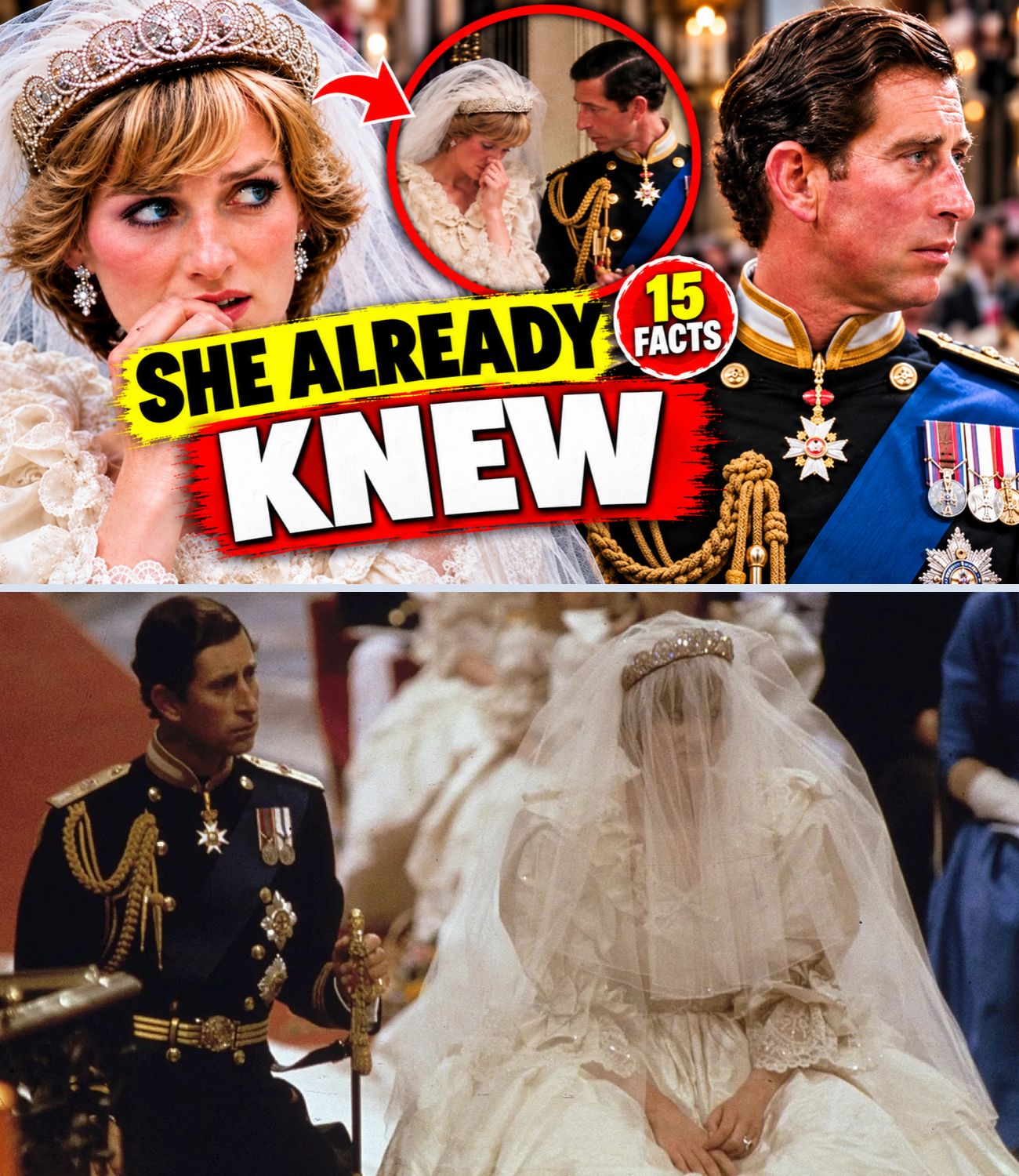
The Spencer tiara was not just an accessory; it was a silent way of saying, before she was Princess of Wales,
“I am Diana Spencer.”
Years later, when Diana no longer held the title of Her Royal Highness after her divorce, the public continued to call her Princess Diana. But the tiara remained a reminder that her identity was never entirely dependent on the crown.
The fifth fact is on her hand. Diana’s engagement ring was not designed exclusively for her in secret. It was chosen from a catalog by Garrard, the historic jeweler to the British Crown. The ring featured an oval Ceylon blue sapphire surrounded by 14 solitaire diamonds set in 18-karat white gold. It was large, brilliant, and unlike what many expected of a future king. In a world where royal rings often have family histories, provenances, inheritances, and palace secrets, Diana’s ring was chosen simply because she liked it.
And yet, that simplicity sparked commentary. Some critics at the time said a catalog piece didn’t seem exclusive enough for a future princess. Others thought it was too flashy, but Diana wore it throughout her life as a visible symbol of her commitment, even after her relationship with Charles became one of the most scrutinized marriages in the world. The ring ended up outlasting the marriage. Years later, William gave it to Catherine when he proposed. He said it was his way of ensuring his mother was present at that moment. For millions, the sapphire ceased to be merely a jewel; it became a visible connection between Diana, William, and a new generation. But in July 1981, the ring was still something else entirely—it was the sign that a 20-year-old had said yes to a life no one could fully comprehend from the outside.
The sixth fact is that the most famous wedding dress wasn’t created by a haute couture house with decades of royal tradition. It was designed by David and Elizabeth Emanuel, a young design couple who at the time didn’t have the clout of the major Parisian or London fashion houses. Diana had met the Emanuels because one of their garments had appeared in a fashion magazine. She liked their romantic, theatrical, and slightly nostalgic style. When she commissioned the dress, the designers understood that they weren’t making an ordinary garment; they were creating something that had to survive the cameras, the distance, the cathedral, the crowds, and history itself. And they had to do it in secret.
The dress was made under enormous security measures. The studio curtains remained drawn. Details were kept secret even from many close associates. The press was desperate to know what it would look like. Every rumor about the fabric, the train, or the design became news. The choice of dress was no small decision for Diana. She knew that image would be forever etched in her memory, but she was also a young woman who liked feminine dresses, full sleeves, and intricate details, romantics and the idea of a silhouette that seemed to come from another era. The result was unmistakable: ivory taffeta silk, puffed sleeves, antique lace, enormous volumes, a veil that seemed to float, and a train of more than 7 meters, one of the longest ever seen at a royal wedding. The dress was grand because the wedding was grand, but it also reflected something of Diana: her youth, her taste for romanticism, and her desire to appear as a bride, not as a cold figure bound by protocol. What no one could have foreseen was that the dress would become one of the most recognizable images of the entire 20th century.
The seventh fact is that the Emanuels made a second, emergency dress. It wasn’t a simple sketch, not an idea tucked away in a drawer. There was an alternative dress prepared in case the main design was completely leaked or if something happened to the original before the wedding. This shows us the level of pressure surrounding the event. A normal wedding dress can be altered, corrected, or replaced with relative ease. Diana’s dress could not fail. If it got stained, ripped, lost, or was photographed too soon, it wasn’t just a fashion issue; it was a global crisis. The Emanuels protected even the scraps of fabric; the leftover pieces couldn’t end up in the wrong hands. The press paid enormous sums for any information. Photographers, reporters, and curious onlookers were searching for clues outside the studio, and yet the great secret survived until the wedding day.
When Diana stepped out of the carriage, the public saw the dress for the first time. There was an immediate reaction. It wasn’t understated. It wasn’t trying to be. It was a creation made for a cathedral, for television, and for posterity. But there’s a less glamorous, more human detail. The taffeta fabric creased during the carriage ride. Diana had traveled to St. Paul’s accompanied by her father, John Spencer. Space inside the carriage was limited for such a full skirt and such a long train. As she stepped out, the dress had visible creases. Some people mentioned it at the time. Over the years, that detail became almost endearing, because it shows that not even a wedding planned for months, with security, protocol, and designers, can control every little mishap of a royal morning. Diana didn’t step out of the carriage like a perfect doll. She stepped out like a nervous young woman, in an enormous dress, with the world watching. And perhaps that’s why people loved her so much.
The eighth fact is hidden in the embroidery. Diana’s dress included more than 10,000 pearls and antique lace details. Some of the lace came from a historic piece associated with Queen Mary, Elizabeth II’s grandmother. It wasn’t a wedding without tradition. It was a wedding that blended Diana’s romanticism with understated gestures toward the continuity of the royal family. At the bottom of the dress, the Emanuels hid a small 18-karat gold horseshoe, sewn inside as a good luck charm. It was a detail that wasn’t seen on television. It didn’t appear in the next day’s newspapers, but it was there, against the fabric, close to Diana’s skin.
It’s easy to get lost in the spectacle of the dress and forget that a bride also seeks small, private symbols. Something of her own. Something only she knows she wears. The horseshoe couldn’t protect her from everything that would come later. No amulet can. But on the morning of her wedding, that small object represented the hope that accompanies every bride. That the day would open a door to a safe, loved, and happy life. Diana needed that hope more than anyone. Not because she already knew how her marriage would end. No one can enter a church knowing the future with precision. But because she had spent years searching for emotional stability. Since her parents’ separation when she was a child, Diana had experienced moving, boarding schools, family tensions, and the feeling that adults could make enormous decisions without asking her. The wedding promised permanence. The dress, the ring, the tiara, and the flowers promised permanence. The institution promised permanence. But a public promise doesn’t always become a private refuge.
The ninth detail is one of the most delicate moments of the entire ceremony. Diana didn’t promise to obey. In the traditional vows of the Church of England at that time, the bride could promise to love, honor, and obey. Diana and Charles chose to omit the word obey. In 1981, that raised eyebrows. It wasn’t a strident rebellion. There was no statement, no official controversy, no dramatic scene. But it was a significant decision. Diana wasn’t entering marriage promising obedience. She promised to love, comfort, honor, and care, but that word wasn’t there. Over time, other royal couples followed suit. William and Catherine didn’t use it in 2011 either, but Diana and Charles helped establish that change in the public discourse.
It was a small gesture within a gigantic ceremony. Yet small gestures sometimes say more about an era than long speeches. Diana was entering one of the most hierarchical institutions in the world. The Queen was present. The heir stood before the altar. Family, bishops, politicians, and representatives from other countries were watching. And yet, in the midst of that tradition, the word obey disappeared. The significance of that detail doesn’t need to be exaggerated. A single omitted word couldn’t, on its own, alter the balance of power within a royal family, but it did reveal something important. Even in 1981, the idea of an obedient wife no longer fit the image Diana projected to so many people. She wasn’t a silent figure meant to nod in the shadows of a husband. And the world was beginning to understand this.
The tenth detail occurred when Diana pronounced Charles’s name. During the vows, Diana reversed the order of their names. Instead of saying Charles Philip Arthur George, she said Philip Charles Arthur George. It was a small mistake, a nervous slip of the tongue, nothing more. But it’s one of those details that makes the ceremony seem real even today. Diana stood before one of the most watched men on the planet, inside a packed cathedral, under cameras broadcasting her image around the world. She was 20 years old, wearing a voluminous gown, a family tiara, an immense veil, and carrying a responsibility that no one her age should have to bear alone. Getting the order of four names wrong wasn’t a dark sign; it was a human sign. Charles also stumbled slightly while pronouncing part of his vows. It wasn’t a cold, perfectly mechanical ceremony; it was one filled with tension, emotion, and visible nerves. People often remember the grand symbols—the carriage, the cathedral, the kiss on the balcony—but these tiny errors are important because they bring us back to the couple behind the broadcast. They weren’t statues; they were two people trying to navigate an impossible ceremony without making mistakes in front of the entire world.
The eleventh fact has to do with the shoes. Diana couldn’t wear high heels because Charles was not taller than her by a significant margin. To avoid them appearing to be the same height or her towering over him in some images, her shoes were designed with a low heel, around 4 cm. They were made by Clive Shilton and covered with hundreds of sparkling details, including pearls and sequins. Inside were the initials C and D: Charles and Diana. It’s a detail that seems romantic, and it was, at least in its intention. The initials were hidden. They weren’t for the cameras. They weren’t for the public waiting outside St. Paul’s. They were a private sign on a day when almost nothing could be private.
Diana also wore blue details, following an old British wedding custom: something old, something new, something borrowed, and something blue. The sapphire ring fulfilled part of that image. The tiara connected with her family. The antique lace connected with tradition. The hidden horseshoe brought good luck. The entire wedding was built on symbols, and the symbols mattered because the public needed to believe in them. The bride wore blue. The prince waited at the altar. The father escorted her. The crowd celebrated. The country witnessed a tidy, almost perfect story, but real life can never be entirely contained within symbols.
The twelfth fact is that the wedding had 27 cakes. Yes, 27. It may sound excessive, but we’re talking about a reception that didn’t belong to just one family. There were diplomats, government representatives, members of other royal houses, figures from British public life, personal guests, and a huge staff working behind every door of Buckingham Palace. The main cake was made by the naval cooking school. It was enormous, with several tiers, elaborate decorations, and the couple’s emblems. The other cakes served the various guests and areas of the reception. The cake itself became another object of fascination.
Some slices were preserved. Over the years, pieces of those cakes have appeared at auctions, carefully packaged, transformed into relics of a wedding the world refused to forget. That may seem strange until we understand what that day represented. People didn’t simply want to remember Charles and Diana. They wanted to keep a piece of a collective emotion. A ticket, a program, a newspaper, a photograph, a slice of cake. Anything that would allow us to return to that summer of 1981, when it seemed that the future of the monarchy had the face of a young woman with blue eyes and a shy smile.
The reception at Buckingham Palace was formal, impeccable, and meticulously organized. But Diana still had to navigate this new world. Learn names, greet guests, keep to schedules, listen to instructions, and remain composed after a ceremony that had changed her life forever. No image can fully capture the exhaustion she must have felt at the end of the day. She wasn’t just a bride; she was a new member of the royal family, and the world expected her to understand the rules from the very first minute.
The thirteenth detail concerns the flowers Diana carried. Her bouquet wasn’t just beautiful; it was full of references to tradition, family, and the future. It contained flowers such as roses, gardenias, orchids, freesias, and lilies of the valley, along with myrtle. Myrtle holds a special place in British royal weddings because it has been used since the 19th century and is considered a symbol of love and hope. The bouquet was placed on the Tomb of the Unknown Warrior in the Abbey of Westminster after the ceremony. It was not an improvised decision by Diana. It was a tradition started by the Queen Mother who left her bouquet there in memory of her brother who died during the First World War. Diana didn’t get married in Westminster, but her bouquet followed that tradition.
That gesture was silent, solemn, and profoundly British. Amidst so much music, so much silk and so much celebration, there was also a memory of loss. The tomb of the Unknown Warrior represents the nameless soldiers who died in the war. The Queen Mother had turned that tribute into a personal custom. The royal brides who arrived later continued the gesture. Diana, who so many years later would be mourned by an entire nation, left flowers on a grave dedicated to the nameless dead. No one could have known then that 16 years later millions of flowers would be laid for her. That’s one of the most touching details of the wedding. Not because it magically foretells the future, but because it demonstrates how much history, loss, and memory can coexist within a single bouquet.
The fourteenth fact is that the honeymoon did not begin as an intimate and isolated tale. Charles and Diana first spent a few days at Broadlands, the country house linked to the Mountbatten family. Afterwards they departed on the royal yacht Britannia for an extended stay in the Mediterranean. From the outside it seemed like the perfect setting: a real yacht, open sea, summer landscapes, apparent privacy. A newlywed couple leaving behind the noise of London, but the idea of privacy in real life was never simple.
Britannia was a state ship. There was a crew, protocol, assigned spaces, and a service structure. Even moments of rest took place within an institution. Diana could not simply step out of public life and become an anonymous young woman on her honeymoon. Furthermore, there were already emotional tensions that the wedding could not erase. Diana would speak years later in recorded conversations for Andrew Morton about the insecurities she felt during that period. She spoke of details that made her feel displaced within her own marriage. She also spoke of realizing that her relationship was not as simple as the world had portrayed it.
There’s no need to turn every object, every gesture, or every silence of the honeymoon into proof of something. But it must be acknowledged that a huge wedding did not resolve the difficulties between Charles and Diana. The wedding was the beginning of a public image. It was not a private solution. That changes the way you look at photographs of the Britannia. Diana appears young, smiling, dressed in elegant summer clothes. Charles appears relaxed. The Mediterranean light makes everything seem serene, but pictures can’t tell what a person thinks when they are alone in their cabin, when the excitement of the wedding has faded and real life begins.
Real life came very soon and here is the fifteenth fact, the one that changes everything we usually believe about Diana’s wedding. The wedding was not the day Diana found her place within the royal family. It was the day the world decided who Diana should be. People saw her as a fairytale princess, a young woman rescued by love, dressed in silk, destined to become a future queen. But that image placed an impossible burden on her. From that day on, Diana had to sustain not only a marriage, but also a national fantasy. Everyone wanted her to be happy because they needed the story to have a happy ending. Everyone wanted Charles and Diana to be a perfect couple because the monarchy needed a perfect image. Everyone wanted the dress, the carriage, the ring, and the balcony to be proof of an undeniable love. And when reality began to show itself, many people didn’t know what to do with it.
That is the true significance of the 1981 wedding. It wasn’t simply a ceremony that went wrong over the years. It was such a grand, celebrated, and idealized ceremony that it left very little room for Diana to be human. If she was sad, the world wanted a smile. If she felt lonely, the world wanted a photograph. If she had doubts, the world expected her to fulfill the role written for her. Diana had entered St. Paul’s as a 20-year-old girl. She emerged as a symbol. And symbols receive admiration, but they rarely receive the protection that a real person needs.
That’s why the dress is still so important. That’s why the ring continues to be exciting. That’s why the Spencer tiara continues to speak of her identity. That’s why flowers, shoes, and silk trains keep appearing again and again in documentaries, books, and photographs. They are not just objects from a wedding, they are pieces of a story that the world understood too late. Diana didn’t stop being a person when she became a princess. She was still a daughter, sister, friend and, soon after, a mother. She still had fears, expectations, memories of a difficult childhood, and a very deep desire to be loved in a simple and safe way. The wedding did not eliminate those needs. It made them more visible.
When William was born in 1982 and Harry in 1984, Diana found a form of love that defined her in a different way. Her role as a mother became central to her life. She wanted to take her children to school. She wanted them to meet people outside of the palaces. She wanted them to understand how normal families lived. She wanted them to be princes, yes, but also children. That need to protect her children says a lot about the young woman who crossed St. Paul’s in 1981. Diana knew about emotional distance. She knew the feeling of adults making huge decisions about her. She knew the pain of seeking attention, closeness, and security. As a mother, she tried to make William and Harry feel something different. She could not always control the world around her—nobody could—but she made the effort.
And perhaps that is the most honest way to end the wedding story. Not with the idea that everything was doomed from the beginning. That would be too simplistic and wouldn’t do justice to anyone. People enter into marriage with hope. Diana had it too. Charles also had his own pressures, duties, and difficulties, but the scale of that wedding turned a public relationship into a public promise that was too heavy for two people. The world saw them waving from the balcony of Buckingham Palace, saw the kiss, saw the dress, saw the blue ring, saw a young woman become a princess. What it didn’t see was how difficult it would be for Diana to keep herself within that story.
Today, more than four decades later, we keep returning to those images because we haven’t forgotten the feeling they provoked. Many people remember exactly where they were when they saw the wedding. Some were in front of a small television, others met with family members, others put away magazines, clippings and programs. For an entire generation, that day was a celebration of hope. That memory deserves respect, but it also deserves truth.
The truth is that the wedding was beautiful. The truth is that Diana was dazzling. The truth is that the world received her with immediate affection. The truth is that there were details full of symbolism, tradition and emotion. And the truth is that beneath all of that was a young woman entering a life that would change her forever. We don’t need to destroy the memory of the wedding to see it in more depth. We can continue to admire the dress and at the same time understand the pressure she carried inside. We can continue to be excited about the Spencer tiara and at the same time remember that Diana needed her own identity. We can continue to see the sapphire ring as a beautiful jewel and at the same time recognize that it ended up living a longer story than the marriage it represented. We can continue to hear the bells of St. Paul’s and remember that Diana was much more than a fairytale bride. She was a real woman, a woman who entered a cathedral with the world watching, and a woman who, even after everything that happened, left a mark that no one has been able to erase.
You Might Also Enjoy

“We Thought They Would Negotiate”—What Argentine Soldiers Said When The British Attacked Goose Green

“You’ll Never Finish My Ruck March, Limey” — US Sergeant Who Challenged the SAS, Then Fell Out First






