3 MIN AGO: Catherine BANS Camilla’s Son From Windsor After William’s ER Rush — Anne REVEALS WHY!
The Windsor Poisoning Plot: Inside Prince William’s Near-Fatal Royal Dinner and the Secret Family War That Shattered the Monarchy
The Night the Crown Stood Still
October 20th, 2026. Windsor Castle, one of the most heavily guarded and secure fortresses in the United Kingdom, played host to what was supposed to be a routine evening of high-level diplomacy. A distinguished delegation from Oman had arrived for a private dinner in a restricted section of Victoria Tower—a venue traditionally reserved for delicate bilateral talks designed to foster quiet trust before formal government negotiations the following morning. Every detail of the evening had been meticulously mapped out weeks in advance; the seating arrangements, the wine pairings, and the menu had all passed through layers of protocol and sign-off.
Yet, precisely thirty minutes after the main course was cleared, the veneer of diplomatic calm shattered into an unimaginable nightmare.
Prince William, seated at the head of the long mahogany table, abruptly dropped his silver cutlery. A sharp gasp escaped his lips as his face flushed a deep, alarming crimson. Within seconds, his breathing turned ragged and severely laboured. Clutching frantically at his throat, the heir to the British throne lurched forward and collapsed against the table, sending a heavy crystal wine glass spinning across the pristine white linen cloth to shatter on the floor.
Catherine, Princess of Wales, froze in horror as her husband crumpled. King Charles sat paralysed at the center of the table, momentarily struck dumb by the suddenness of the catastrophe. In a heartbeat, the heart of the British monarchy was thrust into a life-or-death crisis.
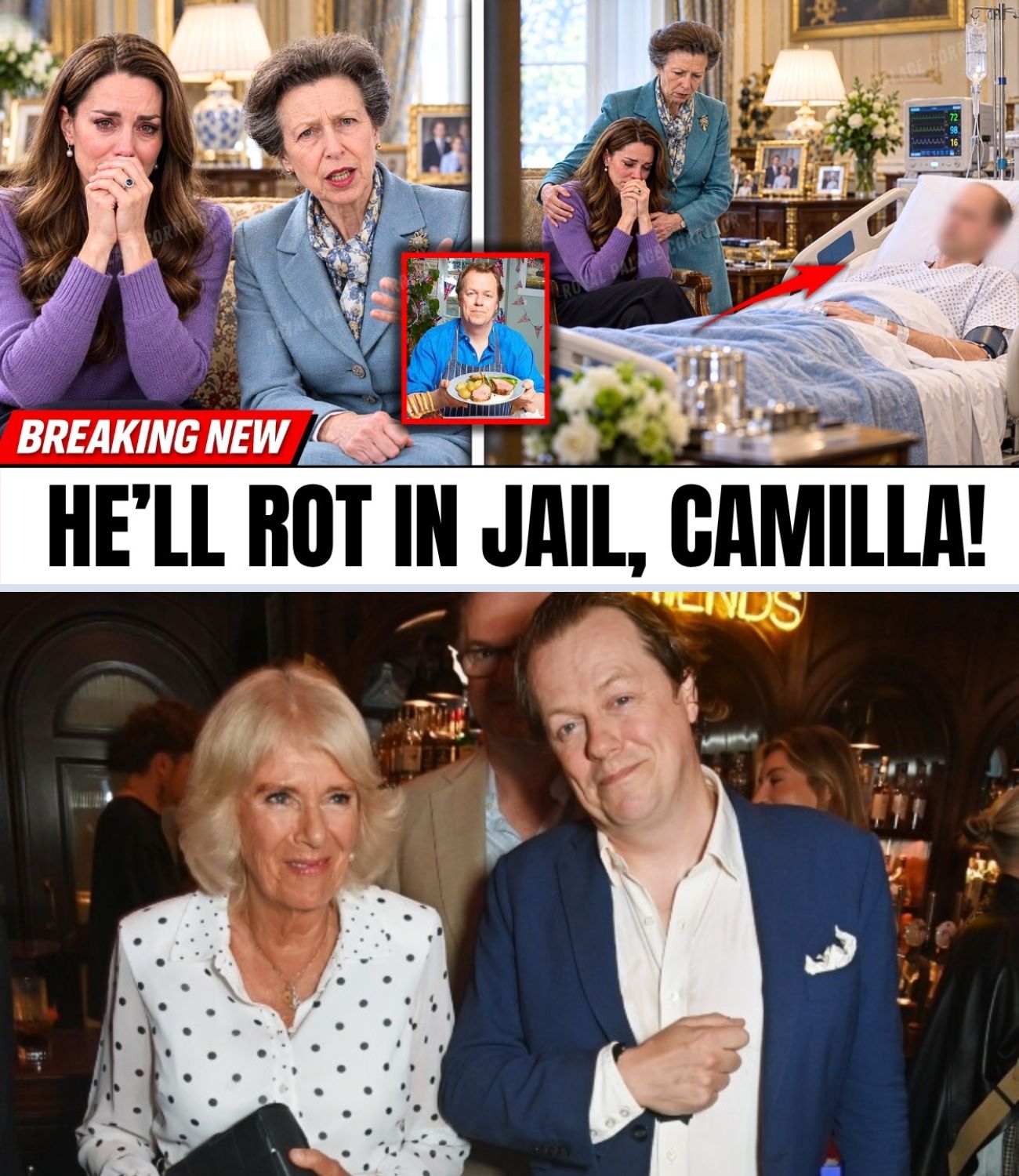
The royal medical team stationed on-site sprinted into the dining hall. Instantly recognising the classic, terrifying markers of a severe anaphylactic shock closing off the airway, the senior physician seized an epinephrine auto-injector and administered an emergency dose directly into William’s thigh. As the prince gasped for air, his condition stabilised just enough to warrant immediate transport. Within minutes, he was loaded into an emergency ambulance and rushed out of the Windsor gates under a screaming police escort, with Catherine fiercely refusing to leave his side.
As sirens faded into the damp Berkshire night, panic gripped the remaining guests. But while others feared the worst, Princess Anne’s sharp, military-honed instincts kicked in. Before a single steward could clear the wreckage of the meal, Anne barked a direct order: halt all cleaning. She personally directed staff to seal William’s unfinished dinner plate in a sterile evidence container. By midnight, kitchen logs, supplier invoices, and shift rotas had been seized and locked away.
Queen Camilla attempted to calm the gathering, suggesting the frightening episode might merely be the result of sheer exhaustion or an anomalous physiological reaction to stress. But Anne stared at her across the table with cold, unyielding skepticism. She knew better than to chalk up a near-fatal collapse to bad luck. And as the initial medical reports began to trickle in from King Edward VII’s Hospital in London, the trail of evidence pointed toward a deliberate, last-minute tampering of the royal menu—and straight to a name the palace could ill afford to scrutinise: Tom Parker Bowles, Queen Camilla’s son.
The Eighteen-Hour Menu Heist
To understand how a lethal allergen found its way onto the royal plate, one must rewind eighteen hours before the diplomatic summit.
Weeks prior, the menu for the Omani delegation had been locked in. The approved main course was a traditional British classic: sustainably sourced Highland lamb, paired with seasonal root vegetables and a light, herb-infused jus. It was safe, familiar, and fully cleared by the household’s dietary compliance officers.
However, at roughly 2:00 AM on October 20th—just eighteen hours before the guests were due to sit down—an urgent electronic directive arrived at the event coordination office from the private office of Queen Camilla. The message requested a radical overhaul of the main course. The lamb was to be scrapped entirely and replaced with pan-seared sea bass, accompanied by what was described as a “contemporary, refined” seafood sauce.
The suggestion originated from Tom Parker Bowles, the Queen’s son, an established food writer and gastronomic commentator who frequently fancied himself an informal culinary advisor to the royal household. On paper, it seemed like a harmless bid to impress foreign dignitaries with modern British flair. But in practice, it bypassed every institutional safeguard designed to protect the royal family.
Protocol 14 of the royal household’s strict security manual dictates that any last-minute alterations to food preparation must undergo a rigorous allergy risk assessment, with dietary specifications cross-referenced by the medical team at least 48 hours prior to service. Because the directive arrived under the banner of Queen Camilla’s office, however, the kitchen staff and event coordinators panicked. Fearing professional repercussions if they questioned a request backed by the Queen’s inner sanctum, they waved the protocol through without notifying the medical detail.
What the kitchen staff did not realise was the lethal trap hidden inside the revised recipe. The original sea bass proposal utilised a simple vegetable broth. But in the frantic final hours of preparation, the sauce was enriched with a highly concentrated, heavy reduction made from boiled lobster heads and raw sea prawns. For an ordinary diner, it was a rich delicacy. For Prince William, whose severe crustacean allergy was indelibly logged in high-security medical archives, it was a ticking time bomb.
The Smoking Gun at the Hospital
In the quiet hours of October 21st, inside a heavily guarded suite at King Edward VII’s Hospital, William lay exhausted beneath cardiac monitors. Though out of immediate danger, doctors warned of the unpredictable secondary waves common in severe anaphylactic episodes.
Catherine sat vigil beside him, her mind racing. The terrifying speed of her husband’s collapse defied coincidence. Summoning her private secretary, she requested two documents: the official menu handed to the Omani delegation and the actual kitchen preparation notes seized by Princess Anne the night before.
Laying the papers side by side on a hospital tray, Catherine began to dissect the discrepancy. The guest menu advertised pan-seared sea bass with roasted asparagus, garlic butter, and a white wine cream reduction. There was not a single word, whisper, or warning regarding shellfish, prawns, or lobster. Yet, when she inspected the kitchen’s master recipe sheet, there it was in bold ink: a heavy crustacean stock reduction used as the foundation of the sauce.
When William regained full consciousness, Catherine presented her findings. The prince’s initial fatigue instantly evaporated, replaced by a cold, calculating fury. He immediately placed a secure call to Tom Parker Bowles.
When confronted, Tom played down his involvement with practiced ease. He insisted he had merely offered a creative culinary concept to elevate the diplomatic dinner, claiming he had zero knowledge of sourcing, kitchen execution, or—most crucially—the Prince of Wales’ private medical records. But his hollow denials only deepened the mystery. If he had merely suggested a fish dish, who had authorised the clandestine addition of a lobster stock, and why had the mandatory safety flags been ignored?
Without wasting a breath, Catherine forwarded the documents, menu variants, and medical files directly to Princess Anne. The investigation was about to break wide open.
The Parallel Kingdom of Influence
On the afternoon of October 21st, Princess Anne convened an emergency inquiry inside the administrative offices of Windsor Castle. Summoning the executive chef and the director of catering services, Anne placed the doctored recipe on the table and demanded accountability.
The head chef cracked under pressure, admitting that while the initial menu featured a safe vegetable reduction, a late-day intervention by Tom Parker Bowles himself had forced the switch to the shrimp stock. When the chef had raised mild procedural concerns, Tom had explicitly invoked the authority of Queen Camilla’s office, brushing aside safety checks as bureaucratic red tape.
Anne’s expression hardened. But she did not stop at a single dinner. Sensing a systemic rot, she ordered an audit of every private function held across Windsor, Sandringham, and Balmoral over the preceding eight months.
The resulting data trail revealed an alarming pattern. The name Tom Parker Bowles appeared in internal logs at least four times acting as an unvouched, informal culinary consultant. Backed by the implicit intimidation of Camilla’s office, he had routinely bypassed standard protocols, treating royal kitchens like his own private experimental workshop.
Worse still, buried deep within the audit files, investigators unearthed a draft administrative blueprint titled the Windsor Hospitality Memorandum 2026-2028. Unsigned but aggressively lobbied for, the document proposed granting Tom permanent, unescorted VIP security clearance across all royal service areas, kitchens, and logistical hubs, alongside a substantial slush fund for culinary ventures that conveniently intersected with his commercial publishing and media projects.
The implications were staggering. A private individual with zero constitutional standing was slowly weaving a parallel network of influence right through the heart of the monarchy’s domestic operations—and the safety protocols meant to protect the royal family were being systematically dismantled to accommodate him.
The Library Showdown and the Digital Footprint
As the investigation closed in, the tension at Windsor Castle reached a boiling point. On the afternoon of October 22nd, amidst a relentless downpour, Queen Camilla arrived unannounced at Windsor, marching straight into the castle library where Anne sat reviewing files.
Camilla was furious. She demanded an immediate halt to the inquiry, arguing that Anne and William were weaponising a simple kitchen mistake to assassinate her son’s professional character and humiliate her publicly. She insisted Tom was merely a passionate foodie trying to help.
Anne did not blink. With icy composure, she reminded the Queen that this was no longer about gourmet recipes; it was about institutional security and a near-fatal breach that had put the future King in an ambulance. “We cannot substitute royal safety for familial indulgence,” Anne stated flatly, refusing to yield an inch. Realising she could not bully her sister, Camilla stormed out, vowing to take the matter directly to King Charles.
Unbeknownst to Camilla, the tightening noose had just secured its final, undeniable piece of evidence. That very afternoon, the palace’s elite cybersecurity unit completed a forensic crawl of the internal email servers.
The findings were explosive. At exactly 2:15 PM on October 20th—four hours before the fatal dinner—the royal medical coordinator had dispatched an urgent warning flag directly to Tom Parker Bowles’ personal email address. The subject line explicitly stated: CRITICAL DIETARY WARNING: HRH THE PRINCE OF WALES – SEVERE CRUSTACEAN ALLERGY.
Crucially, the server logs proved beyond a shadow of a doubt that the email had been opened and read at 2:22 PM—just seven minutes later—on a smartphone securely registered to Tom.
The defence of ignorance vanished in a cloud of digital certainty. Tom had known about the lethal allergy hours before the fish hit the pan. Yet, rather than halting the dish, the logs showed he had pressed forward with the seafood reduction.
The Oval Room Summit: Judgment at Windsor
Armed with the medical reports, the chef’s signed testimony, the doctored recipe notes, and the undeniable server access logs, Prince William decided to bypass further correspondence. On the evening of October 22nd, a somber, unceremonious crisis meeting was convened in an oval room within King Charles’ private residential quarters.
There were no press cameras, no courtiers, and no ceremonial formalities. Only the principals were present: King Charles seated at the center, William and Anne flanked on one side, and Camilla and a visibly shaken Tom seated opposite.
William placed three burgundy leather folders before his father. Without raising his voice, William laid out the chronology: the medical emergency, the deliberate menu tampering, the bypassing of Protocol 14, and finally, the damning 2:15 PM warning email that Tom had acknowledged and opened hours before the meal.
Camilla broke down, pleading with the King to view the catastrophe as a severe lapse in judgment rather than a malicious act, begging him to protect her son’s career from total ruin. Tom bowed his head, muttering a hollow apology and asking for leniency.
King Charles sat in absolute silence for what felt like an eternity, gazing down at the devastating dossier. He looked at his eldest son, still bearing the pale exhaustion of anaphylactic recovery; he looked at his wife, desperately shielding her bloodline; and he looked at the cold, indisputable facts of institutional negligence.
When the King finally spoke, his voice was chillingly definitive.
“The safety of the heir and the integrity of this institution must always take absolute precedence over personal relationships,” Charles declared.
The verdict was swift and merciless.
Total Exile for Tom: Tom Parker Bowles was stripped of all advisory, consultative, and honorary roles within royal operations. The draft Windsor Hospitality Memorandum 2026-2028 was permanently shredded, and he was strictly barred from utilising royal estates, symbols, or titles for any commercial, media, or publishing ventures. As the meeting concluded, a royal protection officer stepped forward and relieved Tom of his permanent VIP security pass on the spot.
Camilla’s Office Neutered: In a stunning rebuke, Queen Camilla’s private office had its autonomy stripped away for the next six months regarding the planning and hosting of state-level functions. Every future menu and operational directive issued from her quarters would now require rigorous sign-off and approval from Princess Anne. Furthermore, Camilla was barred from interfering with ongoing internal audits.
The Total Overhaul: Prince William was officially tasked with leading a comprehensive, root-and-branch security overhaul of food safety protocols across every royal estate in the United Kingdom. From farm-to-table ingredient sourcing to strict medical cross-checks, no menu would ever again bypass protocol, regardless of who commanded it.
The Silent Fallout
On the morning of October 23rd, Buckingham Palace issued a brief, bloodless bulletin announcing a routine administrative restructuring of hospitality operations at Windsor Castle. There was no mention of the near-fatal poisoning, no mention of internal warfare, and no mention of Tom Parker Bowles.
Yet, down at the Castle Hill security checkpoint, reality struck hard. Tom’s electronic access card flashed red, deactivated permanently, and his name was systematically scrubbed from the digital entry logs. As he exited through a subterranean staff corridor, the door closed behind him for the final time.
The dust has now settled over the Berkshire turf, but the message echoing through the corridors of power is unmistakable. In a monarchy built on centuries of survival, personal favoritism and unchecked influence have been dealt a lethal blow. Prince William walked into the jaws of death, but he walked out with something far more powerful: absolute control over the safety of his crown.
Do you believe King Charles was entirely right to strip Tom Parker Bowles of his access and restrict Camilla’s office, or should the monarchy have handled this quiet crisis differently? Share your thoughts in the comments below, and make sure to subscribe to the channel for more explosive royal investigations.
You Might Also Enjoy

“We Thought They Would Negotiate”—What Argentine Soldiers Said When The British Attacked Goose Green

“You’ll Never Finish My Ruck March, Limey” — US Sergeant Who Challenged the SAS, Then Fell Out First






