3 MIN AGO: Prince William & Catherine DROP SHOCKING Evidence — Camilla EVICTED From Windsor Lodge!
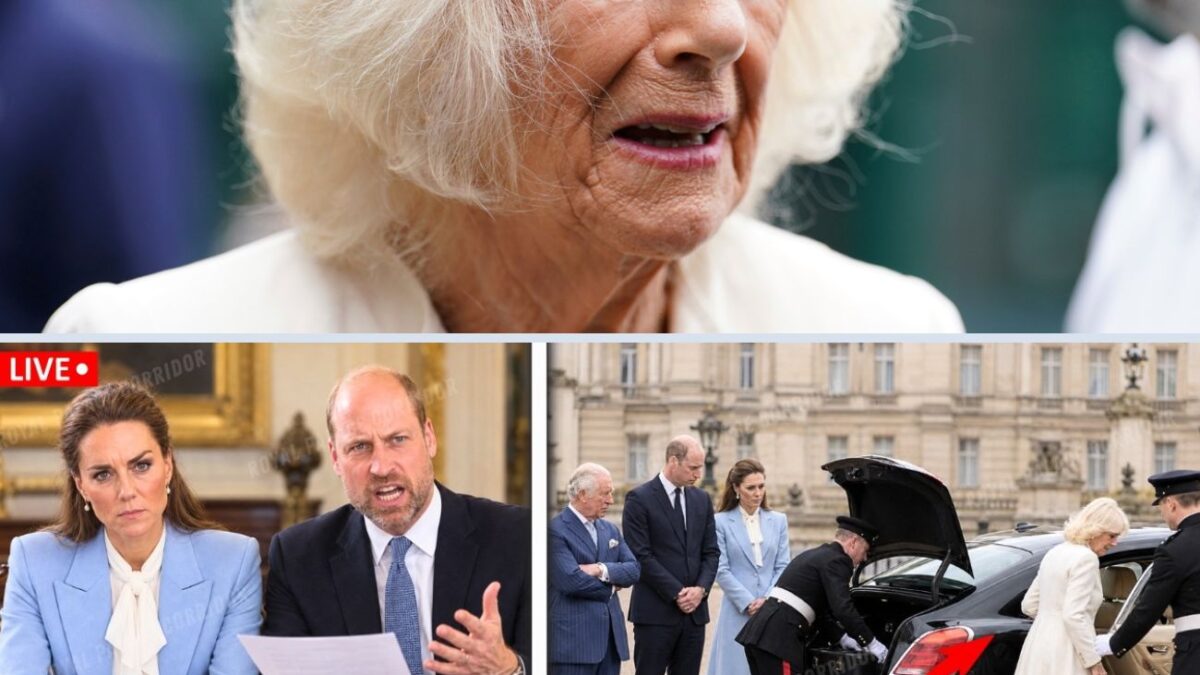
Dawn Raid at Windsor Lodge: The Secret Convoy, the Archival Covenant, and Prince William’s Cold-Calculated Showdown
It was precisely 7:45 a.m. on a crisp, grey morning at Windsor Lodge when the deep rumble of three heavy diesel engines shattered the pastoral silence. Three large, unmarked transport trucks crept slowly toward the estate’s imposing iron security gates, their flanks bearing innocuous manifests listing shipments of winter clothing and personal effects. Inside the lead armored sedan sat Queen Camilla, convinced that within seconds the entire operation would slip past the perimeter and be entirely beyond Prince William’s reach.
She had miscalculated.
Just as the bonnet of the lead vehicle nosed past the stone gateposts, a piercing, hydraulic siren split the morning air. With a heavy metallic clang, the historic iron gates slammed shut, automatically bolting from the inside. Simultaneously, four heavy black SUVs surged out from concealed lateral avenues, forming an impenetrable tactical box that brought the entire clandestine convoy to a screeching halt. As Camilla pressed her face against the tinted window, the color drained entirely from her cheeks. Standing squarely in the centre of the gravel drive, flanked by elite protection officers and a team of senior heritage appraisers, was Prince William. Beside him stood Catherine.
What drove the future king to execute a dawn ambush against his father’s wife? What chilling discoveries prompted the Princess of Wales to search the corridors of Windsor Lodge like an investigator on a crime scene? And how did the ghost of Princess Diana become the flashpoint for the most violent internal crisis the House of Windsor has witnessed in a century?
To understand the magnitude of that morning blockade, one must peel back the velvet curtains of royal estate management and examine the systematic dismantling of history that preceded it.
Chapter 1: The Gutting of Windsor Lodge
Long before the trucks rolled toward the gates, Windsor Lodge had served as a quiet, sacred sanctuary. Steeped in the personal history of Queen Elizabeth II—who spent countless private weekends walking its gardens—and carrying the enduring emotional resonance of Princess Diana, the estate was more than bricks and mortar; it was a living museum of the modern monarchy’s soul.
That fragile equilibrium fractured the moment Camilla assumed administrative control of the property. Almost immediately, the estate’s historic character began to vanish under a wave of aggressive modernisation and sweeping administrative purges. Centuries-old oak paneling was unbolted and hauled away, historic drawing rooms were stripped of their period upholstery, and loyal, long-serving staff members were shown the door without ceremony or explanation.
Among the casualties was Arthur, a veteran butler who had quietly served the royal household with unblemished devotion for three full decades. Arthur’s dismissal came swiftly and brutally after he flatly refused an administrative order to hand over the master keys to the estate’s subterranean vault—a secure repository housing irreplaceable family heirlooms and personal archives. Arthur insisted that no transfer of assets could lawfully occur without a verified provenance inventory overseen by the Crown Estate’s curators. His professionalism was met with an immediate P45.
With Arthur gone, the iron gates were placed under draconian security protocols. Access lists were rewritten, surveillance cameras were redirected, and even senior members of the royal family were suddenly required to submit formal advance requests before stepping foot on the grounds. It was a fortress mentality—one that inadvertently signaled to the rest of the family that something deeply irregular was taking place behind closed doors.
Chapter 2: Catherine’s Chilling Discovery
The facade cracked on an ordinary Tuesday morning when Catherine made an unannounced visit to Windsor Lodge to coordinate logistical arrangements for an upcoming family gathering. Stepping into the grand entrance hall, her instincts immediately flared.
The atmosphere was heavy, saturated with the pungent, chemical odour of fresh white gloss paint. The walls stood bare and skeletal. Familiar, well-loved furnishings that had anchored the rooms for generations were entirely gone. Moving slowly into the drawing room, Catherine came to an abrupt, breathless halt.
The exquisite antique silver writing desk—a piece deeply cherished by Queen Elizabeth II, where countless state letters and personal notes had been penned—had vanished from its alcove. In its place stood only a pale rectangular shadow on the parquet floor.
Catherine turned sharply toward the marble fireplace. The ornate, gem-encrusted French mantel clock was missing too, leaving a clean, dust-bordered silhouette on the stone. Her gaze tracked upward to the opposite wall where a collection of silver-framed photographs had hung for decades—intimate, unvarnished portraits of Princess Diana with her young sons, William and Harry. Now, only raw brass screw anchors protruded from the plaster, accompanied by faint, greasy smears where dust had settled around the missing frames.
Catherine stood motionless in the hollow room. She had witnessed William pause before those exact photographs during previous family visits—rare moments of quiet stillness where he would gaze at his mother’s face without uttering a single word. Those frames were not mere decorative surplus to be swapped out during a seasonal redecoration; they were anchors of emotional memory.
A junior staff member hurried past the open doorway, head bowed, footsteps clicking frantically against the stripped floorboards. That unmistakable posture of avoidance galvanized Catherine into action. Following a sharp, metallic scraping sound down the service corridor—the harsh, tearing rip of heavy-duty packing tape and hurried murmurs—she gravitated toward the rear storage wing.
Peering through the gap of a half-open oak door, the reality of the operation laid itself bare. Rows of reinforced wooden packing crates lined the stone floor. A team of hired commercial movers hammered wooden lids shut while Camilla’s chief administrative assistant aggressively checked off item numbers on a clipboard.
As a worker peeled back a protective layer of heavy felt from an unsealed crate, Catherine’s breath caught. There, resting amidst synthetic packing foam, were the unmistakable hand-carved mahogany legs of Elizabeth II’s silver writing desk. Stacked beside it were rolled oil canvases and nests of small velvet-lined jewellery cases. One box had drifted slightly open, revealing a familiar, intricately patterned silver picture frame—the very frame that had held a portrait of Diana.
This was no routine maintenance sweep. This was a clandestine, highly accelerated evacuation of the estate’s most sacred historical artifacts.
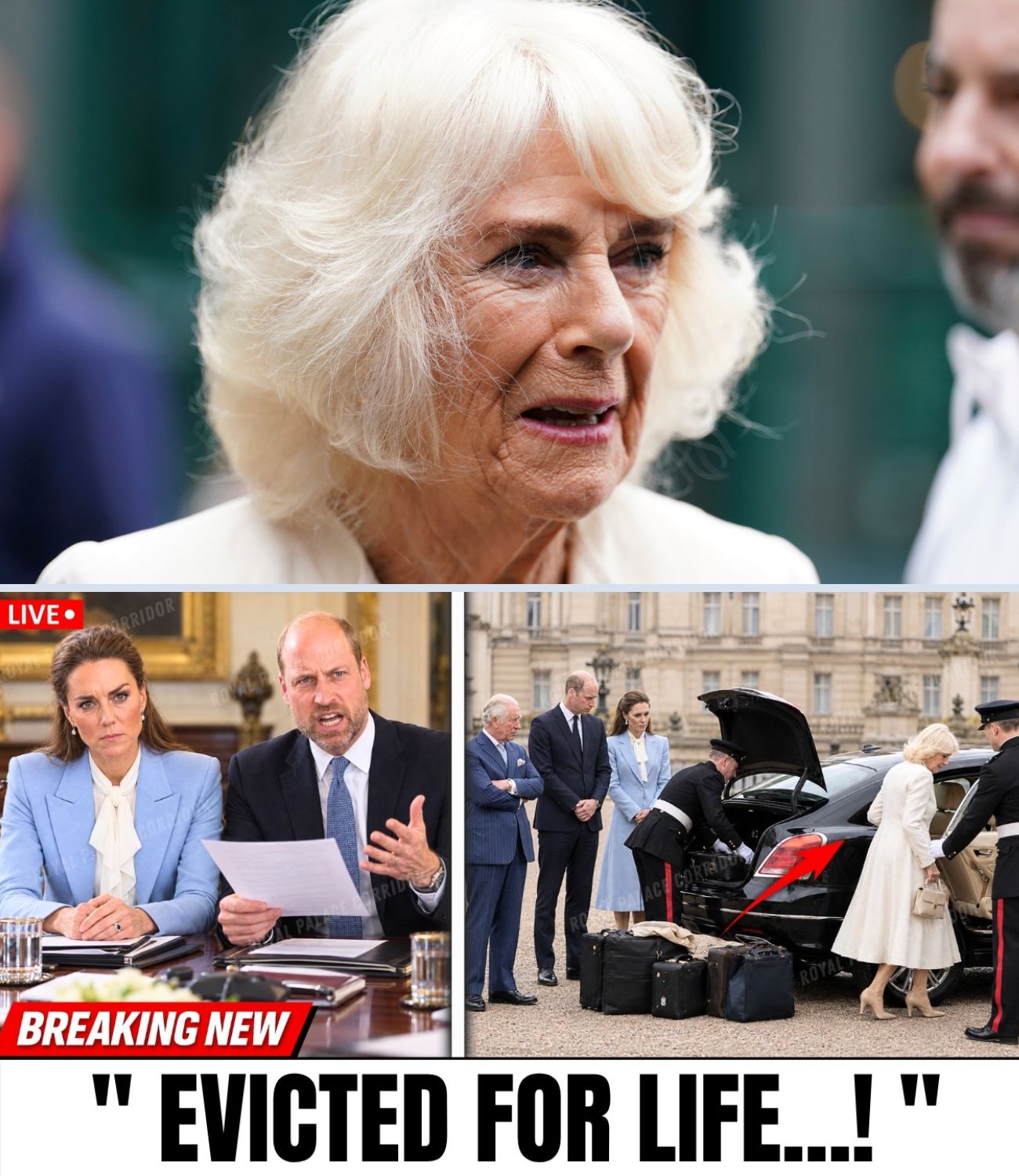
Chapter 3: The Confrontation in the Red Velvet Room
Knowing that making an uncoordinated scene would merely prompt the conspirators to scatter the evidence, Catherine silently retreated from the doorway. She knew the risks; stepping directly into Camilla’s private domain would ignite a ferocious domestic war. Yet her duty to protect the memory entrusted to her husband overrode all hesitation.
Ascending the grand staircase to the second floor, she paused for a single heartbeat outside Camilla’s administrative suite before pushing the heavy mahogany door open without knocking.
Inside, Camilla reclined in a deep red velvet armchair, scanning a high-society periodical. Looking up at the intrusion, her face flashed with sharp irritation—an expression that curdled into sheer frost when she recognised her uninvited guest.
Catherine closed the door firmly, walked straight to the edge of the mahogany desk, and looked her adversary directly in the eye. There were no social pleasantries.
“Who authorized the removal of Princess Diana’s mementos and Queen Elizabeth’s writing desk from the drawing room?” Catherine’s voice was measured, utterly devoid of tremor.
Camilla slowly laid the magazine across her knee, her gaze narrowing into a hard, predatory squint. Refusing to rise, she dismissed the inquiry with chilling casualness. Windsor Lodge, she declared, was undergoing extensive structural renovations, and domestic alterations of that scale required zero accountability to the younger generation.
“I saw them packed into shipping crates with my own eyes,” Catherine countered, her stance unyielding. “Those items are not decorative props. They belong to the historical record of this family. I demand every crate be unsealed, fully inventoried, and returned to its rightful room today.”
Camilla let out a dry, venomous laugh. Leaning forward, her voice dropping into a harsh register, she delivered a pointed warning: “You seem to be forgetting precisely who you are speaking to, Catherine. I manage this lodge. I decide what stays, what moves, and what is discarded. You have no legal locus standi here”.
“Does William know his mother’s personal photographs have been ripped from the walls?” Catherine pressed, ignoring the rank intimidation.
At the mention of William, Camilla’s composure fractured. Striking her palm hard against the upholstered arm of her chair, she accused Catherine of manufacturing a vulgar family dispute out of routine estate management. She invoked her supreme authority, asserting that the King’s blanket consent gave her carte blanche to execute any changes she deemed fit.
When Catherine refused to yield, Camilla transitioned from bureaucratic stonewalling to naked coercion. Rising from her seat, she closed the physical distance between them. Her tone turned dark and menacing, warning that continuing to meddle in household logistics would carry severe professional and personal consequences. She hinted that the daily schedules, public privileges, and even the peaceful upbringing of Catherine’s young children could easily become collateral damage in a protracted media war.
It was a veiled threat of the highest order. Yet, in that precise moment, Catherine’s resolve hardened into steel. Maintaining absolute calm, she replied that no threat in the world could alter her commitment to safeguarding the heritage left behind by Diana.
As Camilla turned momentarily to pour a glass of water from a crystal carafe, Catherine’s peripheral vision locked onto the mahogany desk. Protruding from beneath a dark leather dispatch folder was a stack of formal shipping manifests bearing stark red administrative labels. A single address caught her photographic memory: the destination was not a recognized royal archival vault or a neutral restoration facility, but a sprawling, private country estate owned outright by Camilla’s private family line.
Memorising the logistical coordinates in a fraction of a second, Catherine stepped back as Camilla turned around. With one final demand that all transport operations be frozen pending a formal audit, Catherine turned on her heel and exited the room.
Chapter 4: The Midnight Rendezvous with Arthur
Within hours, Catherine sat beside William in the private study of Kensington Palace, laying out the chilling sequence of events. She detailed the missing heirlooms, Camilla’s explicit threats, and the private estate address uncovered on the shipping manifest.
William remained eerily silent. But when Catherine recounted how his mother’s photographic frames had been tossed into wooden crates like unwanted rubbish, the muscles in his jaw locked, and his knuckles turned stark white against the edge of the desk. Rising abruptly, he walked to the tall French windows, staring out into the darkened gardens. He knew full well that raw emotion alone would accomplish nothing against the entrenched bureaucracy of the palace; they needed immutable, cast-iron proof.
Opening a heavy oak bottom drawer, William retrieved a weathered black leather address book. There was only one man alive who possessed the encyclopaedic knowledge required to unravel the paper trail: Arthur, the veteran butler discarded by Camilla’s regime.
Under the cover of a moonless night, William drove an unmarked saloon car out of London without his standard police protection detail. An hour later, tucked away behind a dense thicket of ancient oaks in a quiet rural lane, he pulled up outside a modest red-brick cottage.
Arthur was waiting by the door. The elderly man’s hands trembled slightly—not from fear, but from the staggering realization that the prince he had bounced on his knee decades ago had driven out into the dark to find him.
Sitting across a scarred wooden kitchen table over a steaming cup of tea, Arthur laid bare the mechanics of the purge. He explained that his dismissal had been engineered precisely because he demanded proper legal handover documentation for every antique leaving the lodge. When agents operating under Camilla’s orders tried to force open the inventory vault without a curator present, Arthur stood his ground—a refusal that cost him his livelihood.
Reaching into a worn leather satchel, Arthur produced a thick, brown-cloth ledger. For thirty years, he had maintained a meticulous, handwritten archival log of every single item brought into, moved within, or restored at Windsor Lodge. Complete with Polaroid reference images, serial numbers, accession codes, and rigorous date stamps, it was an unimpeachable forensic record.
William spent two hours turning the pages, cross-referencing descriptions of the silver writing desk, the French mantel clock, and Diana’s picture frames. Beside the ledger, Arthur handed over a stack of internal memoranda—official protests he had filed against unauthorized asset relocations months prior.
Before departing, William grasped the old man’s hand in both of ours. “You kept your promise to my grandmother,” William murmured quietly. “Your service to this family is far from finished.”
While William met with Arthur, Catherine mobilized a parallel digital investigation. Contacting a sympathetic high-ranking security officer who had formerly overseen Windsor’s perimeter infrastructure, she tapped into the automated Automatic Number Plate Recognition (ANPR) logs governing the estate’s service gates.
The resulting digital footprint was damning. Cross-referencing timestamps with maintenance schedules revealed that heavy logistics trucks had repeatedly cleared the gates on pitch-black nights when zero structural work was officially logged. The conspiracy was massive, systematic, and thoroughly documented.
Chapter 5: The Forgotten Covenant
Armed with Arthur’s inventory ledger and the ANPR transport logs, William faced a daunting legal hurdle: even if he could prove the artifacts were being spirited away in violation of protocol, did the Prince of Wales possess the statutory authority to halt a queen’s actions on a royal estate?
Driven by relentless instinct, William drove directly to the subterranean Crown Estate Archives. Burrowing through miles of leather-bound historical charters under flickering incandescent bulbs, he finally located the foundational residency agreement governing Windsor Lodge, drafted during the twilight years of George VI and formally ratified under Elizabeth II.
Spreading the yellowed parchment across a felt-lined table, William traced his finger down the dense legal clauses until he struck gold.
Buried deep within Section 14, a crucial proviso outlined the strict limitations of royal residency: The granting of residency rights upon crown properties does not confer ownership or untrammeled disposal rights over historical assets, architectural fixtures, or accessioned chattels appurtenant to the domicile. Furthermore, a bolded addendum spelled out the ultimate sanction: In the event of a grave material breach of heritage preservation obligations, the sitting Prince of Wales is constitutionally empowered to unilaterally revoke said residency rights, seize administrative management, and execute asset recovery—without requiring the explicit counter-signature or assent of the reigning sovereign.
William sat motionless in the subterranean vault. The instrument was bulletproof. It bypassed bureaucratic inertia, cut through the King’s protective hesitation, and placed absolute executive power directly into his hands.
Returning to Kensington Palace that night, William laid the document before Catherine. The legal architecture was complete. Without a moment’s hesitation, William took up a heavy fountain pen and formally signed the executive notice revoking Camilla’s right of residency at Windsor Lodge.
Chapter 6: The 24-Hour Ultimatum
At dawn the following morning, two senior inspectors from the Royal Protection Unit presented themselves at the main entrance of Windsor Lodge. Requesting an immediate audience with Camilla, they handed over a crimson leather portfolio sealed with royal red wax.
Breaking the seal, Camilla scanned the formal legal text. As her eyes registered the execution clause, the color drained from her face. The document mandated that she completely vacate Windsor Lodge within twenty-four hours, discharge all personal retainers from the premises, surrender all master keys, and leave every historical artifact untouched pending a full forensic audit.
Staring at the signature slashed across the bottom—William, P.—she flew into a towering rage. Rejecting the officers’ authority, she bellowed that the King himself had granted her management rights and that no prince could unilaterally tear up a sovereign dispensation. The officers stood impassive, leaving the notice behind before withdrawing to the perimeter.
Within the hour, Camilla bolted into her private saloon car, ordering her chauffeur to drive at breakneck speed straight to Kensington Palace. Storming down the private corridor, she threw open the study door where William and Catherine sat waiting.
Slamming her palms onto the mahogany table, she launched into a furious tirade, accusing William of treasonous insubordination, public humiliation, and gross abuse of his constitutional prerogatives.
William did not shout back. Waiting for her voice to crack, he slowly slid a thick evidentiary dossier across the polished wood. Resting atop the pile was the Elizabeth II-era covenant; beneath it lay Arthur’s inventory records, photographic proofs, and the surveillance transcripts.
“We need not argue over titles,” William said, his voice terrifyingly calm. “The facts are documented down to the last inventory code.”
Realising for the first time that this was not a negotiation but an execution of law, Camilla’s panic briefly flickered before hardening into a final, desperate threat. Dropping her voice to a venomous whisper, she warned that her powerful media allies in Fleet Street were primed to unleash a devastating barrage of smear stories against the Wales family if the eviction notice was not instantly withdrawn.
William stood up, towering over the desk. “You can print whatever headlines you choose,” he retorted coldly. “Surveillance footage, invoices, and physical manifests do not vanish because of a tabloid smear.”
He slammed the portfolio shut, delivering his final, unalterable deadline: “By 8:00 a.m. tomorrow, every personal staff member leaves Windsor Lodge, all master keys are surrendered, and not a single piece of heritage leaves these grounds”.
Chapter 7: The Dawn Raid and the Iron Gates
Camilla had no intention of complying. Returning to Windsor Lodge under the cover of darkness, she summoned her most trusted aides to orchestrate a frantic, pre-dawn smuggling operation.
Outwardly, the estate appeared dormant. Internally, a frantic salvage operation played out beneath dim corridor lights. Elizabeth II’s silver writing desk was swaddled in thick wool rugs; oil paintings were cocooned in industrial foam; and Diana’s priceless picture frames and personal music boxes were crammed deep inside packing crates bearing fraudulent labels marking them as winter coats and household linens. Camilla gambled that no security team would dare rip open a Queen’s personal luggage crates at the break of day.
By 5:00 a.m., the packing was complete. Three massive transport lorries lined up in the courtyard. At exactly 7:45 a.m., Camilla took her seat in the lead armored sedan, the three heavy trucks rumbling in her wake toward the main exit. There were precisely fifteen minutes left before William’s absolute deadline.
Then came the sirens.
The hydraulic iron gates slammed shut in her face. The four black tactical SUVs materialized to lock the convoy in a vice grip. As William stepped out from the command vehicle alongside Catherine and a team of forensic art appraisers, Camilla bolted from her car, screaming orders for the gates to be thrown open immediately.
William ignored her entirely, nodding to the head of security to begin the physical inspection.
Officers unlatched the rear doors of the first transport lorry. Snipping the security seals, an expert art conservator pulled back a wool blanket from the primary crate. There sat Queen Elizabeth II’s immaculate silver writing desk.
Moving to the second truck, officers tore open crates marked as winter clothing. Beneath layers of protective foam lay the antique French mantel clock, priceless oil canvases, and Diana’s silver picture frames. Catherine stepped forward as an officer lifted a frame containing the iconic portrait of Diana embracing her young sons.
Cornered, Camilla stammered frantic denials, suggesting that overzealous movers had mistakenly packed the historical items alongside her personal effects.
Without a word of debate, Catherine produced an encrypted tablet. Pushing play, high-definition security camera footage captured at 5:00 a.m. that very morning began to broadcast across the screen. The video clearly displayed Camilla’s chief assistant meticulously wrapping Diana’s personal music box and placing it into the heart of a packing crate.
The screen went dark. Camilla turned her head away, her defenses completely annihilated.
Stepping forward, the head of security held out a velvet presentation tray. For a long, agonizing moment, Camilla stood frozen amidst her detained convoy. Finally, trembling with suppressed fury, she reached into her coat pocket, retrieved a heavy gold master key engraved with the royal cypher, and dropped it onto the tray.
Clink.
The sharp metallic ring echoed across the silent courtyard.
Escorted by protection officers back to her armored saloon, Camilla’s vehicle was waved through the gates into permanent exile from the estate.
Epilogue: Restoring the Past
As the dust settled over the Windsor gardens, William turned his gaze back toward the historic lodge. The victory was absolute, but the immediate work had only just begun.
By late morning, Catherine personally welcomed Arthur back through the grand entrance hall. As the elderly butler stepped across the threshold, his eyes welled with tears. Smiling warmly, Catherine reached into her pocket and pinned his authentic gold butler’s badge back onto his lapel. “Welcome home, Arthur,” she whispered.
Within hours, the silver writing desk was carefully maneuvered back into its exact historical alcove in the drawing room. Arthur personally wound the antique French clock, its steady, rhythmic ticking filling the silent halls once more.
Together, William and Catherine unboxed Diana’s keepsakes, carefully returning each silver picture frame to its original nail anchor on the wall. Standing alone before the photograph of his mother and his younger self, William lingered in quiet contemplation.
Catherine stepped up beside him, slipping her hand gently into his.
Outside the tall leaded windows, the evening sun bathed the Windsor estate in a golden, amber light—a silent reminder that while political power and royal titles may shift like sand, the sacred duty of preserving memory, family, and history can never be rewritten.
Yet, as the nation digests the fallout of the dawn raid, a monumental question hangs heavy over the palace walls: How will King Charles react when he learns his son dismantled an entire royal residency to protect the ghost of Princess Diana?
You Might Also Enjoy

“We Thought They Would Negotiate”—What Argentine Soldiers Said When The British Attacked Goose Green

“You’ll Never Finish My Ruck March, Limey” — US Sergeant Who Challenged the SAS, Then Fell Out First






