5 Things American Soldiers Found Strange About British Uniforms
September 1942 an airfield in Essex a line of young pilots stands on parade in the blue uniform of the Royal Air Force on each shoulder sewn onto the British cloth is an eagle they are Americans. Today they are being handed back to their own country some of them have flown and fought in British uniform for two years now they will be given American ones but some of the men who should be standing here are not. Three days earlier one of their squadrons flew 12 new Spitfires across the channel the men on parade know what happened to them so why were Americans wearing British uniform at all? And when the time came to take it off why did they keep one small piece of it?
Over the next two years around a million and a half American soldiers would pass through Britain and to many of them the British uniform was one of the strangest things in the country. Their own army printed a guidebook to prepare them. They found plenty to stare at. The women in uniform who could give them orders the British soldiers in berets a British general who wore two badges on one hat and a plain wool battle dress the British war for everything from the front line to Buckingham Palace. Some of it looked odd. But the strangest thing about British uniform was the way Americans kept ending up in it or copying it the pilots on that airfield in Essex had worn it for up to two years and they had their reasons.
So tonight we are counting down the five things American soldiers found strangest about British uniforms. Saving for last the Americans who wore it themselves and the one piece of it they would not give back. Everything here comes from what Americans wrote and were told from their own armies guidebook to the words of their generals and from the records both air Forces kept, some of it is comedy. The last one is not.
One thing before we begin. The guidebook was called A Short Guide to Great Britain. And it was given to American soldiers in 1942. It warned them that British civilians might look shabby.
“All clothing is rationed,” it explained. “And the British wear old clothes until they can no longer be patched.”
“Old clothes,” it told them, “are good form.”
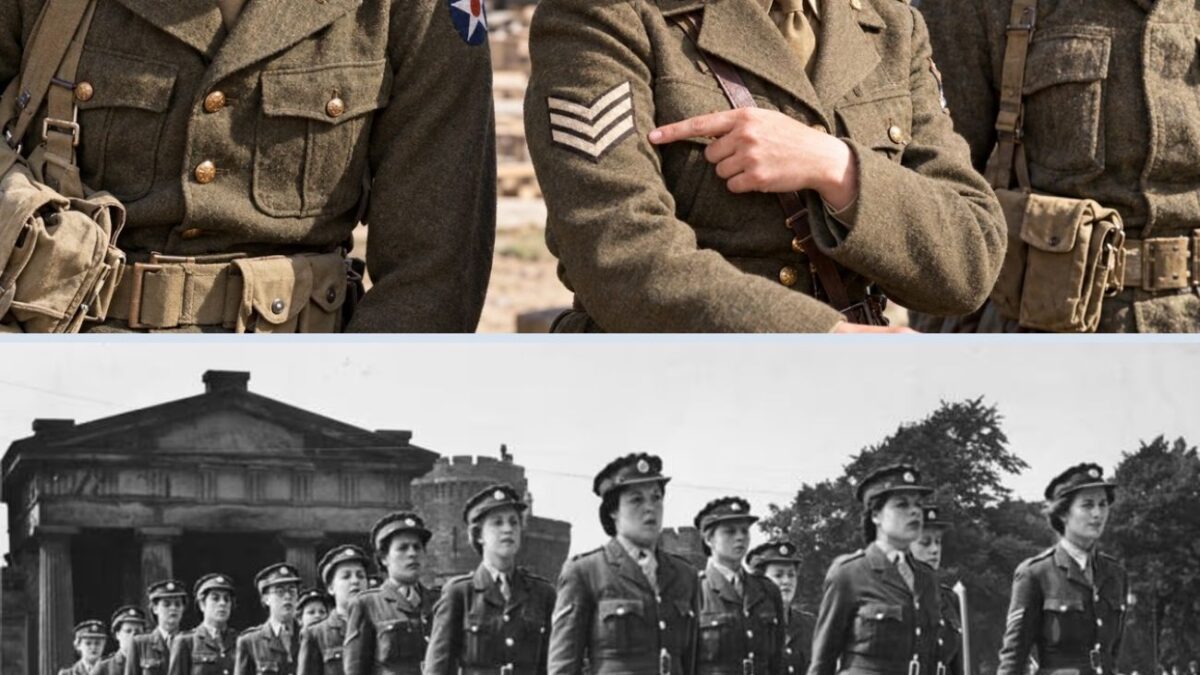
Number five. The women in uniform could give you orders. An American private in Britain in 1942 could look up and see a young woman in khaki with stripes on her sleeve. And his guidebook had already told him what that meant. A British woman officer or non-commissioned officer can and often does give orders to a man private. That line was in the American guidebook. The army thought its soldiers needed to be told. The British women’s services were big and they had been in uniform for years. The Auxiliary Territorial Service, the women’s branch of the army, was formed in 1938. By the end of the war in Europe, it had more than 190,000 members. They drove lorries, repaired engines, and worked the radar and rangefinders of anti-aircraft batteries tracking German bombers at night. They were not allowed to fire the guns themselves. But on many gun sites, the women found the target and the men pulled the trigger.
The guidebook had a warning for any American who thought it was all for show.
“When you see a girl in khaki or Air Force blue with a bit of ribbon on her tunic,” it said, “remember she didn’t get it for knitting more socks.”
Even the Prime Minister’s family wore it. Mary Churchill, his youngest daughter, served in the ATS on the anti-aircraft guns. In 1945, Princess Elizabeth joined, too, and trained as a driver and a mechanic in the same khaki as everyone else. The Americans were not far behind. In May 1942, the United States created its own Women’s Army Auxiliary Corps. But in 1942, a British woman sergeant was still something an American private had to be warned about in writing. The joke, when there was one, was on the American. The woman he had just been told to take seriously had probably been at war longer than he had. And the men around her had something on their heads that American soldiers did not wear.
Number four, they wore berets. To most Americans in 1942, a beret meant a Frenchman or an artist. The British Army had been wearing them for years, and every color meant something. The first were black. In 1924, the British tank men adopted a black beret. It was said to be practical inside a cramped tank, where a peaked cap got in the way, and it did not show the oil. The design, the story goes, was modeled on the beret of the French Alpine troops the British had seen in the First World War. The black beret became the mark of the Royal Tank Regiment, and tank men wore it from the training ground to the desert.
Then came maroon. In July 1942, the British Airborne Forces adopted a maroon beret on the orders of their commander, Major General Frederick Browning. It is often said that his wife, the novelist Daphne du Maurier, helped choose the color. That story is hard to prove. What is certain is that German soldiers in North Africa would soon call the men who wore it the Red Devils. Then green. In October 1942, the first green berets were issued to the commandos. It had to be earned. A soldier got it only after passing the commando course at Achnacarry in the Scottish Highlands, where the training was so hard that the beret became a prize in itself. To American soldiers who wore a helmet in the field and a garrison cap or a peaked cap everywhere else, a whole army in soft wool caps of different colors was an unfamiliar sight.
Here is the twist. The Americans took the idea home. In 1952, the new US Army Special Forces chose a green beret because it was reminiscent of the British commando beret of the Second World War. In 2001, the US Army made a black beret standard for all its soldiers. The beret was strange in 1942. In time, it became a badge of honor on both sides of the Atlantic. And one British general had already turned it into something else entirely, a trademark known to every soldier who served under him. Keep those pilots in Essex in mind. They are still standing on parade in British blue and we will come back to them. First though, the British general who wore his beret with two badges on it.
Number three. The generals dressed as they pleased. The Western Desert, late 1942. The commander of the British Eighth Army, General Bernard Montgomery, is wearing a black tank beret. On it are two badges. One is the badge of the Royal Tank Regiment. The other is a general’s badge. According to the Imperial War Museum, which has the beret, his first one was given to him by his tank driver around the Battle of El Alamein. Montgomery wore it so that his soldiers could pick him out from every other general in a peaked cap. It worked. He added pullovers and corduroy trousers, and he was not alone. Long before the Eighth Army existed, the men in the desert had a reputation for what one military history journal calls a certain eccentricity of dress. Suede desert boots, corduroy trousers, silk scarves. A cartoonist in the Eighth who signed himself John, drew two officers dressed exactly like that and called them the two types. He drew around 300 of their adventures for the Eighth Army’s own newspaper. He said a lot of Eighth Army officers really did dress like that.
On the 7th of April, 1943, American troops of the Second Corps met the Eighth Army for the first time on a desert road in Tunisia. The American Army ran on regulation dress. The British Army in front of them had its own ideas. Eisenhower later wrote that Montgomery, like Patton, conformed to no type and deliberately pursued certain eccentricities of behavior not every American minded.
The US Navy’s chief, Admiral Ernest King, defended the beret and pointed at his own side.
“It is true that his beret was somewhat dramatic,” King wrote, “but hardly more so than MacArthur’s gold embroidered cap and corncob pipe or Patton’s two pearl-handled pistols.”
The Americans had their eccentrics, too. In the desert, though, the British eccentricity went well below the generals, down to young officers in silk scarves. The ordinary British soldier wore something much plainer, number two.
They fought in the same clothes they paraded in. An American soldier in Britain had a field uniform for work and a smart service uniform for going out. A four-pocket coat, a shirt, and a tie. On a Saturday night in an English town, he looked sharp. In March 1943, an American investigator writing for the British Ministry of Information put it bluntly:
“The GI could cut out any Englishman with any girl partly because he came from a country where beautiful clothes are ridiculously inexpensive.”
The British soldier next to him wore battle dress, a short blouse of wool serge buttoned onto high-waisted trousers and heavy boots with iron studs in the soles that crunched on the pavement. British soldiers called them crunchies. It was the uniform he trained in, fought in, went on leave in, and paraded in. During the war, battle dress was even worn for mounting the guard at Buckingham Palace. Next to a collar and tie, it looked like working clothes. It had been designed that way on purpose. The British had based it on the ski suits of the 1930s. The sleeves were curved forward for firing, lying down, or driving. It used less cloth and it was warm even when wet.
Then the Americans went to war in their own field uniforms and discovered a problem. In May 1943, Eisenhower wrote to General George Marshall about the virtual impossibility of appearing neat and snappy in our field uniform. He wanted something better by the next winter. According to Eisenhower’s biographer, Carlo D’Este, Eisenhower had already admired a jacket worn by the American air commander, Ira Eaker. It had been made by a London tailor modeled on the standard dress of the British forces. Eaker gave it to him. What followed was a short, waist-length American wool jacket. In November 1944, it became standard issue as the M-44 field jacket. Soldiers called it the Ike jacket after the general who made it famous. It stayed in the US Army until 1960. So, the plain British working clothes that looked so strange next to an American tie ended up on the back of the American supreme commander.
But, copying the British was one thing. Some Americans had gone much further. They had worn the real thing. Back in Essex, in September 1942, the American pilots in British blue are still on parade. In a few minutes, they will stop being members of the Royal Air Force, and some of them have not even bought their American uniforms yet. Number one, some Americans wore it themselves. In 1940, the United States was neutral. By law, Americans were not supposed to join a foreign army at war. An American who took an oath of loyalty to another government could lose his citizenship. Thousands wanted to fly against Germany anyway. A recruiting network called the Clayton Knight Committee quietly helped them reach the Royal Canadian Air Force and the RAF and found a way around the oath. The Americans only pledged to obey the orders of their commanders. They never gave up their American citizenship.
On the 19th of September 1940, at Church Fenton near York, the RAF formed number 71 Squadron, the first Eagle Squadron, made up of American pilots. Two more followed, 121 and 133. They wore RAF blue with a shoulder patch showing an eagle like the one on an American passport. At first, the patch carried the letters AES for American Eagle Squadron. The A was later dropped. The patch was designed by Charles Sweeney, one of the Americans who had helped recruit them. The Clayton Knight Committee approved about 6,700 applications from Americans to join the Canadian or British Air Forces. Only 244 Americans ever served in the Eagle Squadrons. They flew Hurricanes then Spitfires over the Channel and over France. They wore the uniform of a country that was not their own for a war their own country had not yet joined.
By the end of September 1942, 77 Americans of the Eagle Squadrons had been killed. Then came Pearl Harbor and America was in the war. The Eagle Squadrons were to be handed over to the American Air Force in England. The date was set for the end of September 1942. Three days before the handover, on the 26th of September, 133 Squadron was sent to escort American bombers over France in brand new Spitfire Nines. Unexpectedly strong winds threw their navigation off. Coming back, low on fuel, above thick cloud, the pilots mistook the French port of Brest for the English coast. Of 12 Spitfires, 11 were lost. Four pilots were killed. Six were captured. One escaped through France. They had gone out in Royal Air Force uniform three days before their squadron was due to become American.
On the 29th of September at Debden, the three Eagle Squadrons became three fighter squadrons of the American Fourth Fighter Group. The British commander of Fighter Command, Air Chief Marshal Sholto Douglas, spoke to them.
“We of Fighter Command deeply regret this parting,” he said, “for in the course of the past 18 months, we have seen the stuff of which you are made, and we could not ask for better companions with whom to see this fight through to a finish.”
“It is with deep personal regret,” he told them, “that I today say goodbye to you whom it has been my privilege to command.”
The pilots went on flying the same Spitfires, now painted with American markings. The uniforms were the strange part. Some of the pilots did not have American ones yet. One of them, James Goodson, remembered going to London in ones and twos on precious 24-hour passes to pick up their US uniforms. Goodson went on to become one of the group’s aces. And when they put the American uniform on, they did not leave the British one completely behind. By special order, the former Eagle pilots were allowed to keep their RAF wings. They wore them, reduced in size, on the opposite side of the chest from their new American wings. The Fourth Fighter Group became one of the most successful American fighter groups of the war. And some of its best pilots flew right to the end with a small pair of RAF wings on their chests.
So, the strangest thing American soldiers found about British uniforms was not the berets or the badges or the plain wool battle dress. It was that some of them had fought in it first, and when they finally got their own, they would not take all of it off. The rest of the American army went on finding the British uniform odd, the beret, the battle dress, the women’s stripes. Then, one by one, it copied them. A short jacket for the supreme commander, a green beret for its own special forces.
So, we go back to Essex, September 1942. A line of young Americans stands on parade in the blue uniform of the Royal Air Force with eagles on their shoulders. Three days earlier, 11 of their Spitfires did not come home. Soon, they will be Americans in American uniform. But, on their chests, for the rest of the war, there will be two pairs of wings, one American and one a little smaller from the country whose uniform they wore when their own country was not yet in the fight.
You Might Also Enjoy

“We Thought They Would Negotiate”—What Argentine Soldiers Said When The British Attacked Goose Green

“You’ll Never Finish My Ruck March, Limey” — US Sergeant Who Challenged the SAS, Then Fell Out First






