7 MINUTE AGO: Princess Anne BREAKS IN TEARS Over Tragic News About King Charles
THE UNBREAKABLE CRACKS: Inside the Private Moment That Brought Princess Anne to Tears and Forced the Crown to Its Greatest Test
For generations, the British public has looked to Princess Anne as the ultimate embodiment of iron-willed stoicism. Through state funerals, historic scandals, bruising family fractures, and moments that threatened to pull the very fabric of the institution apart, the Princess Royal has remained an unyielding rock. She is a woman who does not crack under pressure, who disdains public displays of vulnerability, and who treats duty as an absolute religion. Protocol is her armor; endurance is her default setting.
Yet, behind closed doors, away from the glittering chandeliers of state rooms and the watchful lenses of the press pack, the armor finally shattered.
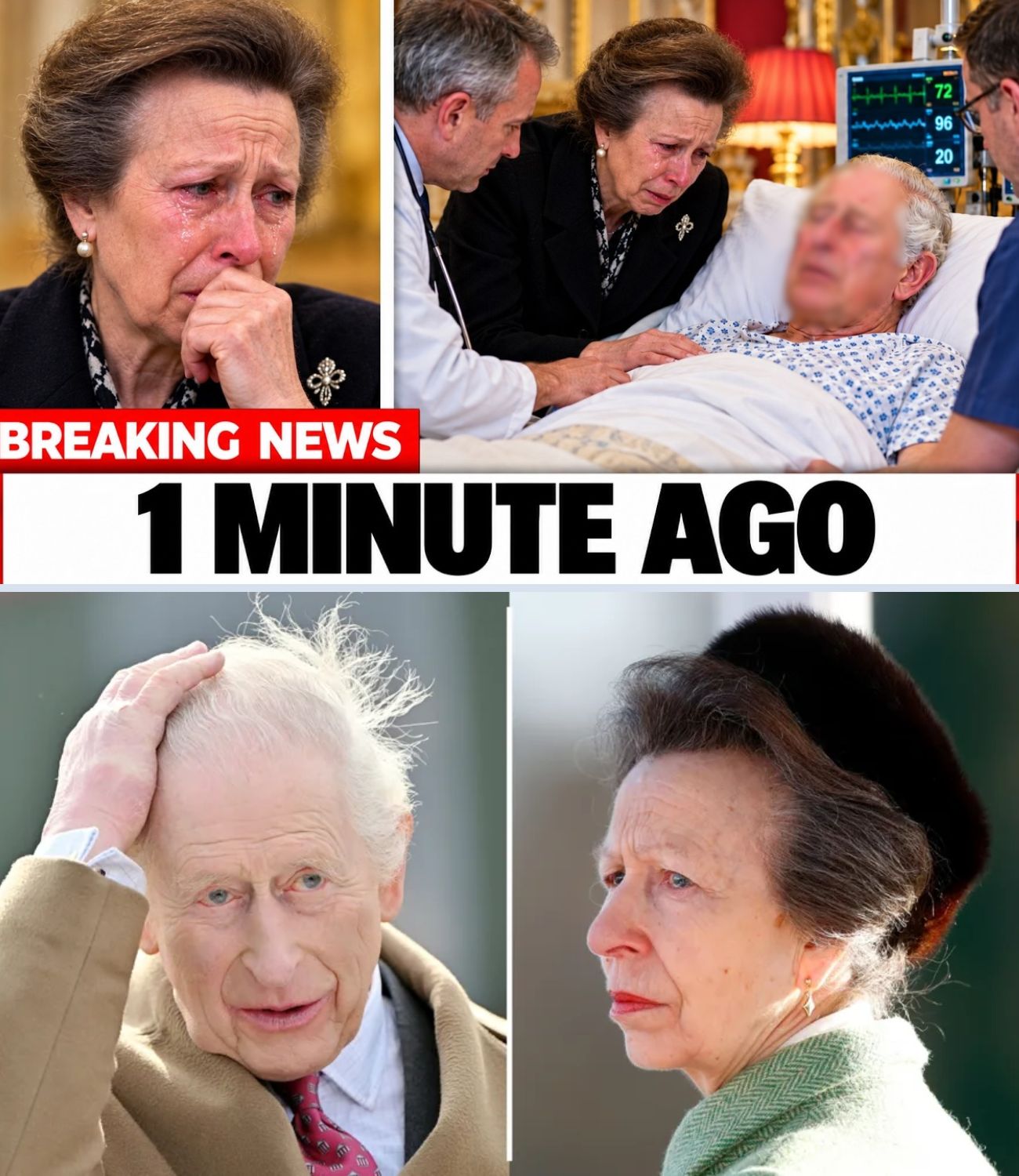
When a private briefing concerning King Charles reached her hands, the woman whom aides and courtiers had spent decades describing as unbreakable did something the royal household had never witnessed before. She lowered her head, gripped the edge of a polished mahogany table until her knuckles turned white, and began to cry.
The Dispatch That Changed Everything
The silence inside the private room was suffocating. The document delivered to her was not a routine administrative circular or a polite scheduling update; it was an official medical and operational dispatch confirming what those closest to the sovereign had secretly feared for months. King Charles had reached a definitive physical wall. A severe health setback had forced him to suspend his major public duties immediately, demanding urgent, intensive treatment and an extended, uncompromising period of recovery.
Buckingham Palace does not issue such language lightly. The institution speaks for the crown with calculated precision, and the wording left zero room for euphemism or routine caution. For Anne, the stark reality hit with the force of a physical blow. Her elder brother—the man who had spent seventy-odd years waiting to inherit a crown, only to be diagnosed with cancer shortly after taking the throne—had finally pushed his body past the absolute limit of what human biology could endure.
Staring at the briefing as if willing the ink to rearrange itself into something less ominous, Anne felt the heavy weight of the closed door. Senior aides waited anxiously in the corridor, maintaining a respectful, hushed distance. When Anne finally lifted her head, her voice was tightly controlled, stripped of all official cadence, as she asked the only question that mattered: “Has Charles been told everything?”
The answer was immediate. Yes. The King was fully aware of the severity of the setback, the uncompromising nature of the treatment plan, and the non-negotiable reality that his public workload had to cease entirely.
That was when the control slipped. Anne turned away from the table, trying desperately to steady herself, but words failed. The tears that fell were not born of self-pity or theatrical despair. They were the raw, unfiltered grief of a younger sister suddenly confronted with the terrifying realization that discipline, tradition, sacred oaths, and royal titles could not protect her brother from the frailties of mortal flesh.
Duty Versus Mortality
What made the moment even more agonizing was the king’s immediate reaction to his own crisis. Even as his doctors pulled the emergency brake on his schedule, Charles’s first instinct was not self-preservation, but continuity. True to the lifelong conditioning instilled in him by Queen Elizabeth II, he was already worrying about calendars, state papers, and the seamless transition of responsibilities.
The monarchy, at its core, is a delicate machinery built entirely around the person of the sovereign. When the sovereign stumbles, the shockwaves reverberate through every tier of government, the Commonwealth, and the royal household itself. Charles had insisted that the institution must move forward without hesitation, quietly instructing his advisers to prepare Prince William for a massive expansion of high-level duties.
When an aide quietly revealed to Anne the full scope of what Charles was asking his eldest son to carry, her initial grief hardened into a fierce, protective concern. She understood instantly that her own tears were merely the prologue. The family was entering uncharted waters, and the burden was about to shift with brutal suddenness.
Long before Charles became king and Anne became the relentless Princess Royal, they were simply two children growing up inside an institution that viewed emotional expression as a professional liability. Their personalities could not have been more contrasting. Charles was naturally reflective, sensitive, and prone to carrying his anxieties inward, while Anne answered every pressure with blunt pragmatism, sharp wit, and relentless physical activity.
Yet, shared loss had forged an unbreakable bond between them. Following the death of their mother, Anne had become one of the very few people in the world to whom Charles could speak without ceremony or pretense. To the rest of the world, he was the sovereign. To her, he remained the boy she had shared a nursery with—a brother who carried the crushing weight of history on his shoulders.
The Warning Everyone Tried to Ignore
As the reality of the suspension sank in, Anne’s thoughts drifted backward, unravelling the weeks leading up to this breaking point. Every major royal crisis always possesses a quiet, seemingly insignificant catalyst that only looks like a warning sign when viewed through the lens of hindsight.
For Charles, that turning point had occurred weeks earlier during a private meeting at Windsor Castle. There had been no flashing cameras, no public gasps, and no dramatic headlines. It had been an ordinary afternoon behind closed doors until the King stopped dead in the middle of a sentence. His hand had tightened convulsively around the arm of his chair, his expression draining of colour. With a strained, barely audible voice, he had asked for several minutes alone.
Anne had moved toward him instantly, but he had raised a single hand, stopping her with a look that pleaded for dignity. “Do not make a scene,” he had whispered.
She had obeyed, but her hawk-like vigilance never relaxed. She watched every micro-movement, every laboured breath, every clumsy attempt he made to pretend the episode was nothing more than a passing fatigue. Later, when the room was entirely private, she had confronted him with characteristic bluntness, demanding he cancel half his upcoming engagements.
Charles had refused flatly. “The public needs continuity, not panic,” he had argued.
Anne had fired back that continuity is entirely meaningless if the man at the center of it drives himself into the grave. But at the time, his stubborn determination won out. A modified schedule was agreed upon, but it was a compromise born of fear disguised as duty. Now, standing in the aftermath of the official health announcement, Anne realized that the Windsor incident had not been a mere scare; it had been the point of no return.
Stripping Away the Crown
Deciding that protocol had done enough damage, Anne bypassed the layer of secretaries and advisers entirely, picking up her phone and dialing his private line directly.
When Charles answered, she ignored every constitutional convention, every diary commitment, and every advisory memo. “How are you feeling?” she asked simply.
The sheer directness of the question seemed to unsettle him. He attempted a dry, forced chuckle, brushing off the disruption by complaining that he was more annoyed by canceled tour dates than anything else. But Anne heard the unnatural strain vibrating beneath his words. He was trying to protect everyone from his own underlying terror.
Her frustration sharpened into a demand. She told him that for once in his life, he was forbidden from speaking like the sovereign. He needed to answer her as her brother.
The silence that followed was heavy and absolute. When Charles finally spoke, all the defensive armor was gone. In a quiet, subdued tone, he admitted that he was frightened, too. It was a confession Anne had never heard him utter so plainly. He had spent decades hiding his doubts behind the impenetrable shield of kingship, and hearing him acknowledge its limits changed the atmosphere in the room entirely.
He went on to reveal that he had formally instructed his team to prepare William for a substantial increase in public and private responsibilities. But before their conversation ended, Charles pulled out a folder containing one final, unexpected decision—a directive that would place Anne herself right at the epicenter of the family’s stabilization efforts.
William Steps Forward
Back at Windsor, the logistics of a reigning monarch stepping back were already spinning into motion. Prince William sat at a large oak desk, reviewing the heavily revised schedules that now bore his name. Dozens of high-level briefings, overseas engagements, and constitutional duties had been redirected to his office.
Setting his fountain pen down on the blotter, William exhaled slowly, admitting to Catherine that every added responsibility felt unnervingly heavy. The transition from being the heir apparent to actively absorbing his father’s daily workload was a psychological hurdle. Preparation for kingship is usually an abstract, gradual exercise; suddenly, it had transformed into an immediate, reactive reality.
Catherine reminded him gently that supporting a recovering father is entirely different from stepping into his shoes prematurely. William listened, finding steady ground in her calm reassurance.
Meanwhile, Charles’s directive to Anne was crystal clear: she must act as the ultimate stabilizing force within the family, keeping everyone steady, challenging William when pressure clouded his judgment, and supporting him when the burden threatened to overwhelm.
A Nation Holds Its Breath
Outside the palace gates, the ripples of the royal announcement were already transforming the urban landscape. Broadcasters broke into regular programming, newspapers prepared sombre front pages focusing on health rather than succession drama, and ordinary citizens began quietly gathering outside Buckingham Palace.
There were no angry protests, no political demonstrations—just thousands of everyday people standing in respectful silence, leaving bouquets of flowers and handwritten cards beside the wrought-iron gates. One simple, poignant sign appeared repeatedly in television coverage, handwritten on plain white cardstock: “Rest now, your Majesty. We can wait.”
The message cut straight through the complex machinery of statecraft and protocol. It proved to Charles what Anne had been trying to argue for days: true public service does not require self-destruction, and the British people possess a deep, instinctive capacity to accept royal vulnerability without losing faith in the institution.
When Anne saw the image of the flowers during a late-night briefing, she studied the words in silence. The public sympathy offered a profound comfort, yet it also brought a quiet unease. For generations, the House of Windsor had fiercely controlled every drop of information it released to the world. Now, complete strangers were openly responding to a human weakness that the family itself had struggled for decades to admit.
A New Era of Honest Strength
In the days that followed, the dynamic at the heart of the British monarchy shifted irrevocably. Charles finally yielded entirely to his medical team, stepping away from unnecessary paperwork and allowing his family to shoulder the weight. William stepped forward into his expanded role with a measured, calm authority that projected stability without ever appearing impatient for the throne.
And Anne remained where she had always been—not as a detached military commander or a rigid enforcer of protocol, but as a devoted sister standing firmly between the past and the future.
The dramatic episode proved something vital about the endurance of a thousand-year-old crown. The institution did not survive this crisis because everyone successfully hid what they felt behind stiff upper lips. It survived because a legendary princess finally allowed herself to cry, because a beleaguered king finally listened to his body and his family, and because a son stepped up not to usurp his father, but to help him carry an impossible weight.
In the end, true strength was redefined. It was no longer about endurance at any catastrophic cost. It was built on trust, raw honesty, and the courageous wisdom of knowing exactly when to let someone else take the strain.
You Might Also Enjoy

“We Thought They Would Negotiate”—What Argentine Soldiers Said When The British Attacked Goose Green

“You’ll Never Finish My Ruck March, Limey” — US Sergeant Who Challenged the SAS, Then Fell Out First






