9 Things British SAS Snipers Refused To Carry (That Shocked US Marines)
9 Things British SAS Snipers Refused To Carry (That Shocked US Marines)
The Marine sniper instructor stopped halfway down the gear line.
“Where’s the rest of it?”
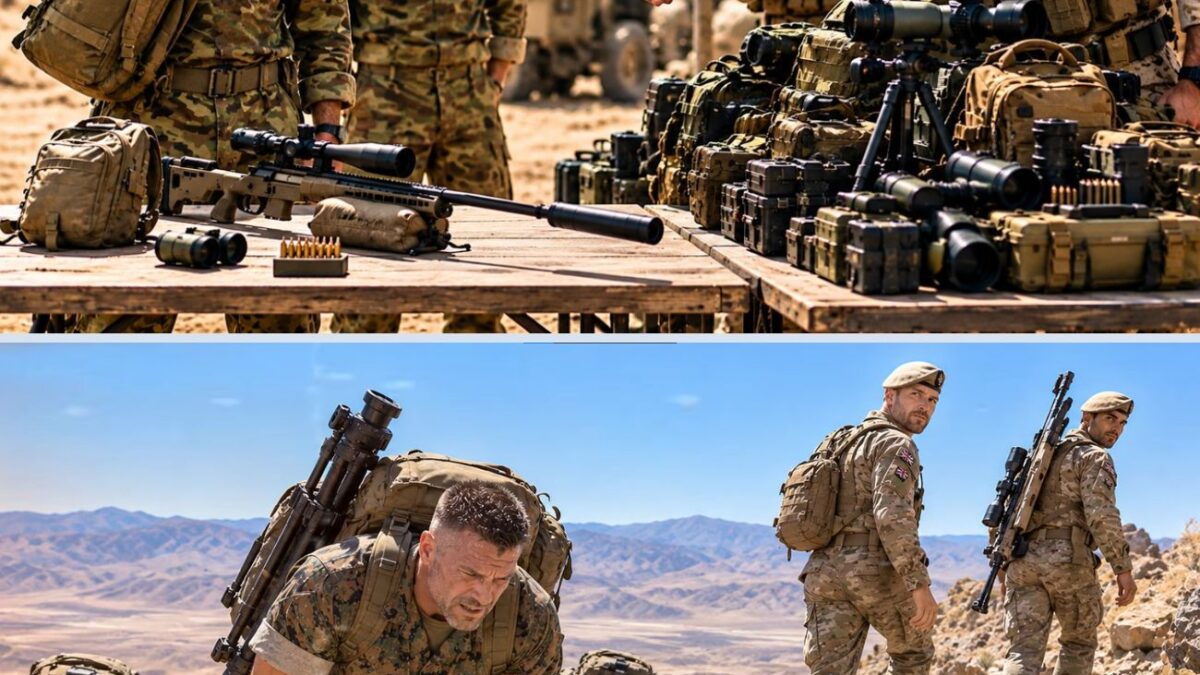
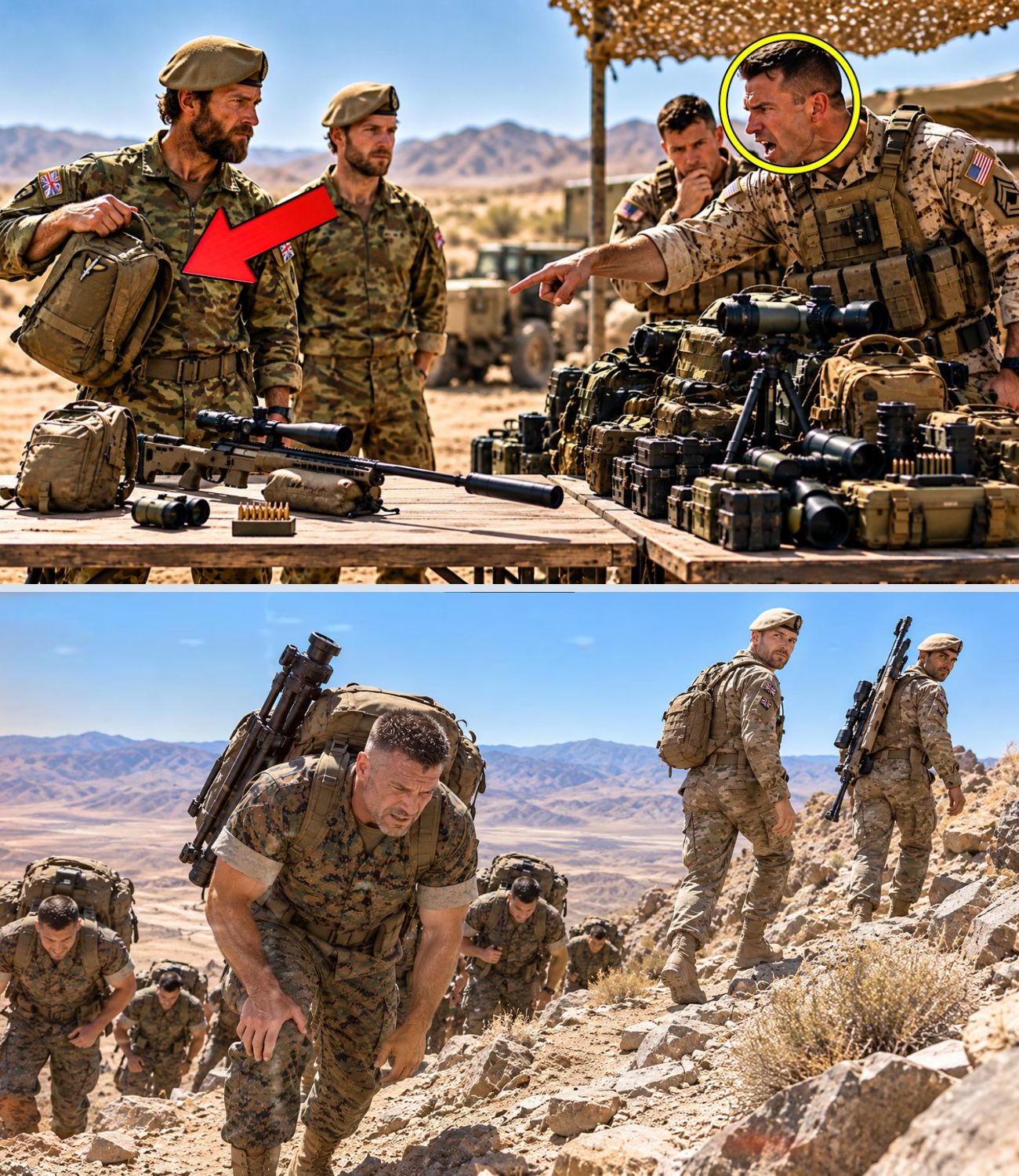
Nobody answered. On the table in front of the two SAS snipers set a rifle, a compact optic, a strip-down pack, and almost nothing else. No heavy tripod. No mountain of spare gear. No backup for every backup.
Half the equipment the Marines considered essential had been left behind on purpose. Gunnery Sergeant Colbert looked at the British team leader.
“You planning to borrow ours when yours fails?”
Staff Sergeant Daniel Mercer gave him a flat look.
“No.”
Then he picked up his pack with one hand.
“Most of that gear fails you before it ever breaks.”
Six hours later, the Marines would understand exactly what he meant. And the first thing the SAS refused to carry was the one nobody expected.
The exchange had begun 3 days earlier as the kind of joint training event that usually produced more polite conversation than surprises.
A small British detachment had arrived to work beside a Marine sniper section on dry training ground where scrub, broken stone, and long open folds punished anyone who moved carelessly. Nobody expected an argument about equipment. The Marines had their systems. The British had theirs. Both groups had years invested in believing that the things they carried had survived enough bad days to earn a place on their backs.
Barrett had spent most of his career around men who could tell the difference between useful weight and dead weight before sunrise. His Marines were not overloaded amateurs. Their packs had been built by experience, trimmed by instructors, and adjusted after enough field problems that every pouch had a reason for being where it was.
That was why the British table bothered him. It did not look disciplined. It looked incomplete. Mercer seemed entirely unconcerned by the judgment forming around him. He was 38, lean, weathered, and quiet in the particular way of a man who did not feel obliged to fill silence simply because other people were watching him.
Beside him stood Sergeant Owen Price, his spotter, younger by 4 years, and just as unwilling to explain himself before there was something worth explaining. Between them, the two men had brought less equipment to the line than some of the Marine pairs had packed for one shooter. Barrett walked the table once more.
“This isn’t a speed march.”
Mercer nodded.
“Good. You know you’re staying out all day.”
Another nod.
“And you still left half the issue kit behind.”
Mercer looked at the rows of equipment on the Marine tables and then back at his own pack.
“Not half.”
Barrett waited.
“The half we didn’t need.”
That answer earned a few smiles.
Not hostile ones. More the reaction professionals give another professional when they think confidence has moved slightly ahead of evidence. Barrett did not challenge him again. The training lane would do that soon enough. The first difference became visible at the ammunition check. One of the Marine staff sergeants lifted Mercer’s ammunition pouch, squeezed it once, and looked at him.
“That’s it.”
Mercer confirmed the count. The Marine checked again as if a second look might create more cartridges inside the pouch. His own pair carried considerably more. Not because they expected a firefight, but because contingency planning had a habit of adding weight one reasonable decision at a time. A primary load for the rifle. A reserve.
Extra in case the range period changed. Extra in case another shooter needed it. Extra because nobody wanted to be the man who had carried one round too few when the day stopped following the plan. Mercer’s calculation had gone the opposite direction. He carried what the exercise required, a small margin beyond it, and no comfort weight disguised as preparedness. Barrett folded his arms.
“You lose access to the resupply point after step-off.”
“I know.”
“You get an unexpected serial added, you can’t fix it from out there.”
“I know.”
The answer irritated Barrett slightly because Mercer was not arguing the facts. He simply did not assign them the same importance. Price finally spoke.
“If the job changes enough to need all that, the job changed before the ammunition did.”
That quieted the table. There was a logic to it, though not one Barrett completely accepted. The British pair were not treating ammunition as a general symbol of readiness. They were treating it as mission-specific weight. Their assumption was narrow. This was a sniper observation and shooting problem, not an infantry fight.
If conditions changed so drastically that the pair needed a large reserve of rifle ammunition, they would already be facing a larger failure in planning, position, or extraction. Barrett understood the argument. He also understood why Marines tended to carry more. Institutions do not build habits around the perfect day.
They build them around the day when the truck does not arrive, the route closes, the plan shifts, and one team suddenly has to stay longer than anyone expected. Extra ammunition was not stupidity. It was insurance. Mercer’s objection was not to insurance. It was to paying for every imaginable disaster with weight before the first problem had even appeared.
The lane began just after first light. Each pair had to move through broken country, establish an observation position, identify a series of distant markers, and remain unseen while instructors moved through the area searching for signs of them. It was not a competition on paper. By the first hour, everyone had started treating it like one.
The difference in the packs appeared slowly rather than dramatically. The Marine pairs were not struggling. Nobody collapsed. Nobody complained. But every time the route steepened, every time a man lowered himself behind rock or crawled the final distance into cover, small differences accumulated. A heavier pack had to be controlled.
A fuller pouch had to be kept from striking stone. More weight meant slightly more pressure through knees and elbows. Nothing decisive by itself. Everything measurable after hours. Mercer and Price moved without hurry. That was what Barrett noticed first through binoculars. They were not faster. They simply seemed to spend less time managing themselves.
When Mercer lowered his body, the pack followed him instead of swinging around him. When Price shifted behind a fold in the ground, there was almost nothing hanging from his sides to catch or knock against rock. By late morning, Barrett had stopped thinking about how much ammunition they had left and started thinking about how little of their attention their equipment demanded.
The second item caused a larger argument. During the next observation phase, a Marine corporal unpacked a large spotting scope with excellent glass, high magnification, and the kind of resolution that could pull detail out of distance long after the naked eye had given up. Price looked at it for a moment and then set down the smaller optic he had carried.
The corporal said, “Grant, you want to trade?”
“No.”
“You haven’t looked through it.”
“Don’t need to.”
That answer sounded less reasonable than the ammunition argument. Barrett moved closer. The Marine scope was heavier, but it was also objectively more capable in several ways. It gathered more light. It offered more magnification. It made positive identification easier at distance.
There was nothing primitive or foolish about carrying it. Price tapped the side of his compact optic.
“This shows me what I need to see.”
The corporal pointed toward the larger scope.
“That shows you more.”
Price nodded.
“And asks me to carry more, expose more, and set up more.”
Mercer said nothing. He did not need to.
This was Price’s part of the problem. Again, the disagreement was not really about whether one optic was better. It was about what counted as better once everything around the optic was included. A large scope offered more performance at the eye. A smaller one asked less from the body carrying it. It could be moved with less disturbance, placed in tighter cover, and packed away quickly when the position changed.
The British pair had accepted less maximum capability in exchange for a tool they believed they could use more often without changing the shape of what they were doing. Barrett watched Price settle behind a shallow rise where the larger Marine scope would have required a slightly higher position. The difference was only a few inches.
On a firing range, a few inches meant almost nothing. On a piece of ground where instructors were searching for outlines and movement, Barrett could not dismiss it so easily. The marine still found details the British pair missed. That mattered. At one observation point, the larger glass resolved a partially obscured marker before Price could identify it through his smaller optic.
The corporal who had offered the trade gave him a satisfied look. Price simply waited. A shift in light made the marker clear 30 seconds later. He identified it, wrote nothing down, and moved on. Barrett expected irritation from him. There was none. Price had never claimed his optic could see everything first.
His standard was different. If a tool delivered enough information inside the time the mission allowed, then additional capability had to justify the additional burden it created. Sometimes it would. On this exercise, he believed it did not. That distinction began to change the mood. The British pair were not rejecting equipment because they disliked technology or because austerity made a better story.
They were forcing each item to defend itself against the whole mission rather than against a catalog specification. The third refusal was the one Barrett considered hardest to defend. At the afternoon halt, the marine teams prepared for a long observation serial across uneven ground. Several pairs unpacked sturdy tripod systems designed to provide a stable platform for glass and, when required, other supported equipment.
The systems were dependable, familiar, and fast in trained hands. Mercer and Price had not brought one. Barrett looked at the empty side of their pack.
“Don’t tell me you forgot that, too.”
Mercer crouched beside a low rock shelf and rested his compact support bag against it.
“Didn’t forget it.”
“You’re going to hold glass for 2 hours off that?”
“No.”
Mercer adjusted the bag once, used the ground and stone already in front of him, and settled the rifle without building anything that looked like a separate structure. Barrett studied the position.
“Tripod gives you repeatability.”
“It does.”
“Then why leave it?”
Mercer looked toward the training area rather than at Barrett.
“Because repeatability is useful until you start needing the ground to cooperate with your equipment.”
This time Barrett did not have an immediate reply. He knew what Mercer meant. Every tool creates habits around itself. A stable tripod could be brilliant on open ground, behind a wall, on a roof, or anywhere the shooter had room to deploy it properly.
But once a team had paid the weight to carry it, there was a natural pressure to use it. Find enough space. Create enough height. Clear enough vegetation. Build the position the equipment wanted. Mercer’s pair worked in reverse. They carried fewer dedicated supports and expected themselves to solve the position with whatever the ground already offered.
Sometimes that meant a pack. Sometimes a small bag. Sometimes a rock shelf or a depression that would have looked inconvenient to anyone searching for a textbook firing point. The cost was obvious. Their method demanded judgment every time. There was no single setup to repeat. A poor choice of support would punish them immediately.
The advantage was just as obvious. They were not searching for one particular kind of ground. Halfway through the serial, the instructors changed the observation area without warning. The Marine teams broke down equipment, shifted several hundred yards, and rebuilt. They did it efficiently. The British pair moved with them.
Barrett reached the new line expecting Mercer to still be setting his position. He was already watching through the optic. Nothing dramatic had happened. No Marine had failed. No piece of equipment had broken. The tripods worked exactly as designed. That was what made the lesson difficult to dismiss. Mercer had never said the gear was bad.
He had said it had to earn its weight. By the time the sun began dropping behind the high ground, Barrett had seen three items his own section considered normal questioned for three entirely different reasons. Ammunition, because contingency could quietly become excess. Large glass, because maximum capability was not the same as usable capability.
Heavy support systems, because stability could become dependence on a certain kind of position. And there were still six things left on the table. The fourth would bother Barrett more than all three combined, because unlike ammunition, optics, or tripods, it was equipment designed specifically to make a sniper more capable.
Mercer had left most of it on the table before the exercise even began. The fourth refusal was the full electronic stack. Beside the range shack sat the equipment Barrett expected every modern sniper pair to want close at hand. A laser rangefinder, a compact ballistic computer, a clip-on night device, spare battery sleeves, and a weather meter.
Mercer and Price left most of it there. They carried one compact rangefinder because the exercise required rapid distance confirmation, but they refused to build the rest of the day around a pouch full of powered answers. That distinction bothered Barrett more than the missing tripod. The Marines carried electronics not because they had forgotten how to read ground, but because good instruments remove avoidable uncertainty, and uncertainty is expensive when range, wind, light, and time are all changing at once.
Yet Mercer treated the rangefinder like a witness rather than an authority. Consult it, compare it with what the terrain was already saying, then put it away before the screen became more interesting than the world beyond it. At the first navigation point, he checked a distance once and shut the device off.
Barrett asked whether the battery had failed. Mercer slid it into a pouch and said,
“No. I have the answer. If I keep asking the box, I stop noticing when the answer changes.”
Price worked the same way at the next position. A gust registered on the weather meter, but did not match the movement of scrub farther down range.
So, he did not argue with either source. He watched until the difference made sense. To the British pair, disagreement between instrument and terrain was not a reason to choose a favorite. It was a warning that the problem had not been understood yet. Near midday, an instructor quietly removed batteries from one training device before the next serial.
The Marine using it replaced them and continued with almost no delay. Mercer never discovered whether his own spare device had been altered because he had left it at the shack. That was the point Barrett had been resisting. The SAS pair were not anti-technology. They simply refused to carry an electronic solution unless the mission gave that solution enough work to justify its weight, batteries, attention, and failure modes.
The fifth refusal looked almost trivial beside the electronics, the full reference packet. At the next briefing table, each team received laminated data cards, range sketches, target references, and enough written information to fill every quiet second before movement. The Marines were comfortable with that.
Good preparation protects men from memory, and memory is unreliable when fatigue begins to edit what a person thinks he saw. Price read the packet once, copied one hand-drawn reference and three numbers into his notebook, and left the rest behind. Barrett told him the pages had been issued for a reason. Price looked across the valley and answered,
“I read them. Now I need to keep looking at what they describe.”
The serial required three observation positions and a report of what changed between them. The Marine teams could confirm distances and labels quickly from excellent notes. Price carried almost nothing written, but his eyes rarely dropped below the horizon.
At the second position, an instructor asked what had changed near a dry wash more than half a mile away. Price answered before touching his optic.
“One vehicle gone. Shadow moved off the left wall. New canvas on the rear fence.”
The instructor checked the sheet. All three were correct.
Barrett knew better than to turn one exercise into mythology. Paper existed because memory fails and pretending otherwise would be foolish. The British argument was narrower. Every page carried into the field had to survive wind and water. Every glance at a card pulled attention away from the ground and every printed certainty described a world that had already begun changing the moment the briefing ended.
Mercer and Price still recorded what mattered. They refused to carry more written certainty than they believed the mission could keep current. The sixth refusal was visible from 50 yards away. That was why the Marines laughed at it first. Before the camouflage phase, several teams began attaching pre-cut netting, additional strips, mesh panels, and prepared vegetation loops to their outer layers. The equipment was good.
It was designed to break up recognizable human shape and give a sniper more options before he ever touched the ground he intended to hide in. Mercer’s outer layer looked unfinished by comparison. Barrett walked around him once.
“That’s your camouflage?”
“That’s the part one brought.”
“And the rest?”
Mercer pointed toward the training area.
“Already out there.”
The answer sounded clever until the teams entered the lane. Then Barrett saw what it meant. The Marine systems were more complete when they crossed the start line. Mercer and Price looked almost plain, but they changed as the ground changed. Dry grass went into one section. Dark local material broke another edge.
When the route shifted toward rock, they removed what no longer matched rather than collecting more and more material until camouflage became its own silhouette. The important part was not the vegetation. It was the willingness to discard work. A sniper can spend 20 minutes building something that looks perfect in one patch of ground and become emotionally attached to it.
The ground changes. The light changes. The background changes. Suddenly, the thing designed to hide him becomes a costume from somewhere else. Mercer refused to carry camouflage as a finished answer. He wanted a framework he could rebuild. Late in the afternoon, an instructor walked within 20 yards of Price and stopped.
Barrett watched through glass from the control position. Price had almost no recognizable outline left. Not because he wore more material than the Marines, but because nearly everything on him belonged to the exact patch of ground around him. The instructor stared for several seconds, moved on, and never called the position.
Barrett lowered the binoculars.
“That one I’ll give you,” he said later.
Mercer shrugged.
“You don’t have to.”
By then, the tone between them had changed. Barrett was no longer waiting for the British pair to prove themselves wrong. He was trying to predict which assumption they would attack next. The final three refusals were the ones Barrett remembered afterward because none of them had much to do with marksmanship.
They were about what happened to a sniper before he ever looked through glass, how much weight he accepted, how many failures he tried to buy his way out of, and how much noise he was willing to carry into the last few yards. Barrett guessed the next argument would be water. He was almost right.
The seventh refusal appeared during load preparation for the longest movement of the week, extra rigid water bottles. The forecast was warm, the route was exposed, and nobody on the training staff treated hydration casually. Mercer was not proposing less water. He was objecting to carrying the same requirement in more containers than the route actually justified.
The Marine packs used several separate bottles because redundancy has obvious value. If one leaked, the others remained. If water had to be passed to another man, a bottle could be handed over immediately. Mercer used a main reservoir and a small reserve container. Measured the total volume against the route, temperature, expected duration, and resupply point, then left the additional hard bottles on the table.
Barrett initially read the smaller number of containers as a smaller safety margin. It was not. The total water requirement and deliberate reserve were still there. What disappeared was packaging that added bulk, movement, and temptation to fill every available space simply because the space existed. Mercer put it simply,
“I am not saving weight on water. I am saving weight on things that hold water.”
That distinction mattered after several hours on exposed ground. A man can add one extra bottle for caution, another because there is room, and another because nobody wants to defend leaving it behind. Each choice is reasonable by itself. The collection of reasonable choices eventually arrives in the legs.
Mercer and Price drank on schedule, monitored each other, and reached the resupply point with reserves still present. What they refused was automatic redundancy, not hydration. The eighth item sharpened the same argument. Before the final field problem, the Marines laid out spare components, extra tools, backup straps, duplicate small items, and the kind of contingency equipment built from years of learning that tiny failures can destroy large plants.
Barrett expected Mercer to approve. Instead, the British sergeant began removing duplicates. Not all of them, which was the important part, but every backup whose failure would create inconvenience rather than mission failure. Barrett held up a spare strap that weighed almost nothing and asked why it mattered. Mercer looked at the growing pile beside the pack.
“Because every unnecessary thing weighs almost nothing. One item never ruins you. 50 decisions do.”
The distinction was ruthless, but not careless. Mission critical failure deserved redundancy. Discomfort did not automatically deserve it. Some problems could be repaired, some improvised around, and some tolerated until the task ended.
The Marine saw risk in leaving possible solutions behind. Mercer saw another risk in carrying an answer to every problem that imagination could produce before the ground had produced any of them. By the final night exercise, Barrett understood the pattern. The British pair were not chasing light packs as a badge of toughness.
They were trying to make every object explain why it deserved to influence movement, attention, noise, fatigue, and the choices available once the team was committed. The ninth refusal was not the heaviest item, not electronic, and not even a single piece of equipment. It was anything that made noise. Before stepping off, Mercer and Price touched every buckle, zipper, sling end, clip, metal edge, and loose object on each other’s kit.
A Marine corporal joked that they looked as if they were preparing to sneak through a library. Price shook his pack once. Almost nothing answered. Then he pointed at the Corporal’s gear and asked him to walk. Three steps produced one small metallic click near the hip. In daylight beside vehicles and voices, nobody would have noticed it.
At night, with the group standing still, the sound seemed absurdly loud. Another man walked and produced a different collection. Fabric against plastic, a pull tab touching a buckle, water shifting in a half-filled container. None of it was dramatic. That was exactly why the British pair cared. Loud problems get fixed.
Tiny problems survive because people decide they do not matter. The final lane turned that obsession into a result. Teams had to cross broken ground at night while instructors listened from fixed observation points. Speed mattered less than control. The first Marine pair passed cleanly. The second was heard once, but never located.
Then Mercer and Price entered the lane. Barrett knew the corridor they had been assigned, which made the next 20 minutes more frustrating. He heard a scrape once near the low ground, but it never repeated. An observer turned toward another sound and searched the wrong patch. Twice the control net asked for a location on the British pair.
Twice the answer came back negative. Then the final marker moved. Barrett looked through his night glass and found Mercer already beyond it, Price sliding into the dead ground beside him. They had not been the fastest pair on the course, and nobody pretended the Marines had failed. The shock was simpler than that. Barrett had known where two men were supposed to be, had professionals listening specifically for them and still had almost nothing with which to follow their movement.
A sniper could spend hours making himself difficult to see and surrender the final 50 yards to one careless sound. Of all nine refusals, this was the one Barrett no longer needed explained. Back at the equipment table the next morning, the same gear still sat in rows. None of it had become bad overnight.
The large scope still offered excellent glass. The tripod was still stable. Electronics were useful. Extra ammunition, additional water containers, written references, prepared camouflage, and backup equipment could all be exactly right under different conditions. That was what Barrett respected most by the end.
Mercer had never argued that the Marines should copy him. He had argued that nothing should become automatic. Barrett looked over the strip-down British pack one last time.
“So, that’s the secret? Carry less.”
Mercer shook his head.
“Carry what the job needs.”
“And if you’re wrong?”
“Then you learn which thing earned its way back in.”
Nine refusals had sounded like stubbornness at the beginning of the week.
By the end, they looked more like a method. Not proof that one military culture had solved a problem another had missed, but a demand that every ounce, battery, page, strap, bottle, and buckle justify itself against the exact mission in front of the men carrying it. The Marines had arrived prepared for failure by carrying more ways to survive it.
The SAS pair had arrived prepared to prevent a different kind of failure. The slow accumulation of equipment until the tools meant to support the sniper began shaping how he moved, where he could hide, what he listened to, and how tired he became. Copying the British pack item for item would have missed the lesson completely.
The value was not in a fixed list of objects that should always be left behind. It was in the discipline of forcing the list to change with terrain, duration, resupply, concealment, and the people carrying it. A different mission could have put the large scope, extra batteries, or additional water straight back into the pack.
What Mercer refused was allowing yesterday’s answer to become today’s requirement without being questioned. That was the part Barrett had not expected. The British snipers had not brought less preparation. They had brought fewer assumptions. Everything else had been left on the table.
You Might Also Enjoy

“We Thought They Would Negotiate”—What Argentine Soldiers Said When The British Attacked Goose Green

“You’ll Never Finish My Ruck March, Limey” — US Sergeant Who Challenged the SAS, Then Fell Out First






