A US Colonel Ordered the SAS to Stand for Inspection in Basra. Nobody Put Down Their Tea.
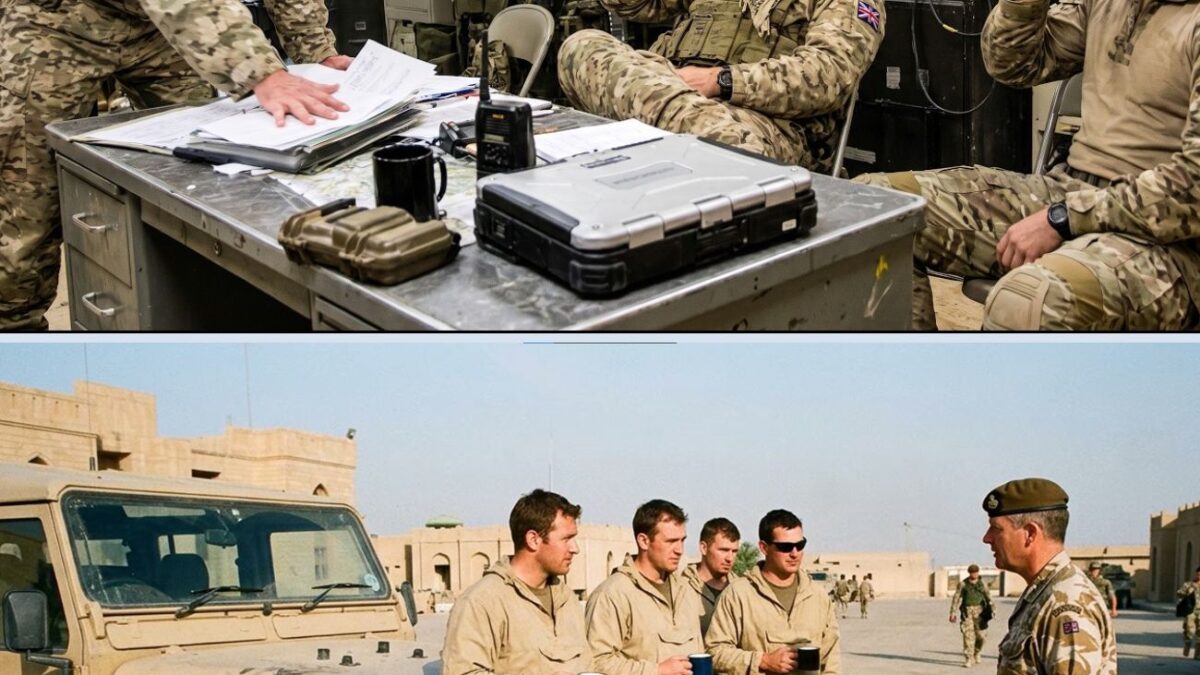
On the roof of the old customs house inside the Basra Palace compound on the night of the 14th of May 2004, two men lie behind a low parapet with a spotting scope trained on a walled yard 400 meters to the north. Trooper Ryan Kesby watches a shape move between two outbuildings, counting seconds against a mortar-base plate he has already logged twice that week.
Beside him, Colour Sergeant Baz Howlet keys a radio handset low against his chest, calling the grid to the ops room below while two Snatch Land Rovers idle in the compound car park with their lights doused, engines running, waiting on the word to move.
By the late spring of 2004, Basra Palace had become one of the more exposed pieces of ground the British Army held in southern Iraq. The compound, a former riverside residence of Saddam Hussein’s regime, pressed into service as a divisional headquarters and accommodation block, sat close enough to the city’s poorer districts that indirect fire had become a nightly rather than occasional event.
The rising of Muqtada al-Sadr’s Mahdi Army that spring had turned the city’s alleys and waste ground into staging areas for mortar teams who fired three or four rounds and were gone before a counter-battery radar could do more than log the point of origin. A composite team from the Special Air Service, four men under Captain Ali Dracott, had been working out of the palace compound since early April, tasked with identifying and disrupting the mortar teams and the wider militia command structure, feeding them, working alongside a small liaison element from the Iraqi police intelligence unit and a British infantry battalion providing the compound’s outer security.
Dracott’s team answered in the first instance to the divisional headquarters inside the same compound and beyond that to a chain that ran back to the regiment rather than to any local infantry command. An arrangement most officers on the ground understood without needing it explained twice.
The team itself had arrived in Basra with a working method built on 18 months of similar tasking further north, refined rather than improvised: pattern analysis first, human sourcing second, and a strike only once the two agreed closely enough to bear the political cost of being wrong. Dracott, 31 years old, and on his second operational tour with the regiment, had led smaller teams through comparable problems in Baghdad the previous year, and treated the mortar cells at Basra less as a novel crisis than as a familiar shape wearing new city streets, down to the same rhythm of a compromised source and a headquarters slower to move than the men doing the actual work.
Howlet, older than Dracott by a decade, and with three tours behind him predating the invasion itself, provided the ballast the method needed when a captain’s confidence ran ahead of the evidence. A role he performed without ever making it visible to anyone outside the team. Kesby and Whitlock, both on their first operational rotation with the regiment, learned the method that spring the way most young operators did, by watching Howlet quietly correct a plan before it left the drawing board, rather than by being told outright what he had changed, and why—a habit both men carried into their own later commands, without ever needing to name where they had first picked it up.
Not every officer on the ground understood it, however, and the one who did not was an American colonel named Walter Briggs, attached to the coalition’s provincial reconstruction and training effort and billeted at Basra Palace for a six-week liaison rotation that spring. Briggs had spent most of his career in conventional formations and had never before shared a compound with British special forces. He noticed within his first week a pattern that unsettled him: four men who came and went from a side building at odd hours wore no rank visible on their sand-coloured smocks and stood nowhere near the twice-daily accountability formations he had grown used to running for his own small training team.
He raised it in the first instance with his own deputy rather than with Dracott directly, describing the arrangement as a disciplined gap that reflected poorly on the compound as a whole. Briggs’s own training team numbered 11, working with a battalion of the newly reconstituted Iraqi army on basic soldiering skills a short drive from the palace. And by his own account, it was a frustrating posting made harder by delays in equipment, interpreters who did not always show up, and a local security situation that grew worse by the week.
He had arrived in Iraq with a clear picture of what right looked like: turnout, punctuality, a formation you could photograph for a headquarters newsletter. And Basra Palace, with its mortar alarms and its odd hours and its four unbadged men who kept to themselves, did not match that picture in any particular he could point to with confidence.
The compound itself, meanwhile, was absorbing indirect fire at a rate that had climbed steadily since the rising began in early April. Rounds landed close enough to the accommodation blocks twice in the space of a single week to send off-duty personnel scrambling for the nearest hardened cover, and the divisional operations room logged 11 separate stand-to alerts in the same period, most resolving within minutes into nothing worse than a scattering of shrapnel and a fresh crater in the compound’s gravel.
The pace alone was enough to erode the distinction most newly arrived officers assumed would hold between a headquarters and a front line. At Basra Palace that spring, there was effectively no such distinction left to draw, and every officer resident there, whatever cap badge he wore, learned that lesson within the first fortnight, whether he had asked for it or not.
The mortar problem, meanwhile, was worsening on its own schedule, regardless of what any colonel thought about formations. Dracott’s team had identified through pattern analysis built up over three weeks a rotating group of firing points used by two separate cells: one operating from a scrapyard near the Shatt al-Arab waterfront and a second from a residential block close enough to a school that any strike against it carried a political weight well beyond the tactical value of the target.
The scrapyard cell was struck twice inside a fortnight by a joint British-Iraqi raid built on Dracott’s targeting packages, and both times the raiding force found the position abandoned minutes before arrival. Evidence Howlet judged of a tip-off reaching the cell faster than the raid itself could close the distance, which meant the compromise sat somewhere inside the very police liaison structure the team was supposed to be working through.
Heat compounded every other pressure that spring in a way that had nothing to do with any headquarters and everything to do with southern Iraq in May. Daytime temperatures at Basra Palace regularly topped 45°C by midday, and the compound’s water supply, drawn from a treatment point shared with the wider British garrison, came under strain of its own when a pumping fault cut daily distribution by roughly a third for four consecutive days.
Dracott’s team, running patrols on a single vehicle and increasingly on foot, felt the shortage directly. Howlet cut the team’s daytime water allowance to conserve what remained for the night patrols when the physical exertion of covering ground on foot mattered more than any comfort during the stifling daylight hours spent resting in the side building with what shade its walls provided.
That suspicion narrowed the team’s options considerably. Dracott could no longer route targeting information through the full Iraqi police liaison cell without risk of it reaching the militia before his own men did, which meant building a second, smaller, and slower channel of trusted contacts almost from nothing in a city where trust itself had become a currency in short supply.
One of those contacts, a former Iraqi army officer known to the team only by the working name Yusef, had already been threatened once for talking to the British, and continued regardless, meeting Howlet at pre-arranged times in a market 2 km from the palace, never twice at the same stall.
Yusef’s motives were never fully clear to the team, and Dracott made a point of not asking too closely on the view that a source who talked too readily about his own reasons was often a source rehearsing a story rather than living one. What mattered was that Yusef’s information, checked twice against unrelated reporting before it was acted on, had not yet been wrong. And in a working environment as thin on reliable sourcing as Basra had become that spring, an unbroken record like that was worth more to Dracott than any explanation for why it existed.
The compromise inside the police liaison structure carried its own political weight because the structure itself had been built as a flagship piece of the coalition’s reconstruction effort, presented more than once to visiting officials as evidence that ordinary Iraqi policing was recovering faster in Basra than in Baghdad.
Dracott’s suspicion, if voiced too loudly or too soon, risked undermining a program several officers well above his own rank had staked some professional credibility on. He raised it in the end only with Ashworth directly in a short conversation that left no paper trail beyond a single coded line in the team’s own operational log, and left the wider question of who inside the liaison cell was talking to the militia for a later, quieter investigation that fell outside his own team’s remit and, so far as Dracott ever learned, was never conclusively resolved by anyone else’s either.
Vehicle reliability added its own strain that same week. One of the team’s two Snatch Land Rovers—the light armored patrol vehicle that had proven increasingly inadequate against the roadside devices appearing with growing sophistication across the province—took a glancing hit from a pressure-plate device on a resupply run along the Shatt al-Arab Corniche, blowing a rear wheel clean off the hub without penetrating the crew compartment.
Trooper Sam Whitlock, driving, kept the vehicle upright and rolling on the remaining wheels for close to 200 meters before it could be brought to a stop under cover. A piece of driving later described without exaggeration as the only reason the patrol came home with four men rather than three.
The vehicle itself was towed back to the compound workshop and written off within the hour by the battalion’s own REME detachment, leaving the team a single working Snatch for a task that had until that morning always run two vehicles as standard practice for exactly this kind of contingency.
Dracott requested a replacement through the divisional transport pool and was told, not unreasonably given the demand across the whole British area of operations that spring, that nothing would be available for at least 10 days. In the meantime, the team ran its patrols with a single vehicle and a foot element covering the last 400 meters of any approach on the theory that four men on foot presented less of a target than one vehicle sitting still in the open.
The single-vehicle arrangement carried its own overload problem, one Howlet solved the same way Marsh had solved a similar problem elsewhere by laying every man’s kit out and cutting what could be cut. With one Snatch instead of two, the team could no longer distribute its water, ammunition, and communications equipment across two vehicle loads.
And Whitlock, still recovering from the Corniche incident and driving again within four days against his own medic’s mild objection, found himself carrying a share of the team’s spare radio batteries on his body rather than in the vehicle in case the single Snatch was disabled a second time and the patrol had to continue the mission on foot with whatever it carried.
It added close to 6 kilos to a set of webbing already heavy with a daytime water allowance. Howlet refused to cut further, no matter how tight the compound’s own supply became.
Political restriction added a further, quieter constraint that the mortar problem alone would not have created. Coalition rules of engagement that spring required a level of positive identification before any strike against a firing point that made sense on paper and cost time in practice—time the mortar teams used to relocate before any response could be authorized.
Dracott’s team worked within the restriction rather than around it, building each targeting package with enough independent confirmation to clear the threshold quickly rather than arguing for the threshold to be lowered on the calculation that a fast, well-supported request moved through the system faster than a contested one, however justified the contest might have been in principle.
It was into this environment—a compromised informant channel, a single serviceable vehicle, and a rooftop watch running on broken sleep—that Colonel Briggs chose to press his concern about accountability formations into an actual order.
He raised it formally with the compound’s senior British officer, a brigadier named Neil Ashworth commanding the division, requesting that all personnel resident in the compound, regardless of unit, stand for a joint stand-to inspection he intended to conduct himself the following morning. Framed as a coalition cohesion exercise rather than anything specific to the SAS team, though nobody billeted near the side building was under any illusion about which four men the request was really aimed at.
Ashworth, who had worked with special forces detachments through most of his career and understood exactly what Dracott’s team answered to and why, could have declined the request outright. He chose instead to let it stand on the calculation that refusing an allied colonel a symbolic gesture over something as small as a morning formation would cost more in coalition goodwill than it saved in principle, and that Dracott’s men could be trusted to handle the moment without anyone needing to spell out for them what handling it meant.
He did, however, warn Dracott privately the evening before over a mug of the same tea that would feature in the story for years afterward, that a colonel with a bruised sense of protocol was still a colonel, allied or not, and that the compound had enough friction points that spring without adding a diplomatic one over something as avoidable as a parade.
Dracott’s answer, delivered without any real concern, was that his men would stand where they were told to stand and answer honestly if asked a direct question, and that beyond those two things, he did not intend to change how the team ran its morning for the sake of a formation neither of them had asked for.
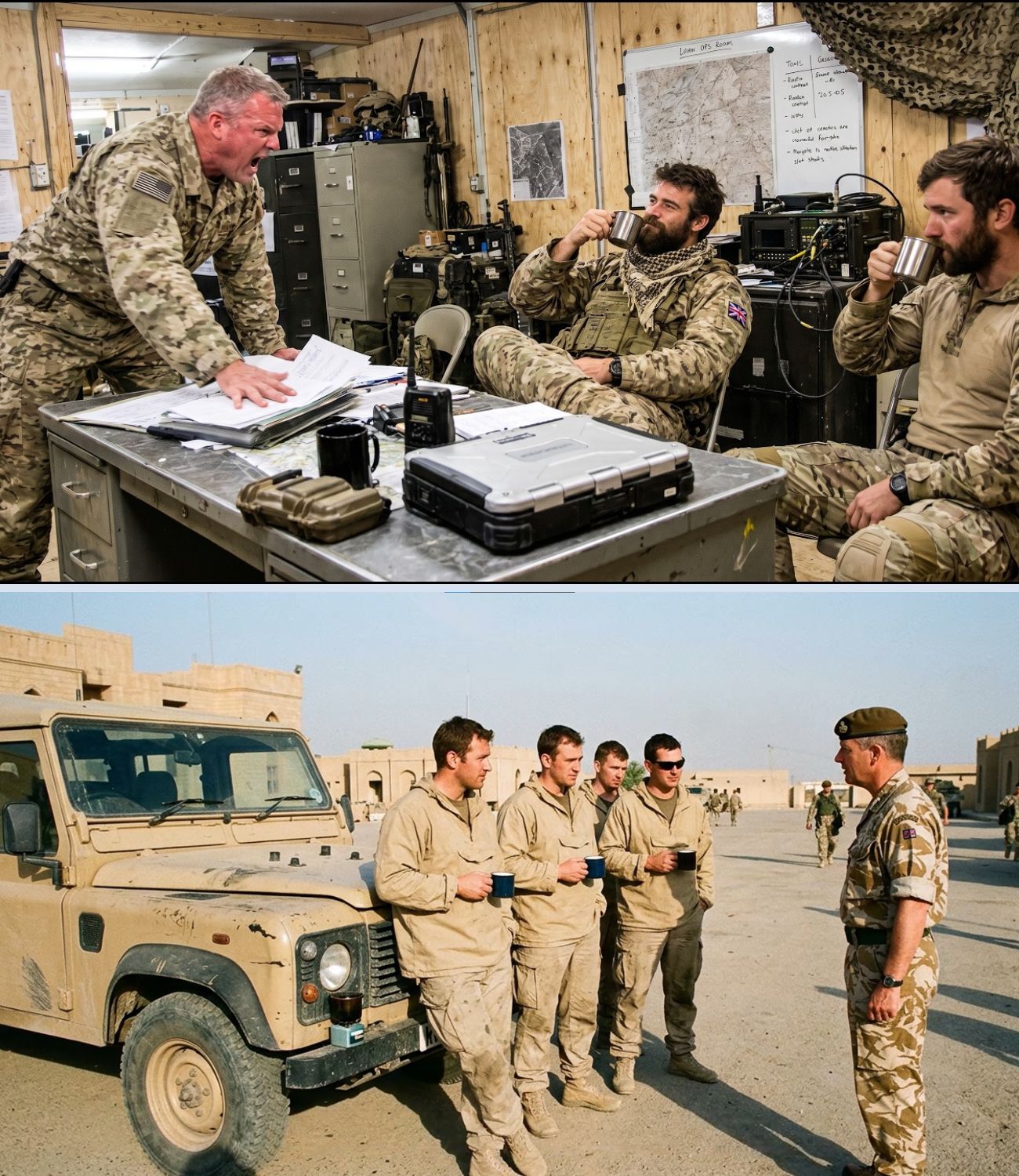
The formation assembled at 07:00 the next morning in the compound’s central yard in front of the customs house, under a sky already turning white with heat. Briggs walked the line in pressed fatigues, checking weapon cleanliness and turnout against a standard built for a very different army, and reached the loose knot of four men standing near their single remaining Snatch Land Rover, roughly where the formation was supposed to end.
Dracott’s team stood there, technically present as requested, in soft soldier’s boots and unbadged smocks, two of them holding enamel mugs of tea brewed on the vehicle’s own hexamine stove 20 minutes earlier because the patrol due out at first light had been delayed by exactly the vehicle shortage Briggs’s own transport pool had created. And a delayed patrol in that heat meant a team that drank tea rather than stood idle sweating for the sake of it.
Whitlock stood a pace behind Kesby, holding nothing, having finished his own mug moments before Briggs’s boots crossed the gravel, and later admitted to a certain private satisfaction at having timed it better than his trooper had. Dracott himself stood slightly apart from the group near the Snatch’s open door, watching the exchange unfold rather than stepping in ahead of it, on the judgment that a captain intervening too early would only confirm to Briggs that something worth intervening over was actually happening.
Briggs stopped in front of Kesby, who was midsip, and asked him directly to put the mug down for the inspection.
Kesby, by his own later account, looked to Howlet rather than answered immediately on the reasonable grounds that questions of this kind belong to the colour sergeant rather than to the trooper being asked them.
Howlet’s answer, delivered with the flat courtesy of a man who had handled far worse mornings than this one, was that the team fell under the brigadier’s authority rather than the colonel’s, that they were dressed and equipped exactly as their tasking required, and that the tea belonged to men who had been awake since 03:00 that morning and would be awake again inside the hour once the vehicle situation allowed the patrol to move. He did not raise his voice. Neither did Kesby, who finished the mug.
Briggs held his ground for a moment longer than the exchange strictly required, standing squarely in front of the vehicle with the heat already climbing off the gravel, glancing once at Dracott as if inviting the captain to overrule his own colour sergeant in front of the parade. Dracott said nothing, which was itself an answer, and Briggs, reading it correctly, moved on down the line to inspect a sentry post manned by the infantry battalion instead, where turnout and protocol matched the picture he had arrived in Iraq expecting to find everywhere.
Briggs, to his lasting credit, according to more than one witness present that morning, did not escalate the moment into a confrontation in front of the wider formation. He completed his inspection of the rest of the assembled personnel, thanked the parade, and dismissed it, then asked Ashworth directly in private what exactly he had just watched.
Ashworth’s explanation was brief: that the four men in question answered to a chain of command that ran through the regiment and not through the compound’s routine administration, that their working hours and appearance were set by the nature of their tasking rather than by any wish to cause offence, and that the tea specifically reflected nothing more than a patrol running late because a vehicle pool under strain across the whole division had not yet found them a replacement for the one blown off its wheels four days earlier.
Briggs asked, not unreasonably, why nobody had simply told him this before he scheduled the formation.
Ashworth’s answer, delivered without any particular edge, was that nobody had realized he needed telling, since every other officer who had passed through the compound in the preceding year had worked it out for himself inside the first week.
Ashworth added one further point Briggs had not asked for, standing in the shade of the customs house doorway rather than back in his own office on the reasoning that it was worth saying once rather than leaving to be inferred: that the team’s appearance—soft boots, no rank slides, beards some of them had grown for work outside the wire that had nothing to do with any personal preference—was itself a piece of operational security rather than a lapse in it, since a recognizably uniformed British soldier moving through certain districts of Basra drew exactly the kind of attention the team’s tasking required it to avoid.
Briggs took the point in silence, turning it over for a moment before admitting with the plain honesty Ashworth came to respect in him over the following weeks that he had spent 11 days assuming the opposite explanation without once asking anyone who could have corrected him faster. A small admission that cost him nothing in front of Ashworth and would have cost him a great deal more in front of the parade he had run that morning.
Howlet, asked long afterward why he had not simply told Kesby to put the mug down and avoid the friction altogether, gave an answer that stayed close to how the team had run all spring: that the moment the team started performing for a visiting officer’s comfort rather than working to its own tasking, the whole arrangement Ashworth had built to keep it functioning quietly would start to unravel one small concession at a time, until eventually somebody in a headquarters somewhere decided a four-man team that stood properly for inspection could just as easily be folded into the compound’s ordinary rotation and lose whatever flexibility had let it work in the first place.
A mug of tea in Howlet’s accounting was a small thing to defend and a large thing to give away. He had seen the same small concessions unravel other arrangements on other tours, always starting with something as trivial as a formation nobody had thought worth arguing over at the time, and he had no intention of letting Basra Palace become the place it happened again on his watch.
The friction did not end there, though it changed character. Briggs, still smarting mildly from the exchange, requested a full accounting of the team’s tasking and results to date, framed as coalition oversight rather than personal irritation. And Dracott, following the same instinct that had served his regiment well in other headquarters on other fronts, chose to answer the request in full rather than outline.
He walked Briggs through the pattern analysis on the two mortar cells, the compromised liaison channel and the reasons for suspecting it, the second slower trusted source network being built to route around it, and the vehicle shortage’s direct effect on patrol tempo and the heat and water strain that had shaped the team’s daily rhythm since the pumping fault began, using a marked city map rather than a verbal summary.
It took the better part of an hour and it left Briggs with a considerably more complete picture of the compound’s real problems than the accountability formation had been designed to surface.
Briggs asked partway through why the vehicle shortage in particular had not been escalated through his own liaison office rather than left to work its way through the standard divisional queue.
Dracott’s answer was that he had not known until that conversation that Briggs’s office had any authority over the transport pool at all, since nothing in the six weeks of Briggs’s rotation had suggested it and every request the team had filed before that morning had gone through the ordinary British channel because it was the only channel anyone had told them existed.
The admission visibly unsettled Briggs more than the tea had. He had arrived at Basra Palace believing his liaison role carried weight it plainly had not been communicated as carrying, at least not to the four men who most needed to know it, and he left the map table that morning with what one witness described as the look of a man recalculating several weeks of his own posting in a single sitting.
Whether that hour changed Briggs’s private opinion of the tea itself was never recorded in so many words. What was recorded in the divisional log a fortnight later was a note in his own hand endorsing an accelerated transport pool allocation for Dracott’s team, moved up from a division-wide queue of nearly two weeks to under four days on his own signature as coalition liaison rather than waiting on the routine request to work its way up through channels.
Neither man had much patience left for protocol in the days between the inspection and the replacement vehicle’s arrival. The mortar teams did not pause to let anyone’s protocol dispute settle. Two further strikes landed inside the compound perimeter, one close enough to the accommodation block to shatter a window in the room Briggs himself was billeted in—an irony not lost on Howlet when he heard of it, though he kept the observation to himself in Briggs’s presence.
Kesby’s rooftop watch logged a fresh firing point on the second of those nights, this one closer to the residential block near the school that the team had so far avoided striking. And the political sensitivity of that location meant Dracott held off requesting authorization until the pattern could be confirmed a second time—a delay of two further nights that cost the compound one more near miss before the confirmation came.
The replacement Snatch arrived on the fifth day, and with two vehicles running again, the team resumed the split approach—vehicle and foot element together—that had kept Whitlock’s crew alive on the Corniche. It mattered within the week because the compromised informant channel finally produced something worth acting on.
Word passed through Yusef rather than through the wider police liaison structure that the residential block cell near the school had shifted its firing point three streets over to a walled yard behind a disused grain store in anticipation of exactly the kind of strike the team had already conducted twice against the scrapyard position.
The raid went in before dawn on the last day of May using both vehicles to seal the yard’s two exits while the foot element cleared the ground itself, working from a sketch of the yard’s layout that Dracott had built from Yusef’s description and confirmed as far as the compressed timeline allowed against a single low pass by an unarmed reconnaissance aircraft the night before.
Whitlock drove the lead vehicle into position at the yard’s northern exit with the same care he had shown on the Corniche, aware that a second wheel lost that close to the objective would strand two vehicles instead of one. Howlet led the foot element over the yard’s low southern wall, Kesby a pace behind him carrying the team’s only working night sight after a second unit failed a battery check an hour before the raid was due to move.
Two men were detained inside the yard along with a mortar tube and 11 rounds of ready ammunition. A third who ran was not pursued past the yard wall on Dracott’s judgment that a chase through unlit residential streets carried more risk than the value of the arrest justified.
It was not a clean, decisive victory of the kind that makes for a tidy report. It closed one firing point out of at least two, and it cost the team nothing beyond another night without sleep.
The mortar tube itself, an old Soviet pattern piece with the serial number filed away, was handed over to the divisional intelligence cell for cataloging—one item among dozens collected that spring, indistinguishable on a shelf from any other seizure, except to the four men who had spent three weeks working out exactly where it would be when they came for it, and who did not linger to watch it logged before heading back to the compound for the sleep they had been owed since before the parade ground had ever come into it.
Yusef himself was quietly moved along with his family out of the neighbourhood he had been operating in once the grain store raid made clear that whoever had compromised the police liaison channel would eventually work out where the better information had actually come from.
It was a small, unglamorous piece of housekeeping that took up more of Dracott’s attention in the raid’s immediate aftermath than the mortar tube did, and one he considered by his own later account the single least reported but most important thing his team did in the whole six weeks of the tasking.
The second cell, working from the scrapyard position further along the waterfront, remained active for a further six weeks after the grain store raid, relocating twice more within the following month before a joint operation involving a different British unit finally accounted for it in July.
Dracott’s team, rotated out of the specific mortar cell tasking by then and reassigned to a broader targeting role across the division’s area, took no direct credit for that later success. Though the pattern analysis method Howlet had refined that spring, cross-checking firing points against known family and tribal affiliations in the surrounding streets, was passed on in full to the incoming team before anyone left the compound.
Briggs, whose liaison rotation ended the following week, asked to sit in on the operations debrief before he left, an invitation Dracott extended without much ceremony. He listened to Howlet walk through the yard’s layout, the timing of the two vehicles, and the single line in the log noting that the informant channel had held for exactly the one use it was needed for, and would now be quietly retired before it too could be compromised.
At the end of it, by an account Howlet gave more than once afterward, Briggs said only that he wished his own training teams moved half as fast on half as little information, and that he had come to Basra Palace expecting to teach the compound something about discipline, and had instead learned something about it he had not expected to need.
Before he left the compound for his onward posting, Briggs sought out Kesby specifically, finding him at the same rooftop parapet where the story had, in effect, begun three weeks earlier. He did not apologize directly—by Kesby’s own account, he was not the kind of officer who found apology easy—but he asked with what Kesby took as genuine curiosity rather than any lingering grievance, how a trooper judged when a mug of tea mattered more than an order to put it down.
Kesby’s answer, offered without much thought because it had never struck him as a difficult question, was that the order had come from a man with no authority over him that morning, and the tea had come from four hours’ sleep he had not yet had. Between the two, the tea was the more honest thing standing in that yard.
Briggs listened to that without comment for a moment, then asked one further, smaller question: whether the mug itself had ever been refilled that morning, or whether Kesby had simply nursed the same dregs through the whole inspection out of stubbornness.
Kesby told him honestly that it had been refilled twice before the parade began and once again after it ended, because a patrol delayed by a vehicle shortage still needed to move eventually, and a trooper going out on four hours’ sleep took what warmth he could get while the chance was there.
Briggs nodded slowly at that, the way a man nods at an explanation he had needed weeks earlier, and only now fully believed.
Ashworth’s own closing note on the rotation, filed for the divisional record rather than for wider circulation, mentioned the inspection only once in a single dry line observing that allied cohesion had been achieved that spring less through any parade ground than through a transport pool allocation moved up by four days on a visiting colonel’s own signature.
He added in the same note that Briggs had proven a more useful ally for the compound’s actual problems than his opening fortnight had suggested he would be, and recommended half in jest and half seriously that any future coalition liaison officer be shown the transport pool queue before being shown the accommodation block on the theory that a colonel who understood the compound’s real bottlenecks early would waste less of everyone’s time discovering them the hard way.
The story of the tea reached the regiment’s own circles back in England well before Dracott’s team rotated home, carried by the ordinary channels such stories travel: a returning officer’s aside at a mess dinner, a line in a letter, a conversation between two colour sergeants who had served together years earlier. By the time it had done a full circuit, it had acquired, as such stories do, a few embellishments no one present that morning would have recognized.
The colonel became a general in one telling. The single mug became four, and Ashworth’s quiet diplomacy behind the scenes dropped out of the account almost entirely, since a story about a trooper finishing his tea needed no brigadier’s intervention to make its point.
Dracott’s report on the mortar cells ran to six pages and did not mention the parade at all. Like the officers before him in similar spots, he considered the yard the job and the formation an interruption to it, however briefly amusing in hindsight.
His one concession to the episode came in a footnote to the report’s section on liaison arrangements recommending that any coalition officer arriving on rotation be given within their first 48 hours a short written brief on the command status of any special forces element resident in a shared compound. A recommendation the divisional staff adopted within the month, less out of any particular urgency than because it cost nothing to write and saved a repeat of a morning nobody on either side especially wanted repeated.
Whitlock, for his part, remembered the Corniche and the grain store yard far more vividly than the parade ground, and said as much whenever anyone tried to draw the story out of him at greater length than he thought it deserved. A blown wheel at speed on an exposed road teaches a driver something a colonel’s inspection cannot.
And Whitlock’s own view, offered without much patience for the version of the story that had by then travelled furthest, was that the team made a better anecdote than the 200 meters he had driven on three wheels to bring his crew home, and that anecdotes, in his experience, were rarely fair about which part of a story had actually cost the most.
Howlet kept the story the way soldiers keep the stories that survived the retelling: worn smooth at the edges, but true in outline. A Basra courtyard, a colonel walking a line he had no real authority over, and a trooper who finished his tea before he answered a direct order because the tea and the four hours of broken sleep behind it belonged to a night that had already been harder than any inspection was ever going to be.
The enamel mug itself, dented at the rim from years of hard use before that morning and years more after it, stayed in Kesby’s kit for the rest of his posting. And it was that same mug, by more than one account, that he was still carrying, still dented, still doing the job it was built for on the morning the team finally rotated out of Basra Palace for good.
Briggs, back at his own headquarters some months later, was asked by a colleague who had heard a garbled version of the story secondhand whether it was true that the British had once ignored a direct order from him over a cup of tea.
His answer, given more precisely than the question deserved, was that no order had been ignored because no order had ever properly applied, only a colonel’s assumption that it did, corrected within the space of a single morning by four men who finished their tea, said their piece, and went back to work on a problem his own formation could never have solved for them.
It was, he added, the cheapest lesson in coalition liaison he ever learned, and one he passed on unofficially to every replacement officer who came through his own desk for the rest of the war, along with a standing instruction meant half as a joke and half in earnest: never to schedule a morning parade before finding out first who in the compound was still owed their tea.
You Might Also Enjoy

“We Thought They Would Negotiate”—What Argentine Soldiers Said When The British Attacked Goose Green

“You’ll Never Finish My Ruck March, Limey” — US Sergeant Who Challenged the SAS, Then Fell Out First






