“Afraid of Heights, Limey?” — The Jumpmaster Who Mocked the SAS, Then His Own HALO Course Broke Him
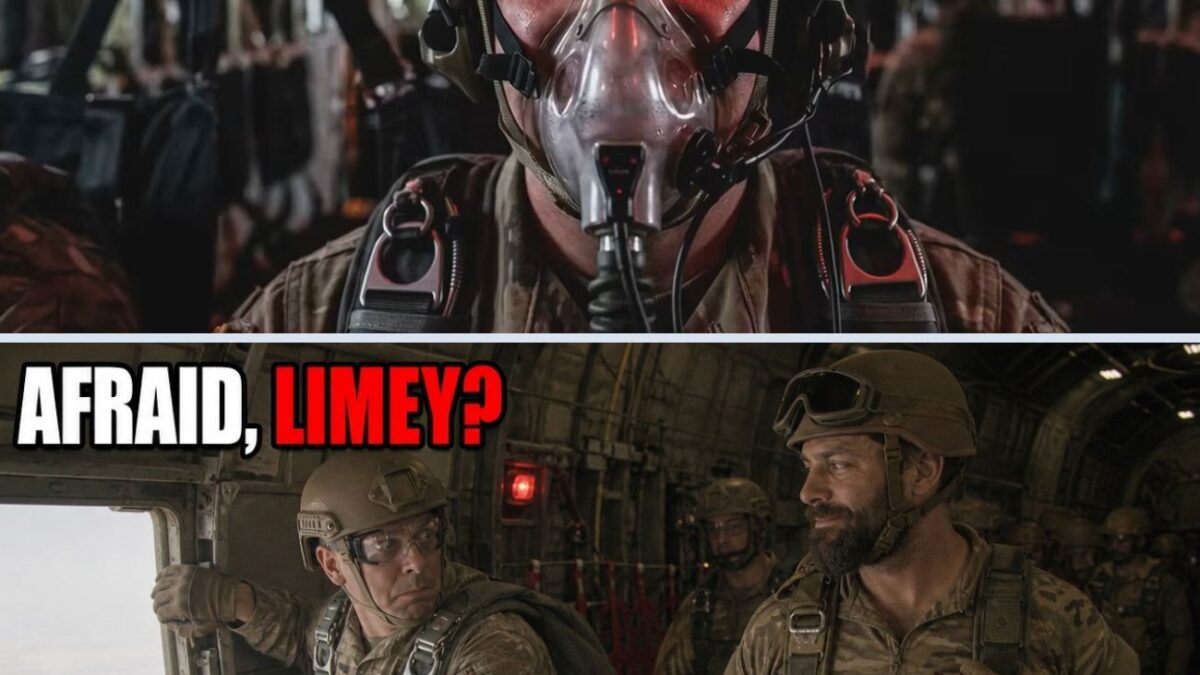
The ramp light was still red when he leaned across the webbing and said it loud enough for every man in the stick to hear. 25,000 ft above the Arizona desert, the inside of a C130J smells of hydraulic fluid and cold aluminium and the sweet, slightly chemical breath of pre-breathed oxygen. And the eight men sitting shoulder-to-shoulder on the portside bench are doing what parachutists have done since parachutes existed, which is to say they are sitting very still and breathing very slowly and not looking at the open door.
Seven of them wear British disruptive pattern under the harness. One of them, the one at the end of the bench, has his helmet on his lap and his gloves tucked into it, and he is chewing the inside of his cheek, the way he always does when he is counting something nobody else is counting. The eighth figure in that image is not with them. He is the American standing in the middle of the airframe with one gloved hand on the overhead rail, feet braced against the roll, grinning down at them like a man who has already decided what he is looking at. His name was Master Sergeant Dwight Vohees. He was a senior military freefall jump master on loan to a joint package and he had been waiting since dawn for the moment he was about to have.
“Afraid of heights, Limey,” he said.
He said it carrying. He said it so the loadmaster could hear and the second cadre man could hear and the brand new trooper at the far end of the bench could hear. Because that’s what you look like. A bunch of tea-drinking amateurs who’ve never left the airframe above 10 grand. You’re not elite. You’re not special. You’re a joke in a beret. And when my course is done with you, you’ll be crying for your mothers at 8,000 ft.
He waited for the laugh. Half the airframe gave him one. The British half did not move. The narrator does not have to tell you yet what the master sergeant was about to find out because the master sergeant did not know it either. He would remember saying it in the hanger that night in the debrief the next afternoon in the long quiet drive back to his quarters. He would remember every word of it, and the men he had said it to would be the ones who made sure he did. He had just taken out a loan at a rate he could not read in a currency he did not use from a bank he had just insulted to its face.
The red light went amber. Nobody on the British bench so much as blinked to understand what the master sergeant was risking. You have to understand what he had already earned. Because the men who read these things to the end are not interested in the humiliation of a clown. A clown’s humiliation is cheap. The master sergeant was not a clown. By the morning the aircraft lifted off the strip at Yuma, Dwight Vohees had been in the United States Army for 22 years, 19 of them in special operations, and the last 11 on the cadre of the military freefall school as an instructor, an evaluator, and finally the senior jump master who signed the course off. He had jumped out of aircraft 2,400 times, give or take the handful he had stopped counting after Afghanistan, and he had jumped into Afghanistan, into Iraq, into places on the map he would not describe except by the heat of the wind on the night he exited. He had nine combat tours. He wore a bronze star with valor and a combat infantryman badge and the quiet weight that senior special forces non-commissioned officers carry in the way they move through a hanger. In third special forces group, he was the man you asked when you did not know what to ask. He was by any measure that mattered to the United States Army a serious man.
That is what made his contempt almost reasonable. He had seen British paratroopers on courses before, and he had never been impressed. He had never been impressed in his view because the British airborne system he had met had been conventional airborne. Static line men out of a C130J at 800 ft, well-drilled, well-led, and nowhere near the altitude he lived at. His experience of the Special Air Service, in particular, had been fleeting and administrative. He had seen them in bars in Fort Bragg. Quiet, not drunk, not loud. He had never seen them jump. He had decided somewhere in the long undocumented territory a man builds inside his own head over nine tours that the British did low and the Americans did high, that the British did regiments and the Americans did troops, and that whatever reputation the regiment carried in the world’s imagination, it had earned on the ground and not in the air.
He said that opinion in the hanger that morning in front of his own cadre and the eight men of the attached troop and the course adjutant and the loadmaster of the aircraft they were about to climb into. He stood on the painted yellow line, feet apart, thumbs tucked into the top edge of his plate carrier, and he looked down the row of seven British operators and one British officer standing in a loose horseshoe behind their kit, and he said what the whole story is built from. The adjutant to his left, a left-handed captain called Osgood with a stopwatch in his right hand, looked at the floor. The second cadre man, a sergeant first class called Keen, who was built like a telephone pole and twice as patient, did not look at the floor. Keen looked at the officer in command of the attached troop. The officer, a major called Croft, did not react. His volume did not go up and it did not go down because it had never been loud in the first place. It just lowered a quarter step on his next sentence, which was:
“After you, Master Sergeant.”
And that was how the day began.
Here is the human detail you need for later. Dwight Vohees carried in the left breast pocket of every uniform he owned a small laminated index card on which was written in his own hand the running total of every parachute jump he had ever made. He updated the card by hand after every jump. He had been doing it since he was a corporal. The card had been laminated and re-laminated four times. His wife had once asked him why he kept it. He had not been able to answer her. He kept it because the number on it was the number that proved him. It was the number he was holding in his pocket when he called the men from Hereford tea-drinking amateurs, and it was the number he would reach for without taking it out on the apron the following evening when the stopwatch in Captain Osgood’s right hand had already said what it was going to say.
The military freefall school sits at Yuma proving ground on the lower edge of Arizona where the air is thin, the sky is almost always clear, and the drop zone is a flat pale rectangle of desert the size of a small town with a wind sock on a pole and a painted circle 15 m across, burned into the ground by a decade of landings. The attached troop had been loaned to the school for a two-week package of high altitude freefall work, oxygen pre-breathe at altitude and a graded sequence of jumps culminating in a high altitude low opening exit at 25,000 ft with full kit weapons strapped bergen under the harness into the painted circle. The arrangement was reciprocal and unremarkable. The British and the Americans ran people through each other’s schools all the time. What was unusual was not the loan. What was unusual was that the senior cadre man on this iteration had decided inside his own head that his students were tourists.
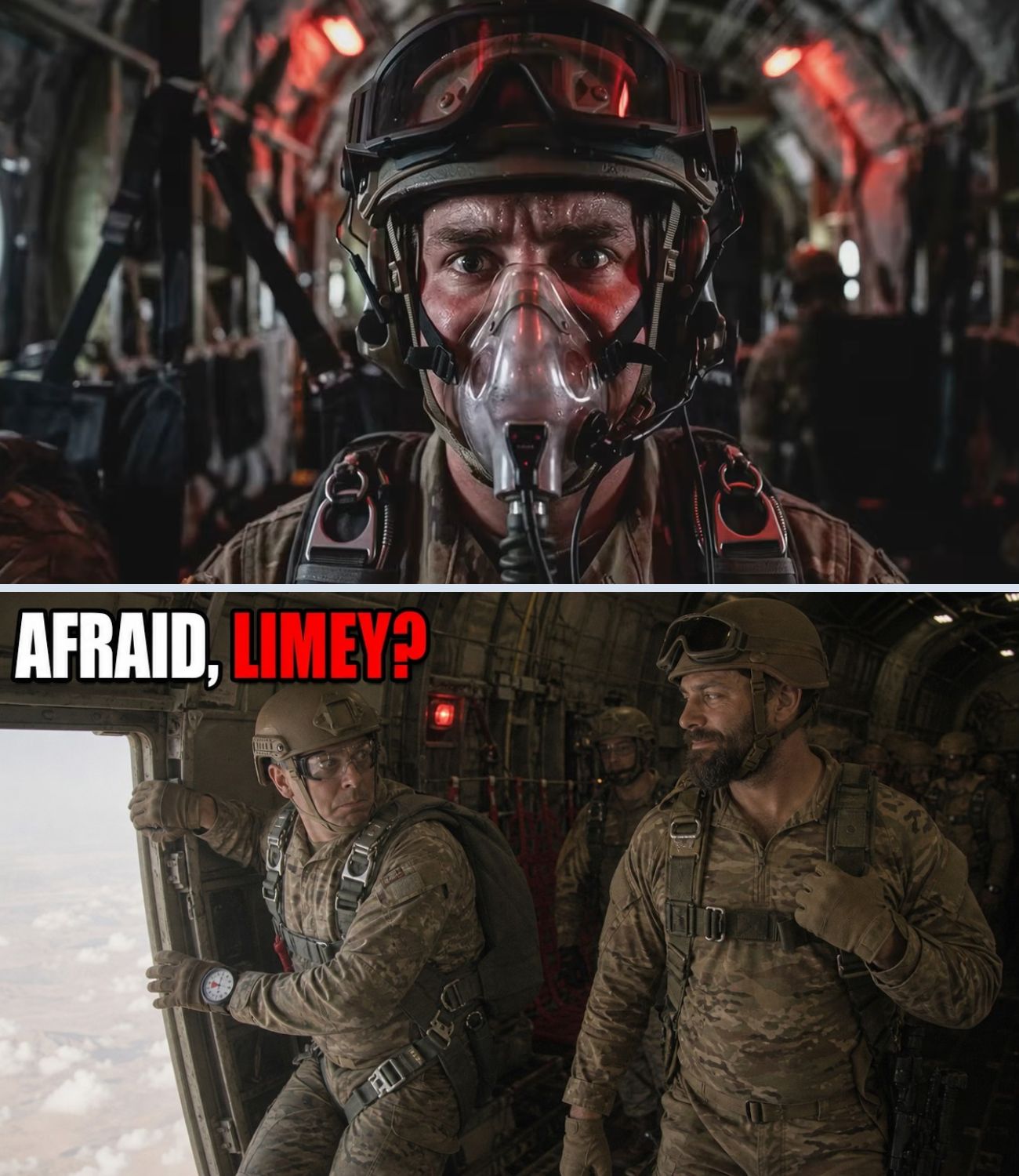
In the hanger on the first morning, the eight British men laid out their kit on the painted lines and did not say very much. The oldest of them, Staff Sergeant Ewan Price, Welsh, 15 years in, laid his main canopy out on the mat and ran the flat of his hand down the length of it, the way a man runs his hand down a horse. He was chewing the inside of his cheek. Next to him, Sergeant Rodri Teague, called bomber by everyone who knew him and nobody who did not, was folding his own canopy because he did not trust other people’s folds. Corporal Ewan McCrae was asleep against his Bergen with his helmet on his chest. The newest man, Trooper Linus Beckwith, was writing something in pencil on the back of a folded square of paper and putting it inside his helmet. The master sergeant walked the length of the mat and watched them and did not understand what he was looking at. He thought he was looking at amateurs because they were not performing competence. He had spent his career in a culture where the senior man speaks and the junior men move, where there is a measurable tempo to a hanger at work, where you can walk down a line of jumpers and hear the cadence of a drill. The British were quiet. Nobody was giving instructions. The Welshman was running his hand down the canopy. Teague was folding. The Scot was asleep. The young one was writing a letter home. In Vohees’ reading, this was slackness. In the reading, you need now to understand. This was the thing he could not see: a troop at the top of its game, not performing for anyone, running its own checks by its own standards, in a silence so thorough it looked like idleness, and was in fact the opposite.
Three details you need which the master sergeant did not register. The first was that when Price ran his hand down the canopy, he was feeling for the ribbing in the leading cells of a ram air. And he was feeling for it in a sequence, top skin, bottom skin, line attachments, slider. That took him 42 seconds, the same 42 seconds every time, and he had done it on every canopy he had ever jumped. The second was that Teague folding was not folding for speed. He was folding for a specific opening characteristic in air of a specific density and he had asked the Met officer that morning for the forecast upper winds at 25,000 ft. And the Met officer had said 26 knots and Teague had folded for 30. The third was that the trooper writing the letter, Beckwith, the newest man, the one Vohees had looked at and already written off, was writing in pencil in his own hand a list of the exit numbers of the men on his stick with his own name second from the end. And he was writing it because Price had told him on the drive that if you can write it, you can fly it, and if you cannot write it, you have no business in the aircraft. The master sergeant saw a boy writing a note to his mother. He was looking at the undoing device, and he could not read it. The one line about cost and kit, said quietly and once, the Americans in the hanger had better altimeters, newer rigs, more spares, and a budget that showed in the shelving on the back wall. The British had been issued what they had been issued, and had checked it twice. That is the entire sentence on that subject. It is not the spine. The spine is what the quiet men on the mat were about to do with what they had.
By midmorning, the cadre had walked the troop through the school’s dirt dive, the ground rehearsal of the exit, the stable position, the pull sequence, the canopy work, the pattern into the painted circle. Vohees ran it himself. He ran it the way he always ran it, loudly with the easy showmanship of a man who knows his material and knows he is good. At the end of it, he looked down the line of eight British faces and asked:
“Any questions, gentlemen?”
The major said:
“No, master sergeant.”
The master sergeant said:
“Good. Tomorrow we go up.”
And that was the loaded gun because tomorrow they were going up to 8,000 ft, which was nothing. The day after they were going up to 12, which was something. The day after that they were going up to 25 into air thin enough to need oxygen with a 32-knot forecast upper wind the Met officer did not yet know about into a painted circle 15 m across. The master sergeant had already told them what they would be doing at 8,000 ft. He had used the words crying for your mothers. He had said it in a hanger in front of his own men. The sentence was in the room. It did not go away just because the red light had gone amber and the amber had gone green.
They went up to 8,000 the next morning because that is where you start on this course and because the master sergeant had already named the altitude at which the British would weep. The aircraft was the same C130J. The run-in was the same long shallow track across the eastern edge of the drop zone. The loadmaster, chief warrant officer Talent, stood with the coffee flask he shared with nobody tucked behind the portside bulkhead and watched the stick with the professional neutrality of a man who had watched 20,000 jumpers go out of the back of 20,000 aircraft. The master sergeant stood in the airframe with his gloved hand on the overhead rail and told the British loudly that 8,000 ft was where tourists discovered that the sky was not interested in them. The red light went amber, the amber went green. Price stood up first. He went out of the door with no visible effort, which was the first thing. The men who stood up behind him went out of the door the same way. There was no shuffle, no pause at the hinge, no small human adjustment at the threshold where new jumpers lose a quarter second to the air. They stepped off the ramp the way a man steps off a curb into a street he has crossed every day for 15 years. The loadmaster, who had been counting under his breath, because that is what loadmasters do, got to eight before the last British boot cleared the ramp and he looked up at the master sergeant and did not say anything because he was not paid to.
Underneath them, in the long still fall of a stable arch, something happened that the master sergeant did not see from the airframe, but his second did. Sergeant First Class Russell Keen had gone out behind the last Britain as the cadre safety and he was in the air with them when they fell. In Keen’s reading, Keen, who had been teaching stable position for seven years, and who could tell by the way a man’s elbows sat whether he had 50 jumps or 500, the seven British men beneath him, did not take the 3 seconds a jumper takes to stabilize, because they were already stable at the end of the first second. They were in neutral arch, legs symmetric, hands at the shoulders, heads up, and they were in that position before the aircraft noise had finished leaving their ears. Then, one by one, in a sequence Keen recognized because he taught it, they tracked. They moved apart in the air into a working formation of eight evenly spaced points, and they held it. And when the lead jumper’s altimeter said 4,500, they broke, tracked clear, and pulled at 2 and 1/2 in a wave so clean Keen found himself counting the canopies out loud into his helmet microphone: one, two, three, four, five, six, seven. Then he pulled his own: eight. He landed 30 seconds behind the last of them. He walked across the painted drop zone to where Price was already standing on the edge of the 15 m circle, canopy gathered, and he said:
“Where did you say you were from, staff?”
Price said:
“Hereford, Sergeant First Class.”
Keen said:
“Yeah, I know.”
Then he walked away.
In the hanger, the master sergeant watched the footage from the belly cam on the aircraft and the chase cam that ran a parallel pattern underneath the stick. He watched it twice. He said afterwards that 8,000 ft was easy air, that stable arches at that altitude did not prove anything, that the real course started at 12, and that anybody could fall straight down for 20 seconds. He said all of this to Keen. Keen did not disagree with any of it because none of it was wrong on its face. But Keen had already seen the thing Vohees was refusing to see from the airframe, which was that none of the seven British jumpers had wobbled, drifted, overcorrected, undercorrected, or presented a single surface the air could grab. And the one who had been written off as the boy writing letters to his mother had tracked out of the stack on a vector so disciplined it had put him in the middle of the painted circle on his landing without a single input to the canopy below 300 ft. The master sergeant said into the quiet of the hangar:
“Anyone can do eight.”
That was the first time that day he would be wrong. It was not the last. By the end of the week, he would have said something very like it four more times. Each time at a higher altitude, each time with less confidence, and each time with a laminated card in his left breast pocket, feeling by small degrees less heavy than it had the morning before.
On the third day, the master sergeant decided to test them. The test was not announced because it was not supposed to be announced. The cadre at the school ran as a matter of routine on day three a climbout variation designed to break the exit sequencing of jumpers who had drilled a specific count. The aircraft would roll a half degree to port on the run-in, hold the roll for 8 seconds, then roll back. The effect on the deck of a C130J was almost nothing visually and considerable kinematically. A jumper who had cued his exit on the feel of the floor underneath him would be a quarter step late. The variation had been failing American students for years. The master sergeant intended it for the British. They went up to 12,000. The red light came on. The master sergeant stood in his usual place with his hand on the overhead rail and called out the exit sequence with the easy showmanship of a man about to watch something funny. The loadmaster in the back saw the roll before anyone else because he always did. The pilot held it the regulation 8 seconds. The master sergeant did not react because the whole point was not to react. The Welshman at the front of the stick reached up, touched the strap of his helmet, and did not stand. What he did instead was look at the aircraft deck, hold his position for a count of four, and then stand into the roll back in a sequence that put his first boot off the ramp on the beat the deck told him to use rather than the beat his drilled count would have used. The six men behind him did the same. The seventh, Beckwith, the newest man, did it a half beat late, and Price reached a gloved hand back without looking and tapped him on the chest at the right moment. Beckwith stepped off the ramp on the beat.
Underneath the aircraft in the stack that formed in the first 6 seconds of freefall, the master sergeant’s wrinkle produced nothing. The British did not scatter. The British did not reform. The British did not need to reform because they had never stacked wrong in the first place. And the man who had tapped the newest trooper on the chest in the airframe had done so because he had read the aircraft, felt the roll, run the mental maths, and corrected his junior man before his junior man’s weight committed to the wrong beat. Keen, following them out as safety, watched this happen above him in the pre-exit sequence he had choreographed with the pilot that morning, and he said into his helmet microphone to nobody:
“You have got to be kidding me.”
The eight British canopies opened in the same clean wave they had opened in the day before. The landing pattern that formed under them was a wind-adjusted circuit flown as if the circuit had been drawn on the ground in paint. Price landed first 3 m inside the painted circle. The six behind him came down inside the circle at intervals of 11, 12, 9, 10, 11, and 12 seconds. Beckwith, the newest man, landed last at the dead centre of the ring and stood up without stumbling. The chase cam captured the whole pattern. The master sergeant, back on the airframe, watched the chase feed on the pilot’s monitor on the way down to the strip and said nothing at all for the first time since the course had begun.
In the hanger that afternoon, he said that the roll had not been held long enough. He said the Met had been forgiving. He said 12,000 ft in Yuma on a cool morning was closer to 10,000 ft in a real theatre. He said finally that the British had been trained specifically for this course and had come primed for it, which was the first thing he had said all week that was partly true and partly an admission. Captain Osgood, the left-handed adjutant with the stopwatch, wrote down the master sergeant’s words in a small notebook and said:
“Yes, master sergeant.”
And left the hanger with his face arranged carefully. Keen, the second cadre man, watched his senior rationalise and did not interrupt because the next jump on the schedule was 15,000 ft with a weapon strapped and a rucksack and a dropped equipment lanyard, and he already knew what the master sergeant was going to say when he watched that one. The school girls, he had called them, in a beret. The school girls had just flown his roll out and landed inside his circle, and the master sergeant had explained carefully and in his own words why that did not count.
On the fifth day, the course went to 15,000 ft with full equipment. Each jumper had a Diemaco L119 strapped diagonally across the chest under the reserve, a Bergen on a dropped equipment lanyard beneath the harness, a Glock 17 on the thigh, and the usual belt kit under the rig. Oxygen was not required at 15, but the pre-breathe was run anyway because the master sergeant was in no mood to concede procedure. The weather over the drop zone was good. The wind was 10 knots on the deck and 16 aloft. The Met officer, who had been reading the morning forecasts with increasing care, warned on his way out that the 25,000 ft layer the following day looked unsettled, and nobody in the hanger paid attention because the following day was the following day. The eight British jumpers stood up on the amber. The master sergeant called it. They walked to the ramp. Trooper Beckwith’s dropped equipment lanyard snagged. It snagged specifically on the portside anchor cable that ran the length of the airframe interior in a way that would have been caught by a jumpmaster’s hand on a drilled aircraft, but that was not caught because the master sergeant was looking at Price and because Keen was already in position behind the last man, and because the loadmaster, who had seen it happen, was reaching for it when Beckwith stepped off the ramp. The lanyard pulled; the Bergen under the harness yanked sideways. The trooper went out of the door in a half rotation with his left shoulder low and his right shoulder high and a 35 kg Bergen swinging under him in a pendulum that would in the time it took to count to four induce a flat spin that the trooper in his second month on the troop had never recovered from in training.
The man ahead of him in the stick was McCrae, the Scot who slept on long flights with his helmet on his chest. McCrae was already in neutral arch and tracking. He heard through the aircraft noise behind him the sound of a Bergen hitting the lip of the ramp, and he did not need to look. He broke his track. He rolled onto his back in the air, found the trooper above and behind him in a half spin he could not correct, closed the distance in a hard track, flipped belly to earth 2 m under the junior man, caught the junior man’s harness with his left hand and the pendulum of the Bergen with his right, held both for three long seconds while the trooper’s spin dampened, released him into a clean, neutral arch, dropped away, and resumed his own track with 4,000 ft still to work with. The whole sequence took 11 seconds. None of the British said a word in the air. Price, who had seen it in his peripheral vision at the moment it started, had already adjusted the formation underneath to open the slot McCrae and Beckwith would need to come back into. When Beckwith re-entered the stack, he was 2 seconds behind the beat. Price reached across and pulled him into place with a hand signal nobody in the aircraft had taught because it was a signal the troop used among itself. The stack reformed. The canopies opened in the same wave. The pattern flew clean. Beckwith landed 6 m inside the ring, stood up, walked over to McCrae and said:
“Thanks, Corp.”
McCrae said:
“Don’t do it again.”
In the control shack, the master sergeant watched the belly cam feed with Captain Osgood beside him and Keen standing behind. He watched the lanyard snag and the half rotation and the flat spin that was not a flat spin because the Scot had killed it before it formed. He watched McCrae catch a 35 kg Bergen in freefall at terminal velocity with one hand. He watched the stack reclose. He watched the eight canopies open. He did not move for the full four minutes it took the chase cam to follow the pattern to the ground. Osgood, who was still writing left-handed into his small notebook, stopped writing. Keen stood behind them both and did not say the thing he was thinking because he was saving it. The master sergeant did not rationalize this one. He did not say the lanyard had been a cadre error, which it had been. He did not say the recovery was lucky, which it had not been. He did not say anything. He stood up, walked out of the control shack, walked across the apron in the Arizona sun, and stood by the painted circle on the drop zone for a long time with the laminated card in his left breast pocket where he always kept it, while the men he had called a joke in a beret folded their canopies and drank water and did not look at him.
The next jump on the schedule was the one he had announced on day one: 25,000 ft full kit high altitude low opening into the 15 m painted circle. The Met officer’s face that evening when he came in with the morning forecast said one thing: 32 knots upper wind forecast, 26. The master sergeant looked at the paper and said:
“We go.”
The morning of the drop was the kind of Arizona morning that photographs well and jumps badly. The sun came up clean over the eastern edge of the drop zone. The wind sock on the pole hung limp. On the ground the air was still. At altitude, in the layer the aircraft would exit at, a jet stream edge the Met officer had been watching since the previous evening was running 32 knots across the planned run-in, six knots harder than forecast, and the Met officer told the master sergeant so. And the master sergeant looked at the paper and said:
“We go.”
The British did not react to the number because they had already been told by Price on the drive-in that the morning would be 30 plus, because Price had asked the Met officer directly on his way out of the hanger the night before and had been given the honest answer the master sergeant had not been given. Teague had folded for 30 since day one. The eight British jumpers kitted up in silence on the painted lines in the hanger. Price ran his hand down his canopy. Teague folded nothing because Teague had already folded. McCrae slept against his Bergen with his helmet on his chest. Beckwith, the newest man, wrote nothing in pencil this time because he had already written what he needed to write and it was already in his helmet. Major Croft walked the line and said one sentence to each man. The master sergeant watched from the yellow line and did not speak.
They climbed in the C130J to 25,000 ft. The pre-breathe took the regulation 30 minutes with the console masks. At the top of the climb, the aircraft leveled off and the loadmaster Talent moved to the ramp control with his coffee flask tucked behind the bulkhead where it always was. The red light came on. The ramp drops. The light goes amber. Price stands. The seven behind him stand. The master sergeant watches from the midline. The amber goes green. Price steps off the ramp into air that is minus 28° and moving at 32 knots across his line and he is in neutral arch before the aircraft’s slipstream has finished leaving his helmet. The seven men behind him exit in a sequence timed to the deck. Beckwith is the last. He goes out on the beat. The master sergeant standing at the open door watches eight British bodies form a stable stack at 25,000 ft in a crosswind that was 6 knots harder than forecast and he does not reach for the laminated card in his left breast pocket. But he thinks about it and the thinking is in his face.
In the stack the British track. They open the formation into a working square and they hold it as the altimeters countdown through 20 through 18 through 15 through 12. The jet stream layer is sliding them east of the planned opening point at a rate the master sergeant in the airframe is now trying to calculate in his head and failing to calculate quickly enough. Underneath them in the stack Price has already calculated it. He hand-signals the correction. The square tilts a quarter step upwind. They hold the new line down through 10 through 8. At 6,000 ft, Price signals the break. The eight men track clear in a wave. At 3,000, they pull. Eight canopies open in a line. Keen, following behind as safety, counts them aloud into his helmet microphone, as he has every day of this course:
“One, two, three, four, five, six, seven, eight.”
Then he pulls:
“Nine.”
The canopies catch the upper layer. And the British fly a pattern that is not the pattern the cadre teaches because the pattern the cadre teaches is for a 26-knot upper wind. And this is a 32-knot upper wind. The British fly a pattern they have modified in the air by small inputs. Right toggle half break. A long downwind leg flown deeper than the cadre would fly it. A base leg cut shorter than the cadre would cut it. A final flown steeper than the cadre would fly it. The chase cam picks up the modification and the control shack sees it and nobody in the control shack says a word. Captain Osgood is holding the stopwatch in his right hand. His thumb is on the pin.
Price lands first. His boots touch the painted ground 2 m inside the 15 m circle. Osgood’s thumb goes down on the pin. Teague lands at 11 seconds inside the ring. McCrae at 22 inside, the fourth at 34 inside, the fifth at 46 inside, the sixth at 58 inside, the seventh at 1 minute 10 inside. Beckwith, the newest man, lands at 4 minutes 19 seconds canopy to ground, which the stopwatch has been counting from the first canopy’s deployment to the last man’s boots on the ground. He lands inside the ring. He stands up 8 for 8 inside a 15 m circle from a 25,000 ft exit in a 32-knot upper wind in 4 minutes 19 seconds canopy to ground on the cadre’s own stopwatch. Captain Osgood, left-handed, writing the number down with his left hand because his right is still holding the watch, says it out loud to the master sergeant who is standing beside him on the edge of the painted circle because the aircraft has landed and he is on the ground now:
“4 minutes 19, master sergeant, all eight in the ring.”
The master sergeant does not answer. The master sergeant is looking at Price, who is standing at the edge of the circle, gathering his canopy, chewing the inside of his cheek, counting something nobody else is counting.
That was the number. It was written left-handed in Osgood’s notebook, and it was signed by Keen as the course safety, and it was logged in the course after action, and the master sergeant did not challenge any of it, because there was nothing in any of it to challenge. The master sergeant stood on the edge of the painted circle in the Arizona sun and watched eight men he had called a joke in a beret fold their canopies into their deployment bags with the practiced economy of men who had been doing this since before he had taught his first American student to count a stable arch. He did not speak. He had been standing there for 90 seconds, and his second had been standing beside him for 40 of them, and the left-handed captain with the stopwatch had been standing on the other side for the full 90, and nobody in the shack had come out to join them, because what was happening on the edge of the ring did not need company.
Price walked past him first, canopy over his shoulder, Bergen in his left hand, rifle re-slung. He did not look at the master sergeant. He did not have to. Teague walked past him second. McCrae third with a junior trooper beside him. Beckwith looked at the master sergeant for one second as he went by, long enough to register the man and short enough not to make it a moment. The major came last. The major did not look at the master sergeant either. The major said as he passed in the voice that had never been loud and had dropped a quarter step since the hanger:
“Thank you for the use of the aircraft, master sergeant.”
The master sergeant did not answer.
Sergeant First Class Russell Keen, built like a telephone pole and twice as patient, standing on the painted line in a uniform he had kept clean for seven years on this cadre, waited until the British had crossed the apron and were out of earshot. Then he said the sentence he had been holding since day one. He said it quietly to his senior in front of Captain Osgood and the loadmaster and the Met officer who had just come out of the shack to look at the number on Osgood’s clipboard:
“Master sergeant, they just flew your course.”
He did not say it cruelly. He did not say it with any pleasure. He said it the way a man reports a fact he is required to report. He did not add to it. He did not need to.
The master sergeant did not answer that either. He reached with his right hand in the automatic gesture of 22 years towards the left breast pocket of his uniform where the laminated card lived. His fingers found the pocket. They touched the edge of the card through the fabric. He did not take it out. He took his hand away. The card stayed where it was. The number on it, the 2,400, had not changed. The thing the number was supposed to prove had. He stood on the painted line for another 30 seconds. He watched the British disappear into the hanger. He watched the loadmaster walk back to the aircraft with the coffee flask tucked under his arm. He watched the Met officer sign the clipboard. He watched Keen walk away. He watched the sun move half a degree over the eastern edge of the drop zone, and then he turned and walked back to the shack by himself, and the apron was quiet behind him in a way it had not been quiet all week.
He had been right about one thing, and only one thing, and it was the surface of it. The British did drink tea. They had drunk tea in the hanger in the mornings and in the evenings out of a battered steel kettle Price had carried in his kit for 15 years. And the master sergeant had seen them drinking it on day one and had taken it inside his head for the proof of what he thought he was looking at. He had been right about the tea. He had been catastrophically wrong about the men who drank it.
That is the shape of contempt, which is why this story was worth telling. Contempt reads the surface. Discipline reads the air. The master sergeant had read the surface of eight quiet men in a hanger and had decided out loud in front of his own cadre that quiet meant idle, that still meant slow, that the absence of performance was the absence of competence. The eight quiet men had been reading the air the whole time. They had been reading the canopy under Price’s hand. They had been reading the fold Teague would not trust to anyone else. They had been reading the beat of the deck under their boots, and the roll the pilot held for 8 seconds on day three, and the lanyard that snagged on day five, and the jet stream edge the Met officer had been watching since the night before the final jump. They had read all of it, and the master sergeant had read none of it, and the stopwatch in the left-handed captain’s right hand had said 4 minutes 19 seconds, and all eight of them had been standing inside the painted circle.
He had said they would be crying for their mothers at 8,000 ft. At 25,000 ft in a 32-knot upper wind in minus 28° air, with full kit on and a weapon strapped across the chest and a bergen on a dropped equipment lanyard and oxygen in their lungs, they had been nowhere near crying. They had been counting. They had been chewing the inside of a cheek. They had been handing a hand signal across a stack to tell a junior man to come half a beat upwind. They had been quiet, which was what they had been in the hangar on day one, and the master sergeant had not been able to read it then, and he was reading it now, standing on the apron in the Arizona sun, with his hand away from the pocket where the card lived.
The British flew back to Hereford at the end of the week. They did not mention the master sergeant at the debrief. They did not have to. The after-action report lodged with the course that evening carried in Captain Osgood’s left-handed writing the number 4 minutes 19 seconds and the words all eight in the ring. And that number was what was going to stand long after the man who had called them tea-drinking amateurs had stopped being able to say the sentence out loud.
You Might Also Enjoy

“We Thought They Would Negotiate”—What Argentine Soldiers Said When The British Attacked Goose Green

“You’ll Never Finish My Ruck March, Limey” — US Sergeant Who Challenged the SAS, Then Fell Out First






